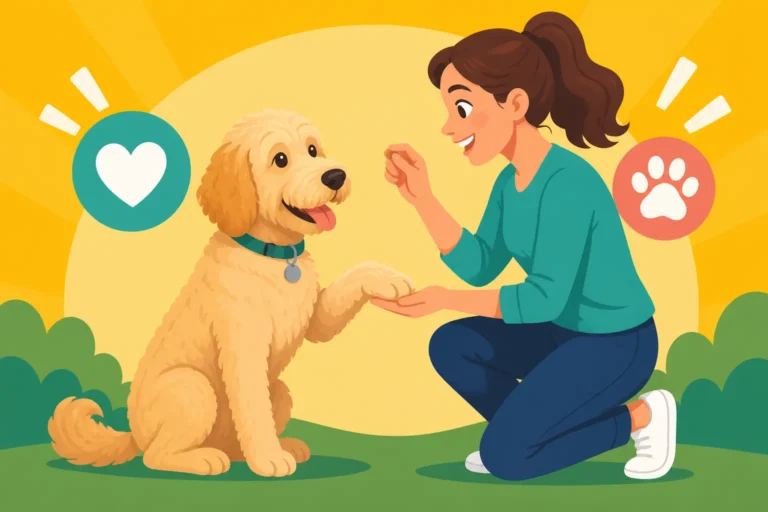
Goldendoodle Recall and the Retriever Half
One of the most common frustrations Goldendoodle owners face is their dog seeming to forget their name the moment a squirrel streaks across the park or another dog appears. This guide is here to walk you through exactly how to tap into your Goldendoodle's natural inclinations and build a recall so reliable, you'll both feel safer and more confident in any environment.
The Inherited Instinct: Why Goldendoodles Want to Come Back
It's easy to feel like your Goldendoodle is intentionally ignoring you when they're off sniffing something fascinating or chasing a leaf in the wind. But the truth is, the Goldendoodle, by its very genetic makeup, possesses a strong desire to please and connect with its human. This isn't just wishful thinking; it's deeply rooted in the working histories of both parent breeds. Understanding these inherent traits is the first step to harnessing them for an unshakeable recall.
The Retriever's Genetic Blueprint for Recall
The Golden Retriever half of your Goldendoodle brings a powerful lineage of partnership and biddability. Golden Retrievers were bred to work closely with their human hunting partners, retrieving downed game from land and water, often in chaotic and distracting environments. This required an innate willingness to stay connected, to respond to cues, and to return to the handler with their prize. They are often described as having an eager-to-please nature, a soft mouth, and a strong retrieve drive. When you call your Goldendoodle, you're not just asking them to come; you're tapping into generations of selective breeding for cooperation. What a Goldendoodle Takes From the Golden Retriever elaborates on these foundational traits. This biddability means they are generally highly motivated by praise, affection, and food rewards from their people, making them excellent candidates for recall training if approached correctly.
Think about a Golden Retriever waiting patiently by a hunter's side, watching for a signal, then bursting into action to find and bring back a bird. That intense focus on the handler, that anticipation of the next command, is still simmering beneath your Goldendoodle's curly coat. They want to be that partner. Our job as owners is to make sure coming back to us is always the most rewarding, exciting, and fulfilling part of their adventure. If they choose to ignore you, it's rarely out of malice, but because something else has momentarily become more intrinsically rewarding than returning to you.
The Poodle's Sharp Mind and Trainability
Then there's the Poodle, the other half of this wonderful cross. Poodles are incredibly intelligent, athletic, and were originally bred as water retrievers, much like the Golden Retriever. Their intellect and problem-solving abilities mean they pick up on cues quickly and can learn complex commands. They are not just pretty faces; they are highly capable working dogs with a keen desire for mental engagement. This intelligence contributes significantly to the Goldendoodle's overall trainability, including their ability to learn and execute a reliable recall, even from a distance or amidst distractions. What a Goldendoodle Inherits From the Poodle Brain dives deeper into their cognitive strengths.
The Poodle's drive isn't just about fetching; it's about active participation and mental stimulation. They thrive on learning and performing tasks, which means they often view training as a fun puzzle to solve alongside their human. This translates into a Goldendoodle who isn't just biddable but also smart enough to understand what you want and how to deliver it. They enjoy the challenge and the subsequent reward, making them highly responsive to well-structured training. When combining the Golden Retriever's enthusiasm with the Poodle's intellect, you often get a dog that is not only willing but also very capable of learning a rock-solid recall.
Understanding "Hybrid Vigor" in Recall Potential
You might hear the term "hybrid vigor" thrown around, especially in relation to Goldendoodle health. While its effects on physical health can be debated, in terms of temperament and trainability, the combination of these two fantastic breeds often creates a dog with an amplified desire to please and a quick mind for learning. Many Goldendoodle owners report their dogs are quick learners, eager to engage, and highly intelligent – all traits that contribute positively to recall training. Why a Goldendoodle Learns Faster Than Most Crosses explains more about this phenomenon.
This unique blend means your Goldendoodle often possesses a powerful combination of both parent breeds' best traits for training. They have the Golden's warm, cooperative nature, coupled with the Poodle's sharp intellect and athleticism. This can make them incredibly rewarding to train, including for recall, because they are often highly motivated by praise, food, and play, and they grasp concepts quickly. It's not a guarantee, of course; genetics are complex, and individual personalities vary widely. However, with consistent positive reinforcement and clear communication, the genetic lottery often lands in your favor when it comes to recall potential in a Goldendoodle.
Laying the Groundwork: Puppy Recall Training Essentials
The moment your Goldendoodle puppy comes home is the perfect time to start thinking about recall. Don't wait until they're older and already developed habits of exploring independently. Early, positive experiences with coming when called will set the stage for a lifetime of reliable responses. This isn't about rigid drills; it's about making every "come" a joyful, rewarding event.
Making Recall a Game, Not a Chore
For a Goldendoodle, especially as a puppy, everything is a game. Their enthusiasm is infectious, and you can leverage this by turning recall into the most fun game they know. Start in your living room or a small, enclosed yard. Get down on their level, use an excited voice, and hide a little if you need to. When they bound towards you, make a huge fuss! Shower them with happy praise, give them a jackpot of tiny, delicious treats, and then let them go play again. The key is to make returning to you feel like winning the lottery. You want them to think, "Oh wow, coming back to Mom/Dad is AMAZING! What's next?!"
Never use your recall word to call your dog for something unpleasant, like going into their crate if they dislike it, or for a bath. This poisons the cue. Your recall word should always predict something fantastic happening. Keep sessions short and frequent throughout the day. A few seconds of "come," praise, reward, release, then repeat later. This builds a positive association that will be invaluable as you introduce more distractions. Remember, the goal is to build an emotional response of joy and eagerness every time they hear that special word.
Choosing Your Recall Cue and Making It Sacred
The recall cue is the most important command your dog will ever learn. It could literally save their life. So, choose a word or phrase that you don't use often in everyday conversation. "Come" is traditional, but some people prefer "here," "front," or even a whistle. Whatever you choose, make it sacred. Only use it when you are absolutely certain your Goldendoodle will respond correctly, especially in the early stages. This means setting them up for success. If you call your dog and they ignore you, you've just taught them that your recall word is optional.
When you're first teaching it, use it when your puppy is already moving towards you, or when they are very close. Say the word once, in a cheerful, clear voice. When they reach you, immediately reward them. A jackpot of high-value treats (like small pieces of cheese or cooked chicken), enthusiastic praise, and perhaps a quick game of tug are perfect. Consistency is vital. Every family member should use the same word and the same rewarding process. Goldendoodle Training Sessions and How Long to Run Them can offer more insights into structuring your training time effectively.
Practicing in a Low-Distraction Environment First
You wouldn't ask a child to run a marathon before they can walk a mile, right? The same applies to your Goldendoodle's recall. Begin all recall training in a quiet, enclosed area with minimal distractions. Your living room, a hallway, or a securely fenced backyard are ideal. The goal is to build a strong, unwavering response in an easy environment before you even think about the great outdoors. This is where your Goldendoodle learns the meaning of the word without being overwhelmed by competing sensory input.
As your puppy consistently nails recall indoors, you can slowly introduce very mild distractions. Perhaps a toy is on the floor, or a family member is quietly walking by. The key is gradual progression. If your Goldendoodle struggles, it means the distraction level is too high, and you need to go back a step. Never jump from your living room to a bustling dog park and expect success. Remember, every successful recall builds confidence and reinforces the positive association. Every ignored call erodes it. Take your time, celebrate every win, and ensure a solid foundation before moving on.
Building Reliability: Mastering Recall in the Real World
Once your Goldendoodle has a stellar recall indoors and in your quiet backyard, it's time to face the real world. This phase is all about "proofing" the behavior, meaning teaching them to respond reliably no matter what exciting things are happening around them. This takes patience, consistency, and the right tools.
The Long Line: Safety and Freedom for Practice
The long line is your absolute best friend for building recall in new environments. It's a lightweight leash, usually 15 to 30 feet long, that allows your Goldendoodle to explore and feel a sense of freedom while you maintain a crucial safety connection. Attach it to a well-fitting harness (never a neck collar, as a sudden stop could injure their neck) and let them drag it initially in a fenced area. Then, move to an open, safe area like a quiet park or field where unleashed dogs are permitted, but there aren't heavy distractions.
The beauty of the long line is that it allows you to practice recall in situations where your dog might be tempted to ignore you, but you still have a gentle way to enforce the command. If you call, and they hesitate or start to wander, a gentle, consistent reel-in on the long line can guide them back to you. The moment they start moving towards you, release tension and praise enthusiastically. This teaches them that your command will be followed, but in a way that doesn't feel punitive. Long Line Practice With a Goldendoodle offers more detailed advice on using this essential tool.
Gradually Introducing Distractions and Proofing Your Recall
Proofing recall means practicing in a variety of locations, with different people, and around increasing levels of distraction. Start with a very quiet park at an off-peak hour, still on your long line. Let your Goldendoodle sniff and explore, then call them. If they respond well, reward them heavily. If they hesitate, gently guide them with the line. Gradually, you can introduce more complex scenarios: a friend walking a calm dog nearby, children playing in the distance, or the sound of traffic.
The key is to increase the challenge incrementally. Don't throw them into the deep end. If your Goldendoodle fails to respond three times in a row, the environment is too stimulating, and you need to move to a calmer location or reduce the distraction. You should always be aiming for a high success rate. Think of it like a ladder: each successful recall helps them climb to the next level of reliability. This methodical approach ensures your Goldendoodle builds confidence and understands that "come" means "come" no matter what exciting smells or sights are around.
The Power of High-Value Rewards and Variable Schedules
When you're working on recall in distracting environments, everyday kibble probably won't cut it. You need high-value rewards—treats so delicious and exciting that they can compete with a squirrel or another dog. Think small pieces of cooked chicken, cheese, hot dogs, or liverwurst. These are your heavy hitters, reserved only for recall practice in challenging situations. The reward needs to be worth their while to disengage from whatever incredible thing they've found.
Beyond the type of treat, consider the reward schedule. In the beginning, you reward every single successful recall. Once your Goldendoodle is consistently responding, you can introduce a variable reinforcement schedule. This means they don't get a jackpot treat every single time, but they never know when they will. Sometimes it's a piece of chicken, sometimes it's enthusiastic praise, sometimes it's a quick game of tug, and sometimes it's the ultimate jackpot. This keeps them guessing and highly motivated, much like a slot machine. They know a big win is possible, so they keep playing. This makes the behavior incredibly strong and resilient to distractions. Positive Reinforcement and Why It Suits a Goldendoodle outlines why this approach is so effective.
Common Roadblocks: Why Goldendoodles Ignore Your Call
Even with the best intentions and consistent training, Goldendoodles can hit patches where their recall seems to vanish into thin air. It’s not that they’ve forgotten; it’s usually that the world has become too interesting, or they’re going through a normal developmental phase. Understanding these common challenges is crucial to effectively navigating them.
The Infamous "Selective Hearing" Phase
Ah, Goldendoodle adolescence! This is often when owners pull their hair out. Typically between 6 months and 18 months, your once-attentive puppy may suddenly seem to develop "selective hearing." They know "come," they've done it a hundred times, but now, a patch of grass or a distant bird is far more captivating. This isn't defiance; it's a normal part of their development as they become more confident, independent, and prone to testing boundaries. Goldendoodle Adolescence and Selective Hearing explores this phase in more detail.
During this time, it's vital not to get frustrated. Instead, go back to basics. Revisit your long line, practice in lower-distraction areas, and make your rewards even higher value. Avoid calling them if you suspect they won't come, as this only reinforces the idea that your command is optional. Instead, go get them yourself, calmly and without anger, and then practice in a setting where you can guarantee success. This phase is temporary, but consistent, patient reinforcement is the only way through it. Double down on making yourself the most exciting thing in their world.
Overcoming Environmental Temptations: Squirrels, Dogs, and Scents
Goldendoodles are often highly social and driven by their keen noses, thanks to both Golden Retriever and Poodle ancestry. This means a passing squirrel, the scent of a deer, or another dog can become an irresistible magnet, overriding all your careful training. This is where proofing truly comes into play. You have to teach them that even with those distractions present, coming to you is the best choice.
This requires careful, controlled exposure. If your Goldendoodle loses its mind over squirrels, start by practicing recall far away from where squirrels are active. Slowly, day by day, decrease the distance, always ensuring you can manage the situation with your long line. Reward heavily when they choose you over the distraction. For highly dog-social Goldendoodles, start with a calm, known dog from a distance, then gradually closer, always rewarding heavily when your dog disengages from play or greeting to come to you. Don't be afraid to take a few steps back if they struggle. It's a marathon, not a sprint.
When Recall Breaks Down: What Went Wrong and How to Fix It
If your Goldendoodle’s recall completely breaks down, the first step is always to assess the situation objectively. Did you ask too much too soon? Was the environment too distracting? Did you fail to have a high-value reward ready? Did you unknowingly poison the cue by using it for something unpleasant? Honest self-assessment is key. Never punish your Goldendoodle for not coming, as this will only teach them that coming to you means punishment, further damaging your recall.
To fix a broken recall, you must reset. Go back to basics in a controlled, distraction-free environment. Use your long line every single time you’re in an unfenced area. Practice short, fun recall sessions multiple times a day. Make coming to you the most exciting, rewarding thing ever, every single time. Rebuild the positive association from the ground up. This might feel like going backwards, but it’s the only way to build a stronger, more reliable foundation for the future. Consider enrolling in an online program like BAXTER & Bella for structured guidance through this process, or even a local positive reinforcement class to get an extra boost and new ideas.
Essential Tools and Techniques for a Reliable Recall
While a Goldendoodle’s desire to please and their intelligence are inherent advantages, even the best natural talents benefit from the right tools and techniques. These aids aren't crutches; they are accelerators, helping you communicate more clearly and motivate more effectively, especially when the world is full of exciting distractions.
High-Value Rewards: What Truly Motivates Your Goldendoodle
We've touched on this, but it bears repeating: for recall, your treats need to be exceptional. Forget the dry kibble or bland biscuits for outdoor recall. You need something that will make your Goldendoodle's eyes light up and their nose twitch with anticipation. Every dog is an individual, so what's high-value for one might just be 'meh' for another. Experiment to find your Goldendoodle's absolute favorites.
Common high-value treats include tiny pieces of cooked chicken breast, cheese sticks, hot dogs, freeze-dried liver, or even a smear of peanut butter (xylitol-free!) on a spoon. Cut them into pea-sized pieces so you can give several quickly as a jackpot. The "jackpot" reward involves giving 3-5 treats in rapid succession for an outstanding recall. This communicates, "Wow! That was amazing! You hit the jackpot!" This makes coming back to you an incredibly positive and memorable experience. Don't underestimate the power of these special treats – they are your secret weapon in a distracting world.
Clicker Training and Marker Words for Precision
A clicker or a consistent marker word (like "yes!") can dramatically improve the precision of your recall training. A clicker is a small device that makes a distinct, consistent sound. When paired with a treat, it becomes a "marker" that instantly tells your Goldendoodle, "THAT exact thing you just did, that's what earned you the reward!" This clarity speeds up learning. You introduce the clicker by simply clicking and immediately giving a treat, hundreds of times, until the click itself makes your dog look for a treat.
Once charged, the clicker (or marker word) allows you to capture the precise moment your Goldendoodle turns towards you, starts running, or arrives at your feet. For example, as soon as they pivot their head towards you after you call, click, then treat. This reinforces the initiation of the recall, not just the arrival. This precision is invaluable, especially when working on recall at a distance or with distractions, as it removes any ambiguity about what behavior earned the reward. Many online training platforms, including those from BAXTER & Bella, integrate clicker training into their foundational programs.
The Role of Play and Engagement in Recall Success
Recall isn't just about treats; it's also about building a strong bond and making yourself incredibly interesting to your Goldendoodle. Play is a powerful motivator for these energetic and social dogs. Incorporating a quick game of tug or fetch as part of your recall reward can be just as effective, if not more so, than a treat for some Goldendoodles. The goal is to make returning to you feel like the ultimate fun, not just a transaction for food.
Teach your Goldendoodle to love interacting with you. Play chase games where you run away from them (a classic retriever move!) and reward them when they catch you. Teach them to play tug and have a reliable "drop it." These interactive games strengthen your bond and increase their desire to engage with you, even when there are other exciting things around. A dog who views their human as the source of all fun and adventure is far more likely to respond to a recall than a dog who sees their human as merely the treat dispenser. The Retriever Biddability Inside a Goldendoodle really highlights how much Goldens, and therefore Goldendoodles, love this kind of interaction.
Common Recall Training Tools and Their Uses
| Tool / Method | Best For | Key Advantages | Considerations |
|---|---|---|---|
| High-Value Treats | Distraction-rich environments, initial training | Powerful motivator, immediate reward, easily varied | Can be messy, easy to overfeed, some dogs prefer other rewards |
| Clicker / Marker Word | Precision, fast learning, clear communication | Consistent, unambiguous signal, helps pinpoint exact desired behavior | Requires initial "charging," can be dropped (clicker), needs consistent timing |
| Long Line | Practicing in open areas, safety, proofing | Allows freedom with control, gentle correction if needed, builds confidence | Can get tangled, requires handler awareness, not for crowded areas |
| Enrichment Toys | Mental stimulation, rewarding recall, engagement | Provides mental workout, satisfying, can be part of a post-recall reward | Not a direct training tool, but supports overall motivation |
| Whistle | Long-distance recall, consistent sound | Cuts through wind/noise, distinct from voice, useful for multiple handlers | Dog needs to be specifically trained to respond to it, requires carrying it |
| Body Language/Tone | Building connection, conveying urgency | Always available, fosters bond, dog reads cues naturally | Needs to be consistent, can be hard to project urgency from a distance |
Advanced Recall Techniques and Management
Once your Goldendoodle has a generally reliable recall in various environments, you might want to consider advanced techniques. These are about adding layers of safety and control, preparing for worst-case scenarios, and ensuring you have every tool in your arsenal to manage your adventurous companion.
Emergency Recall: The Life-Saving Cue
An emergency recall is a separate, distinct cue that your Goldendoodle learns means, "Drop EVERYTHING and come to me IMMEDIATELY, no matter what!" This cue is reserved for true emergencies: a car unexpectedly approaching, another dog acting aggressively, or a dangerous object on the ground. It should never be used for casual calls. You pick a unique word (e.g., "CODE RED!", "FIRE!", or a specific whistle sound) and pair it with the absolute highest-value reward possible – a whole hot dog, a piece of steak, or a special toy only used for this purpose.
Train this cue in extremely low-distraction environments first, making it spectacularly rewarding. Practice it infrequently, always making it a huge, exciting event. The goal is that when you use it, your Goldendoodle's brain immediately bypasses all other stimuli and their instinct is to rocket towards you for that incredible reward. This isn't just a command; it's a promise of the ultimate payoff. It's a layer of security every Goldendoodle owner should cultivate.
Boundary Training and Off-Leash Skills
For some Goldendoodle owners, the ultimate goal is safe off-leash freedom in appropriate areas. This goes beyond just "come" and involves teaching your dog to understand and respect invisible boundaries. This can be taught using various methods, from simple verbal cues to more advanced electronic fence systems (though these require careful, humane training to be effective). The idea is that your dog learns a perimeter they should not cross without your explicit permission.
This kind of training takes a lot of time, consistency, and a strong existing recall foundation. It involves gradually teaching your Goldendoodle to stop and check in with you before crossing an invisible line, always rewarding them heavily for respecting that boundary. It's a complex process that often benefits from professional guidance, but for active Goldendoodles, it can unlock a new level of freedom and enjoyment in their outdoor adventures. Always remember that off-leash privileges are earned, not given, and should only be exercised in safe, legal areas.
Tools to Support Your Recall Journey
Beyond the basics, there are a few other tools that can support your recall efforts. A treat pouch (many good options on Amazon) is indispensable for keeping high-value rewards readily accessible, ensuring you can reward lightning-fast. A clicker, as mentioned, offers precision. For some dogs, a specific whistle can be incredibly effective for long-distance recall, as its sound is consistent and cuts through environmental noise better than a human voice.
For those looking for structured guidance, online puppy and dog training programs, such as BAXTER & Bella, offer comprehensive courses that often include detailed modules on recall training. These programs provide step-by-step instructions, video demonstrations, and support, which can be invaluable for maintaining consistency and learning new techniques. These resources can help you integrate all these tools and techniques into a cohesive training plan, ensuring you're building the most reliable recall possible.
The Lifelong Commitment to a Strong Goldendoodle Recall
Recall training isn't a "one-and-done" achievement; it's a lifelong commitment. Just like you wouldn't expect to go to the gym once and be fit for life, your Goldendoodle's recall needs regular maintenance and adaptation. The world changes, your dog changes, and your recall practice needs to evolve with these shifts.
Consistency is Key: Practice, Practice, Practice
The single most important factor in maintaining a reliable Goldendoodle recall is consistent practice. Even when your Goldendoodle has a "perfect" recall, you need to keep it sharp. Integrate short recall drills into your daily walks and playtime. Call them when they're not expecting it, reward them, and then let them go back to what they were doing. This keeps the behavior fresh and reinforces the idea that coming to you is always a good thing, not just when they're in trouble.
Vary your rewards, environments, and distances. Don't always practice in the same spot, or always with the same treats. Keep it unpredictable and exciting. This ensures your Goldendoodle is generalizing the behavior, meaning they understand "come" applies everywhere, not just in specific contexts. The more consistently positive you are, the more your Goldendoodle will trust that responding to your call is always the right and most rewarding choice.
Adapting Recall Training to Life Stages
Your Goldendoodle will go through several life stages, and their recall training might need to adapt accordingly. As a puppy, it's about building a positive association. In adolescence, it's about navigating "selective hearing" and re-proofing in new environments. As an adult, it's about maintaining consistency and potentially refining off-leash skills. And as a senior Goldendoodle, you might need to adjust for slower response times due to age, hearing loss, or reduced mobility. Senior Goldendoodle Care After the Age of Nine discusses many of these later-life considerations.
For older Goldendoodles, recall might become more about safety and comfort than speed. You might use a more urgent tone, or rely on visual cues if their hearing starts to fade. Always be observant of your Goldendoodle's physical and mental state, and be willing to adjust your expectations and training methods to meet them where they are. The bond of trust you've built through consistent positive recall training will remain invaluable throughout their entire life.
The Freedom and Safety a Reliable Recall Provides
Ultimately, a reliable recall isn't just about control; it's about freedom. It's the freedom to let your Goldendoodle explore a beautiful hiking trail, knowing they'll come rocketing back to you at your call. It's the safety of knowing you can prevent them from running into danger, like a busy road or an unexpected hazard. This peace of mind allows both you and your Goldendoodle to enjoy life to the fullest, building an incredible partnership based on trust and mutual respect.
Imagine a beautiful day at the park: your Goldendoodle is joyfully romping, chasing a ball, sniffing every interesting scent. You see a family with small children approaching, or a loose dog heading their way. A quick, clear call, and your Goldendoodle halts their adventure, turns, and races back to your side, ready for praise and a treat. That moment of perfect connection, that demonstration of trust and responsiveness, is what all this hard work is for. It's a gift you give both your dog and yourself.
Disclaimer
This article is for general informational purposes only and does not constitute professional advice. Laws, prices and regulations vary by location and change over time. Consult a qualified professional for guidance on your specific situation.