Recalculating a Goldendoodle Ration After Neutering
It’s a scenario many Goldendoodle owners face: you bring your beloved pup home after their neutering surgery, you're relieved it's over, and then, slowly but surely, you start noticing a little extra fluff around their middle. You might even chalk it up to a growing spurt or just being cozy, but the truth is, neutering profoundly changes a dog's metabolism, often leading to unexpected weight gain if their diet isn't adjusted. This guide will walk you through why this happens and how to recalculate your Goldendoodle's food intake to keep them happy and healthy.
Why Neutering Changes Your Goldendoodle's Metabolism
Neutering is a common veterinary procedure that offers numerous health and behavioral benefits, but it's also a significant physiological event for your Goldendoodle. Their body undergoes a hormonal shift that directly impacts how they process food and use energy. Understanding this change is the first step in preventing unwanted weight gain.
The Hormonal Shift and Energy Needs
Think about it: before neutering, your Goldendoodle's body was busy producing sex hormones – testosterone in males or estrogen in females. These hormones play a role in metabolism, often keeping dogs naturally leaner and more energetic. Once those hormone-producing organs are removed, that hormonal influence diminishes dramatically. Your Goldendoodle's metabolic rate, which is the speed at which their body burns calories, can drop by a significant amount. We're talking about a reduction of anywhere from 20% to 30% in daily caloric needs for some dogs. This isn't just a minor tweak; it's a fundamental change in their energy requirements. If you continue to feed the same amount of food that an intact, hormonally active dog needs, you're essentially providing a surplus of calories, which their body will happily store as fat. This is especially true for Goldendoodles, who often have a robust appetite and an eager-to-please nature that makes them excellent at begging for extra treats.
This metabolic slowdown can begin almost immediately after the surgery, even if you don't notice a change in body condition for weeks or months. It's a gradual process, but it's relentless. Many owners are genuinely surprised when their once lean and active Goldendoodle starts to pack on pounds, despite seemingly no change in their routine or food intake. The reality is, the internal machinery has shifted, and their energy budget has shrunk. It’s not about them suddenly becoming lazy; it’s about their body needing less fuel for the same output. Recognizing this early on can save you and your Goldendoodle a lot of frustration and potential health problems down the line.
Reduced Activity Levels Post-Surgery
Beyond the hormonal changes, neutering can also subtly affect your Goldendoodle's activity levels. Immediately after surgery, there's a recovery period where exercise is restricted to allow incisions to heal. This period, typically a couple of weeks, means less running, jumping, and strenuous play. While temporary, it can set a precedent. Some dogs might become less inclined to engage in high-energy activities once the hormonal drive for things like roaming or seeking mates is gone. It's not a universal rule – many Goldendoodles remain incredibly active throughout their lives – but it's a factor to consider.
Moreover, as Goldendoodles mature, regardless of neutering, their puppy-like boundless energy often tapers off. They might still enjoy walks and playtime, but the constant, non-stop motion of a young puppy gives way to a more settled, adult dog. If this natural maturation coincides with a neuter, the combined effect on their daily calorie burn can be substantial. An intact Goldendoodle puppy burning off calories with zoomies and endless play has a very different energy requirement than a neutered, calmer adult dog. Owners often continue feeding the "puppy portion" out of habit, or simply because their dog still seems to enjoy their food, inadvertently contributing to weight gain. This is why it's crucial to reassess not just what they eat, but how much they genuinely need to fuel their actual, current lifestyle, not the one they had a few months ago. Goldendoodle Weight Gain and the Strain on Joints is a real concern and directly related to overfeeding after neutering.
Signs Your Goldendoodle's Ration Needs Adjustment
Catching weight gain early is crucial, but it can be tricky with a Goldendoodle's beautiful, often voluminous coat. Their fluffy exterior is fantastic for cuddles, but it can hide a multitude of sins, including those extra pounds sneaking up on them. Being vigilant and knowing what to look for will help you stay ahead of the curve.
Subtle Weight Gain You Might Miss Under the Coat
One of the biggest challenges with Goldendoodles is their fabulous fur. A thick, wavy, or curly coat can be an excellent camouflage for a few extra pounds. You might look at your dog and think they look perfectly fine, not realizing that beneath all that floof, their waistline is disappearing. This is a common frustration for Goldendoodle owners, and it’s why relying solely on visual cues can be misleading. A Goldendoodle could gain five pounds and still appear relatively slender to the untrained eye, especially if they've recently had a professional groom that makes them look lean.
To truly assess your Goldendoodle's body condition, you need to get hands-on. Run your hands along their sides. You should be able to easily feel their ribs without pressing hard, much like feeling the knuckles of your hand with your palm flat. If you have to dig to find them, or if it feels like you're feeling a thick layer of padding before the ribs, your Goldendoodle is likely carrying too much weight. Also, check their waist: when viewed from above, there should be a noticeable tuck behind their ribs. If they look more like a furry sausage, or if their back is broad and flat, it's time to act. It's a bit like checking Finding Ribs Through Two Inches of Goldendoodle Hair – it requires a conscious effort. This tactile examination, done regularly, is far more accurate than just looking.
Changes in Appetite and Begging Behavior
You might also notice subtle shifts in your Goldendoodle's behavior around food. Some neutered dogs might seem hungrier, even though their caloric needs have decreased. This isn't necessarily because they're starving; it can be a combination of habit, boredom, or a change in satiety cues post-neutering. They might become more persistent beggars, following you to the kitchen, staring intently while you eat, or trying to sneak food off counters (a particular challenge for larger standard Goldendoodles!). If your Goldendoodle suddenly becomes an Olympic-level counter surfer or a master of the puppy-dog eyes, it might be a subtle signal that their current food portion isn't matching their reduced energy output, leaving them feeling unsatisfied even if they're calorically replete.
It’s important to differentiate between genuine hunger and opportunistic eating. Goldendoodles, inheriting traits from their Golden Retriever side, are often highly food-motivated and will happily eat more than they need simply because it’s there. If you find yourself giving in to extra treats or larger meal portions because "they seem so hungry," you're inadvertently contributing to the problem. A truly satisfied dog won't typically exhibit frantic begging or food-seeking behaviors unless there's a significant deficit. If your Goldendoodle is showing these signs, it's a strong indicator that their overall caloric intake needs to be re-evaluated, not necessarily increased. Consider whether Treat Costs for a Goldendoodle in Puppy Class might need reviewing or if you're over-treating in general.
How to Accurately Recalculate Your Goldendoodle's Food
Recalculating your Goldendoodle's food intake after neutering isn't just about cutting back randomly. It requires a thoughtful approach, using guidelines and observation to find the right balance for their individual needs. Every dog is different, but there are fundamental principles that apply.
Starting with Basal Metabolic Rate (BMR) and Activity Factors
Veterinarians often use formulas to estimate a dog's Resting Energy Requirement (RER) or Basal Metabolic Rate (BMR), which is the number of calories a dog needs at rest to maintain basic bodily functions. From there, an "activity factor" is applied to determine their daily caloric needs. For intact dogs, this factor is typically higher, reflecting their generally higher metabolism and potentially more active drive. For neutered dogs, a lower activity factor is almost universally recommended to account for the metabolic slowdown.
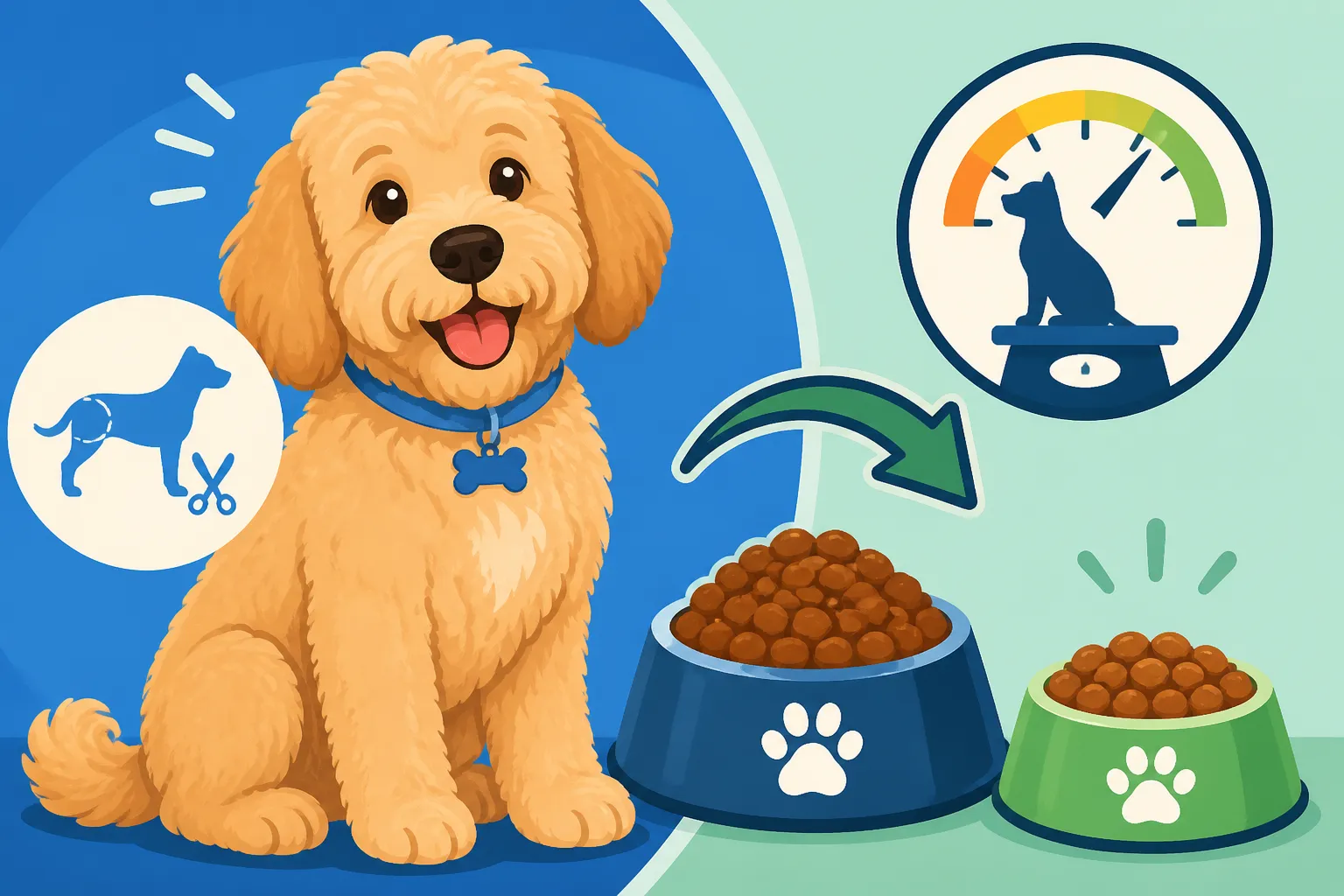
A common starting point after neutering is to reduce their caloric intake by 20-30% from what they were eating before. However, this is a general guideline, not a hard and fast rule. Your vet can provide a more precise calculation based on your Goldendoodle's current weight, ideal target weight, age, and individual activity level. They might recommend starting with a specific formula and then adjusting based on how your dog responds. The goal isn't to starve them, but to provide just enough fuel for their body to maintain a healthy weight without excess. You'll need to know the calorie content of your Goldendoodle's food, which is usually listed as kcal/cup or kcal/kg on the packaging. Brands available on Chewy or Amazon often clearly state this information, making it easier to do the math.
The Importance of Regular Weigh-Ins and Body Condition Scoring
Recalculation is just the beginning; continuous monitoring is essential. Invest in a reliable pet scale if your Goldendoodle is small enough, or make regular trips to your vet's office to use theirs. Weigh your Goldendoodle at least once a month, preferably weekly in the initial adjustment phase. Track their weight diligently. A consistent upward trend, even of a few ounces, is a red flag. Don't wait until they've gained several pounds to make changes.
Alongside weighing, continue to perform body condition scoring (BCS) by feeling their ribs, waist, and spine. Your vet can show you how to accurately assess your dog's BCS using a 9-point scale, where a score of 4 or 5 is ideal. A Goldendoodle with a score of 6 or higher is considered overweight. Many vets offer free weigh-ins, making it easy to pop in and track progress. This regular, objective assessment, combined with your vet's advice, is your best tool for ensuring your Goldendoodle maintains an optimal weight after neutering. It's a proactive step that can prevent more serious health issues like Goldendoodle Arthritis After the Age of Eight or Bloat Risk in a Standard Goldendoodle, which are exacerbated by excess weight.
Choosing the Right Food and Portioning Tools
Beyond the quantity, the quality of your Goldendoodle's food matters. While caloric restriction is key, you still want to ensure they're getting all the necessary nutrients. Opt for high-quality dog food with appropriate protein and fat levels for a less active, adult dog. Many premium brands offer "weight management" or "senior" formulas that are lower in calories but still satisfying. Companies like Ollie provide fresh, pre-portioned meals that can take the guesswork out of calorie counting, especially if you're struggling to measure accurately.
| Goldendoodle Size | Pre-Neuter Estimated Daily Calories (Rough Range) | Post-Neuter Estimated Daily Calories (Rough Range, ~20-30% Reduction) |
|---|---|---|
| Toy (5-15 lbs) | 300-600 kcal | 240-480 kcal |
| Mini (15-35 lbs) | 600-1100 kcal | 480-880 kcal |
| Medium (35-50 lbs) | 1100-1500 kcal | 880-1200 kcal |
| Standard (50+ lbs) | 1500-2500+ kcal | 1200-2000+ kcal |
Note: These are very rough estimates. Individual needs vary widely based on age, activity level, and exact weight. Always consult your vet.
Accurate portioning tools are also non-negotiable. Don't rely on guesswork or a standard household cup, which can vary significantly in volume. Use a kitchen scale to measure food by weight (grams or ounces) for the most accurate portions. If measuring by volume, use a dedicated pet food measuring cup, not your coffee mug! These small differences add up over weeks and months. Sometimes, even the slight variations in scooping can lead to overfeeding. Precision here is your friend. This attention to detail ensures that the recalculated ration is truly what your Goldendoodle is receiving, setting them up for success in maintaining a healthy weight. Knowing Measuring Goldendoodle Food by Weight is far more accurate than by volume can make a huge difference.
Practical Tips for Managing Your Goldendoodle's Weight
Successfully managing your Goldendoodle's weight after neutering goes beyond just adjusting their main meals. It's a holistic approach that incorporates smart treat choices, engaging their minds, and maintaining open communication with your veterinary team.
Adjusting Treats and Incorporating Mental Enrichment
Let's be honest, we all love giving our Goldendoodles treats. They're part of bonding, training, and just generally spoiling our furry friends. However, after neutering, treats become a significant area where hidden calories can quickly derail your efforts. Those tiny training treats, dental chews, or even bits of table scraps add up. If you've reduced your Goldendoodle's main meal, but continue to offer the same amount of high-calorie treats, you've essentially negated your efforts. The easiest way to manage this is to either dramatically reduce the number of treats or switch to much lower-calorie options. Think small pieces of plain cooked chicken, green beans, carrots, or even their own kibble taken from their daily ration.
Mental enrichment is also incredibly important. A Goldendoodle is a smart, engaged dog, inheriting intelligence from the Poodle and biddability from the Golden Retriever. If they're no longer burning as many physical calories, or if they're expressing increased "hunger" through begging, channeling that energy into mental work can be incredibly satisfying for them without adding calories. Puzzle feeders, snuffle mats, and interactive toys (many of which are easily found on Amazon) make them "work" for their food, slowing down mealtime and engaging their brains. Instead of another treat, consider a quick training session with their kibble, teaching them Goldendoodle Impulse Control With Food on the Floor or a new trick. Puzzle Toys That Occupy a Goldendoodle for an Hour can be a fantastic way to stretch out a meal or a small number of treats, providing lasting enjoyment.
Gradual Food Changes and Monitoring Progress
When you decide to adjust your Goldendoodle's food, don't make drastic changes overnight. A sudden, significant reduction can lead to an overly hungry, frustrated dog, or even digestive upset. Instead, aim for a gradual reduction over several weeks. For example, if your vet recommends a 20% calorie reduction, start by reducing their current portion by 5-10% for a week or two, monitor their weight and body condition, and then make further small adjustments. This allows their body to adapt and minimizes stress.
Throughout this period, continue your regular weigh-ins and body condition checks. Pay attention to their energy levels, coat condition, and overall demeanor. Are they still happy and active, or do they seem lethargic? Are they losing weight steadily, or is progress stalled? This ongoing monitoring allows you to fine-tune the amount of food until you find the sweet spot where your Goldendoodle is maintaining a healthy weight, has good energy, and isn't excessively begging. Remember that keeping a Goldendoodle that stops finishing meals in their senior years can also be a challenge, so establishing good eating habits early is key.
Consulting Your Vet for Personalized Advice
Ultimately, your veterinarian is your best resource for guiding your Goldendoodle's post-neutering diet and weight management. They have access to your dog's full health history, can perform a thorough physical examination, and can rule out any underlying medical conditions that might contribute to weight gain (though a hormonal shift after neutering is often the primary cause). They can provide specific calorie recommendations tailored to your Goldendoodle's unique situation and advise on appropriate food choices.
Don't hesitate to schedule a follow-up appointment a few weeks after neutering to discuss diet changes and get their professional opinion. They can help you set realistic weight loss or maintenance goals and offer strategies for achieving them. If your Goldendoodle is particularly resistant to weight loss, or if they have other health concerns, your vet might recommend specific prescription diets or further diagnostics. Partnering with your vet ensures you're making informed decisions that prioritize your Goldendoodle's long-term health and well-being. This proactive approach will help you navigate the changes that come with neutering and keep your furry companion thriving for years to come.
Disclaimer
This article is for general informational purposes only and does not constitute professional advice. Laws, prices and regulations vary by location and change over time. Consult a qualified professional for guidance on your specific situation.