Goldendoodle Impulse Control With Food on the Floor
It's a familiar scene: you're cooking dinner, a stray piece of vegetable rolls off the counter, and before you can blink, your Goldendoodle is there, sniffing, nudging, or even inhaling it. Or perhaps it's a child's dropped snack, or crumbs under the dining table. The struggle with a Goldendoodle and food on the floor is real, frustrating, and often feels like an unending battle of wits. This comprehensive guide is here to walk you through understanding why your Goldendoodle behaves this way and, more importantly, how to teach them the impulse control needed to leave tempting floor-snacks alone.
Understanding the Goldendoodle's Drive for Food
When you look at your Goldendoodle, you see a loving, playful companion. But underneath that fluffy coat and eager expression are instincts inherited from two very capable working breeds: the Golden Retriever and the Poodle. Both contribute to that undeniable drive to investigate, and often consume, anything that looks remotely edible on the floor. It’s not about being "naughty" in their eyes; it's just how they're wired.
The Golden Retriever's Scavenging Instinct
Let's be honest, Golden Retrievers are notorious for being food motivated. They live to retrieve, and that often extends to "retrieving" any dropped morsel, no matter how small or seemingly insignificant, with lightning speed. This isn't a flaw; it's a part of their charm and heritage. They were bred to work closely with humans, often in environments where finding and bringing back items was key. This strong drive, coupled with a keen sense of smell, means that even the tiniest crumb won't go unnoticed.
Imagine a Golden Retriever out in the field, diligently searching for fallen game. That same instinct kicks in when a piece of cheese tumbles from the counter. It's a natural inclination to investigate and consume. This powerful scavenger instinct means that simply telling your Goldendoodle "no" often isn't enough; you're fighting against centuries of selective breeding. It requires proactive training and management to redirect this inherent drive. This is why many Goldendoodle owners find themselves constantly vigilant around meal times or in the kitchen, often feeling like they need eyes in the back of their heads.
The Poodle's Intelligence and Opportunism
Now, add the Poodle's intelligence into the mix. Poodles are incredibly smart, quick learners, and highly adaptable. This is fantastic for training complex commands, but it also means they are adept at figuring out patterns and exploiting weaknesses. If your Goldendoodle learns that sometimes, just sometimes, a dropped piece of food leads to a tasty reward, they'll keep trying. They're not just scavenging; they're problem-solving.
A Poodle's intelligence can manifest as opportunism if not channeled correctly. They observe, they learn, and they remember. If you accidentally drop a piece of toast and, in your haste, they manage to snatch it, they've just had a very rewarding experience. They’ve learned that persistence pays off. This makes consistent training absolutely critical. Their smarts mean they can be trained to incredible levels, but it also means they'll test boundaries and push for any advantage they can get. It's a double-edged sword: you have a dog with incredible potential, but one who will absolutely use their brainpower to outwit you if given the chance. This is why What a Goldendoodle Inherits From the Poodle Brain is so important to understand.
Puppyhood Habits That Stick
The habits your Goldendoodle forms in puppyhood, good or bad, tend to stick. If a puppy learns early on that scavenging for dropped food is a normal and acceptable activity, it becomes ingrained behavior. Puppies are naturally curious and explore the world with their mouths. If every dropped crumb or bit of kibble from an overturned bowl is fair game, that neural pathway gets stronger and stronger.
Many owners, myself included, might not realize the long-term impact of letting little puppy behaviors slide. "Oh, it's just a puppy, he's so cute!" we think, as they lick up a dropped cheerio. But these small allowances contribute to a much larger problem as they grow into strong, fast adult dogs who can snatch a forbidden treat in a flash. Establishing clear boundaries from day one, even for the smallest dropped items, is essential. Prevention during puppyhood is far easier than trying to break an established habit in an adult Goldendoodle. Think of it as shaping their worldview: the floor is not a buffet, even when tempting morsels appear. Teaching Goldendoodle Puppy Biting and Mouthing can also lead into teaching impulse control around food.
Laying the Foundation: Basic Obedience and Management
Successful impulse control around food on the floor starts with a solid foundation of basic obedience and careful environmental management. You can't expect your Goldendoodle to ignore a steak if they haven't learned to ignore a single piece of kibble. This takes patience, consistency, and a whole lot of positive reinforcement. Your Goldendoodle wants to please you, and you can leverage that drive. For more on this, check out Training a Goldendoodle That Wants to Please You.
The "Leave It" Command: Your Best Friend
The "Leave It" command is arguably the most critical tool in your impulse control arsenal. It’s not just for dropped food; it's for anything you don't want your Goldendoodle to interact with. Mastering this command will save you countless headaches and potentially prevent them from eating something harmful.
Here’s a step-by-step approach to teaching a rock-solid "Leave It":
- Start Low-Value, High Reward: Begin with a low-value treat (like a piece of dry kibble) in your closed hand. Show your Goldendoodle the treat. When they try to sniff or lick your hand, say "Leave It" firmly. Keep your hand closed. The moment they pull back, even for a second, open your other hand and immediately reward them with a much higher-value treat (like a piece of chicken or cheese). Repeat this many times.
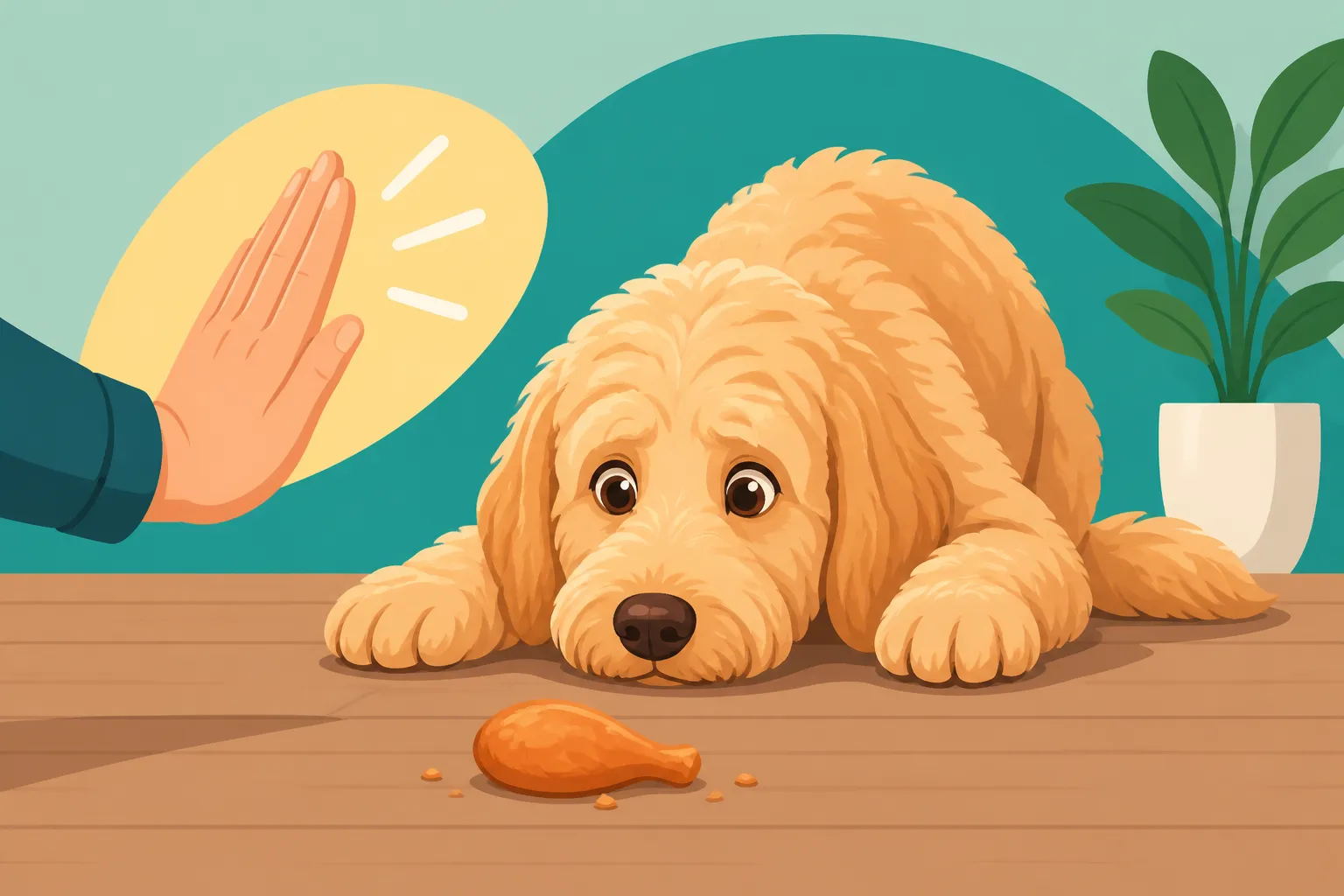
- Move to the Floor (Still Covered): Once they understand "Leave It" with your hand, place a low-value treat on the floor and cover it with your hand or foot. Say "Leave It." When they back away, even slightly, praise them enthusiastically and reward them with a high-value treat from your hand, not the floor.
- Uncovered and Under Supervision: Gradually progress to placing a low-value treat on the floor uncovered. Keep your hand poised to cover it if they lunge. Say "Leave It." The moment they look away from the treat on the floor and at you, reward them with that high-value treat from your hand. If they try to take it, quickly cover it, repeat "Leave It," and wait for them to disengage. Never let them get the "forbidden" treat.
- Increase Value and Distraction: Slowly introduce higher-value items to the floor, always starting with your hand ready to intervene. Practice in different rooms, with increasing levels of distraction. This is where you might bring in the kind of crumbs or fallen food they'd usually target, but always in a controlled training environment.
- Practice, Practice, Practice: This isn't a one-and-done command. Integrate "Leave It" into your daily routine. Every time you drop something non-toxic (like a piece of carrot), use it as a mini-training session. Consistency is the key to truly ingraining this command. Many online resources, including those from BAXTER & Bella, offer excellent tutorials for teaching this crucial command effectively. You might even find specialized long lines on Amazon that can assist in managing their proximity during outdoor "leave it" training sessions.
Consistent Management and Environment Control
Even with a strong "Leave It" command, prevention is still better than cure. Your Goldendoodle is smart, and they will test boundaries if given the opportunity. Consistent management means making it impossible for them to practice the unwanted behavior.
- Keep Floors Impeccable: This sounds obvious, but it's crucial. Sweep or vacuum regularly, especially after meals or cooking. Don't leave crumbs or dropped food accessible. If there's nothing to scavenge, they can't practice scavenging.
- Containment During Risky Times: When you're cooking, eating, or have guests over who might accidentally drop food, manage your Goldendoodle's access. This could mean using baby gates to keep them out of the kitchen or dining area, having them on a leash tethered to a stable object, or crating them with a high-value chew toy. This isn't punishment; it's setting them up for success. You can find durable and secure baby gates and various types of crates readily available on Amazon.
- Educate the Household: Everyone in the house needs to be on board with the rules. Children, especially, need to understand not to feed the dog from the table or leave food unattended. Consistency across all family members is paramount. If one person allows them to scavenge, it undoes the hard work of everyone else.
Structured Feeding Times and Bowl Manners
Believe it or not, how you feed your Goldendoodle can also impact their general impulse control around food. Establishing a clear routine and teaching patience around their own food bowl can help them generalize that patience to other food situations.
- Routine and Predictability: Feed your Goldendoodle at consistent times each day. This helps them understand when and where their food will come from. Free-feeding (leaving food out all day) can make them less appreciative of their own meals and more prone to seeking out other sources.
- "Wait" for the Bowl: Before putting their food bowl down, have your Goldendoodle sit and "wait." Hold the bowl, place it down, and only release them to eat with an "okay" command. This teaches them that food doesn't just magically appear and that they need to control their excitement for it. Start with short waits and gradually increase the duration. This exercise, like "Leave It," builds valuable impulse control. A training program like BAXTER & Bella often provides excellent modules on developing these foundational behaviors.
- No Begging: Absolutely no feeding from the table. Ever. Not even "just a tiny bit." This reinforces begging behavior and makes it harder for them to understand that human food is off-limits. If they try to beg, redirect them to their mat or crate.
Advanced Training for Real-World Scenarios
Once your Goldendoodle has a solid grasp of "Leave It" in controlled settings and you've established good management habits, it's time to level up. The real world is full of unpredictable temptations, and you need to prepare your dog for them.
Practicing with Distractions: The "Drop It" Follow-up
The "Leave It" command is your first line of defense, but sometimes, despite your best efforts, your Goldendoodle might still grab something they shouldn't. That's where "Drop It" comes in. This command teaches them to release whatever is in their mouth.
- Teaching "Drop It": Start by offering a low-value toy. When your Goldendoodle has it in their mouth, present a high-value treat right to their nose. As they open their mouth to take the treat, say "Drop It" and praise them as the toy falls. Immediately give them the high-value treat. Repeat, gradually increasing the value of the item they drop (always ensuring it's safe for them to hold briefly).
- Integrating "Drop It" with "Leave It": In a real-world scenario, if your Goldendoodle manages to grab a forbidden item from the floor despite your "Leave It" command, immediately issue a "Drop It." The goal is to get them to release the item without you having to pry it from their mouth, which can create resource guarding issues. Reward heavily when they drop it, then praise for leaving the now-dropped item.
- Proofing "Leave It" in High-Distraction Environments: Now that "Leave It" is solid, practice it where actual food might fall. Have a friend drop a piece of kibble (or even a small piece of hot dog) while you're supervising. Give the "Leave It" command. If your Goldendoodle ignores it, reward them with a jackpot of treats from your hand. If they go for it, quickly cover it, repeat "Leave It," and start again. This prepares them for those unexpected moments. This is why Goldendoodle Impulse Control Exercises needs to be varied and realistic.
| Training Step | Item Type | Location | Intervention | Reward Source | Goal |
|---|---|---|---|---|---|
| Phase 1: Hand | Low-value treat | Your closed hand | Cover hand | Other hand | Understand "Leave It" cue |
| Phase 2: Floor 1 | Low-value treat | Covered on floor | Cover with foot | Your hand | Extend "Leave It" to ground |
| Phase 3: Floor 2 | Low-value treat | Uncovered floor | Hovering hand | Your hand | "Leave It" without immediate cover |
| Phase 4: Distract | Med-value food | Different rooms | Verbal + body block | Your hand | Generalize "Leave It" in varied settings |
| Phase 5: Real-World | High-value food | Kitchen, dining | Verbal + management | Your hand | Maintain "Leave It" under high temptation |
Teaching a "Place" or "Mat" Command
The "Place" or "Mat" command is invaluable for giving your Goldendoodle a designated spot to go to, especially during high-traffic times like meal prep or family dinners. It's a structured way to keep them out of the action and prevent them from even seeing food fall to the floor.
- Introducing "Place": Start by luring your Goldendoodle onto a designated mat or dog bed. As soon as all four paws are on it, say "Place" and reward them with a treat. Gradually increase the time they spend on the mat before getting a reward.
- Duration and Distance: Once they understand "Place," start adding duration. Practice having them stay on their mat for increasing lengths of time while you move around the room. Then add distance – ask them to "Place" and then walk a few steps away before returning to reward them.
- Applying it to Food Situations: When you're in the kitchen, tell your Goldendoodle "Place." Reward them for staying there. If they try to get off, gently guide them back without scolding, and ask them to "Place" again. The goal is for them to learn that staying on their mat means good things happen, and they don't need to patrol the floor for scraps. This is a fantastic impulse control exercise and helps them learn to settle. Goldendoodle Place Training on a Bed or Mat provides more in-depth guidance on this.
Addressing Counter Surfing and Table Manners
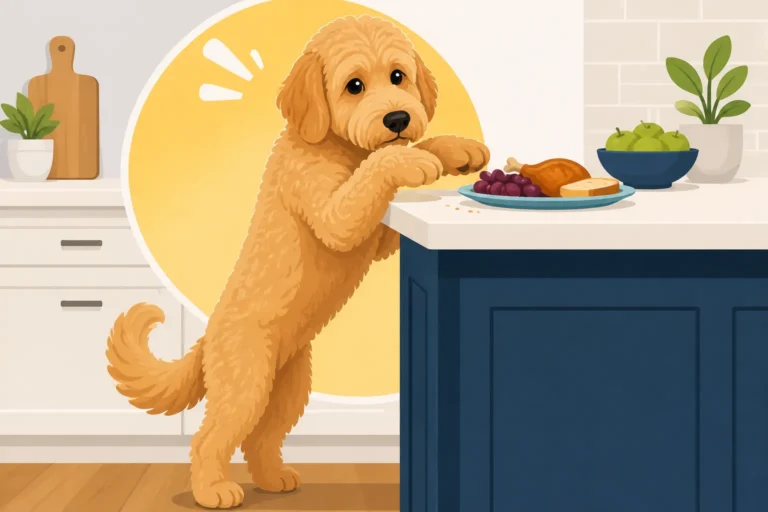
While this article focuses on food on the floor, it's worth noting that if your Goldendoodle is struggling with floor-level impulse control, counter surfing and table manners are likely related issues. The principles are the same: prevention and consistent training.
- Clear the Counters and Table: Don't leave food unattended on counters or tables, especially when you're not actively supervising. If they learn they can get food from these surfaces, they will continue to try.
- "Off" Command: Teach an "Off" command for when they jump up on counters or tables. As they jump, say "Off" and lure them down with a treat to the floor. Reward them when all four paws are on the ground.
- Boundary Training: Similar to the "Place" command, you can teach boundaries around the kitchen or dining area. Use physical barriers (baby gates) initially, then fade them as your Goldendoodle understands that certain areas are off-limits without permission. This is particularly important for A Standard Goldendoodle Tall Enough to Reach the Counter.
Common Pitfalls and Troubleshooting
Training a Goldendoodle in impulse control, especially around something as tempting as food, isn't always a smooth road. There will be setbacks, frustrations, and moments when you feel like you're not making any progress. Understanding common pitfalls can help you navigate these challenges more effectively.
Inconsistency is Your Enemy
This is, hands down, the biggest reason training fails. Every single time your Goldendoodle successfully snatches food from the floor, they get a massive reward. That one successful grab can undo days or even weeks of consistent training. It teaches them that persistence does pay off, and if they just keep trying, eventually they'll hit the jackpot.
- The "Just This Once" Trap: We've all been there. You're tired, you drop a tiny crumb, and you think, "Ah, it's just one time." But your Goldendoodle doesn't understand "just this once." They understand "sometimes this works!" This creates a variable reward schedule, which is actually one of the most powerful ways to reinforce a behavior.
- Family Members Not On Board: If one person in the household is diligent with "Leave It" and preventing floor-snacking, but another lets things slide, your Goldendoodle will learn who the "easy target" is. Ensure everyone, from children to houseguests, understands the rules and is consistent in enforcing them. This includes not leaving plates on coffee tables or low surfaces within reach.
- Solution: Be absolutely, relentlessly consistent. It's tough, but it's the only way. If you drop something you don't want them to have, intervene immediately and use your commands. If you can't supervise, manage their access to the area.
Not Proofing Commands in Different Environments
You've got "Leave It" down pat in your quiet living room, where the distractions are minimal. But then you go to a bustling park, or a friend's house with kids and dropped food, and suddenly your Goldendoodle seems to have forgotten everything. This isn't necessarily a sign of a bad dog or poor training; it's a sign that the command hasn't been "proofed" in varied environments.
- The Problem: Dogs don't automatically generalize commands from one context to another. "Leave It" in the kitchen doesn't automatically translate to "Leave It" in the park when a discarded sandwich is nearby. The environment itself acts as a massive distraction.
- Solution: Systematically practice your impulse control commands in a wide variety of settings. Start with low-distraction environments and gradually increase the challenge.
- Different Rooms: Practice in the kitchen, living room, bedroom.
- Outside Your Home: Practice in your yard, then on quiet sidewalks.
- Public Places: Move to parks (initially during off-peak hours), pet-friendly stores, or friends' houses.
- Increasing Distractions: Introduce other people, other dogs (if appropriate), and more tempting food items as you progress. For outdoor training, using a long line, which you can find on Amazon, can give you a safe way to practice "Leave It" with more room for error. Remember, the goal is for them to respond to "Leave It" no matter where they are or what the temptation.
When to Seek Professional Help
Sometimes, despite your best efforts, you might feel stuck. Your Goldendoodle might have such a strong drive for food that you can't seem to break through, or perhaps they're developing other related behaviors like resource guarding. There's no shame in seeking professional help.
- Signs You Might Need a Trainer:
- Persistent Failure: You're consistently applying the training techniques, but your Goldendoodle simply isn't making progress.
- Escalating Behavior: The behavior is getting worse, or your Goldendoodle is becoming pushy, nippy, or even aggressive around food.
- New Behaviors: Your Goldendoodle starts exhibiting resource guarding (growling or snapping if you approach them when they have food) or other anxiety-related behaviors around food.
- Feeling Overwhelmed: You simply feel out of your depth and frustrated.
- Finding the Right Trainer: Look for a certified professional dog trainer who uses positive reinforcement methods and has experience with Goldendoodles or similar intelligent, food-motivated breeds. Avoid trainers who advocate for harsh corrections or punitive methods, as these can damage your bond with your Goldendoodle and exacerbate behavioral issues. A good trainer can observe your interactions, identify specific triggers, and provide tailored strategies. Finding a Trainer Who Works With Goldendoodles can guide you in this search. Many online platforms and communities, like those offered by BAXTER & Bella, also connect you with trainers or provide structured courses that can be incredibly beneficial.
Teaching your Goldendoodle impulse control around food on the floor is a journey, not a destination. It requires patience, consistency, and a deep understanding of their breed characteristics. But with the right approach, you can help your beloved companion develop the self-control to live harmoniously in a home where delicious food occasionally, and inevitably, ends up on the floor.
Disclaimer
This article is for general informational purposes only and does not constitute professional advice. Laws, prices and regulations vary by location and change over time. Consult a qualified professional for guidance on your specific situation.