Picking the Poodle Parent for Goldendoodle Size
It's incredibly common to have a specific vision in mind when you're looking for a Goldendoodle puppy. Maybe you picture a smaller, more manageable companion for apartment living, or perhaps a larger, sturdy dog for outdoor adventures. But figuring out exactly how to achieve that desired size in a crossbreed like a Goldendoodle can feel like trying to solve a complex puzzle, especially when breeders sometimes offer ranges rather than guarantees. This guide will walk you through the pivotal role the Poodle parent plays in determining your Goldendoodle's eventual size, helping you understand what to look for and the questions to ask to bring home a dog that fits your lifestyle perfectly.
The Poodle's Primary Role in Goldendoodle Size
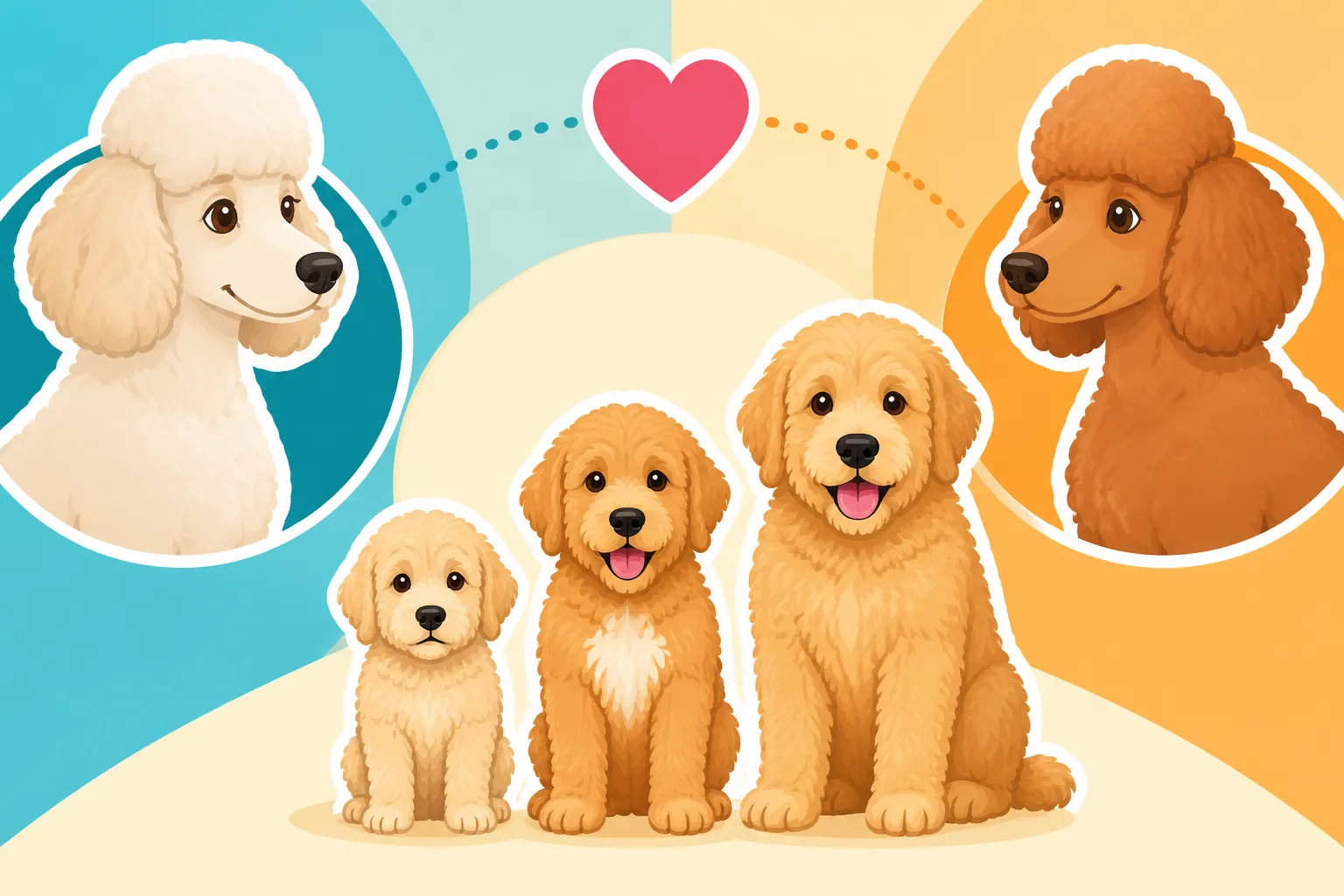
When you're dreaming of a Goldendoodle, it's easy to get caught up in the curly, friendly appeal. However, understanding the genetics behind their size is crucial, and that journey almost always starts with the Poodle parent. Unlike the Golden Retriever, which comes in a relatively consistent size range (though there are minor variations), Poodles are bred in distinct size categories: Toy, Miniature, and Standard. This inherent variability in the Poodle line is precisely what gives Goldendoodles their diverse size options, from tiny companions to substantial family dogs. It's the Poodle that acts as the primary dial, allowing breeders to adjust the potential size outcome of a litter.
Think of it this way: the Golden Retriever parent typically provides the larger, more consistent "base" for the Goldendoodle's genetic blueprint. Its size range is pretty well-defined, usually falling into the 55-75 pound category for females and 65-85 pounds for males. So, if you want a Goldendoodle outside of that general medium-to-large range, the Poodle is the genetic lever that makes it happen. If you're hoping for a compact Goldendoodle, you absolutely need a Miniature or Toy Poodle involved in the pairing. Conversely, if you're set on a big, robust Goldendoodle, the Poodle parent must be a Standard Poodle, as a smaller Poodle simply won't have the genes to produce a truly large offspring when paired with a Golden.
Many aspiring Goldendoodle owners get frustrated trying to guess a puppy's adult size from its adorable, tiny form. The Poodle parent's lineage offers the most reliable clue. A reputable breeder will always be able to tell you the exact size classification of their Poodle dam or sire, and often even their weight and height, which gives you a much clearer picture of what to expect down the line. It's not just about the name "Mini Poodle" or "Standard Poodle," but the actual, measured size of that individual dog and its ancestors.
Understanding Poodle Size Categories
Poodles are categorized into three main sizes, sometimes four if you include "Toy" separately from "Miniature" for very small dogs. Each of these categories has a defined height range, which is measured at the shoulder. This measurement is key because it dictates the overall frame and bone structure of the dog, which directly translates to the potential size of their Goldendoodle offspring. It's not just about weight, but about the dog's stature.
The Standard Poodle is the largest, typically standing over 15 inches tall at the shoulder, with many falling into the 22-27 inch range. They often weigh anywhere from 40 to 70 pounds, or even more. When you imagine a classic, elegant Poodle, you're likely thinking of a Standard. These are athletic, intelligent dogs, and they bring substantial size potential to a Goldendoodle cross. If a breeder is aiming for a large Goldendoodle, they absolutely need a Standard Poodle in the mix.
Next up, we have the Miniature Poodle. These Poodles stand between 10 and 15 inches tall at the shoulder and generally weigh 10 to 15 pounds. They are perfectly sized for many families who want a dog that's not too small to be fragile, but not so large that it takes up too much space. The Miniature Poodle is a popular choice for creating Goldendoodles in the medium and mini categories. They offer a significant reduction in size compared to a Standard Poodle, but still maintain much of the Poodle's intelligence and lively spirit.
Finally, the Toy Poodle is the smallest, usually standing under 10 inches tall at the shoulder and weighing under 10 pounds, often in the 4-6 pound range. These are truly tiny dogs, bred for companionship. When a Toy Poodle is used as a parent, the goal is almost always to produce a very small Goldendoodle, often referred to as a "Toy" or "Teacup" Goldendoodle. While adorable, it's important to remember that crossing such a small Poodle with a much larger Golden Retriever can sometimes lead to greater size variability or even potential birthing complications, though experienced breeders manage this carefully.
The Impact of Each Poodle Size on Goldendoodle Litters
The Poodle's size category directly sets the potential range for the Goldendoodle puppies. This isn't just a slight variation; it's a fundamental difference that dictates whether you'll end up with a dog that can comfortably fit under an airplane seat or one that needs its own sofa. Understanding these typical outcomes is the first step in managing your expectations and making an informed decision about your future furry family member.
When a Standard Poodle is bred with a Golden Retriever, the resulting F1 Goldendoodle puppies are almost always going to be "Standard Goldendoodles." These dogs typically mature to be between 50 and 90 pounds, and can stand quite tall, often 20-26 inches at the shoulder. They're robust, active dogs that require ample space and exercise. If you're dreaming of a large, playful companion, this is the combination to look for. Keep in mind that even within a litter, some pups might lean more towards the Golden's larger frame, while others might take after the Poodle's more athletic build, but they will all generally be in the larger size bracket.
If the Poodle parent is a Miniature Poodle, the Goldendoodle offspring will fall into the "Medium" or "Miniature" Goldendoodle size category. These dogs generally weigh between 25 and 45 pounds, standing 14-20 inches tall. This size is incredibly popular because it offers a happy medium: big enough to be a substantial dog, but small enough to be more manageable in many living situations. These Goldendoodles are often energetic and playful, making wonderful family pets without the sheer physical presence of a Standard. Mini Goldendoodle Height and Weight is a topic many prospective owners delve into for this reason.
Finally, when a Toy Poodle is used, you're looking at "Toy" or sometimes "Micro" Goldendoodles, which are typically under 25 pounds and less than 15 inches tall, often much smaller. These adorable little bundles are perfect for those who want a truly petite companion. However, due to the significant size difference between a Toy Poodle and a Golden Retriever, this pairing is less common for F1 generations and often involves artificial insemination and careful management. More commonly, you'll see Toy Goldendoodles produced by breeding a Miniature Goldendoodle back to a Toy Poodle (an F1b generation) to achieve a more consistent smaller size and maintain a higher Poodle percentage. This helps ensure both health and more predictable outcomes.
Beyond Simple Arithmetic: The Nuances of Goldendoodle Size Prediction
While the Poodle parent is undeniably the most significant factor in determining a Goldendoodle's eventual size, it’s not always as simple as adding the parents' weights and dividing by two. Genetics are wonderfully complex, and several other factors can influence how big your Goldendoodle grows, leading to delightful surprises or slight adjustments to your expectations. It’s crucial to understand these nuances, especially if you have a very specific size in mind for your future canine companion.
One of the most frequent misconceptions is that an F1 Goldendoodle (50% Golden Retriever, 50% Poodle) will always be a perfect average of its parents. While this often holds true, there can be outliers. Puppies in the same litter can display a surprising range of sizes, some favoring one parent's build more than the other. This genetic lottery is part of the fun and unpredictability of hybrid dogs, but it can also be a source of anxiety for those who absolutely need a dog within a certain weight or height bracket. This is why a good breeder will discuss not just the parents' sizes, but also the range seen in previous litters.
Moreover, the specific lineage of the Poodle, beyond just its size category, can play a role. Some Poodle lines naturally run larger or smaller within their respective size classifications, and this genetic tendency can be passed down. It's like how some human families have consistently taller or shorter members. This is where researching a breeder's history and seeing multiple generations of their dogs, if possible, can provide valuable insight. You're not just buying a puppy; you're investing in a lineage.
The Golden Retriever's Consistent Contribution
While the Poodle introduces the variability, the Golden Retriever parent provides a relatively consistent "anchor" for the Goldendoodle's size. Golden Retrievers are a well-established breed with a fairly standard size range. Most adult male Golden Retrievers weigh between 65-80 pounds and stand 23-24 inches at the shoulder, while females typically weigh 55-70 pounds and stand 21.5-22.5 inches. This consistency is a blessing in Goldendoodle breeding because it means breeders have a stable genetic starting point for one half of the equation.
When a Golden Retriever is bred with a Poodle, its genetic contribution for size usually pushes the offspring towards the upper end of what the Poodle's size would typically allow. For instance, a Miniature Poodle paired with a Golden Retriever will likely produce Goldendoodles that are on the larger side of the "Mini" or "Medium" Goldendoodle spectrum, rather than the absolute smallest. This is because the Golden's genes still have a strong influence. You won't typically see a Golden Retriever bred with a Poodle producing a Goldendoodle that is significantly smaller than the Mini Poodle parent, for example.
The Golden Retriever's consistent build also means that even if a Goldendoodle takes after its Poodle parent in terms of curl or intelligence, its underlying bone structure and general robustness often carry hints of its Retriever heritage. This is particularly noticeable in their strong, athletic frames. This predictability from the Golden side helps temper some of the genetic variability that comes from combining two distinct breeds, offering a degree of expectation, even as the Poodle parent opens up a wider range of size possibilities. Learning What a Goldendoodle Inherits From Each Parent Breed really sheds light on these dynamics.
Hybrid Vigor and Size Variability in F1 Goldendoodles
The concept of "hybrid vigor" is often discussed in the context of Goldendoodle health, but it can also manifest in unpredictable ways with size, particularly in the F1 generation. F1 Goldendoodles are the result of directly breeding a purebred Golden Retriever with a purebred Poodle. Because you're combining two distinct genetic pools for the very first time, there's a wider range of genetic expression possible in the offspring. This means that while many F1 Goldendoodles will indeed fall squarely in the middle of their parents' sizes, some can be surprisingly larger or smaller.
Imagine a litter where one puppy strongly inherits the genes for a larger frame from its Golden Retriever parent, while another, its littermate, might inherit a more delicate build from its Poodle side. This is why you can sometimes see a 10-15 pound weight difference between adult Goldendoodles from the same F1 litter. It’s a bit of a genetic lucky dip, which can be exciting but also a bit nerve-wracking if you have specific size constraints for your living situation or travel plans. This variability is one of the aspects that makes Why an F1 Goldendoodle Is the Least Predictable Healthwise also apply to size to some extent.
This size variability often means that even with careful selection of parent dogs, a breeder can only give you a range for F1 puppies, rather than a precise prediction. It's a natural consequence of having such diverse genetic input. For many owners, this slight unpredictability is part of the charm of an F1 Goldendoodle, as they are often celebrated for their robust health and balanced temperaments. However, if precise size is a non-negotiable factor, you might need to consider later generations where breeders have worked to stabilize certain traits, including size.
F1b and Multigen Goldendoodles: The Quest for Predictability
For those who crave more predictability in their Goldendoodle's size, particularly on the smaller end of the spectrum, F1b and Multigen Goldendoodles often become the focus. These generations are specifically bred to consolidate certain traits, and size is a major one. This is where the breeder actively tries to fine-tune the genetic percentages to achieve more consistent outcomes.
An F1b Goldendoodle is typically the result of breeding an F1 Goldendoodle back to a purebred Poodle (often a Miniature or Toy Poodle for smaller sizes). This pairing results in a dog that is approximately 75% Poodle and 25% Golden Retriever. By increasing the Poodle percentage, breeders can more reliably produce smaller dogs, as the stronger Poodle genetic influence tends to pull the size down. For example, if an F1 Goldendoodle (from a Standard Poodle and Golden) is bred to a Miniature Poodle, the F1b offspring will almost certainly be in the Medium or Mini Goldendoodle range, with much less chance of growing into a Standard size. This generation is often sought after not just for size predictability but also for its reduced shedding. Why an F1b Goldendoodle Loses Some Hybrid Vigor might be a factor in some health claims, but when it comes to size, it offers increased control.
Multigen Goldendoodles take this concept even further. These are Goldendoodles produced by breeding two Goldendoodles together (F2, F3, etc.) or by breeding an F1b to another Goldendoodle. The idea here is that after several generations of careful breeding, the genetic traits become more stabilized, making size (and other characteristics like coat type and temperament) much more predictable. A breeder who consistently produces Multigen Mini Goldendoodles, for instance, has likely established a breeding program where the desired smaller size is reliably passed down. This careful selection over generations reduces the "wild card" effect seen in F1s, allowing for a much narrower and more dependable size range in the puppies.
What to Look For in a Poodle Parent's Pedigree and Health Clearances
When you're serious about bringing a Goldendoodle into your home and you have a specific size in mind, simply taking a breeder's word for it isn't enough. You need to become an informed consumer, asking pointed questions and looking for tangible evidence about the Poodle parent. This due diligence is not about distrust; it's about making sure you're getting a healthy, well-bred puppy that aligns with your family's needs and expectations. The size of the Poodle parent directly correlates to the Goldendoodle's adult size, so scrutinizing this aspect is paramount.
A good breeder will welcome your questions and be transparent with all information regarding their breeding dogs. They understand that you're making a significant, long-term commitment. Don't be shy about asking for specifics. Remember, breeders are essentially predicting the future size of a living creature, and while they can be very good at it, the more data points you have, the better your own understanding will be. This also extends to health clearances, which, while not directly related to size, are absolutely critical for any responsible breeder. A breeder who is thorough about health clearances is also likely to be meticulous about understanding and predicting size.
Furthermore, a great way to gauge the potential size of your future Goldendoodle is to look at the other puppies in the litter, and if possible, previous litters from the same parents. While puppies vary, seeing a consistent size range in past offspring can be very reassuring. You can also get a feel for the overall structure of the Poodle parent and the Golden Retriever parent themselves. Do they appear healthy, well-proportioned, and representative of their breed standards? These visual cues, combined with documented information, will build a comprehensive picture.
Examining the Poodle Parent's Weight and Height
This is perhaps the most concrete piece of evidence you can gather. Don't just settle for "Mini Poodle" or "Standard Poodle." Ask for the exact height (measured at the shoulder) and weight of the Poodle parent. While Poodle size categories have ranges, individual dogs can be at the smaller or larger end of those ranges. This distinction can make a real difference in the Goldendoodle offspring. For instance, a Miniature Poodle that is 14 inches tall and weighs 15 pounds will likely produce slightly larger Goldendoodles than a Miniature Poodle that is 11 inches tall and weighs 10 pounds, even though both are technically "Miniature."
A responsible breeder will have these measurements readily available. They should also be able to show you photos or videos of the Poodle parent, giving you a visual sense of its stature. If a breeder is vague about these details, it should raise a red flag. Knowing the precise measurements of both parents gives you the best possible data for estimating your puppy's adult size. You can then compare these measurements to standard Goldendoodle size charts to get a clearer picture. You might even find comprehensive resources on Chewy or other pet supply sites that help you correlate parent size to expected puppy size, offering detailed breed profiles that include typical dimensions.
It's also worth noting that height and weight are typically more stable indicators than visual estimates alone. A Poodle might look stocky or slender, but its measured height provides a more objective data point for its skeletal size, which is what truly determines the potential adult height of a Goldendoodle. Remember, a Goldendoodle's fluffy coat can sometimes be deceptive, making a dog appear larger than it actually is underneath. Focus on the actual measurements for the most accurate prediction.
Reviewing the Poodle's Genetic Lineage
Beyond the immediate parents, looking at the Poodle's genetic lineage can offer further clues, especially when dealing with potential outliers. Ask the breeder about the size of the Poodle parent's own parents (the Goldendoodle puppy's grandparents). Were they consistently within the expected size range for their category, or did they show any unusual tendencies? A strong history of consistent size in the Poodle's ancestry increases the likelihood of predictable size in the Goldendoodle puppies.
For example, if a Miniature Poodle parent comes from a line where its own parents and grandparents were all consistently 10-12 inches tall, you have a much stronger indication that its offspring will also trend towards the smaller end of the Miniature Goldendoodle spectrum. Conversely, if a Miniature Poodle parent has a Standard Poodle grandparent in its recent lineage, there's always a slight chance that some of those larger genes could resurface, even if the immediate Poodle parent is within the Mini size. This is less common but can happen due to recessive genes.
A transparent breeder will often have information, sometimes even photos, of the Poodle parent's lineage. While it might feel like a deep dive into genealogy, understanding the patterns in the family tree provides a more robust prediction than just looking at the immediate parents. This thoroughness also indicates a breeder who is genuinely invested in understanding their lines and producing consistent, healthy puppies. This deep understanding of genetics is particularly vital when a breeder is aiming for specific size categories, such as a Toy Goldendoodle Under Fifteen Inches.
The Importance of Breeder Transparency
Ultimately, the best tool you have for predicting your Goldendoodle's size is a transparent and knowledgeable breeder. A good breeder will not only provide you with the measurements of their Poodle parent but will also discuss the potential size range of the litter candidly, explaining any factors that might lead to variation. They should be able to show you photos of previous litters from the same parents, allowing you to see the growth trajectory and final sizes of adult Goldendoodles they have produced.
Ask about their breeding goals regarding size. Are they specifically aiming for compact minis, or are they producing a broader range within a "medium" category? A breeder who has a clear vision for the size of their puppies is likely more precise in their pairings and can offer more accurate predictions. They will also be upfront about the limitations of prediction; after all, nature always has a hand in the outcome.
Don't hesitate to ask for references from previous puppy buyers. Speaking to other Goldendoodle owners who have purchased from the same breeder can give you invaluable real-world insight into how accurately the breeder's size predictions panned out for their dogs. This collective experience provides a powerful testimony to the breeder's integrity and the predictability of their lines. Responsible breeders are proud of their work and their dogs, and they will be happy to connect you with happy puppy families. A quick search on pet communities or even checking review sections on sites like Chewy for general breeder reputation can also provide anecdotal evidence, though always prioritize direct communication with the breeder.
| Poodle Parent Size | Typical Poodle Height (shoulder) | Typical Poodle Weight | Goldendoodle Offspring Size | Estimated Goldendoodle Height (shoulder) | Estimated Goldendoodle Weight |
|---|---|---|---|---|---|
| Toy | Under 10 inches | Under 10 lbs | Toy Goldendoodle | Under 15 inches | 10 – 25 lbs |
| Miniature | 10 – 15 inches | 10 – 15 lbs | Mini/Medium Goldendoodle | 15 – 20 inches | 25 – 45 lbs |
| Standard | Over 15 inches | 40 – 70+ lbs | Standard Goldendoodle | 20 – 26 inches | 50 – 90+ lbs |
This table provides a general guideline for the sizes you can expect. Remember that individual puppies can vary, and these are estimates. Factors like generation (F1, F1b, Multigen) and the specific genetics of the Golden Retriever parent also play a role, but the Poodle parent is your strongest indicator for size. Always consult with your chosen breeder for the most accurate information on their specific lines.
Disclaimer
This article is for general informational purposes only and does not constitute professional advice. Laws, prices and regulations vary by location and change over time. Consult a qualified professional for guidance on your specific situation.