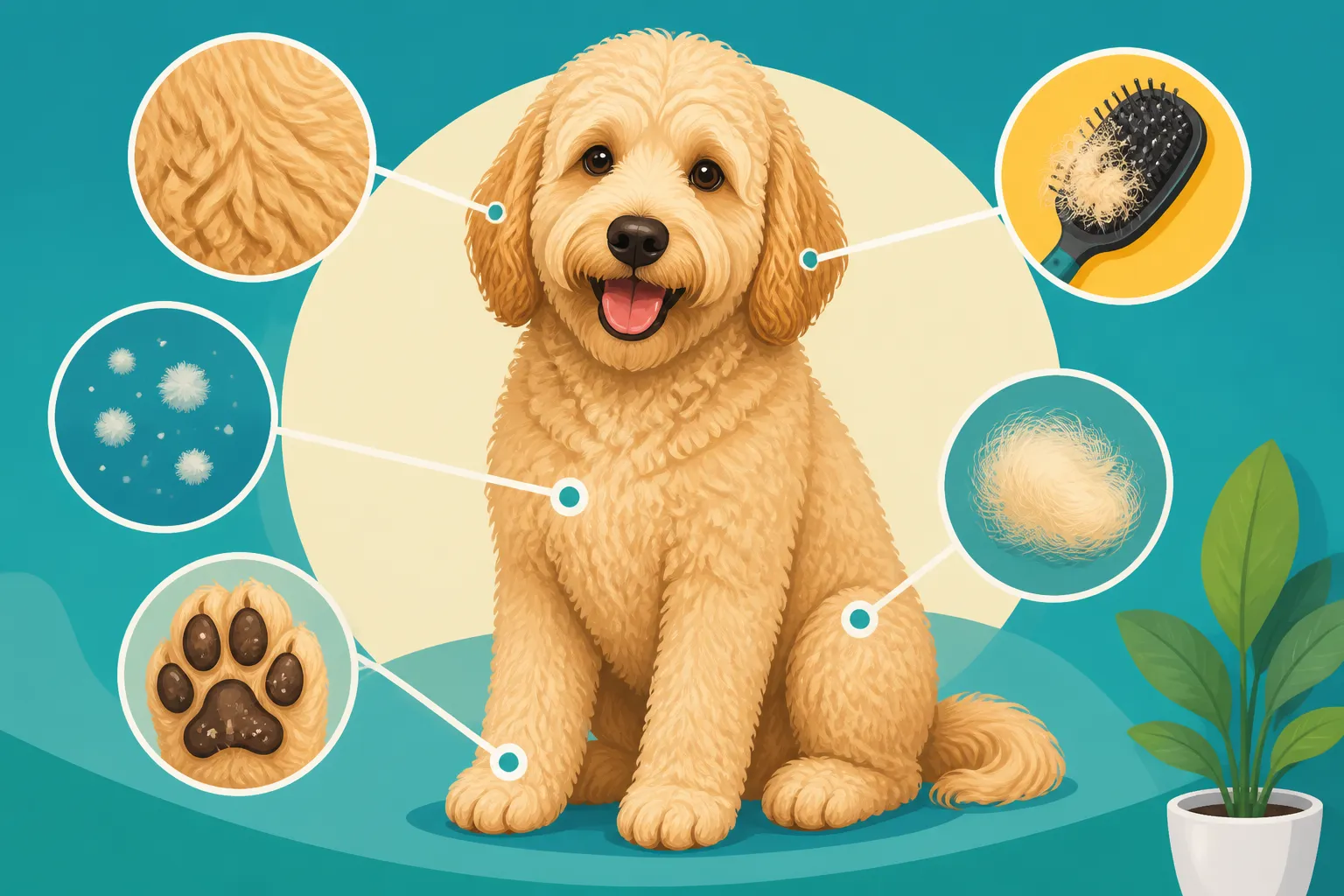
Can f 1 and Where a Goldendoodle Carries Allergens
It’s a heart-wrenching moment when you bring home that adorable Goldendoodle puppy, full of dreams of a furry, non-allergenic companion, only to find yourself or a family member still sniffling, itching, or worse. Many folks get a Goldendoodle specifically because they’ve been told they’re "hypoallergenic," and discovering that’s not quite true can feel like a real betrayal. This guide is here to shed light on the reality of dog allergies, focusing on the main allergen, Can f 1, and exactly where it hides on your beloved Goldendoodle, so you can manage expectations and create a more comfortable home for everyone.
Understanding Dog Allergies Beyond Just Shedding
The term "hypoallergenic" has been tossed around for years, especially concerning certain dog breeds and crossbreeds like the Goldendoodle. It’s a marketing dream, promising a sniffle-free existence with a furry friend. But the truth, as many allergy sufferers discover, is far more nuanced and often disappointing.
The Misconception of "Hypoallergenic" Dogs
One of the biggest misunderstandings out there is that if a dog doesn't shed much hair, it must be hypoallergenic. This makes perfect sense on the surface, right? Less hair floating around means fewer allergens. Unfortunately, it's not the hair itself that triggers allergic reactions in people; it's the microscopic proteins that cling to the hair, skin flakes, and saliva. So, while a Goldendoodle with a curly, Poodle-like coat might shed very little, it's still producing those pesky proteins. This is a crucial distinction to grasp, because it means simply choosing a low-shedding generation, like an F1b Goldendoodle, doesn't automatically solve the allergy problem. You can spend a lot of money on a "low-shedding" puppy and still find yourself reacting.
What is Can f 1? The Primary Culprit
When we talk about dog allergies, the main culprit we’re referring to is a protein called Can f 1. This isn't just some vague chemical; it's a specific glycoprotein produced by dogs. Can f 1 primarily originates in a dog's saliva, but it's also found in their urine and, crucially, in the sebaceous glands in their skin. Every dog, regardless of breed or coat type, produces Can f 1. When a dog grooms itself, its saliva, laden with this protein, transfers to its fur. As the saliva dries, and as the skin naturally sheds microscopic flakes (what we call dander), these allergen-carrying particles become airborne and settle on surfaces throughout your home. This is why even a dog that seems "clean" can still cause symptoms. Understanding Where a Goldendoodle's Allergens Actually Come From is key to effective management.
Other Dog Allergens at Play
While Can f 1 is the most common and potent dog allergen, it’s not the only one. Scientists have identified several other canine allergens, including Can f 2, Can f 3 (a serum albumin), Can f 4, Can f 5 (a prostate kallikrein found primarily in male dogs), and Can f 6. These other allergens can also trigger reactions, though they typically do so in a smaller percentage of the allergic population compared to Can f 1. The presence of these multiple allergens explains why some individuals might react to certain dogs but not others, even if both are considered "hypoallergenic." It's a complex interaction between the dog's unique biological output and the individual's specific immune system sensitivities. This also helps explain Why Some Allergy Sufferers Still React to a Goldendoodle.
Where Goldendoodles Carry Can f 1 and Other Allergens
It’s easy to assume that if a Goldendoodle has that lovely, curly coat, it must somehow magically filter out allergens or not produce them. But the reality is, their bodies function much like any other dog's, producing allergens in very specific places that then get distributed throughout their environment.
Saliva – The Constant Spreader
Think about how much a dog licks itself – after eating, after playing, just as part of regular grooming. Every single lick transfers saliva onto their fur. And, as we know, dog saliva is a rich source of Can f 1. Once that saliva dries on the coat, those tiny allergen particles become brittle and can easily flake off or float into the air. This happens whether your Goldendoodle has a shaggy, flat, or super curly coat. When your Goldendoodle gives you a happy slobbery kiss, or even just licks their paws or stretches out on your couch, they're depositing those allergens. This makes managing contact points crucial, as every surface they touch can become an allergen reservoir. Even just drinking from a communal water bowl can leave allergens behind.
Skin and Dander – The Invisible Dust
Just like humans, dogs continuously shed dead skin cells. These microscopic flakes, known as dander, are another significant carrier of Can f 1 and other allergens. Dander can be so fine that it remains suspended in the air for extended periods, making it easy to inhale. The texture of a Goldendoodle’s coat, whether it’s straight, wavy, or curly, doesn't stop their skin from producing dander. While a very tight, curly Poodle coat might trap more dander against the skin for a longer time compared to a shedding Golden Retriever, the dander is still there, being produced. Eventually, it will be released, often during brushing, petting, or when the dog shakes itself. This continuous production and dispersal of dander means that maintaining a truly allergen-free environment is incredibly challenging, if not impossible, for allergy sufferers sharing a home with a Goldendoodle.
Urine – An Overlooked Source
It’s not the most pleasant thought, but dog urine is another source of allergens, including Can f 1. While typically less of a concern for well-house-trained adult dogs, it can be a significant issue for puppies who are still learning the ropes or for older dogs experiencing incontinence. Accidents on carpets, furniture, or even outdoor spots where the dog frequently urinates, can leave behind concentrated patches of allergens. These allergens can then dry and become airborne, or be picked up on clothing or hands. For homes with an allergic person, it emphasizes the importance of immediate and thorough clean-up of any urine accidents, using enzyme cleaners designed to break down organic matter and remove lingering allergens effectively. You might find specialty cleaners on sites like Chewy that are formulated for pet stains and odors.
The Goldendoodle Coat as an Allergen Trap
Here’s where the Goldendoodle’s infamous coat actually plays a complex role. While many are drawn to Goldendoodles because they're told they "don't shed," implying less allergen dispersal, their coat structure can actually hold onto allergens more effectively. A thick, wavy, or curly coat, especially one with furnishings (that characteristic beard and eyebrows), can trap dander and saliva-laden hair deep within its layers. Instead of shedding frequently and dispersing allergens immediately, these coats can become reservoirs, holding a greater concentration of allergens closer to the dog’s body. When the dog is petted, brushed, or even just moves around, these trapped allergens can be released in a concentrated burst. This means that while you might not see as much hair on your furniture, the allergens are still present, sometimes in higher localized concentrations than you’d expect from a heavy-shedding dog that constantly releases its lower levels of dander.
Why Goldendoodle Coat Type Doesn't Guarantee Allergy Relief
The variability in Goldendoodle coats is one of their most charming, yet also most frustrating, characteristics when it comes to managing allergies. It’s not just about how much they shed; it’s about the very nature of allergen production.
The Variability of Goldendoodle Coats
One of the beautiful things about Goldendoodles is their incredible variety, which can also be a source of confusion. You can find Goldendoodles with coats ranging from flat and relatively smooth, like a Golden Retriever, to wavy, to tightly curled like a Poodle. This spectrum of coats is due to the complex genetics at play, especially in earlier generations like the F1 or F2. An F1 Goldendoodle, for example, is a 50/50 mix, and their coat can be highly unpredictable. Some might have a "furnished" coat with the beard and eyebrows, while others might be "unfurnished" with a smooth face. This genetic lottery means that even within the same litter, you can have puppies with vastly different coat textures and shedding tendencies. This unpredictability in coat type, discussed further in Why an F1 Goldendoodle Is the Least Predictable Healthwise, directly impacts how much dander and hair might be released, and how many allergens are trapped, making it impossible to guarantee a specific outcome for allergy sufferers based solely on generation.
Shedding vs. Allergen Production
This is a point worth reiterating again and again: shedding and allergen production are two entirely separate biological processes. Shedding refers to the physical loss of hair from the follicle. Allergen production, particularly Can f 1, is a biochemical process occurring in the salivary glands, skin (sebaceous glands), and urinary tract. A Goldendoodle, even one with a "non-shedding" Poodle-like coat, still has skin, still produces saliva, and still urinates. Therefore, it still produces allergens. The low-shedding aspect simply means less hair is visibly falling out and spreading around. It does not mean less allergen is being produced. In fact, as we discussed, those low-shedding coats might even hold onto allergens more effectively for a period, only to release them during grooming or intense activity. So, while Whether a Low-Shedding Goldendoodle Helps Allergies is a common question, the answer is often "not as much as you'd hope."
Individual Allergen Sensitivity
Perhaps the most challenging aspect of dog allergies is the highly individual nature of human immune responses. What triggers a severe reaction in one person might cause only mild irritation in another, or no reaction at all. An individual’s sensitivity level, the specific allergens they react to (Can f 1 being the most common, but not the only one), and the cumulative allergen load in their environment all play a role. Some people might react to any dog, regardless of breed or coat. Others might find they can tolerate a Poodle or a certain Goldendoodle, but not a Golden Retriever. This is why personal exposure is so critical. Relying on a blanket statement about a breed being "hypoallergenic" ignores the complex interplay between the dog's biology and the human's immune system.
Managing Allergens in a Goldendoodle Household
Living with a Goldendoodle when someone in the home has allergies is absolutely possible, but it requires a proactive, multi-pronged approach. It’s not about finding a magic bullet, but rather consistently reducing the allergen load in your environment.
Regular Grooming and Bathing
This is your first line of defense. Frequent grooming is essential to remove loose dander, saliva, and hair from your Goldendoodle’s coat before it has a chance to spread throughout your home. We're talking about brushing your Goldendoodle three to five times a week, if not daily, especially during the dreaded "coat change" around 8-12 months. Make sure you're Brushing a Goldendoodle Often Enough to Stop Matting as matting can trap even more allergens. Use a slicker brush and a good metal comb to get down to the skin and remove shed undercoat and dander.
Regular bathing, ideally weekly or bi-weekly, can also significantly reduce the allergen load. Use a veterinarian-recommended shampoo that suits your Goldendoodle's skin and coat, and ensure you rinse thoroughly to avoid skin irritation. You can find a good selection of specialized dog shampoos on Chewy. Doing this regularly, especially if the allergic person isn’t the one doing the grooming, can make a huge difference.
Environmental Controls at Home
Beyond grooming the dog, you need to groom your home. This means implementing strategies to minimize allergen accumulation in your living space:
- HEPA Filters: Invest in high-quality air purifiers with HEPA filters for rooms where your Goldendoodle spends the most time. Also, ensure your HVAC system has a good quality allergen filter (MERV 11 or higher) and change it frequently.
- Frequent Cleaning: Vacuum carpets and upholstered furniture regularly with a vacuum cleaner that has a HEPA filter. Damp mop hard floors to pick up settled allergens without kicking them back into the air. Washing bedding, including your Goldendoodle's bed, on a hot cycle weekly is also crucial.
- Restrict Access: Consider making certain areas of your home, like the allergic person's bedroom, a "dog-free zone." This creates a sanctuary where allergen levels can be kept significantly lower.
- Fabric Choices: Opt for hard flooring (wood, tile, laminate) over carpeting, and choose leather or synthetic furniture over upholstered fabrics, as these are easier to clean and don't trap allergens as readily.
Personal Care for Allergy Sufferers
For the person in the household with allergies, personal care is just as important as dog and home care.
- Hand Hygiene: Wash hands thoroughly with soap and water after petting or playing with your Goldendoodle. Avoid touching your face, especially your eyes and nose, until you’ve washed your hands.
- Clothing Changes: If you've had a lot of direct contact with your Goldendoodle, consider changing your clothes when you come inside or before settling down for the evening, especially before going into allergen-free zones.
- Medical Consultation: Work with an allergist. They can help identify specific triggers, recommend appropriate over-the-counter or prescription antihistamines, nasal sprays, or even discuss immunotherapy (allergy shots) which can desensitize you over time. Don't suffer in silence – there are medical interventions that can significantly improve quality of life.
Testing the Waters Before Committing
Before you bring a Goldendoodle puppy or adult dog into your home, especially if you have allergy concerns, it is absolutely vital to spend extended, direct time with the specific dog you’re considering, or at least one with a very similar coat type and genetic background. A brief visit to a breeder’s home for an hour isn't enough. Can you spend several hours, or even better, have a trial run for a day or two? See if you can visit the breeder's home and interact with the puppies and adult dogs there, or even fostering for a short period through a rescue might be an option. This hands-on experience is the best way to gauge your personal reaction. It’s an important step that can prevent a heartbreaking situation down the line, as discussed in Spending Time With a Goldendoodle Before Buying and Allergy Testing Before You Bring a Goldendoodle Home.
The Science Behind Allergen Levels and Goldendoodles
The conversation around Goldendoodles and allergies often veers into anecdotal evidence and hopeful wishes. However, science has provided some valuable insights into why that "hypoallergenic" label is, at best, misleading, and at worst, completely false.
Studies on "Hypoallergenic" Breeds
For years, it was widely believed that certain breeds, particularly those with Poodle-like coats, produced fewer allergens. However, scientific studies have challenged this notion. A landmark study in 2012, for instance, compared Can f 1 allergen levels in homes with various "hypoallergenic" breeds (including Poodles, Portuguese Water Dogs, and Airedale Terriers) to homes with other breeds. The findings were quite eye-opening: there was no significant difference in the concentration of Can f 1 allergen between homes with "hypoallergenic" breeds and those with so-called "non-hypoallergenic" breeds. This study, and others like it, underscore the point that allergen production isn't solely tied to shedding or coat type. This is why The 2012 Study That Undercut the Goldendoodle Claim was such a pivotal moment in the discussion.
Comparing Goldendoodle Allergen Levels to Parent Breeds
Given that Goldendoodles are a cross between a Golden Retriever and a Poodle, it's natural to wonder if their allergen levels fall somewhere in between, or if they inherit the "low allergen" qualities some mistakenly attribute to Poodles. Since Poodles themselves don't inherently produce less Can f 1, a Goldendoodle's allergen production is largely unpredictable. It can vary wildly from one Goldendoodle to another, even within the same litter, much like their coat types do. A Goldendoodle might inherit more of the Golden Retriever's skin characteristics, leading to higher dander production, or more of the Poodle's, without necessarily reducing allergen protein levels. The genetic blend is simply too varied to make reliable predictions about individual allergen output. What a Goldendoodle does What a Goldendoodle Inherits From the Poodle in terms of coat or other traits doesn't equate to allergen levels.
Why an F1b Might Not Be the "Magic Bullet"
Many breeders and buyers alike pin their hopes on the F1b Goldendoodle (first-generation backcross), which is typically 75% Poodle and 25% Golden Retriever. The logic is that with more Poodle genetics, these dogs will shed even less and thus be "more hypoallergenic." While an F1b is indeed more likely to have a very curly, low-shedding coat, this still doesn't guarantee a lower level of Can f 1 production or a reduced allergic reaction. As discussed, every dog produces allergens. The increased Poodle percentage primarily influences coat texture and shedding, which might mean fewer visible hairs around the house, but it doesn't change the underlying biological mechanisms of allergen protein creation in saliva and skin. Therefore, even an F1b Goldendoodle cannot be considered a "magic bullet" for allergy sufferers. The focus should always be on careful management and direct exposure testing, rather than relying on generational claims.
Allergen Sources & Mitigation Strategies
To give you a clearer picture, here's a table summarizing the main allergen sources in a Goldendoodle and the practical steps you can take to mitigate their impact in your home.
| Allergen Source | Description | Mitigation Strategy |
|---|---|---|
| Saliva (Can f 1) | Secreted by salivary glands; transferred to coat during grooming, licking, and direct contact. | Frequent Bathing: Bathe your Goldendoodle weekly or bi-weekly with appropriate shampoo. Limit Licking: Discourage face licking. Clean Water Bowls: Wash bowls daily to remove saliva residue. Hand Washing: Always wash hands after petting your dog. |
| Dander (Can f 1) | Microscopic skin flakes shed by all dogs; contains allergen proteins. | Regular Brushing: Brush 3-5 times a week (daily if possible) with a slicker brush and comb to remove loose dander. HEPA Filtration: Use air purifiers and high-MERV HVAC filters. Vacuuming & Mopping: Clean floors and furniture frequently with a HEPA vacuum and damp mop. Restrict Access: Keep dog out of bedrooms. |
| Urine (Can f 1) | Allergen proteins present in urine, especially if accidents occur indoors. | Thorough House Training: Ensure complete house training. Immediate Cleanup: Use enzymatic cleaners for any accidents on carpets or upholstery. Outdoor Management: Consider designated outdoor potty spots. |
| Coat/Hair (Carrier) | While not the allergen itself, the coat traps dander and dried saliva, acting as a reservoir. | Professional Grooming: Schedule grooms every 6-8 weeks for proper cleaning and trimming. Home Grooming: Maintain regular brushing and bathing routines. Detangler Spray: Use a detangler to prevent mats which can trap more allergens. You can find these on Chewy. |
| Environment | Allergen particles settle on furniture, bedding, clothing, and other surfaces, becoming airborne when disturbed. | Wash Bedding: Wash dog and human bedding frequently in hot water. Non-Porous Surfaces: Opt for hard flooring and leather/vinyl furniture over carpets and fabric. Air Purifiers: Place in high-traffic areas. Dedicated Dog Gear: Use washable covers for beds and crates. |
Disclaimer
This article is for general informational purposes only and does not constitute professional advice. Laws, prices and regulations vary by location and change over time. Consult a qualified professional for guidance on your specific situation.