Reading a Goldendoodle Parent’s OFA Record
When you’re dreaming of bringing home a fluffy Goldendoodle puppy, it's easy to get caught up in the adorable pictures and charming personalities. But beneath all that cuteness lies a crucial responsibility: understanding the health background of your prospective puppy's parents. Many families feel overwhelmed trying to make sense of all the jargon, especially when it comes to health clearances like those from the Orthopedic Foundation for Animals (OFA). This guide is designed to cut through the confusion and help you confidently read and understand a Goldendoodle parent's OFA record, empowering you to make the best decision for your future furry family member.
Why OFA Health Testing Matters for Goldendoodle Parents
It’s a common misconception that simply because Goldendoodles are a "hybrid" or "designer" breed, they are inherently healthier than their purebred parents. This idea, often linked to a term called "hybrid vigor," is something many prospective owners cling to, hoping it means they can bypass the deep dive into health testing. However, the reality is far more nuanced, and neglecting to scrutinize the health records of the parent dogs can lead to significant heartaches and financial burdens down the line.
Understanding the "Hybrid Vigor" Misconception
The term "hybrid vigor" suggests that the offspring of two distinct breeds will be healthier and more robust than either parent. While there's a kernel of truth to the general concept in some crossbreeding scenarios, it's frequently misunderstood and misapplied to Goldendoodles. The truth is, Goldendoodles can and do inherit genetic diseases from both the Golden Retriever and Poodle sides of their family tree. If both parents carry a predisposition for the same genetic condition, or if they both carry a recessive gene for a specific disease, their Goldendoodle puppies can absolutely be affected.
A Goldendoodle doesn't suddenly develop an immunity to hip dysplasia or progressive retinal atrophy just because it's a crossbreed. Instead, it gets a mix of genes from two distinct purebred lines, each with its own set of potential genetic vulnerabilities. This is precisely why careful health testing of both parent breeds is not just recommended, but absolutely essential. Without it, you're essentially playing genetic roulette, hoping for the best but without any informed assurance. You'll find more insights into this in our article on why testing beats the word hybrid on a Goldendoodle.
Common Genetic Conditions in Golden Retrievers and Poodles
Both Golden Retrievers and Poodles, wonderful breeds as they are, come with their own genetic predispositions to certain health issues. When you cross them, these predispositions don't disappear; they combine. The Orthopedic Foundation for Animals (OFA) focuses heavily on orthopedic and certain cardiac and eye conditions because these are prevalent and often debilitating in many large and medium breeds.
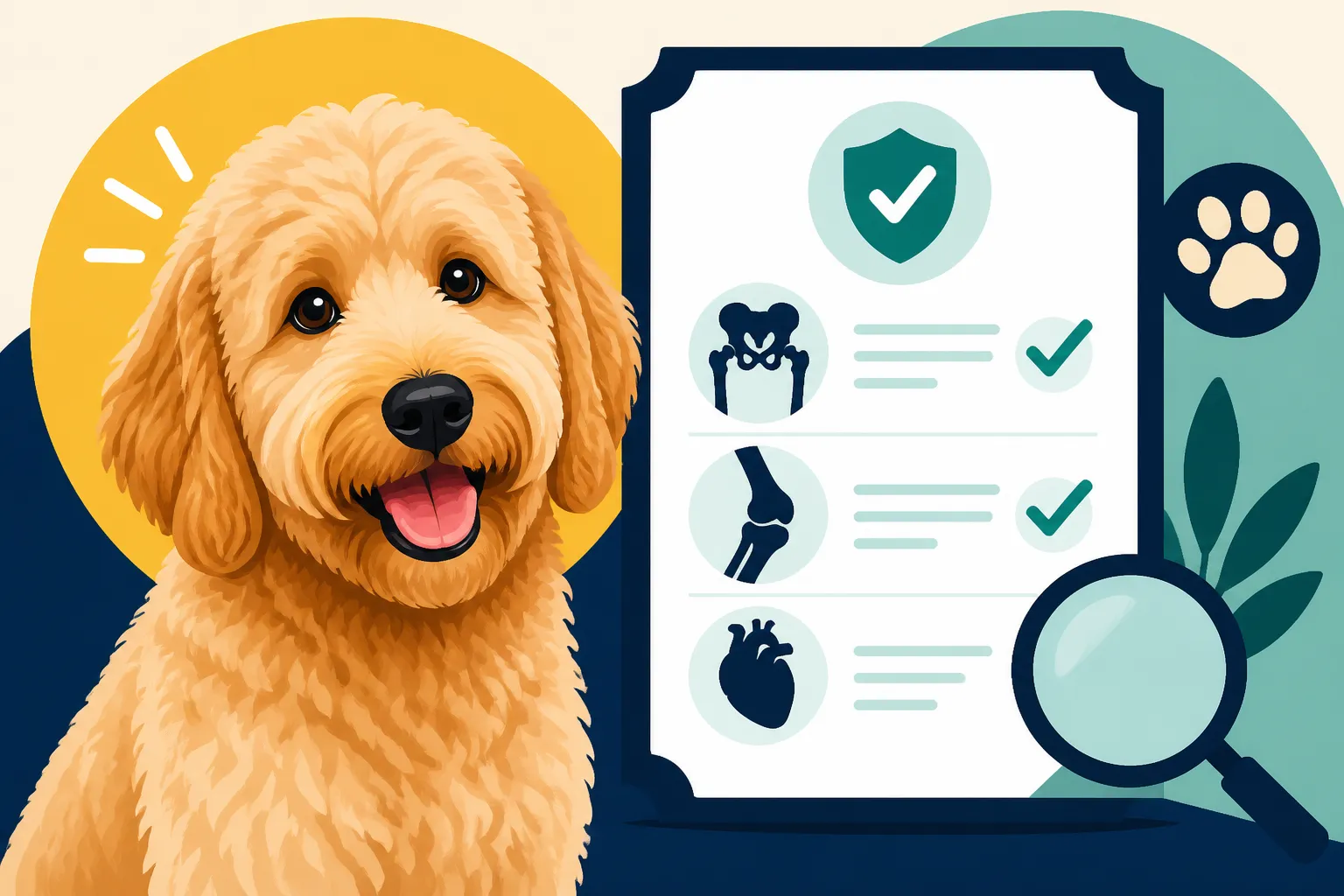
For Goldendoodle parents, the primary concerns that OFA clearances address typically include:
- Hip Dysplasia: A malformation of the hip joint that can lead to arthritis and lameness. It's notoriously common in Golden Retrievers and can also affect Poodles, particularly the Standard Poodle. The severity can range from mild discomfort to severe, crippling pain.
- Elbow Dysplasia: Similar to hip dysplasia, this involves abnormal development of the elbow joint, leading to pain and arthritis. Both parent breeds can contribute to this condition.
- Eye Conditions: Issues like Progressive Retinal Atrophy (PRA) are a serious concern. While PRA is often tested via DNA panels, OFA's companion eye certification (CAER/CERF) looks for other inherited eye diseases that might not be on a typical DNA panel.
- Cardiac Disease: Certain heart conditions, such as Subvalvular Aortic Stenosis (SAS), are known to affect Golden Retrievers. While Poodles generally have fewer significant cardiac issues compared to some breeds, testing ensures a sound heart.
Understanding these inherited risks means recognizing that a Goldendoodle puppy, regardless of how cute it is, carries the genetic blueprint from both parents. Therefore, a breeder who doesn't perform comprehensive health testing, including OFA, is essentially rolling the dice with your puppy's future health.
Deciphering the Orthopedic Foundation for Animals (OFA) Database
The Orthopedic Foundation for Animals (OFA) is a not-for-profit organization dedicated to improving the health and well-being of companion animals through health testing and education. Their open-access database is an invaluable tool for prospective puppy buyers to verify the health clearances of parent dogs. It's where responsible breeders register their dogs' results for conditions like hip and elbow dysplasia, patellar luxation, and cardiac health.
Navigating the OFA Public Database
The OFA website is straightforward to use once you know what you're looking for. You can search for a dog using its full registered name or its OFA registration number, which a reputable breeder should readily provide.
Here’s what you typically find when you look up a dog:
- Registered Name: The official name of the dog as registered with a kennel club (e.g., AKC for Golden Retrievers and Poodles).
- Breed: Will indicate Golden Retriever or Poodle. Remember, OFA doesn't register Goldendoodles directly as a breed, so you're looking for the purebred parents.
- Sex: Male or female.
- Birth Date: Crucial for verifying the dog's age at the time of testing, as some tests have minimum age requirements.
- Test Dates: The dates when specific health examinations were performed.
- Results: The official clearance or evaluation for each tested condition.
It’s absolutely vital to look up the actual parents of the specific Goldendoodle litter you're interested in. Don't just take a breeder's word for it. A responsible breeder will be transparent and encourage you to verify everything. This due diligence ensures that the claims about "health tested parents" aren't just empty promises.
Understanding Specific OFA Clearances
Each OFA clearance comes with specific terminology and grading. Knowing what these mean is key to understanding the risk level for your potential puppy.
Hip Dysplasia Results
Hip dysplasia is a significant concern for Goldendoodles, with figures like Goldendoodle hip dysplasia at 15 to 20 percent being reported. OFA evaluates hip joint conformation and assigns a rating. For breeding, only dogs with hips rated Fair, Good, or Excellent are considered suitable.
| OFA Hip Grade | Description | Suitability for Breeding (OFA Recommendation) |
|---|---|---|
| Excellent | Superior hip conformation with a deep seated femoral head and a tight fit into the acetabulum (hip socket). | Recommended |
| Good | Well-formed hip joint with significant congruity and a good fit. | Recommended |
| Fair | Minor irregularities in hip joint conformation, but still within normal limits. | Recommended |
| Borderline | Marginally dysplastic; not definitively dysplastic or normal. Re-evaluation may be recommended. | Not Recommended |
| Mild | Evidence of hip dysplasia, with slight subluxation of the femoral head and minor secondary changes. | Not Recommended |
| Moderate | Significant evidence of hip dysplasia, with noticeable subluxation and secondary changes. | Not Recommended |
| Severe | Marked evidence of hip dysplasia, with a shallow acetabulum, malformed femoral head, and significant secondary changes. | Not Recommended |
When you see a parent with a "Fair," "Good," or "Excellent" rating, it means their hips meet the minimum standard for breeding according to OFA. Anything below "Fair" should be a red flag. It's also worth noting that some breeders use PennHIP alongside or instead of OFA. PennHIP offers a different, quantitative measure of hip laxity, often providing earlier and potentially more accurate risk assessment. For more detailed information, consider our article comparing PennHIP against OFA for a Goldendoodle.
Elbow Dysplasia Results
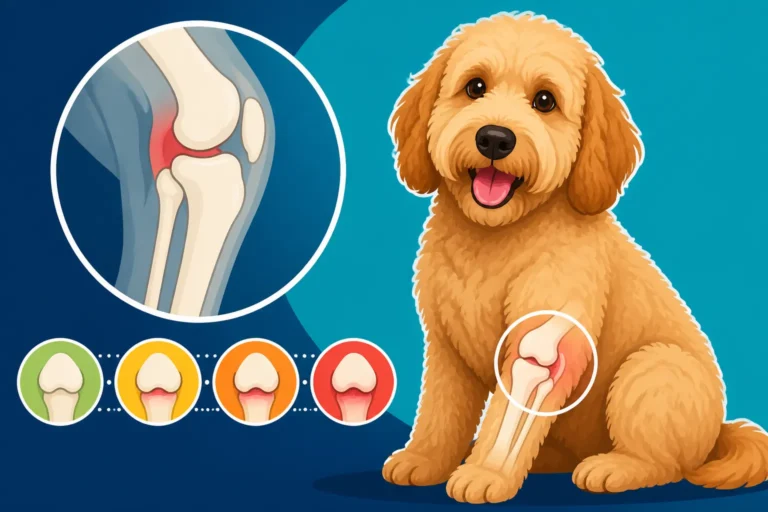
Elbow dysplasia is another painful and potentially crippling condition that can affect Goldendoodles. The OFA provides a simple grading system for elbows.
- Normal (Grade 0): This is the ideal result, indicating no evidence of elbow dysplasia. Only dogs with normal elbows should be bred.
- Grade I (Mild): Minimal changes, indicating early elbow dysplasia.
- Grade II (Moderate): More significant changes.
- Grade III (Severe): Extensive changes, indicating severe elbow dysplasia.
If you see anything other than "Normal" (Grade 0) for a Goldendoodle parent's elbows, it should be a deal-breaker. Breeding dogs with any grade of elbow dysplasia is irresponsible, as it dramatically increases the likelihood of Goldendoodle elbow dysplasia from both parent breeds in their offspring.
Eye Certification (CAER/CERF)
The Companion Animal Eye Registry (CAER), formerly known as CERF, involves an annual eye exam performed by a board-certified veterinary ophthalmologist. This is a visual inspection to screen for a variety of inherited eye diseases, not just those detectable by DNA tests.
It's critical to remember that CAER certifications are only valid for 12 months from the date of examination. This means a breeding dog needs to be examined every year to maintain its certification. A breeder should be able to provide documentation of a current, clear eye exam for both parents. Conditions like Progressive Retinal Atrophy (PRA) are a particular concern for Goldendoodles, and while there are DNA tests, the CAER exam covers other possibilities. You can learn more about this in our guide on progressive retinal atrophy and the Goldendoodle eye test.
Cardiac Heart Clearances
Cardiac health is another important OFA screening area. There are two levels of cardiac clearance:
- Practitioner Exam: A general veterinarian performs a physical exam, including auscultation (listening with a stethoscope) for murmurs. A "normal" result here is a basic screening.
- Cardiologist Exam: A board-certified veterinary cardiologist performs the exam, often including an echocardiogram (ultrasound of the heart) to thoroughly assess heart structure and function.
For breeding animals, especially in breeds known for heart issues like Golden Retrievers (which can pass on heart defects), a cardiologist exam is highly recommended for a more definitive clearance. This helps rule out conditions such as Subvalvular Aortic Stenosis, which can be devastating. Our article on the heart defect a Goldendoodle gets from the Golden line offers more context.
Patellar Luxation Kneecaps
While more common in smaller breeds, patellar luxation (slipping kneecaps) can affect Poodles, particularly Mini and Toy Poodles, and therefore Mini and Toy Goldendoodles. OFA provides a rating based on a physical examination:
- Normal: No evidence of patellar luxation.
- Grade 1-4: Indicates increasing severity of luxation.
For breeding, only dogs with normal patellas should be used to minimize the risk in puppies. This is especially pertinent if you're looking at a smaller Goldendoodle variety, as patellar luxation in a Mini Goldendoodle can be a significant issue.
What a "Cleared" Goldendoodle Parent Really Means
It's easy to see "OFA Cleared" on a breeder's website and assume that's the end of the story. However, understanding what these clearances truly represent, and their limitations, is vital for a truly informed decision. It's not just about seeing the word "clear"; it's about understanding the depth of that clearance.
Interpreting "Clear by Parentage" vs. Direct Testing
One phrase you might encounter, particularly with genetic diseases that have DNA tests (like some forms of PRA or Von Willebrand's disease), is "clear by parentage." This means that if a dog's parents were both tested and found to be clear of a specific genetic disease, that dog is presumed to be clear, because it inherited two healthy genes.
While this can be acceptable for some conditions, especially when breeding F1 Goldendoodles from fully tested purebred parents, it's generally not a substitute for direct testing of the individual dog. This is especially true as you move into F2 or multigen Goldendoodles, where the genetic lines become more complex. Direct DNA testing confirms the status for that specific dog, leaving no room for error or undocumented parental lineage. For orthopedic issues like hips and elbows, "clear by parentage" is absolutely never an acceptable substitute for direct OFA x-rays and evaluations. Each dog needs its own OFA clearances.
The Limitations of OFA and Ongoing Health Considerations
While OFA clearances are incredibly valuable, they are not an exhaustive list of every possible health problem a Goldendoodle might face. OFA primarily focuses on conditions with a strong genetic component that can be diagnosed through imaging or physical examination at a certain age.
Here's what OFA generally doesn't cover, but are still crucial for Goldendoodle health:
- Other Genetic Diseases: Many diseases, like Addison's Disease (which a Goldendoodle gets from the Poodle), Von Willebrand Disease, or certain thyroid conditions, are diagnosed via specific blood tests or DNA panels. This is where a comprehensive DNA panel a Goldendoodle breeder should run comes into play, providing a much broader look at potential genetic predispositions.
- Cancer Risks: Golden Retrievers, in particular, have a higher incidence of certain cancers. While OFA doesn't test for cancer susceptibility, a responsible breeder will be transparent about the longevity and health history of their breeding lines regarding cancer. You can delve into the cancer risk a Goldendoodle carries from the Golden side for more information.
- Environmental Factors: OFA clearances only speak to genetic predispositions. A dog's health can also be impacted by nutrition, exercise, environment, and unforeseen accidents.
It's also important to remember that OFA clearances are a snapshot in time. For hips and elbows, results are generally considered permanent after the final evaluation (usually at 24 months of age). However, eye certifications (CAER) need to be renewed annually. A responsible breeder goes beyond just obtaining clearances; they are committed to ongoing health monitoring, excellent care for their breeding dogs, and open communication with puppy buyers about the health history of their lines.
Practical Steps for Goldendoodle Puppy Buyers
Navigating the world of Goldendoodle breeders can feel like a minefield, especially with varying standards and a lack of official breed registration. However, being proactive and well-informed about health testing, particularly OFA records, will significantly increase your chances of finding a healthy puppy from an ethical breeder.
Asking the Right Questions to Goldendoodle Breeders
When you connect with a breeder, don't be shy about asking direct and specific questions about their health testing protocols. A good breeder will welcome your questions and be eager to share detailed information. They understand that you're investing in a family member and deserve full transparency.
Here are some critical questions to ask, specifically regarding OFA records:
- "Can you provide the full registered names and OFA numbers for both the sire (father) and dam (mother) of this litter?" (Insist on both registered names and OFA numbers to verify yourself).
- "What were the OFA hip and elbow scores for both parents?" (Listen for "Fair," "Good," or "Excellent" for hips and "Normal" for elbows.)
- "When were the parents' eyes last certified by a veterinary ophthalmologist, and can I see the current CAER paperwork?" (Remember, these are annual and must be current.)
- "Have the parents had their hearts screened by a board-certified veterinary cardiologist, and can I see the OFA cardiology reports?"
- "Beyond OFA, what other genetic health tests have you performed on the parents (e.g., DNA panels for PRA, Von Willebrand's, etc.)?"
- "At what age were the parents tested for hips and elbows?" (OFA hip and elbow clearances are considered final only after 24 months of age. Preliminary clearances can be done earlier but are not final.)
Once you have the OFA numbers and registered names, take the time to visit the OFA website and search for those specific dogs. Verify that the results match what the breeder told you and that the clearances are indeed "clear" or within acceptable breeding ranges. This simple step is one of the most powerful tools you have as a prospective puppy owner. You also need to ask about what health papers a Goldendoodle breeder should show, as this goes beyond just OFA.
Ensuring Your Puppy's Future Health
Even with the most rigorous health testing by a responsible breeder, genetics are complex, and no guarantee is 100% foolproof. A health guarantee in your puppy contract is a crucial safety net. This usually outlines what happens if your puppy develops certain genetic health conditions within a specified timeframe, often up to two years. Read it carefully and understand its terms.
Beyond the initial purchase, planning for your Goldendoodle's long-term health is paramount. Pet insurance can be an invaluable resource for unforeseen circumstances, from ear infections (a common Goldendoodle ailment) to major surgeries for conditions like hip dysplasia. Providers like Healthy Paws offer comprehensive coverage that can help mitigate the financial impact of veterinary emergencies or chronic illnesses, allowing you to focus on your dog's recovery rather than the bill. Even if your Goldendoodle comes from impeccably tested parents, life happens, and having Goldendoodle pet insurance for a dog with no breed papers can provide peace of mind.
Regular veterinary check-ups throughout your Goldendoodle's life, appropriate nutrition, and maintaining a healthy weight are also critical components of lifelong health. These proactive measures, combined with the assurance of parents with verifiable OFA clearances, set the stage for your Goldendoodle to live a long, happy, and healthy life. Understanding Goldendoodle joint health by size category will also help you manage their exercise and development effectively.
Disclaimer
This article is for general informational purposes only and does not constitute professional advice. Laws, prices and regulations vary by location and change over time. Consult a qualified professional for guidance on your specific situation.