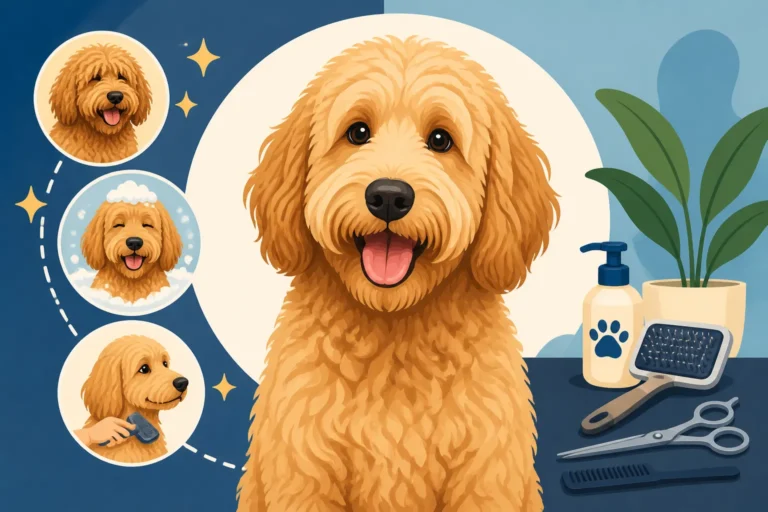
Whether an F1 Goldendoodle Grooms Cheaper Than an F1b
One of the biggest concerns for new Goldendoodle owners, beyond the initial puppy price tag, is the ongoing cost of grooming. Many of you hear about the differences between F1 and F1b generations and wonder if one might save you a few dollars at the salon. It’s a completely valid question, especially when you consider that grooming can quickly become the biggest line item in your Goldendoodle’s annual budget. This guide will break down the nuances of F1 and F1b Goldendoodle coats and explain how each might impact your grooming expenses, helping you understand where your money really goes.
Decoding Goldendoodle Generations and Their Coats
When you’re looking at Goldendoodles, you'll inevitably encounter terms like F1 and F1b. These aren't just fancy labels; they actually tell you a lot about your dog's genetic makeup and, consequently, its potential coat type. And when it comes to grooming, coat type is king.
What Defines an F1 Goldendoodle?
An F1 Goldendoodle is a first-generation cross, meaning it’s a direct result of breeding a purebred Golden Retriever with a purebred Standard Poodle. This 50/50 split gives you a wonderful mix of traits from both parent breeds, but it also introduces a fair bit of genetic lottery when it comes to the coat. You might get a puppy with a relatively straight, shaggy coat that more closely resembles a Golden Retriever, or one with a wavy, almost curly fleece coat leaning more towards the Poodle side.
Because of this inherent variability, predicting the exact coat an F1 Goldendoodle will have can be tricky. Even within the same litter, you might see puppies with vastly different coat textures. Some will have the classic "furnished" look with eyebrows and a beard, while others might have a smoother face, sometimes referred to as an "unfurnished" or "flat coat." This wide spectrum means that while some F1s might be relatively low-maintenance in terms of matting, others can surprise you with a dense, wavy coat that loves to tangle.
What Defines an F1b Goldendoodle?
An F1b Goldendoodle, on the other hand, is a backcross. This means an F1 Goldendoodle is bred back to one of the parent breeds, almost always a purebred Poodle. This results in a Goldendoodle that is roughly 75% Poodle and 25% Golden Retriever. The purpose of this backcross is often to increase the likelihood of a more Poodle-like coat: very curly, very dense, and typically low-shedding.
Many people seek out F1b Goldendoodles specifically because they are perceived as more "hypoallergenic" due to their increased Poodle genetics. This higher percentage of Poodle DNA usually translates to a coat that is consistently curlier and thicker than many F1 coats. While this can be a blessing for allergy sufferers, it often comes with a trade-off: a coat that requires more diligent and specialized grooming to prevent matting and keep it healthy. This generation typically displays the strong "furnished" traits, guaranteeing the characteristic Goldendoodle beard and eyebrows.
The Spectrum of Goldendoodle Coat Types
Beyond just F1 and F1b, Goldendoodle coats generally fall into three categories:
- Straight/Flat Coat: This is rarer, often seen in F1s, and looks much like a Golden Retriever's coat. It sheds more than other Goldendoodle coats but is often the easiest to groom as it's less prone to matting. However, it’s not what most people expect from a Goldendoodle, and it’s certainly not "hypoallergenic."
- Wavy/Fleece Coat: This is the most common and highly sought-after Goldendoodle coat. It's soft, shaggy, and tends to shed minimally. Both F1 and F1b generations can have wavy coats, though F1bs generally have a tighter wave, almost a loose curl. This coat type requires regular brushing to prevent mats, especially in high-friction areas.
- Curly/Wool Coat: This coat is very dense and tightly curled, much like a Poodle's. It's most commonly found in F1b and subsequent generations with a higher Poodle percentage. This coat type is considered the most "hypoallergenic" but is also the most demanding to maintain. Without daily brushing, it will mat quickly and severely.
Understanding The Three Goldendoodle Coat Types and How to Tell Them is crucial because the "F-number" is less important than the actual coat growing on your dog.
What Really Drives Goldendoodle Grooming Costs
You might think that the generation (F1 vs. F1b) is the primary factor in grooming costs, but it's actually a combination of several critical elements that determine your bill. These factors influence how much time and effort your groomer needs to put in, and therefore, how much they charge.
Coat Texture and Density
This is arguably the single most important factor. A Goldendoodle with a dense, woolly, or tightly curled coat will always be more expensive to groom than one with a sparser, straighter coat. Why? Because it simply takes more time and specialized skill to work through. Each strand of hair in a curly coat acts like a tiny spring, interlocking with others, making it prone to tangling and matting. Groomers often need to use specific tools, like high-velocity dryers and a variety of brushes and combs, to properly detangle and dry these coats. This is especially true for F1b Goldendoodles, whose coats are typically denser and curlier thanks to their stronger Poodle genetics.
Imagine trying to brush out a head of very fine, straight hair compared to a head of thick, curly hair; the latter takes significantly more effort and time. The same principle applies to your Goldendoodle. A groomer might spend an extra 30-60 minutes on a curly-coated dog just on the bathing and drying process alone to ensure every layer of hair is thoroughly clean and dry, which is essential for proper scissoring and clipping later.
Matting Potential
Matting is the bane of every Goldendoodle owner's existence and the biggest reason for increased grooming costs. Goldendoodle coats, particularly the wavy and curly types, are highly susceptible to matting. Mats are tangles that become tight knots, pulling on the skin and causing discomfort, pain, and even skin infections. They can form anywhere, but common culprits are behind the ears, in the armpits, under the collar, and on the legs and tail. For more insights, you might want to read Why Goldendoodle Matting Is Almost Always Preventable.
When a dog comes in with mats, groomers have two options: painstakingly demat them, which is time-consuming, painful for the dog, and often carries a significant dematting surcharge, or shave them off. Shaving a matted dog is often the most humane option, but it also takes specialized skill and care to avoid "clipper burn" or cutting the dog's skin, which is often thin and loose under a mat. Either way, dealing with mats adds considerable time and cost to your grooming bill. A well-maintained coat, free of mats, is always cheaper to groom because the groomer can proceed directly to bathing, drying, and styling without obstacles.
Groomer Time and Skill
Ultimately, grooming costs are heavily influenced by the groomer's hourly rate and the total time spent on your dog. A Goldendoodle, regardless of generation, is not a quick groom. Their coats require thorough washing, careful drying to prevent mats, and precise scissoring or clipping to achieve the desired style.
A groomer who specializes in Goldendoodles and other "doodle" breeds will understand the nuances of their coats and how to best manage them. This expertise comes at a price. If your dog takes longer to groom due to its coat type, matting, or even its temperament (an anxious or wiggly dog takes more time and patience), your bill will reflect that extra time. This is why you'll find that Goldendoodle Grooming as the Biggest Line in the Budget isn't just a saying – it's a reality for many owners.
Size of the Goldendoodle
This factor is often overlooked when discussing generation, but it's significant. A standard Goldendoodle, whether F1 or F1b, will almost always cost more to groom than a mini or toy Goldendoodle. More dog simply means more coat to wash, dry, brush, and cut.
The sheer volume of hair on a large Goldendoodle can add another hour or more to the grooming process compared to a smaller dog, even if their coat texture is similar. Groomers often have tiered pricing based on breed size and weight, so a 70-pound F1 Goldendoodle with a relatively flat coat might still cost more than a 25-pound F1b with a very curly coat, simply because of the dog's overall mass. Make sure to consider Goldendoodle Joint Health by Size Category when choosing the size of your Goldendoodle, as bigger dogs can have more orthopedic issues that might impact grooming comfort as they age.
Comparing F1 and F1b Grooming Costs in Practice
So, with all these variables at play, how does the F1 versus F1b distinction actually shake out in terms of your grooming bill? It's less about a hard-and-fast rule and more about probabilities and individual coat characteristics.
The F1 Goldendoodle's Varied Grooming Bill
An F1 Goldendoodle's grooming costs are highly unpredictable because their coats are highly unpredictable. If you get an F1 with a genuinely flat or mildly wavy coat, resembling more of its Golden Retriever parent, you might indeed find its grooming to be less expensive. These coats tend to mat less severely and are generally quicker for a groomer to work through. You might get away with professional grooms every 8-10 weeks instead of every 6, and brushing at home might be a 15-minute affair a few times a week rather than a daily commitment.
However, an F1 Goldendoodle can just as easily inherit a dense, wavy coat that is very similar to what you’d expect from an F1b. In these cases, your grooming costs will be on par with, or even exceed, those of an F1b. There’s simply no guarantee with an F1 that you’ll hit the "easy groom" lottery. That initial excitement of bringing home an F1 Goldendoodle can sometimes turn into frustration when you realize just how much care that plush coat truly demands. This is also why Why an F1 Goldendoodle Is the Least Predictable Healthwise is a valid concern for more than just health issues—it extends to coat care, too.
The F1b Goldendoodle's Generally Higher Grooming Needs
Because F1b Goldendoodles have more Poodle genetics, they typically present with curlier, denser coats. This type of coat is phenomenal for minimizing shedding and can be a godsend for individuals with mild dog allergies. However, this same coat characteristic means higher grooming demands. These curls love to intertwine, forming mats quickly if not brushed regularly and correctly.
Most F1b Goldendoodles will require professional grooming appointments every 4-6 weeks to keep their coats in check. Missing an appointment or neglecting daily brushing for even a week can lead to severe matting, which then incurs those dreaded dematting surcharges. While the cost per session might be similar to a curly-coated F1, the frequency of necessary appointments often means the annual grooming cost for an F1b averages out to be higher. You're paying for the consistency of that low-shedding, curly coat, which translates directly into more intensive maintenance. Many owners realize that A Goldendoodle Grooming Year at Ninety Dollars a Visit (or more!) truly adds up.
When an F1 Might Be Cheaper to Groom
The best-case scenario for an F1 Goldendoodle owner hoping for lower grooming costs is to have a dog with a flat or very loosely wavy coat. If your F1 Goldendoodle has minimal furnishings (less beard, less hair around the eyes) and a relatively smooth body coat, it will naturally collect fewer tangles and be easier to brush. This type of coat might allow for longer stretches between professional grooms, maybe 8 weeks instead of 6, and home brushing might be less intensive.
It's this specific coat type within the F1 spectrum that could lead to a cheaper grooming experience. However, it's important to remember that this isn't a guaranteed outcome for all F1s. Many F1s still develop lush, wavy coats that require significant attention.
When an F1b Might Not Be Dramatically More Expensive
While F1bs generally have higher grooming needs, a well-maintained F1b might not incur dramatically higher costs than a well-maintained F1 with a similar wavy coat. The key here is proactive care. If you are extremely diligent with daily line brushing, using high-quality grooming tools from places like Chewy, and keeping up with your professional grooming schedule, you can prevent matting.
Preventing mats is where the real savings happen, regardless of generation. If your groomer can work efficiently without spending extra time dematting, your bill will be lower. So, an F1b whose owner dedicates time to home grooming will still cost a fair bit, but it won't be as astronomical as an F1b (or F1, for that matter) that comes in severely matted. The focus should always be on maintaining the coat's health, rather than simply relying on the generation.
The True Cost-Saving Strategy: Diligent Home Grooming
No matter if you have an F1 or an F1b Goldendoodle, the most impactful way to control grooming costs and ensure your dog's comfort is consistent, diligent home grooming. This isn't just about saving money; it's about building a bond with your dog and keeping their coat healthy between professional appointments.
Investing in the Right Tools
You can't effectively groom a Goldendoodle without the proper equipment. This is where a small initial investment pays off hugely in the long run. You'll need:
- Slicker Brush: Essential for removing loose hair and small tangles. Look for one with fine, sturdy pins.
- Metal Comb: A good quality, stainless steel comb with both wide and fine teeth is crucial for finding and working out mats, especially in areas like behind the ears or in the armpits.
- Detangler Spray: This helps tremendously when brushing through tangles and mats, making the process less painful for your dog.
- Nail Clippers or Grinder: Keeping nails trimmed prevents discomfort and helps maintain good paw health.
- Ear Cleaner: Goldendoodles are prone to ear infections due to their floppy, furnished ears. Regular cleaning is vital. Read more about Cleaning a Goldendoodle Ear Before It Gets Infected.
- High-Quality Shampoo and Conditioner: Products designed for curly or long coats will make bathing and brushing easier.
You can find all these essentials readily available online at retailers like Chewy, ensuring you have the right arsenal to tackle that beautiful Goldendoodle coat.
Establishing a Consistent Routine
Consistency is absolutely key. Goldendoodles, especially those with wavy or curly coats, need to be brushed several times a week, if not daily, depending on their coat type and length. A quick once-over isn't enough; you need to engage in what's called "line brushing."
Line brushing involves parting the hair down to the skin and brushing section by section, ensuring you get all the way through the coat. This prevents mats from forming close to the skin, which are often invisible until they become severe. Establish a routine early on, making grooming a positive experience with treats and praise. This will make future sessions, both at home and with the professional groomer, much easier. Skipping a week of brushing can lead to small tangles quickly escalating into painful mats, particularly during the dreaded The Goldendoodle Coat Change at Eight to Twelve Months.
Learning the Techniques
Don't be afraid to ask your professional groomer for tips or even a quick lesson on how to properly brush your Goldendoodle at home. There are also countless online tutorials that demonstrate effective line brushing techniques. Learning how to trim hair around your Goldendoodle's eyes and sanitary areas yourself can also extend the time between full professional grooms, or at least keep those areas clean and comfortable.
Understanding how to effectively use your slicker brush and metal comb to work through minor tangles will save you money on dematting fees and keep your Goldendoodle happier. Remember, a professional groom is not a replacement for home care; it’s an enhancement.
Preventing Matting to Reduce Professional Fees
This cannot be stressed enough: preventing mats is the single best way to reduce your grooming costs. When your Goldendoodle arrives at the groomer with a matted coat, it adds significant time and effort to their work. As mentioned, groomers typically charge a separate fee for dematting, or they may even refuse to demat and insist on a full shave-down, which might not be the style you wanted. These Dematting Surcharges on a Goldendoodle can add anywhere from twenty to sixty dollars or more to your bill, and if the matting is severe, it could be even higher.
Regular brushing, keeping your dog clean, and ensuring they don't get excessively wet without being thoroughly dried and brushed afterward (especially after swimming!) are crucial steps. Even what your dog eats can impact coat health; a balanced diet, perhaps from a brand like Ollie, can contribute to a healthier, more manageable coat. Furthermore, consider pet insurance from providers like Healthy Paws. While it won't cover routine grooming, it can certainly help with unexpected vet bills for skin infections or other issues that might arise from severe matting if it’s not properly managed.
By being proactive and consistent with your home grooming, you’re not just saving money; you’re ensuring your Goldendoodle remains comfortable, healthy, and happy in their beautiful coat.
| Goldendoodle Generation | Typical Coat Traits | General Grooming Needs (without matting) | Matting Potential | Typical Grooming Frequency |
|---|---|---|---|---|
| F1 | Variable: straight, wavy, or loosely curly. 50% Golden, 50% Poodle. | Variable, can range from moderate to high | Moderate to High | 6-10 weeks (highly variable) |
| F1b | Usually wavy to curly, dense. 75% Poodle, 25% Golden. | Generally high | High | 4-6 weeks (more consistent) |
Ultimately, whether an F1 Goldendoodle grooms cheaper than an F1b largely depends on the individual dog's coat and the owner's commitment to home care. While an F1 might have a chance at a more manageable, less expensive coat, an F1b usually presents with the denser, curlier coat that necessitates more frequent and intensive professional grooming. However, a well-cared-for F1b can certainly be less expensive to groom than a neglected F1 with severe matting. Your diligence with brushing and preventative care at home will always be the biggest determining factor in your Goldendoodle's grooming bill, regardless of its generation.
Disclaimer
This article is for general informational purposes only and does not constitute professional advice. Laws, prices and regulations vary by location and change over time. Consult a qualified professional for guidance on your specific situation.