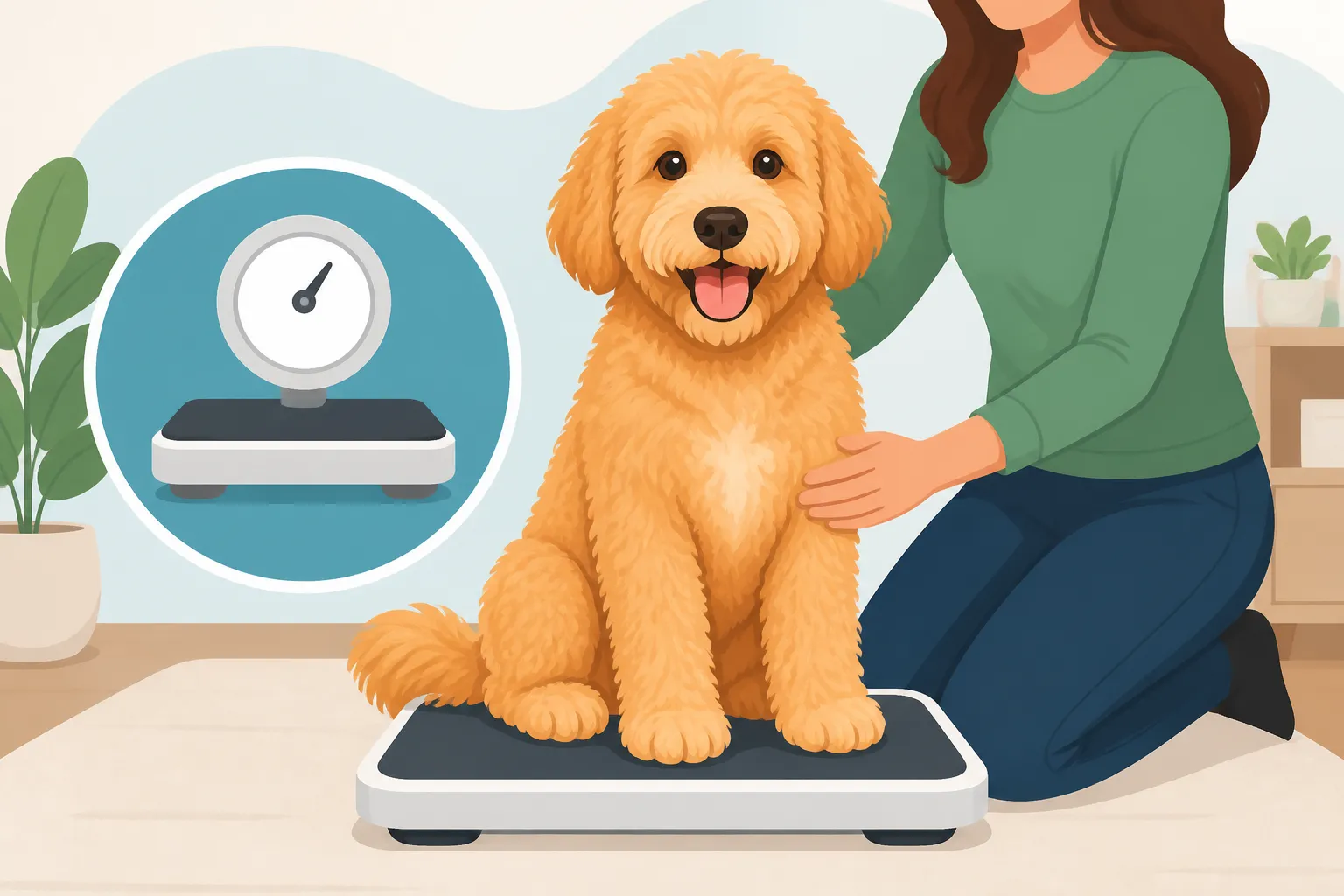
Weighing a Goldendoodle at Home
One of the biggest struggles we face as Goldendoodle parents is keeping tabs on their weight. Beneath all that glorious fluff, it can be incredibly hard to tell if your pup is gaining a little too much or perhaps losing weight unexpectedly. But weight is a critical indicator of health, dictating everything from food portions to medication dosages, and making regular, accurate home weighing a real game-changer. This guide will walk you through practical, low-stress methods for getting reliable weight measurements for your Goldendoodle right in your own home.
Why Regular Goldendoodle Weight Checks Are So Important
You might think a quick pat-down or a visual check is enough, but with a Goldendoodle’s dense, often curly coat, it’s remarkably easy to miss subtle changes in their body condition. Their fluffy exterior can act like a cloak, hiding both weight gain and loss until it becomes a significant issue. Regular home weighing empowers you to catch these shifts early, allowing you to adjust their diet, consult your vet, and potentially prevent more serious health problems down the road.
Monitoring Growth and Development in Puppies
For Goldendoodle puppies, especially during those first crucial months, tracking their weight is less about preventing obesity and more about ensuring healthy growth. A rapidly growing puppy needs consistent nutrition, and a sudden stall in weight gain or an unexpected drop could signal a dietary problem or an underlying health concern. You want to make sure they're hitting those growth plateaus consistently, without shooting up too fast or lagging behind. Think of it as their personalized growth chart, helping you confirm they're developing as they should. Consistent weight checks allow you to adjust their puppy food portions as they grow, ensuring they get all the nutrients they need without overfeeding or underfeeding, which can both impact long-term joint health.
Preventing and Managing Obesity in Adult Goldendoodles
Once your Goldendoodle reaches adulthood, typically around 12-18 months depending on their size, the focus shifts to maintaining a healthy weight. Goldendoodles, with their love for food and often energetic dispositions, can sometimes be prone to creeping weight gain, especially as they get older or if their activity levels dip. Extra pounds put undue stress on their joints, increase the risk of conditions like Goldendoodle Hip Dysplasia at 15 to 20 Percent or Goldendoodle Elbow Dysplasia From Both Parent Breeds, and can exacerbate other health issues. Home weighing allows you to notice a few extra ounces turning into a few extra pounds before it becomes a real problem. You can then make small, manageable adjustments to their Daily Calories by Goldendoodle Size Category or increase their exercise, rather than facing a significant weight loss challenge later.
Spotting Early Signs of Illness or Underlying Conditions
Weight loss, even a gradual decline, can be a silent symptom of many underlying health issues in adult Goldendoodles. This could range from dental problems making it painful to eat, to more serious conditions like thyroid issues, kidney disease, or even cancer. If you're consistently weighing your Goldendoodle and suddenly notice a downward trend, even if their appetite seems normal, it's a huge red flag that warrants a call to your veterinarian. Conversely, rapid, unexplained weight gain might also signal hormonal imbalances, fluid retention, or other medical problems. Your vet will always ask about recent weight changes during check-ups, and having accurate, consistent data from your home weigh-ins provides invaluable information. It’s part of understanding The Goldendoodle Bill Owners Never See Coming if issues go undetected.
Practical Methods for Weighing Your Goldendoodle at Home
The best method for weighing your Goldendoodle at home largely depends on their size. A tiny Toy Goldendoodle puppy is going to be a lot easier to manage on a bathroom scale than a hefty Standard Goldendoodle. Let’s break down the most effective approaches for each size category.
The "Hold and Subtract" Method for Smaller Goldendoodles
This is probably the most common and accessible method for smaller Goldendoodles, whether they're still puppies or fully grown mini/mediums. It's simple, requires no special equipment beyond your regular bathroom scale, and with a bit of practice, can be quite accurate.
Here's how it works:
-
Weigh yourself alone: Step onto your bathroom scale and get your weight. Make sure the scale is on a hard, flat surface for accuracy – no rugs or uneven tiles. Jot this number down.
-
Pick up your Goldendoodle: Gently pick up your Goldendoodle and step back onto the scale together. This is where it helps if your dog is comfortable being held. Some Goldendoodles are naturally cuddlers, while others might be a bit more squirmy. Make sure they're held securely and calmly.
-
Get the combined weight: Read the new, combined weight on the scale and write it down.
-
Do the math: Subtract your weight (from step 1) from the combined weight (from step 3). The result is your Goldendoodle's weight!
Step Measurement Example: You (lbs) Example: You + Goldendoodle (lbs) Goldendoodle Weight (lbs) 1. Your weight alone Your Weight 150 N/A N/A 2. Your weight + Goldendoodle Combined Weight N/A 185 N/A 3. Calculate Goldendoodle Combined Weight – Your Weight N/A N/A 35
This method works best for Goldendoodles up to about 40-50 pounds. If you're struggling to hold your pup steady, you might need an extra set of hands to keep them calm. For those particularly wiggly pups, offering a high-value treat during the process can make a huge difference. You can find some great options on Chewy or Amazon that they'll focus on instead of squirming.
Using Pet Scales for Small to Medium Goldendoodles
If your Goldendoodle is a Mini or a smaller Medium, or if you simply prefer a dedicated tool, a pet scale can be a fantastic investment. These scales are designed specifically for animals, often with a wider, lower platform and a higher weight capacity than baby scales, but still more precise than a standard bathroom scale for smaller creatures.
You'll find these scales available from various retailers. Some are essentially larger versions of baby scales, offering precision to the ounce, which is perfect for tracking a growing Goldendoodle puppy. Others are more robust, resembling small platforms, and can accommodate dogs up to 100 pounds or more. The advantage here is not having to lift your dog, which is a blessing as they get bigger. It also removes the "human weight" variable, leading to a more direct measurement.
To use a pet scale:
- Place it in a quiet area: Find a spot in your home where your Goldendoodle feels comfortable and won't be distracted.
- Introduce the scale: Let your Goldendoodle sniff and investigate the scale. You can toss a few treats on it to encourage them to step on.
- Encourage them to stand: Ask your Goldendoodle to "sit" or "stay" on the platform. Again, treats and praise are your best friends here. You might need to gently guide them or hold them for a few seconds until the reading stabilizes.
- Record the weight: Note down the reading.
This method can also be fantastic if your Goldendoodle has any joint issues and lifting them isn't an option. For a senior Goldendoodle with arthritis, a low-profile pet scale can make weigh-ins comfortable and stress-free.
The "Basket/Crate" Method for Larger or Nervous Goldendoodles
This is a clever workaround for Goldendoodles that are too big for the "hold and subtract" method, or for those who are just plain scale-phobic. It combines the accuracy of your home bathroom scale with a familiar, comforting object for your dog.
- Find a suitable container: Get a laundry basket, a sturdy plastic crate, or a large, shallow box that your Goldendoodle can comfortably fit into, and that can be easily lifted onto your bathroom scale. The key is that it needs to be light enough for you to lift, but strong enough to hold your dog.
- Weigh the empty container: Place the empty basket or crate onto your bathroom scale and record its weight.
- Entice your Goldendoodle: Put your Goldendoodle inside the container. You can use treats, toys, or even their favorite blanket to make it an inviting space.
- Place container + Goldendoodle on scale: Carefully lift the container with your Goldendoodle inside and place it on your bathroom scale.
- Get the combined weight: Record the new, combined weight.
- Subtract the container's weight: Subtract the weight of the empty container (from step 2) from the combined weight (from step 5) to get your Goldendoodle's weight.
This method offers a few advantages: it contains a wiggly dog, it can be less intimidating than a bare scale, and it works for Goldendoodles that are too heavy to hold directly. Just make sure the container is stable on the scale and won't tip over.
Visiting the Vet or a Pet Store for the Biggest Goldendoodles
Let’s be real, if you have a Standard Goldendoodle that’s pushing 70, 80, or even 90 pounds, wrestling them onto a home scale—even with the basket method—might be more trouble than it’s worth. For these larger pups, the easiest and most accurate option is often to use a commercial pet scale.
Many veterinary offices are happy to let you pop in for a quick weigh-in, especially if you're a regular client. Just call ahead to make sure it's a good time and that the scale is available. Pet supply stores like Petco or Petsmart often have large, walk-on scales right in the entrance, free for public use. It’s a great way to combine a quick errands run with a necessary health check. This also provides an opportunity to help your Goldendoodle practice Goldendoodle Behavior at the Vet or in a public setting.
Tips for Accurate and Stress-Free Weighing
Getting an accurate weight isn't just about the scale; it's also about making the experience positive and consistent for your Goldendoodle.
Establish a Consistent Weighing Schedule
The most important aspect of home weighing is consistency. Don't just weigh them sporadically. Pick a day of the week or month and stick to it. Weigh them at roughly the same time of day (e.g., first thing in the morning before breakfast, after their morning potty break). This helps eliminate variables like a full bladder or stomach, which can skew the numbers. Regularity also helps your Goldendoodle get used to the routine, making it less stressful over time. For a Goldendoodle puppy, weekly checks are ideal to track their rapid growth, while adult Goldendoodles can typically be weighed every two to four weeks.
Create a Positive Association with the Scale
No one wants to force their beloved Goldendoodle onto a scary metal object. Start slow and make the scale a happy place.
- Introduce it gently: Place the scale on the floor and let your Goldendoodle sniff it. Don't push them on immediately.
- Treats, treats, treats: Toss high-value treats (think tiny pieces of cooked chicken or cheese) near and then onto the scale. Reward them for simply approaching it, then for touching it with a paw, then for stepping one paw on, and eventually for stepping fully on.
- Praise generously: Use a happy, encouraging voice and lots of verbal praise.
- Keep sessions short: Especially at the beginning, don't prolong the process. A few seconds on the scale, a treat, and then they're done. You want them to leave the experience wanting more, not dreading it.
- Practice regularly: Even if you're only weighing once a month, take a few minutes each week to do a "practice run" with treats to reinforce the positive association. This is especially helpful if your Goldendoodle tends to be nervous.
Ensure a Stable and Safe Weighing Environment
Wherever you choose to weigh your Goldendoodle, make sure it’s safe and stable.
- Flat, hard surface: Bathroom scales are calibrated for flat, hard floors. Placing them on carpet can give inaccurate readings.
- Non-slip surface (if possible): If your pet scale has a smooth, slick surface, consider laying a thin, non-slip mat or towel on it. This will make your Goldendoodle feel more secure and less likely to slip or jump off.
- Minimal distractions: Try to weigh your Goldendoodle in a quiet room, away from other pets, loud noises, or exciting toys that might make them squirm or try to get away.
- Secure footing for you: If you're doing the "hold and subtract" method, make sure you have solid footing so you don't lose your balance while holding your dog.
What to Do With Your Goldendoodle's Weight Data
Collecting weight data is just the first step. The real value comes from tracking it, understanding what it means, and knowing when to reach out for professional advice.
Keeping a Weight Log and Charting Progress
You're taking the time to weigh your Goldendoodle, so don't let that data disappear! A simple logbook, a spreadsheet on your computer, or even a dedicated app on your phone can be invaluable.
Record:
- Date: When you took the measurement.
- Weight: The exact number.
- Notes: Any observations, like "just ate breakfast," "had a big walk," or "seems a bit thinner."
Over time, this log will allow you to see trends. You'll easily spot a gradual increase that you might not notice day-to-day, or a concerning dip. This visual tracking can be incredibly motivating for weight management and a critical alert system for health issues. If you're using a fresh food service like Ollie, they often have apps or dashboards where you can track your dog's weight, and it directly influences their portion recommendations.
Understanding Body Condition Score (BCS) Beyond the Numbers
While the number on the scale is important, it doesn't tell the whole story, especially with a Goldendoodle's diverse coat types. This is where the Body Condition Score (BCS) comes in. Your vet uses BCS to assess how much fat your dog has and how well-muscled they are. It’s a visual and tactile assessment, usually on a scale of 1 to 9 (with 5 being ideal).
Even with a thick Goldendoodle coat, you should be able to:
- Feel the ribs: You should be able to feel your Goldendoodle's ribs without pressing hard. They shouldn't be visible (too thin) nor should they be hard to find under a thick layer of fat (too heavy).
- Notice a waist: When looking down at your Goldendoodle from above, you should see a discernible waistline behind their ribs. It won't be as dramatic as a lean sighthound, but it should be there.
- Observe an abdominal tuck: When looking at your Goldendoodle from the side, their belly should tuck up slightly, rather than hanging low.
Combine your Goldendoodle's weight measurements with regular BCS checks. You might find that even if their weight stays the same, their body condition changes – perhaps they're losing muscle and gaining fat. This is important information to share with your vet. For more on this, check out Finding Ribs Through Two Inches of Goldendoodle Hair.
When to Consult Your Veterinarian
Your home weighing efforts are a fantastic early warning system. Don't hesitate to contact your vet if you notice:
- Sudden or significant weight loss: Even a small percentage drop, say 5-10% of their body weight, over a short period (a few weeks) should prompt a call. This is particularly concerning if accompanied by other symptoms like Goldendoodle Vomiting and When It Matters or a change in appetite.
- Unexplained weight gain: If your Goldendoodle is gaining weight despite no changes in diet or exercise, it could indicate a medical issue.
- Stunted growth in puppies: If your Goldendoodle puppy isn't gaining weight steadily according to typical Goldendoodle Puppy Growth Chart by Size for their size, it's worth investigating.
- Difficulty maintaining body condition: If you're struggling to keep their BCS ideal, even with careful feeding, your vet can help rule out underlying issues and provide dietary guidance.
- Any other concerning symptoms: Weight changes combined with lethargy, changes in thirst or urination, coat problems like Goldendoodle Hair Loss Traced to the Thyroid, or behavioral shifts are always a reason for a vet visit.
Remember, you are your Goldendoodle's best advocate. Knowing their typical weight and being able to spot deviations means you can partner with your vet to keep them happy and healthy for years to come.
Disclaimer
This article is for general informational purposes only and does not constitute professional advice. Laws, prices and regulations vary by location and change over time. Consult a qualified professional for guidance on your specific situation.