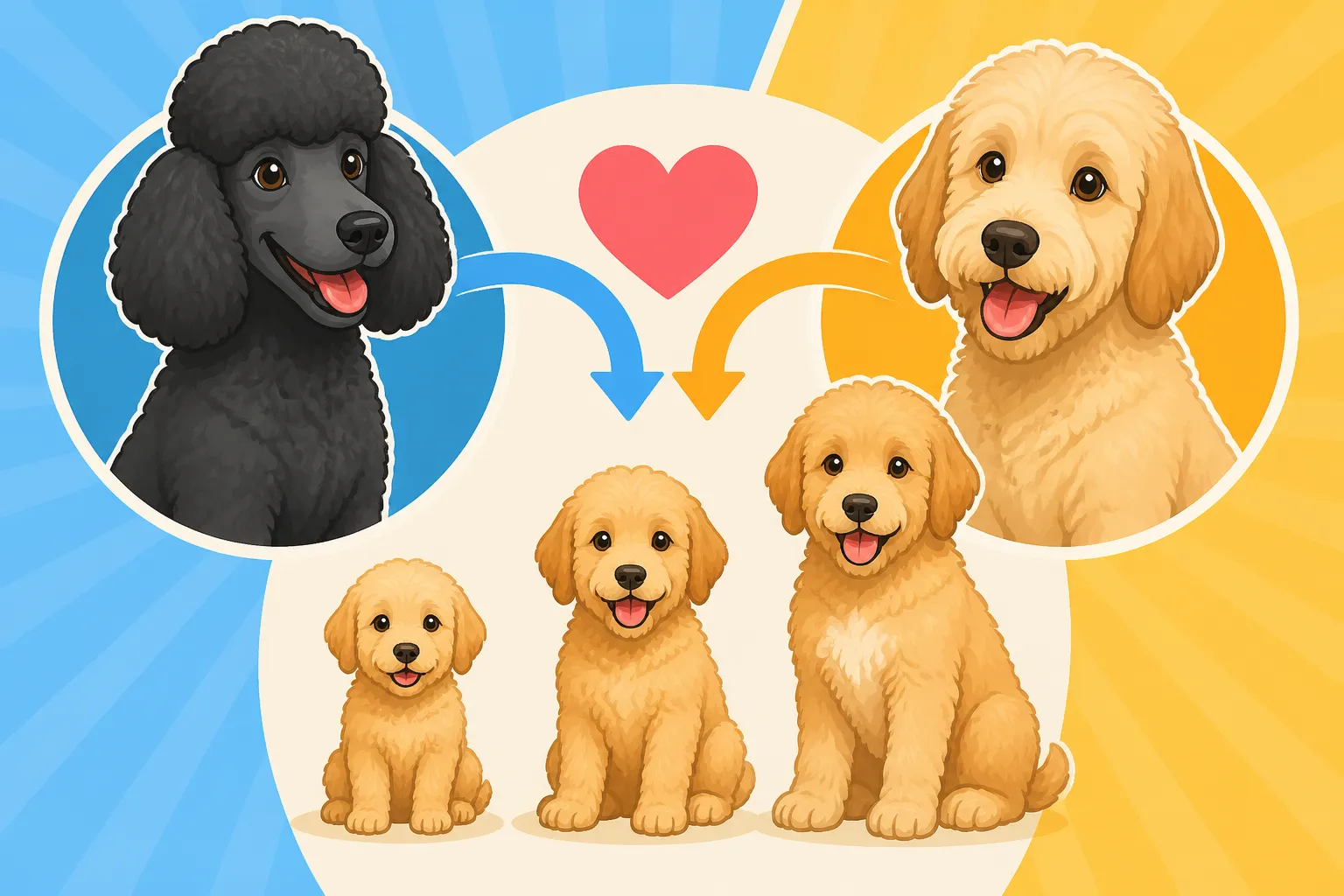
How the Poodle Parent Sets Goldendoodle Size
It’s a common dream for many aspiring Goldendoodle parents: envisioning the perfect size, whether that’s a compact companion for apartment living or a majestic, cuddle-loving giant. However, the reality of Goldendoodle sizing can be a bit of a mystery, especially when you consider that these wonderful dogs are a mix of two distinct breeds. This guide is dedicated to demystifying one of the biggest factors in a Goldendoodle's eventual adult size: the undeniable influence of their Poodle parent.
The Poodle's Genetic Power Over Goldendoodle Size
When you look at a Golden Retriever, you generally know what you’re getting in terms of size. They’re a pretty consistent breed in that regard. But Poodles? They come in a spectacular array of sizes—from the dainty Toy to the imposing Standard. It's this vast spectrum within the Poodle breed that gives Goldendoodles their incredible range in size, making the Poodle parent’s genetic contribution the absolute key to understanding how big your fluffy friend will get. Without a Poodle parent, you wouldn't have the smaller Goldendoodles many families adore.
Why the Golden Retriever is the "Constant"
Think of the Golden Retriever side of the equation as the anchor, generally providing a predictable genetic component for size. Most Golden Retrievers fall within a relatively narrow weight range, typically between 55 and 75 pounds, and stand around 21 to 24 inches tall at the shoulder. While there's always a little individual variation, they don't have the same dramatic size differences that Poodles do. This means that when you cross a Golden Retriever with a Poodle, the size of the Poodle is almost always the determining factor for where the Goldendoodle will land on the size spectrum. It's not often that you see a Golden Retriever that's drastically outside this norm, so their influence on the overall variability of Goldendoodle size is less impactful than the Poodle's.
The Poodle's Role as the "Variable"
The Poodle, on the other hand, is the ultimate variable. You have Toy Poodles, Miniature Poodles, and Standard Poodles, each with distinctly different size parameters. A Toy Poodle might weigh 6-9 pounds, while a Standard Poodle can easily tip the scales at 70 pounds or more. When a Goldendoodle breeder selects a Poodle for breeding, they're essentially setting the upper and lower bounds for the size of the resulting puppies. If they breed a Golden Retriever with a Toy Poodle, they're aiming for a much smaller Goldendoodle than if they use a Standard Poodle. This is the genetic lottery ticket that allows for the creation of mini, medium, and standard Goldendoodles, all from the same Golden Retriever starting point. Understanding these foundational Poodle sizes is crucial for any potential Goldendoodle owner.
Decoding Goldendoodle Size Categories Through Poodle Parents
Navigating the world of Goldendoodle sizes can feel a bit like learning a new language. You hear terms like "Mini," "Medium," and "Standard," but what do they really mean, and how do they directly relate to the Poodle parent? It all comes down to the size of the Poodle that was bred with the Golden Retriever. Each Poodle size category creates a corresponding Goldendoodle size range, giving us the wonderful variety we see today.
Toy Poodles and the Miniature/Petite Goldendoodle
When a breeder aims for a tiny companion, they'll typically use a Toy Poodle as one of the parents. Toy Poodles are generally under 10 pounds and stand less than 10 inches tall. When crossed with a Golden Retriever (or often, a smaller Goldendoodle for multi-generational breeding), their genetics contribute to what's known as a Petite or Mini Goldendoodle.
These smaller Goldendoodles are usually designed for those living in apartments or smaller homes, or simply for owners who prefer a lap-sized dog. They typically range from about 15 to 30 pounds and stand around 14-17 inches at the shoulder. It's important to remember that even within this range, there can be variation. Sometimes, even with a Toy Poodle parent, you might get a pup that leans towards the larger end of the "mini" scale due to the Golden Retriever's genetic input. If you're hoping for a genuinely small Goldendoodle, make sure to look at the size of both Poodle parents in the lineage, especially if it's an F1b or Multigen Goldendoodle, which means more Poodle genetics are at play.
Miniature Poodles and the Medium Goldendoodle
The Miniature Poodle is the next step up in size, typically weighing between 10 and 15 pounds and standing around 10-15 inches tall. These Poodles are a popular choice for creating what we call Medium Goldendoodles. This size category is often a fantastic middle ground for many families, offering a dog that's substantial enough for active play but still manageable in most living situations.
Medium Goldendoodles usually fall into the 30-45 pound range and stand about 17-20 inches tall. They're a favorite for their versatility, often fitting comfortably into both suburban homes and slightly larger urban apartments. The Miniature Poodle’s genes are instrumental in achieving this 'just right' size, balancing the Golden Retriever's slightly larger build. When looking at puppies from a Miniature Poodle parent, it’s worth asking the breeder about the history of their Poodle lines to understand the typical adult size outcomes. You can learn more about Mini Goldendoodle Height and Weight in another one of our articles.
Standard Poodles and the Standard Goldendoodle
For those who dream of a big, cuddly companion, the Standard Poodle is the Poodle parent of choice. Standard Poodles are the largest of the Poodle varieties, often weighing 40-70 pounds or more and standing over 15 inches tall (though usually much taller, often 20-27 inches). When a Golden Retriever is bred with a Standard Poodle, the result is a Standard Goldendoodle, the largest size category for this crossbreed.
Standard Goldendoodles typically weigh 45-75 pounds and stand over 20 inches tall, sometimes even larger. These are big, robust dogs that need space and plenty of exercise. Their size means they are fantastic for active families, hiking, and playing fetch in large yards. The sheer size of the Standard Poodle ensures that the offspring will also be sizable, truly inheriting that larger frame. If you're considering a Standard Goldendoodle at Fifty to Ninety Pounds, be prepared for a generous amount of dog! It's important to note that even with a Standard Poodle, there can be size variations. Some Standard Goldendoodles might be on the lower end of the weight spectrum, while others might push past 75 pounds, depending on the individual genetics of both parents.
Predicting Your Goldendoodle Puppy's Adult Size
Ah, the million-dollar question for every Goldendoodle puppy parent: "How big will they get?!" It’s a natural curiosity, and while there’s no crystal ball, understanding the Poodle parent's role in this equation gives us some pretty strong clues. It’s not an exact science, but we can make educated guesses that help you prepare for your future furry family member.
The Influence of Poodle Size in Different Generations
The generation of your Goldendoodle plays a significant role in how directly the Poodle parent's size influences your pup. For an F1 Goldendoodle, where you have a purebred Golden Retriever and a purebred Poodle, the Poodle parent's size directly dictates the primary size category. A Standard Poodle parent means a Standard Goldendoodle, a Miniature Poodle parent means a Medium Goldendoodle, and a Toy Poodle parent means a Mini or Petite Goldendoodle. It’s a relatively straightforward genetic blend.
However, things can get a little more nuanced with subsequent generations, like F1b or Multigen Goldendoodles. An F1b Goldendoodle, for instance, is typically 75% Poodle and 25% Golden Retriever. This means the Poodle genetics are even more dominant. If an F1 Goldendoodle (from a Standard Poodle) is bred back to a Miniature Poodle, you might see a Goldendoodle that is smaller than a traditional F1 Standard, leaning towards the medium size. Similarly, if an F1 Goldendoodle (from a Mini Poodle) is bred back to a Toy Poodle, you'll likely get very small pups. Breeders carefully plan these crosses to achieve specific size outcomes, often aiming for consistency, but variations can still occur within litters. You can often see this variability playing out, with some pups being significantly larger or smaller than their littermates. This is why discussing the breeding pair's history and expected size range with a reputable breeder is so important, as they will have a clearer picture of potential outcomes. The Four Goldendoodle Sizes and How They Are Set is a great resource if you want to dive deeper into this topic.
Growth Curves and Milestones
Just like human children, Goldendoodle puppies don't grow at a perfectly linear rate, but there are general patterns and milestones that can offer insight into their adult size. While the Poodle parent sets the potential size, tracking your puppy's growth can give you a better idea of where they'll land within that range. Standard Goldendoodles, for example, will typically grow rapidly during their first 6-8 months, then slow down, filling out their chest and body for another 6-12 months. Smaller Goldendoodles, like minis and petites, tend to reach their full height and weight much faster, often by 8-10 months of age.
Many owners find it helpful to look at general growth charts for their specific size category. While your breeder might provide an estimate, watching how your puppy grows relative to these charts can give you an indication. For instance, if your Mini Goldendoodle puppy is already at the higher end of the weight range for their age group, they’re likely to be a larger mini. Conversely, if they're consistently on the lower side, they'll probably be a smaller adult. Websites like Chewy often have resources or community forums where owners discuss these growth patterns, providing anecdotal insights into what to expect. Remember that a puppy's growth plates need to close properly, and ensuring they receive appropriate nutrition for their size is key to healthy development.
Beyond Poodle Genes: Other Factors Influencing Goldendoodle Size
While the Poodle parent is undeniably the primary driver behind a Goldendoodle’s size, it's not the only factor at play. Genetics are complex, and even within the same litter, you can see a surprising range of sizes. Understanding these additional influences can help you manage your expectations and appreciate the unique growth journey of your own Goldendoodle.
The Golden Retriever's Contribution and Genetic Variability
Even though the Golden Retriever's size is more consistent than the Poodle's, their genetics still contribute to the overall package. A Goldendoodle is, after all, a 50/50 mix (in an F1 generation) of both breeds. A larger-than-average Golden Retriever parent, even if bred with a Miniature Poodle, might result in a Goldendoodle that nudges the upper limit of the "Medium" category. Conversely, a Golden Retriever from a line known for being on the smaller end of the spectrum could, when bred with a Standard Poodle, produce a Standard Goldendoodle that's a bit lighter than average.
This genetic variability means that two puppies from the same litter, with the same Poodle parent, could still end up being slightly different sizes as adults. It’s part of the charming unpredictability of hybrid dogs. Breeders strive for consistency, but nature often has its own plans. This is why responsible breeders track the adult sizes of previous offspring and can give you a more accurate expectation based on their specific lines. It's a reminder that genetics are a roll of the dice to some extent, even with careful planning.
Gender and Individual Growth Rates
Just like in many other dog breeds, male Goldendoodles often end up being slightly larger and heavier than their female counterparts. This isn't a hard and fast rule, and there's certainly overlap, but it's a general trend to keep in mind. If you have a litter with both male and female puppies, you might notice the males tend to be a bit more robust as they grow.
Beyond gender, individual growth rates vary greatly from one puppy to the next. Some pups are early bloomers, shooting up in size quickly, while others might have a slower, steadier growth curve. Don't be alarmed if your Goldendoodle puppy seems to be growing faster or slower than a friend's Goldendoodle of the same age; what matters most is consistent, healthy growth. Factors like nutrition, general health, and even exercise levels can subtly influence how a puppy grows and develops within their genetically predetermined size range. It's important to provide a balanced diet, often specific to large breed puppies for standard sizes, to support healthy bone and joint development. Websites like Chewy offer a wide range of specialized puppy foods to ensure your growing Goldendoodle gets the right start. Goldendoodle Growth Plates by Size Category delves into the important topic of puppy development and joint health.
Setting Realistic Expectations for Your Goldendoodle's Size
Bringing a Goldendoodle into your home is an exciting time, and having a clear picture of their potential adult size is really important for long-term planning. It affects everything from the size of their crate to how much food they'll need and even the type of car you drive. While we rely heavily on the Poodle parent for size prediction, it's vital to embrace the inherent variability of a crossbreed and set realistic expectations.
Understanding the "Range" and Not the "Exact Number"
One of the biggest lessons to learn about Goldendoodle sizing is that you should always think in terms of a range, not a precise number. A breeder might tell you a puppy is expected to be a "Mini Goldendoodle," meaning they'll likely fall between 15-30 pounds. This doesn't mean they'll be exactly 22 pounds; they could easily be 17 pounds or 28 pounds. This range exists because of the complex genetic interplay between two different breeds, even with the Poodle parent's strong influence.
It’s easy to get fixated on a specific weight or height, especially if you have a particular vision in mind for your dog. However, being prepared for your Goldendoodle to be on either the smaller or larger end of their projected range is key. This flexibility will save you from disappointment and ensure you're ready for whatever wonderful size your unique Goldendoodle blossoms into. It also helps when you're purchasing items like a travel kennel or an elevated food dish; always err on the side of accommodating the upper end of the predicted size range.
Why Size Charts Can Be Confusing
If you've spent any time looking up Goldendoodle sizes online, you've probably noticed that Why Goldendoodle Size Charts Disagree across different websites and breeders. One chart might list a Mini Goldendoodle as 15-25 pounds, while another says 20-35 pounds. This inconsistency can be incredibly frustrating when you're trying to get a clear answer. The reason for these discrepancies often comes down to a lack of universally agreed-upon breed standards, since the Goldendoodle is a crossbreed, not a recognized purebred.
Different breeders might have their own slightly varying definitions of what constitutes a "mini" or "medium" size, based on their specific breeding programs and the lines they work with. Furthermore, the parent breeds themselves can have their own variations within their accepted standards. Instead of relying solely on generic charts, the most reliable information will come directly from your chosen breeder, who knows the specific genetics of their breeding dogs and the typical adult sizes of their past litters. Always ask for specific weight and height ranges of the parent dogs, and ideally, their previous offspring.
| Goldendoodle Size Category | Typical Poodle Parent | Approximate Weight Range | Approximate Height Range (at shoulder) | Best Suited For |
|---|---|---|---|---|
| Petite/Mini | Toy Poodle | 15-30 lbs | 14-17 inches | Apartments, Smaller Homes, Less active owners |
| Medium | Miniature Poodle | 30-45 lbs | 17-20 inches | Average Homes, Moderate activity |
| Standard | Standard Poodle | 45-75+ lbs | 20+ inches | Active Families, Homes with large yards |
Note: These ranges are approximate and individual Goldendoodles may vary. Always consult with your breeder for specific expectations regarding your puppy.
Asking the Right Questions to Your Breeder
When you're choosing a Goldendoodle puppy, especially if size is a significant consideration for your lifestyle, don't be shy about asking your breeder detailed questions. A responsible and transparent breeder will be happy to provide this information. Ask about the precise size (height and weight) of both the Poodle parent and the Golden Retriever parent, as well as the Poodle's parents if possible. Inquire about the typical adult size of previous litters from the same pairing, or from similar parent dogs.
You should also ask what generation the puppies are (F1, F1b, Multigen) and how that might affect size predictability. A good breeder should be able to give you a realistic range and help you understand why your particular puppy is expected to fall into a certain category. They won't promise an exact number, but they should offer clear, well-informed guidance. Don't hesitate to ask to see the parents in person, or at least photos and videos that give you a sense of their true size and build. This proactive approach will help ensure you bring home a Goldendoodle that fits perfectly into your life, no matter their final delightful dimensions.
Disclaimer
This article is for general informational purposes only and does not constitute professional advice. Laws, prices and regulations vary by location and change over time. Consult a qualified professional for guidance on your specific situation.