What the Letter F Means in a Goldendoodle Pedigree
If you've spent any time looking into Goldendoodle puppies, you've undoubtedly stumbled upon terms like "F1," "F1b," and "Multigen" in their descriptions. It can feel like you're trying to crack a secret code, and for new prospective owners, this alphabet soup of generations is genuinely confusing. Understanding what these letters and numbers mean is absolutely essential because they tell you a lot about what you can expect from your future furry family member, especially when it comes to their coat, shedding potential, and even aspects of their health and temperament. This guide is here to demystify the Goldendoodle pedigree system, making sense of those "F" designations so you can choose a puppy with confidence.
Deciphering the 'F' System: What Goldendoodle Generations Mean
The "F" in Goldendoodle generations stands for "Filial Hybrid." It's a genetic term used in animal breeding to denote a generation resulting from a cross between two distinct parent breeds or lines. In the world of Goldendoodles, it specifically refers to the cross between a Golden Retriever and a Poodle, or subsequent crosses involving Goldendoodles themselves. This system helps breeders and buyers understand the genetic makeup and the expected traits of a puppy, although it’s important to remember that genetics always come with an element of unpredictability, especially in crossbreeds.
The Purpose of Goldendoodle Generations
The primary reason breeders use this generational labeling is to communicate the genetic proportion of each parent breed (Golden Retriever and Poodle) within a Goldendoodle. This proportion directly influences key characteristics like coat type, shedding, and even the potential for certain inherited health conditions. For instance, someone with allergies might specifically seek an F1b Goldendoodle because it typically has a higher Poodle percentage, which is often associated with less shedding. Without these labels, every Goldendoodle would just be a Goldendoodle, and it would be a complete guessing game to understand what traits might emerge in a litter. It's a way to bring a semblance of order and expectation to a crossbreed that doesn't have the long-established pedigree records of purebred dogs.
Why It's Not as Simple as "Purebred"
Unlike purebred dogs, which have extensive, multi-generational pedigrees with consistent traits, Goldendoodles are still relatively new and are a crossbreed. This means their genetic combinations are inherently more varied. While purebred breeders work within a closed gene pool to maintain specific breed standards, Goldendoodle breeders are combining two very different breeds. The "F" system is an attempt to create a common language for this variability, but it's not a perfect predictor. You might see two F1 Goldendoodles that look wildly different, or an F2 that sheds more than an F1. It's about probabilities and tendencies, not guarantees. This is why thorough DNA Coat Testing on a Goldendoodle can be so valuable in addition to understanding the generational labels.
Breaking Down the Core Goldendoodle Generations (F1, F1b, F2)
These are the most commonly encountered generations, and understanding their distinctions is crucial for anyone considering a Goldendoodle. Each one represents a different ratio of Golden Retriever to Poodle genetics, leading to varying outcomes in coat, shedding, and sometimes even temperament.
F1 Goldendoodle: The First Generation Cross
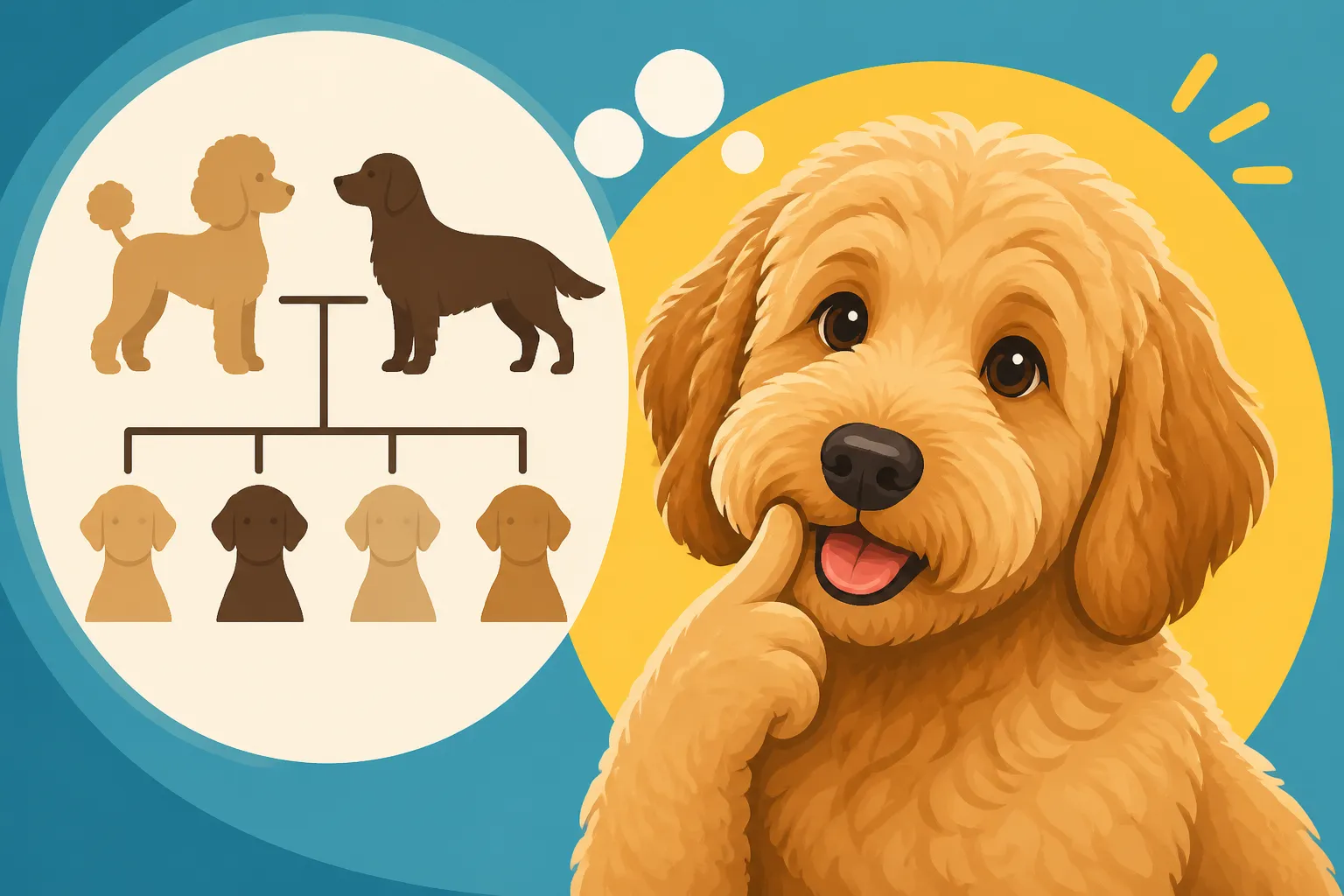
The F1 Goldendoodle is the original, first-generation cross. It's produced by breeding a purebred Golden Retriever with a purebred Poodle. This means an F1 Goldendoodle is typically 50% Golden Retriever and 50% Poodle.
- Parentage: Golden Retriever x Poodle
- Genetic Makeup: 50% Golden Retriever, 50% Poodle
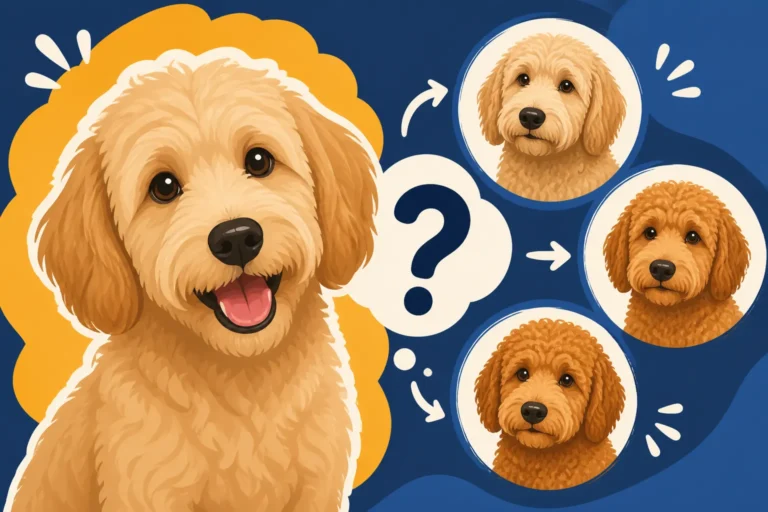
- Coat & Shedding: This is where the F1 can be the most variable. Because you're combining two distinct coats (a Golden's shedding double coat and a Poodle's non-shedding, curly coat), F1s can have a range of coats from straight and wavy to slightly curly. Shedding can also vary greatly; some F1s shed minimally, while others can shed moderately, closer to a Golden Retriever. If shedding is a major concern, an F1 might be a bit of a gamble, though many people find their F1s to be low-shedders. You can learn more about The F1 Goldendoodle at Fifty Fifty.
- Hybrid Vigor: F1s are often touted as having the most "hybrid vigor," which is the increased strength, growth, fertility, and health in crossbred individuals compared to purebred parents. While this can be true in a general sense for some traits, it's not a blanket guarantee of perfect health. It simply means they benefit from a broader genetic diversity than either purebred parent. However, The Goldendoodle Hybrid Vigor Claim and Where It Breaks explains that this doesn't protect them from all inherited conditions.
- Temperament: Generally, F1s exhibit a wonderful blend of the Golden's friendly, eager-to-please nature and the Poodle's intelligence and trainability. They are often good-natured, social, and intelligent dogs.
F1b Goldendoodle: The Backcross for Specific Traits
The "b" in F1b stands for "backcross." This generation is created by breeding an F1 Goldendoodle back to one of its parent breeds, almost always a Poodle. The intention behind this backcross is to increase the Poodle genetics, thereby enhancing certain traits, primarily the low-shedding, more hypoallergenic coat.
- Parentage: F1 Goldendoodle x Poodle
- Genetic Makeup: Approximately 75% Poodle, 25% Golden Retriever
- Coat & Shedding: F1b Goldendoodles are much more likely to have the curly or wavy "Poodle-like" coat and are generally considered the most reliably low-shedding and allergy-friendly generation. This is why they are often sought after by individuals with mild dog allergies. If you’re looking for a Goldendoodle that is less likely to trigger allergies, the F1b is usually a safer bet than an F1. For a deeper dive, check out The F1b Goldendoodle at Three Quarters Poodle.
- Temperament: With a higher percentage of Poodle, some F1b Goldendoodles might lean slightly more towards the Poodle's inherent intelligence and sometimes a touch more sensitivity or energy, but they generally retain the Goldendoodle's lovely, friendly disposition.
- Hybrid Vigor: While F1bs still benefit from some hybrid vigor, it's generally considered to be slightly less pronounced than in an F1 because they are genetically closer to one purebred parent. Why an F1b Goldendoodle Loses Some Hybrid Vigor delves into this concept.
F2 Goldendoodle: The Second Generation Cross
An F2 Goldendoodle is the result of breeding two F1 Goldendoodles together. This generation is famous, or perhaps infamous, for its genetic variability. When you combine two dogs that are both 50/50, the puppies in the litter can inherit a wide range of traits from either side.
- Parentage: F1 Goldendoodle x F1 Goldendoodle
- Genetic Makeup: Theoretically 50% Golden Retriever, 50% Poodle, but with much greater variability in the actual genes inherited by each puppy.
- Coat & Shedding: This is the most unpredictable generation for coat type and shedding. An F2 litter can produce puppies with straight coats (like a Golden Retriever, and heavy shedding), wavy coats (moderate shedding), or curly coats (low shedding). It's not uncommon to see all three coat types in a single litter. This unpredictability makes F2s less common for breeders aiming for consistent low-shedding coats. You can understand why it's called The F2 Goldendoodle and Its Unpredictable Coat.
- Temperament: Like their F1 parents, F2s generally inherit the desirable traits of both breeds, but the specific blend can be more varied from puppy to puppy within the same litter.
- Hybrid Vigor: Hybrid vigor is typically less in F2s compared to F1s due to the possibility of a greater concentration of genes from one breed or the other, or a reduction in overall genetic diversity if the F1 parents share too many common ancestors.
Here's a quick comparison table for clarity:
| Generation | Parentage | Golden/Poodle Ratio (Approx.) | Coat Predictability | Shedding Tendency | Hybrid Vigor (Relative) |
|---|---|---|---|---|---|
| F1 | Golden Retriever x Poodle | 50% / 50% | Variable (Straight-Curly) | Variable (Low-Moderate) | High |
| F1b | F1 Goldendoodle x Poodle | 25% / 75% | More Consistent (Wavy-Curly) | Very Low | Moderate |
| F2 | F1 Goldendoodle x F1 Goldendoodle | 50% / 50% (Variable) | Highly Variable (Straight-Curly) | Highly Variable (High-Low) | Moderate to Low |
Beyond the Basics: Multigen Goldendoodles and Predictability
Once you move beyond F2, you enter the realm of Multigenerational (or "Multigen") Goldendoodles. These generations are often preferred by experienced breeders aiming for greater consistency in desired traits, particularly coat type and temperament.
Multigenerational Goldendoodles (F2b, F3, etc.)
Multigen Goldendoodles are the result of breeding F1b Goldendoodles together, or breeding an F1b to an F2, or any Goldendoodle that is F3 or higher (e.g., F2 x F2 = F3). The goal with Multigen breeding is to create a more established "line" of Goldendoodles where the traits are more predictable and consistent across litters.
- Parentage: Various combinations involving F1b, F2, F3, etc., Goldendoodles. For example, F1b Goldendoodle x F1b Goldendoodle.
- Genetic Makeup: Highly varied, but breeders typically aim for a balance that optimizes desired Goldendoodle traits, often with a higher Poodle percentage to maintain low-shedding coats.
- Coat & Shedding: This is where multigen breeding truly shines. Responsible multigen breeders select parent dogs with proven low-shedding, wavy or curly coats. This allows them to produce litters with a high degree of predictability for these desired coat types. They can reduce the chance of unexpected straight coats and heavy shedding that can appear in F1 or F2 litters. This is why many families seeking a truly "hypoallergenic" option will lean towards a multigen Goldendoodle. Read more about Multigen Goldendoodles and Why Breeders Prefer Them.
- Temperament: Similarly, multigen breeding allows for selection based on temperament, aiming to consistently produce dogs with the friendly, intelligent, and biddable nature that Goldendoodle owners adore. Over generations, breeders can reinforce these positive attributes.
- Hybrid Vigor: As you move further down the generations, the degree of hybrid vigor can lessen. This doesn't mean multigen Goldendoodles are unhealthy, but it underscores the importance of rigorous health testing by reputable breeders. They are working with a more established gene pool, which can lead to greater consistency but also potentially reduce the broad genetic diversity seen in a first-generation cross.
The Role of "Backcrosses" in Later Generations
You might also see terms like "F2b" or "F1bb." These are further backcrosses designed to fine-tune the genetic composition. For example:
- F2b Goldendoodle: This is an F2 Goldendoodle bred back to a Poodle. Similar to an F1b, the "b" indicates a backcross, further increasing the Poodle genetics (often to around 87.5% Poodle, 12.5% Golden Retriever). This is done to achieve an even curlier, more reliably non-shedding coat than an F2 could provide on its own. It's an excellent option for those with severe allergies.
- F1bb Goldendoodle: This is an F1b Goldendoodle bred back to a Poodle. This results in an even higher Poodle percentage, sometimes as much as 93.75% Poodle. These dogs are almost indistinguishable from a purebred Poodle in coat and shedding, making them among the most allergy-friendly Goldendoodle options available.
These more complex generational designations highlight the breeder's intent to produce very specific traits, moving away from the more unpredictable nature of earlier generations.
Why Understanding Generations Matters for Your Goldendoodle
Knowing the generational system isn't just for breeders; it's a critical tool for prospective Goldendoodle owners to make an informed decision that aligns with their lifestyle, expectations, and any specific needs, like allergy concerns. It goes beyond just knowing What a Goldendoodle Puppy Costs and Why.
Managing Expectations for Coat and Shedding
The biggest impact of Goldendoodle generations is on the coat and shedding. If you or a family member has allergies, understanding the "F" system is paramount.
- Allergy Sufferers: If you have mild allergies, an F1 Goldendoodle might be acceptable, but you're rolling the dice a bit. For more significant allergies, an F1b or a multigen (especially F2b or F1bb) Goldendoodle with a higher Poodle percentage is generally a much safer bet. These dogs are specifically bred to have the curly, low-shedding coats that trap dander and hair, reducing allergens in the environment. Remember, no dog is truly 100% hypoallergenic, but these generations come closer.
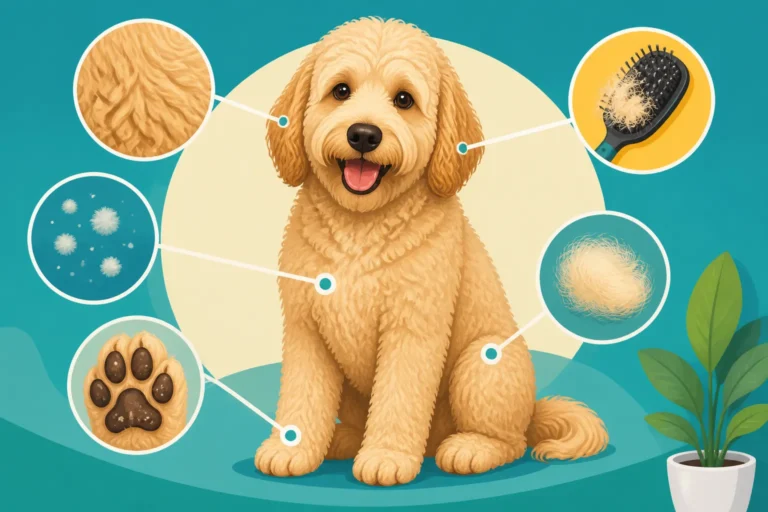
- Grooming Needs: Along with shedding comes grooming. Curly and wavy coats require significant grooming to prevent matting. An F1b or multigen Goldendoodle will likely need professional grooming every 6-8 weeks and consistent brushing at home. Even F1s, depending on their coat type, will need regular attention. You'll want to stock up on quality brushes and combs, maybe from a place like Chewy, early on. Neglecting the coat can lead to painful mats and expensive de-matting fees at the groomer. This regular grooming is critical for Brushing a Goldendoodle Often Enough to Stop Matting.
Health Considerations and Genetic Predictability
While hybrid vigor is often discussed, it's not a magical shield against all genetic conditions. Understanding generations can give you an idea of potential health considerations, though responsible breeding and health testing of the parents are far more important.
- Inherited Conditions: Both Golden Retrievers and Poodles are prone to certain genetic health issues, such as hip and elbow dysplasia, eye conditions like Progressive Retinal Atrophy, and certain cancers. When you cross them, the puppies can inherit these predispositions from either side. For example, Goldendoodle Hip Dysplasia at 15 to 20 Percent is a concern, regardless of generation.
- Breeder Responsibility: A reputable breeder, regardless of the generation they are breeding, will always conduct extensive health testing on their parent dogs. This means OFA clearances for hips and elbows, eye exams, and genetic testing for conditions like von Willebrand's Disease and Progressive Retinal Atrophy. Relying solely on the "F" designation for health is a mistake; always ask for proof of parent health clearances. The generational label describes the mix, not necessarily the quality of the genetic material.
Temperament and Training Expectations
While the Golden Retriever and Poodle both contribute wonderful temperaments, the ratio can subtly influence a Goldendoodle's personality and energy levels.
- Golden Retriever Traits: Known for their friendly, loyal, and somewhat goofy nature, Golden Retrievers are often eager to please and make fantastic family pets. They can be prone to "zoomies" and need a good outlet for their energy.
- Poodle Traits: Poodles are highly intelligent, agile, and can sometimes be a bit more reserved or sensitive than Goldens. They excel in dog sports and mental stimulation.
- Balancing Act: Most Goldendoodles, regardless of generation, inherit a lovely blend of these traits. However, an F1b or multigen with a higher Poodle percentage might be a touch more energetic, requiring more mental stimulation, or perhaps a little more sensitive to environmental changes. An F1 might be a bit more laid-back, like a Golden. Understanding Goldendoodle Temperament From Two Parent Breeds can help set appropriate training expectations. You can find a range of puzzle toys and training aids on Chewy to cater to different intellectual needs.
- Consistency: With multigen breeding, breeders are often able to achieve a more consistent temperament across litters, helping families predict the kind of personality they'll be bringing home. Whether Generation Predicts Goldendoodle Temperament is a nuanced topic, but consistency is a goal for many multigen breeders.
In conclusion, the "F" system for Goldendoodle generations is a valuable tool, but it's just one piece of the puzzle. It gives you an idea of the genetic blend and helps predict coat type and shedding. However, it should always be considered alongside the reputation of the breeder, the health clearances of the parent dogs, and the individual temperament of the puppy itself. Choose wisely, and you'll find an amazing companion in any Goldendoodle generation.
Disclaimer
This article is for general informational purposes only and does not constitute professional advice. Laws, prices and regulations vary by location and change over time. Consult a qualified professional for guidance on your specific situation.