Marker Training a Goldendoodle From Week One
Bringing home a Goldendoodle puppy is an absolute whirlwind of joy, puppy breath, and let's be honest, a good dose of utter chaos. You're trying your best to teach this fluffy, energetic creature the rules of the house, but sometimes it feels like you're speaking two different languages. How do you clearly communicate "Yes! That's exactly what I want!" when your puppy is just trying to figure out if your shoe is a chew toy or a snack? This guide is all about bridging that communication gap from day one, diving deep into marker training and why it’s the secret sauce for raising a well-behaved Goldendoodle.
What Marker Training Is and Why It's a Goldendoodle's Best Friend
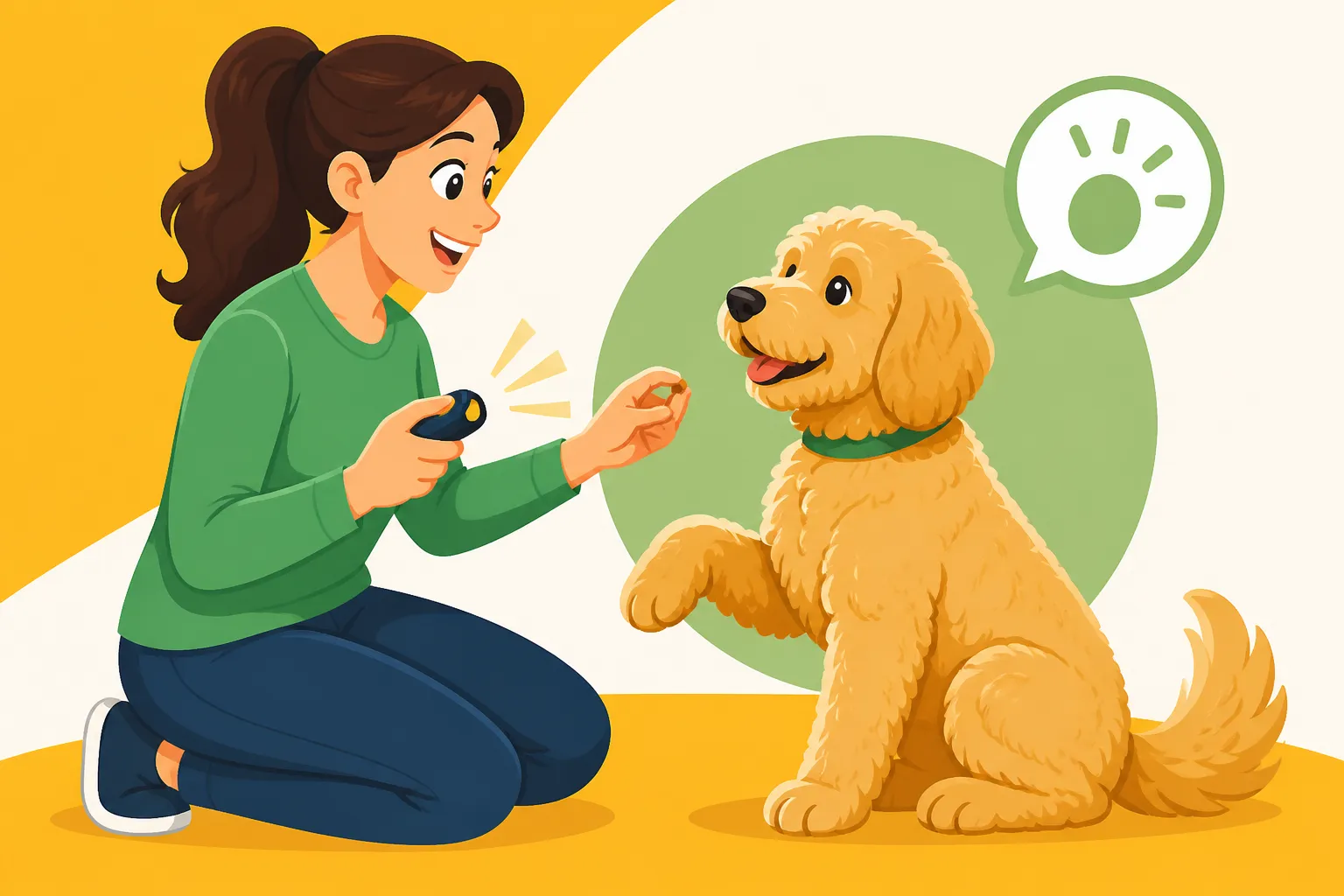
Marker training, at its heart, is about crystal-clear communication. It’s a way to tell your Goldendoodle, in the exact moment they’re doing something right, that that specific action will earn them a reward. Think of it as taking a mental snapshot of the desired behavior. The "marker" itself can be a clicker or a verbal cue like "Yes!" or "Good!" – something short, consistent, and distinct that your dog learns to associate with good things happening immediately after.
Why This Method Clicks with Goldendoodles
Goldendoodles are often described as having "Poodle brains with Retriever hearts." What does that mean for training? It means you've got a dog that's incredibly intelligent and eager to please, a fantastic combination for learning. Poodles are known for their sharp minds and ability to pick up complex commands quickly, while Golden Retrievers bring an inherent biddability and a strong desire to work with their humans. This blend makes Goldendoodles highly responsive to positive reinforcement methods, and marker training is the pinnacle of positive reinforcement.
Imagine trying to teach your Goldendoodle to sit. If you just say "Sit" and then give a treat when their rear hits the floor, they might not fully connect the treat to the act of sitting. Was it sitting down? Was it looking at you? Was it the wiggle of their tail right before the treat? With a marker, you click (or say "Yes!") the very instant their bottom touches the floor. That precise timing allows them to understand, "Oh! That is what earned me the reward!" This clarity reduces confusion and speeds up learning, which is a huge win when you have a smart, energetic puppy trying to figure out the world. You’ll find that Why a Goldendoodle Learns Faster Than Most Crosses is often attributed to this wonderful genetic combination.
The Problem with Delayed Gratification
One of the biggest frustrations for new puppy owners is when their dog just doesn't seem to "get it." You might ask them to sit, they finally do, and by the time you reach for the treat, they've already stood up again, sniffed the floor, or turned their head. In those few seconds, the opportunity for precise feedback is lost. Dogs live in the moment; their understanding of cause and effect is immediate. If the reward comes even a second or two too late, they're associating the reward with whatever they were doing at that exact moment – which might not be the behavior you wanted.
Marker training solves this. The clicker's sound (or your chosen verbal marker) is instantaneous. It's like a tiny, perfectly timed cheer that says, "Bullseye!" This allows you to reward behaviors even when you can't get the physical treat to them in the blink of an eye. This is especially helpful for complex or dynamic behaviors where getting a treat to them exactly at the peak of the action might be impossible. For instance, if you're trying to teach a calm greeting, you can click when all four paws are on the floor, even if it takes you another second to produce the treat. This precision solidifies the desired behavior in your Goldendoodle's mind, making future training much smoother and less frustrating for both of you. You're giving them clear, unambiguous feedback, which is exactly what a smart, eager-to-please dog thrives on.
Charging the Marker: Making the Clicker Mean "Good Things Are Coming!"
Before your Goldendoodle can understand that a click means "you did well," you have to teach them its meaning. This process is called "charging the marker," and it's the absolutely crucial first step in week one. Without a charged marker, it's just a random sound to your dog, utterly meaningless. The goal is to create a positive association so strong that the sound of the marker itself becomes a predictor of something wonderful.
The Initial Setup: Low Distractions, High Value Rewards
You'll want to start this process in a quiet environment where your Goldendoodle puppy can focus solely on you and the new sound. Your living room floor, away from windows and other pets, is a perfect spot. Make sure you have plenty of high-value treats readily available. These aren't your everyday kibble; think tiny pieces of cooked chicken, cheese, or small, soft training treats that your puppy absolutely adores. They should be pea-sized or smaller, something your puppy can gobble down quickly without much chewing, keeping the momentum going. Many owners find great soft training treats on Amazon that are perfect for this.
Hold your clicker in one hand (or be ready with your verbal marker) and a handful of treats in the other. Your puppy might be curious, or they might be distracted. Don't ask them to do anything yet. The goal here is purely about association: sound equals treat. You might even find that Why Goldendoodle Owners Get Wrong in Year One often stems from skipping or rushing this foundational step.
The Repetition Phase: Click, Treat, Repeat
The process is delightfully simple:
- Click (or say "Yes!").
- Immediately follow with a treat.
- Repeat.
Do this about 10-20 times in a short session, then take a break. You're not waiting for your Goldendoodle to do anything specific. You're just clicking and treating. The key is the immediate delivery of the treat after the marker. It should be so fast that your puppy barely registers the click before the treat is appearing. After a few repetitions, you'll start to notice your puppy's ears perk up at the sound, or their head might snap towards you in anticipation. This is a good sign!
Here’s a sample schedule for charging the marker in your Goldendoodle’s first week:
| Day | Session Frequency (times/day) | Repetitions Per Session | Environment | Notes |
|---|---|---|---|---|
| Day 1 | 3-4 | 10-15 | Quiet Living Room | Focus on immediate treat delivery. Don't ask for behaviors yet. |
| Day 2 | 3-4 | 15-20 | Living Room, Kitchen | Start moving to slightly different quiet spots. |
| Day 3 | 3-5 | 15-20 | Indoors, Low Distraction Yard | Introduce very mild background noise or a new room. |
| Day 4 | 3-5 | 20-25 | Various Low-Distraction Areas | Your Goldendoodle should eagerly anticipate the treat after the click. |
| Day 5+ | Integrate into Training | N/A | N/A | Begin using the marker for actual behaviors. |
Don't rush it. You want your Goldendoodle to really understand and love that sound. You'll know the marker is "charged" when, upon hearing the click, your puppy immediately looks at you, perhaps with a wagging tail, anticipating their reward, even if you don't actually give them a treat right then (though you should mostly continue to do so during initial charging).
Applying Marker Training to First Week Behaviors
Once your Goldendoodle understands that the marker sound means a treat is coming, you can start using it to shape their behavior. This is where the real magic happens in those early days, helping you teach foundational skills and set positive habits.
Encouraging Calmness and Settling
Goldendoodle puppies are bundles of boundless energy, which is adorable but also needs direction. One of the first things you'll want to teach is how to settle down. When your puppy is playing, zoomie-ing around, or nipping at everything, it's hard to get them to just be calm. But there will be moments, even fleeting ones, when they naturally settle. Maybe they lie down for a second, or take a deep breath, or stop mouthing for a beat. This is your chance!
The instant your puppy exhibits a calm behavior – they lie down quietly, or they're just chilling out on their bed for a few seconds – click! and deliver a treat. Don't ask them to do anything, just observe and mark the natural calm. Repeat this throughout the day. You’re essentially telling them, "Yes! That relaxed state is exactly what I like!" Over time, they'll start to offer these calm behaviors more frequently, understanding that this is a way to earn your attention and a yummy snack. This is a fantastic way to lay the groundwork for A Goldendoodle That Cannot Settle in the Evening.
Potty Training Precision
Potty training is often one of the most frustrating aspects of puppyhood, filled with accidents and missed opportunities. Marker training can significantly speed up the process by providing immediate, clear feedback when your Goldendoodle eliminates in the right spot. Every time your Goldendoodle squats and pees or poops outside, the very second they finish, click! and deliver a high-value treat.
This precise timing is critical. If you wait until they've walked back to the door, or if you just give praise without a marker, the connection between the act of eliminating outside and the reward might be fuzzy. The marker ensures they understand, "Eliminating right here, right now, earned me a jackpot!" This makes them much more likely to seek out that specific spot for future potty breaks. Consistency is key here. Every successful potty break outside should be marked and rewarded. For more details on this, you might find Goldendoodle Potty Training by Week helpful.
Redirecting Nipping and Chewing
Goldendoodle puppies, like all puppies, explore the world with their mouths. Nipping, mouthing, and chewing on inappropriate things are par for the course. Marker training can be invaluable in redirecting these behaviors towards acceptable outlets. When your puppy starts to mouth your hand, instead of yelling or pulling away (which can sometimes be seen as play), redirect them to an appropriate chew toy. The moment their teeth touch the toy instead of your hand, click! and reward.
The key here is not just redirecting, but marking the correct choice. You're not just telling them "no" to your hand; you're telling them "yes!" to the toy. This positive reinforcement strengthens the association with the toy. Make sure to have a variety of safe, appropriate chew toys available and constantly redirect any unwanted mouthing towards them. You can learn more about managing this common puppy behavior in Goldendoodle Puppy Nipping at Hands. Remember to keep training sessions short and positive, around Five Minute Goldendoodle Training Sessions at a time, especially for young puppies. Many online resources, like those provided by BAXTER & Bella, emphasize marker training for early puppy development.
Common Pitfalls and Troubleshooting Your Marker Training
Even with the best intentions and a smart Goldendoodle, marker training can have its hiccups. It's not always a perfectly smooth road, but understanding common issues can help you troubleshoot and keep your training on track.
Timing is Everything: When a Click is Too Late
One of the most frequent challenges in marker training is timing. As we discussed, dogs live in the moment. If your marker (click or verbal cue) comes even a fraction of a second too late, you might be rewarding the wrong thing. For example, if you're teaching "sit" and your Goldendoodle starts to stand up just as you click, you've accidentally marked the standing up motion. This can lead to confusion and slow down learning.
The solution is practice, practice, practice. Don't be afraid to click too early rather than too late in the beginning. It's better to mark a behavior approximating what you want than to miss the window entirely. Many trainers practice their timing by dropping a coin and clicking the instant it hits the ground. It sounds silly, but it hones your reflexes. Also, ensure your marker is truly instantaneous. A simple clicker is usually faster and more consistent than a verbal marker, especially when you're first starting out. Some people find that specific clickers from Amazon offer a consistent sound that's easy to use.
Over-Reliance on Treats: Fading the Lure
While treats are absolutely essential for charging the marker and initially teaching behaviors, you don't want your Goldendoodle to become a "treat junkie" who only obeys when they see food in your hand. This is known as becoming a "lure" and not truly understanding the command itself. The goal is to eventually fade the visible lure and rely on the verbal cue or hand signal, with the marker and treat serving as confirmation after the behavior.
To fade the lure, start making your hand motion smaller or delivering the treat from your pocket after the click. Once your Goldendoodle performs the behavior reliably with the marker and treat, start reducing the frequency of the treat. You'll still mark the behavior, but every third or fourth time, you might just give the marker and enthusiastic praise, saving the treat for truly outstanding efforts or new, challenging environments. Remember, the marker is the promise of a reward, but not every marked behavior needs a food reward after the initial learning phases. You can substitute with praise, a quick game, or a favorite toy. This process helps your Goldendoodle generalize the behavior and perform it even when a treat isn't immediately visible.
Distractions and Generalization: Taking Training Outdoors
Your Goldendoodle might be a superstar at "sit" in your quiet living room, but the moment you step outside where there are squirrels, birds, and interesting smells, it's like they've forgotten every single thing you've taught them. This is a very common scenario! It means your Goldendoodle hasn't yet "generalized" the behavior to different environments.
The key to overcoming this is to gradually introduce distractions. Start by training in slightly more distracting environments within your home (e.g., in the kitchen while someone is cooking). Then move to your backyard, then a quiet park, and so on. At each new level of distraction, go back to basics. Use your marker and high-value treats every single time the desired behavior is performed. Your Goldendoodle needs to understand that "sit" means "sit" regardless of whether a squirrel is running by. Short, successful sessions are better than long, frustrating ones. If your Goldendoodle is struggling, reduce the distraction level and build up again. Consistent practice in varied settings will make your Goldendoodle's training truly reliable. You'll want to apply this approach to important commands like Goldendoodle Recall in an Open Field as well.
Disclaimer
This article is for general informational purposes only and does not constitute professional advice. Laws, prices and regulations vary by location and change over time. Consult a qualified professional for guidance on your specific situation.