The DNA Panel a Goldendoodle Breeder Should Run
You found a Goldendoodle litter you love, the breeder says the parents are “fully health tested,” and then you ask to see the DNA results and get a blurry screenshot with half the markers cut off. That frustration is common. This guide explains exactly which genetic markers a Goldendoodle breeder should test, how to read the results, and what a good pairing decision looks like.
Why a DNA Panel Matters More for a Cross Than People Think
A lot of families come to Goldendoodles believing that crossing two breeds automatically washes out inherited disease. The trouble is that Golden Retrievers and Poodles share some of the same recessive mutations, and a cross does nothing to protect a puppy when both parents hand down the same faulty copy of a gene. That is the whole reason a DNA panel exists, and it is why I tell every buyer that the paperwork matters far more than the label on the litter.
The Hybrid Label Does Not Cancel Shared Recessives
Most of the inherited conditions on a canine DNA panel are autosomal recessive. A dog needs two copies of the mutation, one from each parent, to be affected. A dog with one copy is a carrier: it usually lives a completely normal life, but it can pass that copy on. When a Golden Retriever line and a Poodle line both carry the same mutation, an F1 cross can still produce affected puppies if both parents happen to be carriers.
The classic example is progressive rod cone degeneration, the form of progressive retinal atrophy known as prcd-PRA. It shows up in both parent breeds. A Golden carrier bred to a Poodle carrier has the same odds of producing a blind puppy as two carrier Goldens would. If you want the deeper version of this argument, see Why Testing Beats the Word Hybrid on a Goldendoodle, which walks through why the vigor claim breaks down exactly where shared genes overlap.
What a Panel Can and Cannot Tell You
A DNA panel is excellent at one specific job: telling you whether a dog has zero, one or two copies of a known, single gene mutation. For simple recessive conditions with a validated test, that answer is close to definitive. A dog that tests clear for prcd-PRA will not develop that particular form of PRA and cannot pass it on.
What the panel cannot do is predict complex, polygenic conditions. Hip dysplasia, elbow dysplasia, most heart disease, many cancers and allergies come from many genes plus environment, growth rate, weight and luck. No cheek swab screens for them in any reliable way. That is why a DNA panel is only half of a breeder’s testing program, with the other half being physical exams by specialists, which I cover further down.
The Core Health Markers on a Goldendoodle Panel
Most broad panels from reputable labs screen for well over a hundred conditions. For a Goldendoodle, only a handful of those are realistically relevant, because they are documented in Golden Retrievers, Poodles or both. These are the ones a breeder should be able to show you by name, on a report with the dog’s identity attached.
Eye Mutations a Breeder Cannot Skip
Progressive retinal atrophy is the headline item on any Goldendoodle panel. Three forms matter here:
- prcd-PRA, found in both Golden Retrievers and Poodles, which makes it the single most important shared marker for a cross.
- GR-PRA1, linked to the SLC4A3 gene and found in Golden Retrievers.
- GR-PRA2, linked to the TTC8 gene and also found in Golden Retrievers.
Because GR-PRA1 and GR-PRA2 come from the Golden side, an F1 puppy bred from a clear Poodle cannot be affected by them even if the Golden parent is a carrier. But once you breed doodle to doodle, those Golden-side mutations can start meeting again. A breeder producing F1b, F2 or multigen litters should test for all three forms on every breeding dog. The details of the test itself are laid out in The PRA DNA Test Both Goldendoodle Parents Need, and it is worth reading before you talk to any breeder.
Blood and Neurological Markers
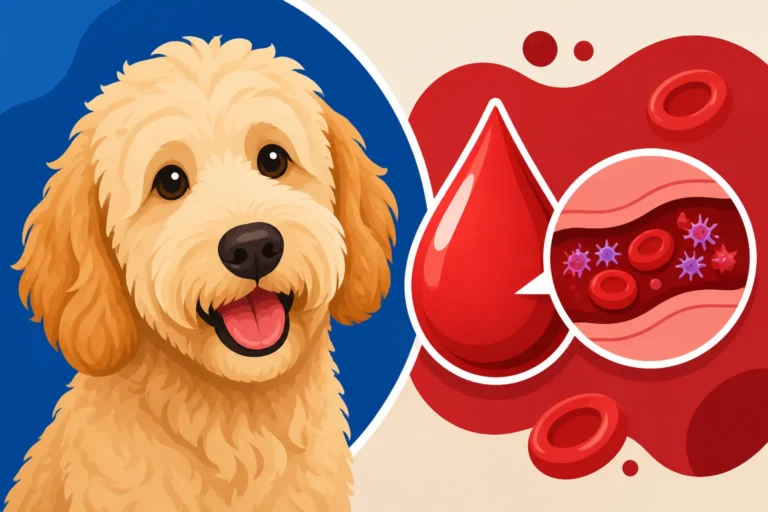
Von Willebrand disease type 1 is a bleeding disorder documented in Poodles. Affected dogs have low levels of a clotting protein and can bleed heavily after surgery, dental work or injury. Severity varies a lot, and some affected dogs never have a problem until they are spayed. Because the risk travels from the Poodle side, it matters most in F1b and multigen litters with heavy Poodle ancestry. The inheritance pattern across generations is covered in Von Willebrand Carried Down Both Goldendoodle Lines.
Neonatal encephalopathy with seizures, usually shortened to NEwS, is a Standard Poodle condition. Affected puppies are weak, uncoordinated and often seizure, and most do not survive past the first weeks of life. It is rare, but the test is cheap insurance for anyone breeding Standard Poodle lines.
Degenerative myelopathy, tied to a mutation in the SOD1 gene, appears in both breeds. It is a slow, progressive spinal cord disease of older dogs. The test is trickier to interpret, because many dogs with two copies never develop clinical signs. Breeders usually treat it as information rather than a hard stop, avoiding producing at-risk puppies where possible without throwing away otherwise excellent dogs.
Skin, Muscle and Skeletal Markers
Ichthyosis in Golden Retrievers, linked to the PNPLA1 gene, causes flaky, scaly skin and dark, rough patches on the belly. It is not life threatening, but it is lifelong and itchy, and in some Golden lines the carrier rate is high. A second, rarer ichthyosis mutation has also been described in the breed, and good panels include both.
Osteochondrodysplasia is a skeletal dwarfism found in Miniature Poodles, which matters for any mini or toy Goldendoodle program. Chondrodystrophy with the CDDY mutation, an inserted copy of the FGF4 gene, is linked to short legs and a higher risk of intervertebral disc disease. It is common in small Poodles, and it is the one marker on this list that is not a simple recessive: even one copy raises disc risk. That makes it especially relevant when you are buying a smaller doodle.
Macrothrombocytopenia shows up in Poodles too. It means the dog has fewer but larger platelets. It is generally harmless, but a vet who does not know about it can misread routine bloodwork, so knowing the result is useful for the owner even if it never affects a breeding decision.
| Marker | Parent breed source | Inheritance | Why it matters for a Goldendoodle |
|---|---|---|---|
| prcd-PRA | Both | Recessive | Shared mutation, can appear even in F1 litters |
| GR-PRA1 | Golden Retriever | Recessive | Becomes a risk in doodle to doodle pairings |
| GR-PRA2 | Golden Retriever | Recessive | Same pattern as GR-PRA1 |
| Von Willebrand type 1 | Poodle | Recessive, variable severity | Surgical bleeding risk, matters for F1b and multigen |
| NEwS | Standard Poodle | Recessive | Fatal in young puppies |
| Degenerative myelopathy | Both | Recessive, incomplete penetrance | Late onset spinal disease, interpreted with care |
| Ichthyosis | Golden Retriever | Recessive | Lifelong scaly skin |
| Osteochondrodysplasia | Miniature Poodle | Recessive | Skeletal dwarfism in small lines |
| CDDY | Small Poodles | Dominant risk effect | Higher disc disease risk with one or two copies |
| Macrothrombocytopenia | Poodle | Recessive | Mostly harmless, affects lab interpretation |
Reading Results and Pairing Parents
The value of a panel is not in the PDF itself. It is in what the breeder does with it when choosing which dogs to pair. A breeder who tests everything and then ignores the results is not much better than one who never tested at all.
Clear, Carrier and At Risk
Reports from different labs use slightly different wording, but they all boil down to three outcomes for a recessive condition:
- Clear, sometimes written as “normal” or “no copies.” The dog has no copies of the mutation and cannot pass it on.
- Carrier, sometimes written as “one copy.” The dog is usually healthy but passes the mutation to roughly half its puppies.
- At risk, sometimes written as “affected” or “two copies.” The dog is expected to develop the condition, or at least has the genetic setup for it, and passes one copy to every puppy.
You will also run into the phrase “clear by parentage.” That means the dog itself was not tested, but both of its parents tested clear, so it cannot have inherited the mutation. It is a legitimate shortcut when the parentage is verified, and a weak one when it is not. For a closer look at how carrier results affect a litter, see What a Carrier PRA Result Means for a Goldendoodle.
The Pairing Math
Here is the arithmetic every breeder should know by heart for a simple recessive condition. The percentages are averages across many litters; any single litter can land differently by chance.
| Pairing | Clear puppies | Carrier puppies | At risk puppies |
|---|---|---|---|
| Clear with clear | 100% | 0% | 0% |
| Clear with carrier | About 50% | About 50% | 0% |
| Clear with at risk | 0% | 100% | 0% |
| Carrier with carrier | About 25% | About 50% | About 25% |
| Carrier with at risk | 0% | About 50% | About 50% |
| At risk with at risk | 0% | 0% | 100% |
The only lines that produce affected puppies are the ones where both parents carry at least one copy. That is the scenario explained in When Both Goldendoodle Parents Carry the Same Gene, and it is the scenario a panel exists to prevent.
Why a Carrier Is Not Automatically Pulled From Breeding
Buyers sometimes panic when they see “carrier” on a parent’s report. Usually they should not. A carrier bred to a clear mate produces no affected puppies at all. Responsible breeders keep carriers in their programs all the time, because pulling every carrier would shrink the gene pool and throw away dogs with great hips, great temperaments and great hearts.
What a good breeder does is track carrier status in the puppies that will be bred later. Pet puppies from a clear by carrier pairing can be carriers without any consequence to their own health. Breeding prospects from that litter should be tested themselves, so the next generation of pairings is planned on real data rather than assumptions.
Where you should worry is if a breeder pairs two carriers for the same condition, or uses an at risk dog without a very clear reason and a clear mate. Neither is common among careful breeders, and both are a strong sign the testing is for show.
Coat and Color Genes Breeders Add to the Panel
Most panels that Goldendoodle breeders order also report trait genes. These have nothing to do with health, but they shape what kind of dog the puppy grows into, and for many families they matter almost as much as the disease markers.
Furnishings, Curl and Shedding
Three coat genes drive most of what people expect from a Goldendoodle:
- Furnishings, the RSPO2 gene. One or two copies give the dog the beard, eyebrows and leg hair of a “doodle face.” A dog with no copies, often called an improper coat or flat coat, looks more like a Golden and typically sheds more.
- Curl, the KRT71 gene. Zero, one or two copies push the coat from straight to wavy to curly. Curl affects texture and grooming, but it does not on its own decide shedding.
- Shedding, the MC5R gene. This one is associated with lower shedding when a dog carries the low shedding variants, and it works alongside furnishings rather than replacing it.
A breeder who wants to produce low shedding, furnished puppies needs to know these results on both parents. Pairing two dogs that each carry one copy of the unfurnished allele will produce some flat coat puppies, which is not a health problem, but it is a big surprise for an allergic family promised a non-shedding dog. More detail lives in DNA Coat Testing on a Goldendoodle.
Color Loci and a Note on Merle
Color genes on the panel include the E locus for red and cream shades, the B locus for chocolate, the K locus for solid versus patterned coats, the A locus for sable and phantom patterns, and the D locus for dilution. A breeder planning a specific color, or explaining why a puppy is apricot rather than red, should be working from these results rather than guesswork.
The one color result with real health consequences is merle. Merle is not native to either Golden Retrievers or Poodles, so its presence in a Goldendoodle line means another breed has been introduced at some point. Breeding two merle dogs together risks “double merle” puppies with a high rate of deafness and eye defects. Any breeder producing merle should be testing for it on every breeding dog and never pairing merle to merle, including cryptic merles that do not show the pattern clearly.
| Trait gene | What it controls | Why breeders test it |
|---|---|---|
| RSPO2 | Furnishings, beard and eyebrows | Predicts doodle face and lower shedding |
| KRT71 | Curl | Predicts straight, wavy or curly coat |
| MC5R | Shedding tendency | Adds to shedding prediction |
| E, B, K, A, D loci | Base color and pattern | Planning colors honestly |
| M locus | Merle | Prevents double merle health problems |
Building a Complete Testing Program Around the Panel
A DNA panel by itself is not a health program. It covers the single gene conditions and nothing else. The breeders I trust treat the panel as one piece of a larger set of clearances and records, and they expect to repeat parts of that work across a dog’s breeding life.
Where DNA Ends and Physical Exams Begin
The conditions that tend to cost Goldendoodle owners the most are often the polygenic ones, and those are screened with physical exams rather than swabs:
- Hips and elbows, evaluated through radiographs submitted to the Orthopedic Foundation for Animals or through PennHIP. Golden Retrievers in particular have a meaningful rate of hip and elbow dysplasia.
- Eyes, examined by a board certified veterinary ophthalmologist. This catches cataracts, eyelid and eyelash problems and other conditions that a DNA test does not screen for, and it is usually repeated regularly.
- Heart, especially for Golden lines, where subvalvular aortic stenosis is a known concern. A cardiologist exam is the standard, not just a general vet listening with a stethoscope.
- Thyroid, sometimes added for both breeds, because hypothyroidism appears in each.
Goldendoodles are not eligible for the purebred breed club schemes that bundle these exams together, so there is no single certificate that tells a buyer the job is done. That gap is the subject of What Replaces CHIC for a Goldendoodle Buyer, and it is exactly why buyers need to look at individual results. The physical exam side of the picture is described in OFA Clearances on a Goldendoodle Sire and Dam.
Choosing a Lab and Verifying Results
Breeders have several reputable options for DNA testing, including Embark, Wisdom Panel, Paw Print Genetics and the Veterinary Genetics Laboratory at UC Davis. Each lab lists its own markers, so it is worth comparing panels directly instead of assuming that “breeder panel” means the same thing everywhere. Pricing and bundle options change, so breeders should check each lab’s own site for current details. A sensible process looks like this:
- List the markers that matter for the program, based on the parent breeds and the generation being bred, using the table above as a starting point.
- Confirm the lab’s panel covers every one of those markers, including all three PRA forms and CDDY for smaller lines.
- Collect the sample so that identity is not in doubt. A vet collected sample, or a sample linked to a microchip number, carries more weight than a swab done at the kitchen table.
- Make sure the report names the dog, shows the registration or microchip number, and states each result individually.
- Where possible, submit results to the OFA database so they become publicly searchable, which lets buyers check them independently.
- Retest only when there is a reason, such as doubtful identity, but repeat the physical exams on schedule.
Embark reports in particular are a common sight in doodle listings, and they can be dense. If you are handed one, see Which Embark Results Matter on a Goldendoodle Parent for a practical walkthrough of what to read first and what you can skim.
What Buyers Should Ask to See
If you are on the buying side, here is the sequence I would follow with any breeder. It takes a few emails and saves a lot of heartache:
- Ask for the full DNA reports for both the sire and the dam, not a summary or a social media graphic.
- Check that each report lists the dog’s name and microchip or registration number, and that the names match the parents of the litter.
- Look specifically for prcd-PRA, GR-PRA1, GR-PRA2, von Willebrand, NEwS, ichthyosis and, for smaller doodles, CDDY and osteochondrodysplasia.
- Confirm that no condition shows a carrier or at risk result on both parents at the same time.
- Ask for hip, elbow, eye and heart results as separate documents, and look them up in the OFA database where they have been submitted.
- Ask how the breeder chose this pairing and what they would do if a puppy developed a problem.
The broader checklist for both parents is in Health Testing Both Goldendoodle Parents Should Have.
What the Panel Means After the Puppy Comes Home
A clean set of parent results does not end the story when your puppy walks through the front door. It shapes how you think about insurance, how you talk to your vet, and what you keep in your files for the next ten or more years.
Insurance and Hereditary Conditions
Pet insurers vary in how they treat hereditary and congenital conditions, and Goldendoodle owners should read that part of any policy carefully. Healthy Paws is one provider many doodle owners look at, because its policies have been structured to include hereditary conditions as long as they are not pre-existing. The key point for any insurer, Healthy Paws included, is timing: a condition that shows signs before enrollment or during a waiting period will usually be treated as pre-existing, regardless of what the parents’ DNA results say.
That is why parent testing and early enrollment work together. Testing lowers the chance of a single gene disease showing up at all, and enrolling a young puppy before any symptoms appear keeps the polygenic risks, such as hip dysplasia, more likely to be covered. Whether a puppy’s own DNA results affect underwriting is a separate question, and it is explored in Whether a DNA Test Helps a Goldendoodle Policy. If you are comparing Healthy Paws against other insurers, check each company’s own policy documents for current coverage terms, waiting periods and exclusions rather than relying on what a friend was told years ago.
Keeping the Records for Life
Ask the breeder for copies of every parent result in a format you can save, and keep them with your puppy’s vaccination and microchip records. If your dog ever needs surgery, your vet will want to know about von Willebrand status. If your dog’s bloodwork comes back with low platelet counts, a macrothrombocytopenia result on a parent can save you a frightening and expensive round of tests. If your dog starts bumping into furniture at dusk, knowing the PRA status of both parents changes the conversation with your vet immediately.
You might also consider testing your own puppy. For a pet, the main benefits are confirming parentage, finding out about trait genes, and having a baseline record for your vet. It is not essential when both parents have verified clear results, but plenty of owners find it useful and reassuring. Because no registry holds a central health record for Goldendoodles, the job of keeping these files falls on you, and Keeping the Records No Goldendoodle Registry Holds offers a practical system for doing it.
Frequently Asked Questions
Does an F1 Goldendoodle Need a Full DNA Panel?
Yes. An F1 is less exposed to breed-specific mutations than a multigen dog, but prcd-PRA and degenerative myelopathy appear in both Golden Retrievers and Poodles. Testing both parents is the only way to rule out a shared carrier pairing.
Is a Puppy From Clear Parents Guaranteed to Be Healthy?
No. Clear parents mean the tested single gene conditions cannot appear in the litter. They say nothing about hips, elbows, heart disease, allergies or cancer, which is why physical exams and a sensible upbringing still matter.
Should I Walk Away If One Parent Is a Carrier?
Not necessarily. A carrier bred to a clear mate produces no affected puppies. The red flag is two carriers for the same condition, or a breeder who cannot explain the pairing.
Disclaimer
This article is for general informational purposes only and does not constitute professional advice. Laws, prices and regulations vary by location and change over time. Consult a qualified professional for guidance on your specific situation.