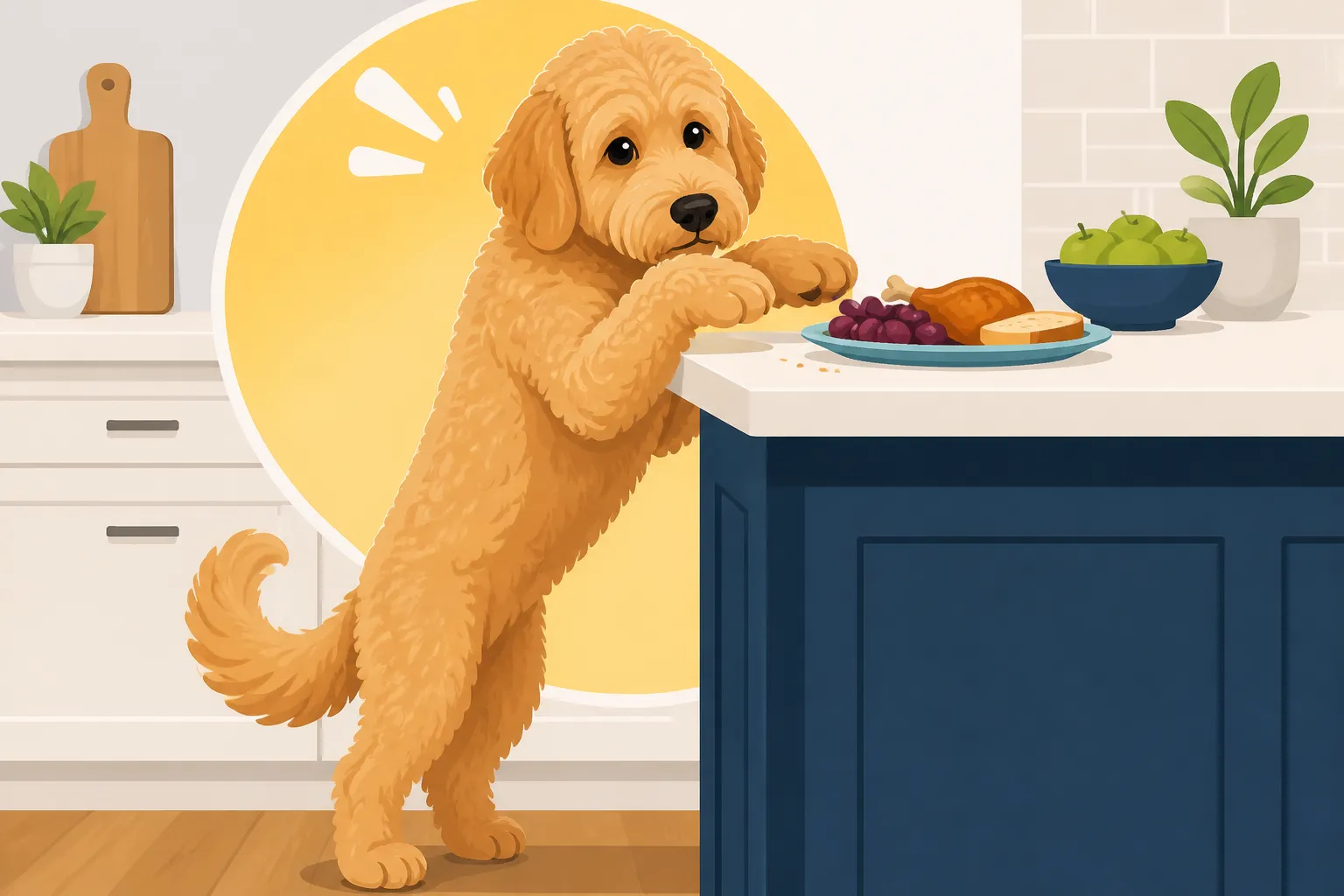
Goldendoodle Counter Surfing at Standard Height
You step out of the kitchen for what feels like just a second to grab a drink, only to return to a half-eaten sandwich or a package of chicken pulled right off the counter. The culprit? Your adorable Goldendoodle, standing tall and proud, probably with a few crumbs still on their whiskers. It's an incredibly common and frustrating problem for many Goldendoodle owners, especially as these clever dogs reach their full "standard height" potential. This comprehensive guide will walk you through understanding why your Goldendoodle sees your countertops as fair game and, more importantly, how to implement practical strategies to put an end to this sneaky habit for good.
Understanding the "Why" Behind Goldendoodle Counter Surfing
It’s easy to get frustrated when your Goldendoodle helps themselves to your meal, but understanding why they do it is the first step toward finding a solution. It’s not about malice; it’s about instinct, opportunity, and reward.
The Goldendoodle's Natural Inclinations
Goldendoodles are a unique blend of two highly intelligent and eager-to-please breeds: the Golden Retriever and the Poodle. Both bring traits to the table that can contribute to counter surfing, sometimes in surprising ways.
The Golden Retriever side of your Goldendoodle is rooted in their history as bird dogs, bred to retrieve game for hunters. This means they often have a strong "retrieve drive" – an innate desire to pick things up with their mouths and carry them. If that "thing" happens to be a delicious piece of toast on your counter, their natural inclination kicks in. They're also incredibly food-motivated, which makes any accessible food item a high-value target. A Goldendoodle’s natural exuberance and zest for life can sometimes translate into a boundless curiosity that extends to every surface in your home. They're explorers by nature, and a counter represents a new frontier of interesting smells and potential treasures.
Then there's the Poodle influence. Poodles are famously intelligent, often ranking among the smartest dog breeds. This intelligence means they are quick learners, for better or for worse. If your Goldendoodle successfully snags a treat from the counter even once, their Poodle brain quickly registers this as a rewarding and repeatable behavior. They'll remember the circumstances, the angle of the counter, and how to execute the mission again. They aren't just reacting; they're problem-solving. This cleverness also means they might observe your habits, learning when the kitchen is unattended or when a particularly tantalizing smell signals an opportunity. For more on their inherited traits, consider reading What a Goldendoodle Inherits From Each Parent Breed.
The Height Advantage and Opportunity
Let's face it, many Goldendoodles, especially standard-sized ones, can be quite tall and agile. A standard Goldendoodle can easily stand on their hind legs and reach a surprising height, putting even the most carefully placed items within their grasp. What might seem out of reach to a smaller dog is often eye-level for a Goldendoodle. This physical capability, combined with their strong sense of smell and curiosity, creates a perfect storm for counter surfing.
The reality is that we, as humans, often inadvertently create the opportunity. A forgotten plate, groceries left on the edge of the counter while we unpack, or a cooling pie on a cooling rack – these are all irresistible invitations. To your Goldendoodle, if it’s there and they can reach it, it’s fair game. They operate on a different set of rules than we do. They don't have the abstract concept of "private property" or "human food." They see resources, and if those resources are available, they'll seize them. It’s a classic case of demand meeting supply, and if your Goldendoodle is getting rewarded (with food!), the behavior will continue and even intensify. This highlights why management is so crucial.
Proactive Prevention: Setting Up for Success
The old adage "an ounce of prevention is worth a pound of cure" couldn't be more true when it comes to Goldendoodle counter surfing. By taking proactive steps, you can drastically reduce the opportunities for your dog to practice this unwanted behavior.
Removing Temptation and Creating Barriers
The single most effective way to prevent counter surfing is to eliminate the reward. This means ensuring that absolutely nothing tempting is left on your counters, especially when you're not actively supervising. It sounds simple, but it requires a conscious effort and a shift in household habits. Think of your kitchen counters as empty canvases when not in use.
Practically, this means wiping down counters immediately after preparing food, putting leftovers away promptly, and never leaving plates or food items unattended, even for "just a minute." Be mindful of items that might not seem like food to you but are highly enticing to a dog, such as dirty napkins, empty takeout containers, or even dish towels that smell of food. For Goldendoodles that are particularly persistent, even items that aren't edible, like remote controls or keys, can become targets if they associate them with your attention or a game of chase. For help teaching your dog to keep their paws off forbidden snacks, check out Goldendoodle Impulse Control With Food on the Floor.
Beyond simply clearing the decks, consider physical barriers. Baby gates are your best friend here. A sturdy, tall baby gate can effectively block access to the kitchen when you can't supervise. These can be found on retailers like Amazon, offering various heights and widths to suit your space. For standard-sized Goldendoodles, you'll want to ensure the gate is high enough that they can't easily jump over it. Crates can also be invaluable for supervised chew time or when you simply need a safe, dog-free zone while you cook or eat. Training your Goldendoodle to comfortably settle in their crate or on a designated "place" mat during meal prep can be a game-changer.
Managing Waste and Household Habits
It’s not just about what's on the counter; it's also about what's around the counter, especially your trash can. Many Goldendoodles are expert trash excavators, and an open or easily accessible bin is just another invitation to an all-you-can-eat buffet. Invest in a heavy-duty trash can with a secure, dog-proof lid. Look for models that are pedal-operated and have an internal locking mechanism, or are simply too heavy for your Goldendoodle to tip over.
Beyond physical barriers for your waste, consistent household habits are paramount. Every member of the family needs to be on board with the "no food on counters" rule. If one person slips up, it creates an opportunity for your Goldendoodle to get a reward, which reinforces the undesirable behavior. Establish clear rules and communicate them to everyone, including guests. A simple sign on the refrigerator or a quick verbal reminder can help.
Consider creating a "Goldendoodle-free zone" during meal times or when cooking. This could involve placing your dog in their crate with a long-lasting chew, or using a baby gate to keep them confined to another area of the house. Teaching a reliable "go to your mat" or "place" command is incredibly helpful here, providing them with a calm alternative activity rather than leaving them to patrol the kitchen. This redirection gives them something appropriate to do instead of something naughty. For advice on managing their energy levels, take a look at Goldendoodle Exercise at Thirty to Sixty Minutes.
Active Training and Behavior Modification
While prevention is crucial, you'll also want to actively train your Goldendoodle what you do want them to do, and gently discourage unwanted counter surfing when it occurs. This involves consistency, positive reinforcement, and clear communication.
Teaching "Off" and "Leave It"
Two of the most valuable commands for a counter-surfing Goldendoodle are "Off" and "Leave It." These commands empower you to communicate boundaries and redirect their attention before they even get a chance to snatch something.
"Off" is for when your Goldendoodle has already put their paws on the counter or is leaning against it, but hasn't yet taken anything. The goal here is to teach them that four paws on the floor is the desired position.
- Set up: Place a tempting but non-essential item (like a toy they like, not food initially) on a low counter or chair.
- Wait: Wait for your Goldendoodle to put their paws up.
- Command and Lure: As soon as their paws touch the counter, say "Off" firmly but calmly. Immediately lure them away from the counter with a high-value treat, bringing the treat down towards the floor.
- Reward: As soon as all four paws are on the floor, praise them enthusiastically and give them the treat.
- Repeat: Practice this many times in different locations and with different items. Gradually increase the value of the item on the counter as they get better.
"Leave It" is for when your Goldendoodle sees something tempting but hasn't yet touched it. This command teaches them to ignore the item.
- Set up: Hold a low-value treat in your closed fist.
- Command: Say "Leave It."
- Wait: Your Goldendoodle will likely sniff and try to get the treat. Keep your fist closed.
- Reward: The instant they look away from your hand, open your hand and give them a different, higher-value treat (from your other hand or pocket).
- Progress: Once they understand this, place a low-value treat on the floor, cover it with your hand, say "Leave It," and reward when they look away. Gradually move to placing the treat on the floor uncovered, always rewarding for ignoring it.
These commands require immense consistency. Everyone in the household must use the same commands and timing. If your Goldendoodle gets mixed signals, their Poodle intelligence might lead them to experiment with who they can ignore. Many Goldendoodle owners find that online training programs, such as those offered by BAXTER & Bella, can provide structured lessons and support for teaching these foundational commands effectively. Their step-by-step approach can be incredibly helpful for maintaining consistency across a family.
Redirection and Positive Reinforcement
Punishing your Goldendoodle after the fact (e.g., yelling after they've already eaten the sandwich) is generally ineffective and can even damage your bond. Dogs don't connect punishment to past actions; they only understand what's happening right now. Instead, focus on redirecting their attention and rewarding appropriate behavior.
If you catch your Goldendoodle eyeing the counter, before they even jump, redirect them! Call their name, ask them to "sit" or "down" on their mat, and then reward that desired behavior generously. This teaches them that engaging with you and following commands leads to good things, not counter-surfing. For more general training tips that work with the Goldendoodle's eager nature, consider Training a Goldendoodle That Wants to Please You.
Positive reinforcement is key. When your Goldendoodle chooses not to investigate the counters, or when they successfully follow an "Off" or "Leave It" command, shower them with praise, treats, and affection. Make the desired behavior more rewarding than the forbidden one. This means having high-value treats readily available in the kitchen. A small piece of cheese, cooked chicken, or a favorite training treat can go a long way in reinforcing good choices.
Consider providing appropriate outlets for their chewing and mental stimulation needs. A bored Goldendoodle is a creative Goldendoodle, and that creativity often extends to finding new sources of entertainment (like your dinner). High-quality chew toys, puzzle feeders, and engaging play sessions can help burn off excess energy and keep their minds occupied. After all, a tired dog is often a well-behaved dog. Puzzle Toys That Occupy a Goldendoodle for an Hour can be a lifesaver for keeping their busy minds engaged away from the counter.
Essential Tools and Long-Term Management
Successfully stopping counter surfing isn't just about training; it's also about leveraging the right tools and committing to long-term management strategies.
Deterrents and Physical Barriers
Sometimes, simply clearing the counters isn't enough, especially with a determined Goldendoodle. That's where specific deterrents can come in handy. These are typically used as temporary measures to break the habit by making counter-surfing an unpleasant, rather than rewarding, experience.
One classic, low-tech deterrent is the "can trap." Stack empty soda cans or lightweight plastic containers on the edge of the counter, perhaps balanced on a cookie sheet, so they tumble down and make a loud noise if your dog paws or nudges the counter. The startling noise, not punishment from you, teaches them that the counter is an unpleasant place. Another option involves motion-activated alarms or air sprays (like Ssscat or PetSafe brand products). These devices emit a loud hiss or a burst of air when triggered by motion, creating an immediate, unwelcome consequence. They can be particularly effective because the dog doesn't associate the deterrent with you, but rather with the counter itself. You can find many of these motion-activated deterrents and tall baby gates for Goldendoodles on Amazon.
For long-term physical management, sturdy baby gates are indispensable, especially those designed for larger breeds or higher openings. Some owners find success with strategically placed furniture that blocks direct access to specific counter sections. Remember, A Standard Goldendoodle Tall Enough to Reach the Counter means your barriers need to be substantial. Consider gates that stand at least 36-40 inches high, or even taller, depending on your dog's size and jumping ability.
| Strategy Type | Description | Best For | Key Benefit |
|---|---|---|---|
| Prevention | Removing all tempting items; using secure trash cans; baby gates. | Early stages, unsupervised moments, general household management. | Eliminates opportunity, prevents practice of unwanted behavior. |
| Active Training | Teaching "Off," "Leave It," "Place" with positive reinforcement. | Directly addressing the behavior, building communication. | Teaches desired behaviors, builds impulse control. |
| Deterrents | Motion-activated alarms, can traps, scat mats. | Breaking established habits, temporary discouragement. | Creates unpleasant association with counters without handler intervention. |
| Redirection | Offering appropriate chew toys, puzzle feeders, engaging in play. | Managing boredom, redirecting energy, rewarding good choices. | Keeps dog occupied, reinforces alternative appropriate behaviors. |
Consistency and Lifelong Habits
The journey to a counter-surfing-free home is rarely a quick fix; it requires unwavering consistency and a commitment to long-term habits. Every single time your Goldendoodle successfully counter-surfs, the behavior is reinforced, making it harder to break. This means every family member, every guest, needs to be on the same page.
Don't give up if you experience setbacks. It’s normal for dogs to test boundaries, especially when they’re puppies going through their "teenage" phases or if household routines change. If your Goldendoodle puppy starts Goldendoodle Puppy Chewing Through Furniture, it’s often a sign they’re exploring boundaries in general, which can extend to counter surfing. Revisit your training, reinforce your management strategies, and double down on consistency.
Beyond prevention and active training, ensure your Goldendoodle is getting adequate physical and mental exercise. A dog that is physically tired and mentally stimulated is less likely to invent their own "games" that involve your kitchen counters. Daily walks, playtime, training sessions, and interactive toys all contribute to a well-adjusted dog who is less prone to mischievous activities. Providing engaging alternatives, like a food puzzle stuffed with their dinner or a high-value chew, can give them an appropriate outlet for their natural drives when you need to focus on cooking. By consistently applying these strategies, you're not just stopping an annoying habit; you're building a stronger, more trusting relationship with your clever Goldendoodle.
Disclaimer
This article is for general informational purposes only and does not constitute professional advice. Laws, prices and regulations vary by location and change over time. Consult a qualified professional for guidance on your specific situation.