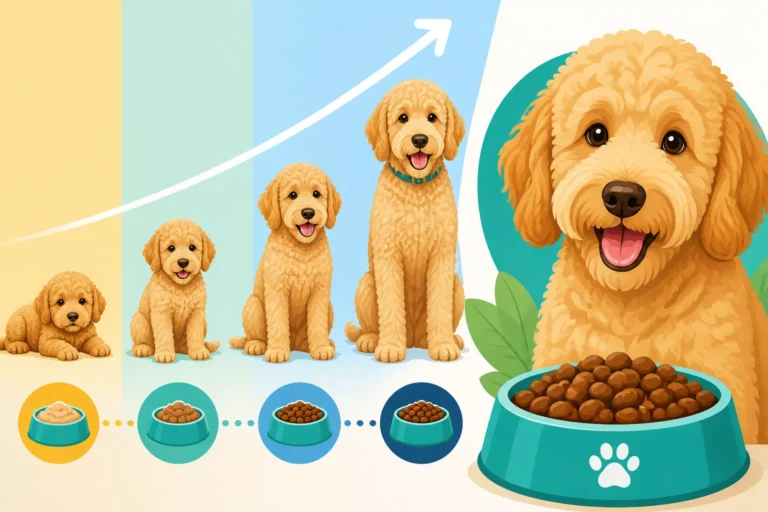
Daily Calories for a Mini Goldendoodle
Figuring out exactly how much to feed your Mini Goldendoodle can feel like an impossible puzzle. You bring home this adorable, energetic fluffball, and suddenly you're faced with bags of food that give vague ranges, or online calculators that seem to contradict each other. It’s frustrating because you want to do everything right for your furry family member, but the guidelines are rarely clear-cut. This guide is here to cut through the confusion and give you a realistic, practical framework for determining and managing your Mini Goldendoodle’s daily caloric intake, ensuring they stay happy and healthy throughout their lives.
Decoding Your Mini Goldendoodle's Calorie Needs
When you're looking at the back of a dog food bag, the recommended serving sizes often feel like a shot in the dark. Your Mini Goldendoodle isn't just a number on a scale; they have a unique metabolism, activity level, and growth stage that all play a huge role in how many calories they truly need each day. It’s not just about keeping them full, it’s about providing the right fuel for their boundless energy and maintaining a healthy body condition.
Why Calorie Needs Aren't One-Size-Fits-All
Imagine two Mini Goldendoodles, both weighing 25 pounds. One might be a couch potato who enjoys short strolls around the block, while the other is an agility enthusiast who spends hours running and training. Clearly, their energy demands are vastly different! Age also plays a critical role. A rapidly growing puppy needs more calories per pound of body weight than an adult dog, and a senior dog's metabolism often slows down, requiring fewer calories to prevent weight gain. Then there are factors like whether they're spayed or neutered, which can significantly impact their metabolic rate. It’s easy to see why a single blanket recommendation simply won't work.
Key Factors Influencing Daily Calorie Intake
So, what are these crucial factors we need to consider? First, there's your dog's age. Puppies are building bones, muscles, and organs, so their caloric needs are much higher. Adults need energy for maintenance, while seniors might need fewer calories and possibly different nutrient ratios. Second, activity level is huge. A highly active Mini Goldendoodle that goes on long hikes, plays fetch for an hour, or participates in dog sports will burn far more calories than one who mostly hangs out indoors. Third, their spay/neuter status is important; spayed or neutered dogs often have slower metabolisms and tend to gain weight more easily if their caloric intake isn't adjusted. Lastly, individual metabolism varies from dog to dog, just like in people. Some dogs are naturally lean, others pack on pounds if you're not careful. Keeping a close eye on their body condition, even under their beautiful coat, is paramount. Keeping a Goldendoodle Lean When the Coat Hides It
Calculating the Magic Number: A Starting Point for Daily Calories
Okay, so we know it's not a simple answer, but we need a place to start. Thankfully, there's a basic formula vets often use to estimate a dog's Resting Energy Requirement (RER) – the calories needed for basic bodily functions – and then adjust it for their individual situation. This isn't a perfect science, but it provides a much better baseline than just guessing.
The Resting Energy Requirement (RER) Formula
The most common formula to calculate RER is:
RER (in kcal/day) = 70 * (body weight in kg)^0.75
Now, before you panic about the math, let's break it down for our Mini Goldendoodles.
- Convert pounds to kilograms: Divide your dog's weight in pounds by 2.2. So, a 25-pound Mini Goldendoodle is about 11.36 kg.
- Calculate weight to the power of 0.75: This is the trickiest part without a scientific calculator. Many online calculators or apps can do this for you. For 11.36 kg, (11.36)^0.75 is roughly 6.09.
- Multiply by 70: So, 70 * 6.09 = 426.3 kcal/day. This is your dog's resting calorie need.
This RER is for a dog just sitting there, doing nothing. Your Goldendoodle definitely does more than that! So, we use a "Metabolic Factor" to adjust this RER.
Applying the Metabolic Factor
Once you have your RER, you multiply it by a metabolic factor based on your dog's life stage and activity level. This gives you their estimated daily energy requirement (DER).
| Life Stage/Condition | Metabolic Factor | Estimated DER Calculation (example 25lb Mini Goldendoodle) |
|---|---|---|
| Puppy (0-4 months) | 3.0 | 426.3 kcal * 3.0 = 1278.9 kcal |
| Puppy (4 months-adult) | 2.0-2.5 | 426.3 kcal * 2.0 = 852.6 kcal (use 2.5 for highly active) |
| Adult, intact | 1.8 | 426.3 kcal * 1.8 = 767.3 kcal |
| Adult, spayed/neutered | 1.6 | 426.3 kcal * 1.6 = 682.1 kcal |
| Weight Loss | 1.0-1.4 (target ideal weight) | 426.3 kcal * 1.2 = 511.5 kcal (using 1.2 factor) |
| Weight Gain | 1.8-2.0 | 426.3 kcal * 1.9 = 810 kcal (using 1.9 factor) |
| Senior | 1.4 | 426.3 kcal * 1.4 = 596.8 kcal |
Note: These are estimates. Always consult your vet for precise recommendations, especially for puppies, seniors, or dogs with health concerns.
So, for our average 25-pound spayed/neutered adult Mini Goldendoodle, a starting point would be around 680 calories per day. This is a much more actionable number than "feed 2-3 cups" when you don't even know the calorie density of your specific food! This method is a far more personalized approach than just looking at the bag. Many reputable pet food brands, like those found on Chewy, will list the calorie content per cup or per kilogram right on the label, often as "kcal/cup" or "ME (Metabolizable Energy) kcal/kg," which helps immensely when trying to hit that daily target.
Adjusting for Life Stage, Activity, and Health
Now that you have a baseline, it's time to refine it. Our Mini Goldendoodles are rarely static creatures, and their calorie needs will ebb and flow throughout their lives. This is where your keen observation skills as a pet parent come into play.
Goldendoodle Puppy Power-Up
Those adorable Mini Goldendoodle puppies are growing at an incredible rate, and they need a lot of fuel! Their metabolic factor is much higher because they're building bone, muscle, and a whole lot of mischief. For puppies up to about four months old, they might need 2.5 to 3 times their RER. As they get a bit older, say from four months to a year, this can drop to 2 to 2.5 times RER. It's crucial to feed them a high-quality puppy food specifically formulated for growing dogs. You'll likely be feeding them more frequent, smaller meals too – often three times a day, sometimes even four for very young puppies – to help them digest and utilize those calories efficiently. Remember, rapid growth spurts mean fluctuating appetites, so keep an eye on their body condition constantly. Feeding a Goldendoodle Puppy Through Growth and Dropping a Goldendoodle Puppy to Two Meals can offer more insights into feeding schedules.
Adult Goldendoodle Activity Levels
For an adult Mini Goldendoodle, the activity factor is your biggest variable.
- Low Activity (1.4-1.6x RER): This is for the dog that gets short walks, mostly plays indoors, and isn't typically sprinting or engaging in vigorous exercise daily. If your Mini Goldendoodle is a certified snuggle bug, this might be their range, especially if they're spayed or neutered.
- Moderate Activity (1.6-1.8x RER): This covers most active pets. Daily walks, some enthusiastic playtime in the yard, or regular trips to the dog park for a good romp would fit here. This is often the sweet spot for many Mini Goldendoodles.
- High Activity (1.8-2.0x RER): For dogs involved in serious training, dog sports like agility, or who accompany you on long runs or hikes daily. These dogs are burning serious calories and need the fuel to match.
It’s always better to start a little lower and increase gradually if your dog seems too lean or constantly hungry. Remember that treats also add to the daily calorie count! If you're using training treats frequently, make sure to factor those into their overall intake. A handful of small treats can easily add 50-100 calories without you even realizing it. Goldendoodle Exercise for Body and Mind highlights the importance of matching their food intake to their energy expenditure.
Senior Goldendoodles and Special Considerations
As your Mini Goldendoodle enters their golden years (typically around 8-9 years old), their metabolism tends to slow down. They might not be as active as they once were, and their bodies require fewer calories to maintain weight. A metabolic factor of 1.2 to 1.4 times RER is often appropriate for senior dogs. This helps prevent weight gain, which can put unnecessary strain on aging joints.
However, some senior dogs might actually lose weight due to other health issues. This is where regular vet check-ups are essential. Conditions like thyroid disease, kidney disease, or dental problems can all affect appetite and nutrient absorption. If your senior Mini Goldendoodle is losing weight unintentionally, a trip to the vet is definitely in order. Don't just increase their food without understanding the cause. Senior Goldendoodle Vet Visits After Nine discusses the importance of these check-ups. You might also consider specific senior formulas from brands available on platforms like Amazon, which often have different nutrient profiles to support aging health.
For dogs that have been spayed or neutered, their metabolism might shift, making them more prone to weight gain. Recalculating a Goldendoodle Ration After Neutering delves deeper into these adjustments. Likewise, if your dog is recovering from an illness or surgery, their caloric needs might temporarily increase for healing. Always work with your veterinarian during these times to ensure appropriate nutritional support.
How to Monitor and Maintain a Healthy Weight
Calculating calories is one thing, but consistently maintaining a healthy weight for your Mini Goldendoodle is an ongoing process. Their coat can sometimes hide subtle changes, making it tricky to spot weight fluctuations. This is where a hands-on approach and regular monitoring truly make a difference.
The Body Condition Score (BCS)
This is perhaps the most important tool you have. The Body Condition Score isn't about the number on the scale as much as it is about how your dog looks and feels. It’s a visual and tactile assessment, usually on a 9-point scale, where 4-5 is ideal.
- Too Thin: You can easily see and feel their ribs, spine, and hip bones. There's little to no fat cover.
- Ideal: You can easily feel their ribs without pressing hard, but you can't see them. They have a visible waist when viewed from above, and an abdominal tuck when viewed from the side.
- Overweight: It's hard to feel their ribs under a layer of fat. They have no discernible waist, and their abdomen sags.
Because of the Mini Goldendoodle's fluffy coat, you really have to get your hands on them. Run your fingers along their sides to feel for those ribs. Can you count them easily without them being visible? That's a good sign. If it feels like you're searching for them under a thick cushion, it's time to consider a calorie adjustment. Goldendoodle Body Condition Under a Thick Coat goes into more detail on how to assess this.
Tools for Accurate Feeding
Once you've landed on a calorie target, consistent and accurate feeding is crucial.
- Digital Food Scale: This is hands-down the best way to ensure accuracy. Cups can vary wildly in how much food they hold depending on density, kibble size, and how you scoop. Weighing your dog's food, even dry kibble, in grams is far more precise. You can find affordable kitchen scales on Amazon or other online retailers that work perfectly for this. Measuring Goldendoodle Food by Weight emphasizes this point.
- Measuring Cups (as a last resort): If you must use a measuring cup, use a standard kitchen measuring cup, not a random plastic scoop that came with a bag of food. And always level it off. Still, it's not as accurate as weighing.
- Managing Treats and Chews: Remember that treats aren't "freebies"! They contribute to your dog's daily calorie intake. Aim for low-calorie treats, or break larger treats into smaller pieces. If you're using fresh food options like Ollie, be mindful of their calorie density as well, as these can sometimes be richer than dry kibble. Always deduct treat calories from their main meal portion. This is especially important during training sessions where many treats are used.
When to Adjust and When to See the Vet
If your Mini Goldendoodle is consistently too thin or gaining weight despite your best efforts to manage their calories, it's time to adjust their food intake.
- Weight Gain: If your dog is starting to get a little chunky, reduce their daily calories by about 10-15%. Give it a few weeks, continue monitoring, and adjust again if needed. Increased exercise can also help, but diet is usually the primary factor in weight loss. Goldendoodle Weight Gain and the Strain on Joints explains why keeping them lean is so important for their long-term health.
- Weight Loss: If your dog is too thin, slowly increase their calories by 10-15%. If they continue to lose weight, or you notice other symptoms like a dull coat, lethargy, or changes in stool, it’s absolutely time for a vet visit. Unexplained weight loss can be a sign of underlying health issues, from parasites to more serious conditions like thyroid imbalance or even certain cancers. Sometimes it's also a matter of finding a food they truly enjoy and digest well. Exploring different reputable food brands on sites like Chewy might be beneficial if you suspect palatability or digestibility issues.
Remember, this isn't a "set it and forget it" process. Your Goldendoodle's needs will change over time, so regular monitoring of their weight and body condition is essential for a long, healthy life.
Disclaimer
This article is for general informational purposes only and does not constitute professional advice. Laws, prices and regulations vary by location and change over time. Consult a qualified professional for guidance on your specific situation.