What F2b and F1bb Mean on a Goldendoodle Pedigree
Trying to navigate the world of Goldendoodle generations can feel like you need a genetics degree, especially when terms like F2b or F1bb start popping up on breeders' websites or in conversations. It's totally understandable to feel a bit lost; these designations aren't always intuitive, and you just want to understand what they truly mean for the puppy you might bring home. This guide is here to unravel those tricky genetic labels, helping you grasp their makeup and what you can realistically expect from these specific Goldendoodle generations.
Decoding Goldendoodle Generations: The F-Numbers Explained
Before we dive into the specifics of F2b and F1bb, it's helpful to understand the basic "F" nomenclature that Goldendoodle breeders use. The 'F' stands for 'Filial,' simply indicating a hybrid cross. The number that follows tells you which generation the dog is. The goal with these generations is often to achieve more consistent traits, particularly regarding coat type and shedding, but it's not a perfect science. We're dealing with genetics, after all, and nature loves a good surprise! For a broader understanding of how these generations fit into the bigger picture, check out Goldendoodle Generations From F1 to Multigen.
The Foundation: F1 and F1b Goldendoodles
Every Goldendoodle lineage starts with the F1 generation. This is the original cross, where a purebred Golden Retriever is bred with a purebred Poodle. The result is a 50/50 mix of their genetic material. An F1 Goldendoodle often has a wavy coat, which can vary in shedding. Some might shed lightly, while others might shed more, similar to a Golden Retriever. You can learn more about this foundational generation in The F1 Goldendoodle at Fifty Fifty.
The F1b (F1 backcross) generation is where breeders start to introduce more Poodle influence. This dog is created by breeding an F1 Goldendoodle back to a purebred Poodle. The 'b' signifies this backcross. An F1b Goldendoodle typically has a genetic makeup of roughly 75% Poodle and 25% Golden Retriever. This higher percentage of Poodle genetics usually results in a curlier coat and a much higher likelihood of being low-shedding, which is often a significant draw for families with allergies. We delve into this more deeply in The F1b Goldendoodle at Three Quarters Poodle.
The F2 Generation: Where Things Get Interesting
The F2 generation is created by breeding two F1 Goldendoodles together. Logically, you might think an F2 would be consistently 50/50, just like its F1 parents. However, this is where genetic variability really kicks in. While the average genetic contribution is 50% Golden Retriever and 50% Poodle, the individual puppies within an F2 litter can vary wildly. Some F2 puppies might lean heavily towards the Golden Retriever side, with straighter, shedding coats, while others might favor the Poodle, with curly, low-shedding coats. This unpredictability can be a bit of a challenge for those seeking specific coat types. If you're interested in the nuances of this generation, you'll find more details in The F2 Goldendoodle and Its Unpredictable Coat. This variability is precisely why breeders began to develop the F2b and F1bb generations – they wanted more consistency, especially for those highly sought-after low-shedding traits.
Unpacking the "F2b" Goldendoodle: More Poodle, Less Shedding?
Now, let's tackle the F2b. This is one of the more common "b" backcrosses you'll encounter, and it's popular for a reason: it aims for a more predictable, often low-shedding coat than a standard F2.
The Genetic Blueprint of an F2b
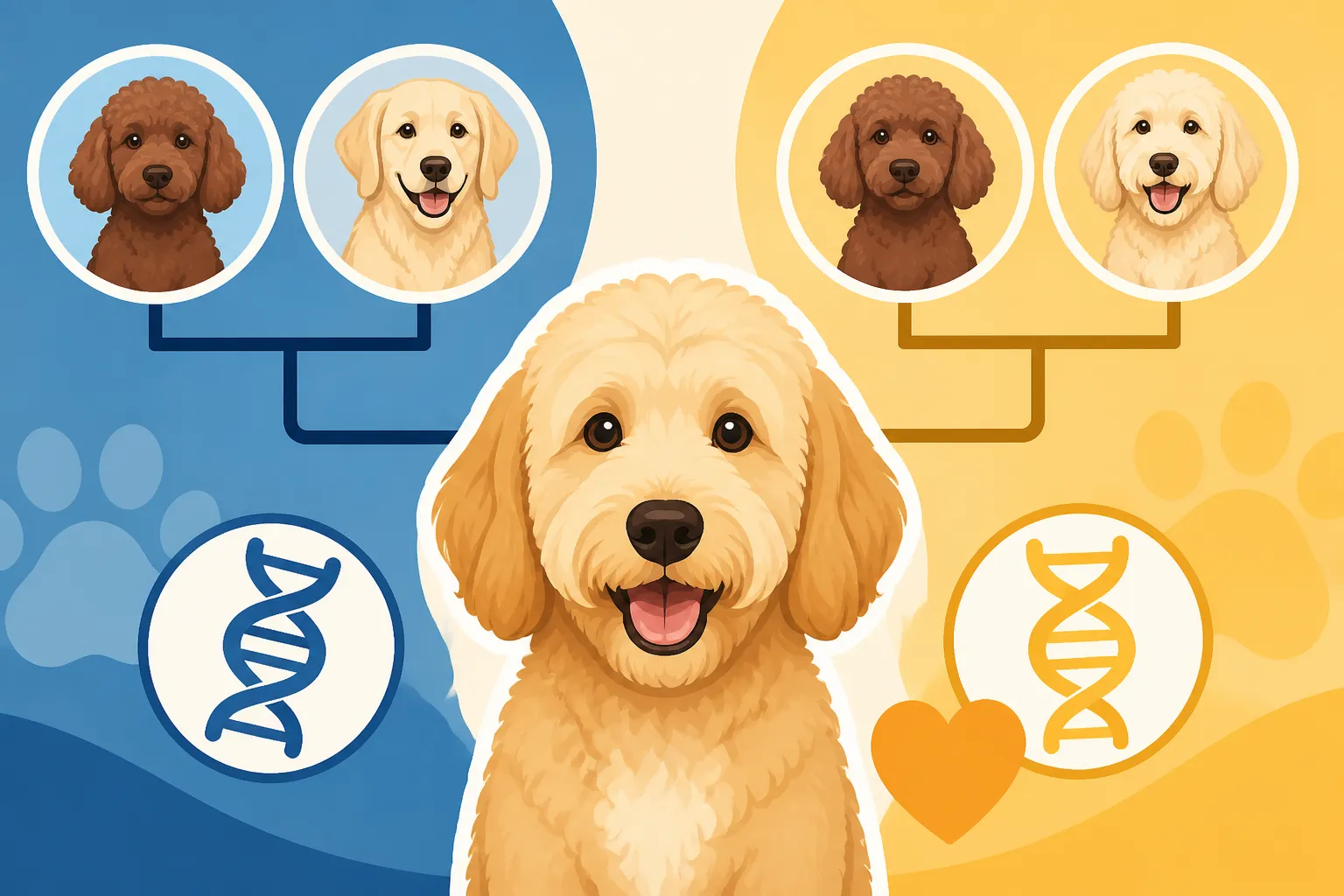
An F2b Goldendoodle is typically the result of breeding an F2 Goldendoodle with a purebred Poodle. Think of it like this: you're taking a dog that's a mix of an F1 (50/50) and an F1 (50/50), and then breeding that outcome back to a Poodle.
So, genetically, an F2b Goldendoodle generally has a makeup of approximately 62.5% Poodle and 37.5% Golden Retriever. This is why you'll often hear them described as being "more Poodle-like" than an F2. The increased Poodle genetics are intended to push the coat towards curlier, less shedding territory.
Why Breeders Create F2b Goldendoodles
Breeders typically aim for the F2b generation to achieve greater consistency in coat type and a higher likelihood of reduced shedding compared to the F2 generation. The F2 generation, as we discussed, can be a bit of a genetic lottery, with puppies having a wide range of coat types, from straight to curly, and shedding levels to match.
By backcrossing an F2 Goldendoodle to a purebred Poodle, breeders are essentially trying to "lock in" the desirable Poodle traits, particularly the non-shedding, curly coat. For families that specifically seek a Goldendoodle for allergy reasons, or simply prefer less dog hair around the house, the F2b can be a very appealing option because it generally offers a more reliable outcome in terms of shedding than an F2. It's an attempt to mitigate some of that F2 variability and provide a more consistent product.
What to Expect from an F2b Coat and Temperament
With that 62.5% Poodle influence, F2b Goldendoodles often have coats that are wavy to curly, and they are generally considered to be low-shedding. However, it's crucial to remember that "low-shedding" is not "no-shedding," and even within an F2b litter, there can still be some variation. Some puppies might have a curlier, denser coat, while others might have a slightly wavier, looser curl. The famed Goldendoodle "furnishings" (the longer hair on the face, eyebrows, and beard) are almost always present in an F2b, contributing to that classic "doodle" look. Understanding Why a Goldendoodle Puppy Coat Predicts Nothing is important, even with these generations, as coats can change as they mature.
Temperament-wise, F2b Goldendoodles still inherit the wonderful blend of their parent breeds. You'll likely see the intelligence and eagerness to please from the Poodle side, coupled with the friendly, outgoing nature and biddability of the Golden Retriever. They tend to be very social, affectionate, and intelligent, making them highly trainable and wonderful family companions. You can read more about what makes them so special in The Goldendoodle Temperament Owners Describe. Like all Goldendoodles, they thrive on interaction and mental stimulation, so having a good supply of puzzle toys from a place like Chewy can be really beneficial for their smart brains!
Unpacking the "F1bb" Goldendoodle: Maximum Poodle Influence
If you're looking for an even higher likelihood of a non-shedding, allergy-friendly coat, the F1bb generation pushes the Poodle genetics almost to their maximum in a Goldendoodle cross.
How the F1bb Generation is Bred
The F1bb Goldendoodle is created by breeding an F1b Goldendoodle back to a purebred Poodle. Let's break that down:
- An F1 is 50% Golden Retriever / 50% Poodle.
- An F1b is an F1 bred to a Poodle, making it 25% Golden Retriever / 75% Poodle.
- An F1bb then takes that F1b (75% Poodle) and breeds it to another purebred Poodle.
This intense backcrossing means the F1bb Goldendoodle is roughly 87.5% Poodle and only 12.5% Golden Retriever. It's as close as you can get to a purebred Poodle while still technically being a Goldendoodle cross.
The High Poodle Percentage and Its Implications
With 87.5% Poodle genetics, the F1bb generation is specifically bred for individuals who need the absolute lowest shedding potential and the curliest coat possible. This high Poodle content almost guarantees a very curly, dense coat, often referred to as a "wool" coat, which is most similar to that of a purebred Poodle. This coat type is generally considered the most allergy-friendly among all Goldendoodle generations.
However, a very curly coat also means significant grooming needs. These coats can mat quickly if not brushed regularly and professionally groomed every 6-8 weeks. So, while it's great for allergies, be prepared for consistent coat maintenance! You'll want to invest in good quality brushes and combs, readily available at places like Chewy, to keep those curls mat-free.
In terms of temperament, the increased Poodle influence means you might see a slightly more reserved or sensitive personality compared to generations with more Golden Retriever. They are still incredibly intelligent and eager to please, making them highly trainable. However, they might be a bit less boisterous in greetings and potentially more prone to developing separation anxiety if not properly acclimated to alone time.
F2b vs. F1bb: A Direct Comparison
Choosing between an F2b and an F1bb often comes down to your priorities, particularly regarding coat type and shedding. Here's a quick comparison to help clarify the differences:
| Feature | F2b Goldendoodle | F1bb Goldendoodle |
|---|---|---|
| Parentage | F2 Goldendoodle x Poodle | F1b Goldendoodle x Poodle |
| Genetic Ratio | ~62.5% Poodle / 37.5% Golden Retriever | ~87.5% Poodle / 12.5% Golden Retriever |
| Coat Type | Wavy to curly; generally low-shedding | Very curly, dense (wool-like); extremely low-shedding |
| Allergy-Friendly | Highly likely to be allergy-friendly | Highest likelihood of being allergy-friendly |
| Grooming Needs | Significant; regular brushing, professional grooms | Very high; daily brushing, frequent professional grooms |
| Temperament | Balanced Golden Retriever/Poodle traits; social | More Poodle-like; intelligent, potentially more sensitive |
| Consistency | Good consistency in coat/shedding | Very high consistency in coat/shedding |
If your primary concern is allergies and you need the absolute lowest shedding potential, an F1bb might be your best bet. If you're looking for a good balance of traits and a highly likely low-shedding coat without the extreme curl, an F2b could be a fantastic fit. Both are excellent choices, but understanding their genetic leanings can help you make an informed decision. For more on shedding, consider Which Goldendoodle Generation Sheds Least.
Beyond the Pedigree: What Truly Matters for Your Goldendoodle
While understanding F-numbers is a valuable tool, it's just one piece of the puzzle when choosing a Goldendoodle. A good breeder will emphasize that healthy, well-socialized puppies come from more than just a specific generation.
Health First: Why Genetic Testing Trumps Generation
No matter the generation, the health of your Goldendoodle puppy should always be the top priority. The F-number tells you about the mix of breeds, but it doesn't guarantee freedom from inherited diseases. Both Golden Retrievers and Poodles are prone to certain genetic health issues, such as hip and elbow dysplasia, eye conditions like Progressive Retinal Atrophy, and certain cancers. These can absolutely be passed down to Goldendoodles of any generation.
A truly responsible breeder will perform comprehensive health testing on both parent dogs before breeding. This includes certifications for hips, elbows, eyes, and often genetic panel testing for diseases common to Golden Retrievers and Poodles. Always ask to see these test results. They are far more important than any F-number in predicting your puppy's long-term health. Check out Health Testing Both Goldendoodle Parents Should Have for a deeper dive into what to look for. Even if you're buying a puppy from a reputable breeder, it's a good idea to set up an account with a pet supply retailer like Chewy for easy access to quality food and any supplements your vet might recommend down the line.
Coat Concerns: "Hypoallergenic" Is Never a Guarantee
The promise of a "hypoallergenic" dog is often what draws people to Goldendoodles, and generations like F2b and F1bb aim to maximize that low-shedding potential. However, it's a common misconception that any Goldendoodle is truly hypoallergenic. The truth is, no dog is 100% hypoallergenic. Allergies are caused by dander (dead skin cells), saliva, and urine, not just hair. While a low-shedding dog disperses fewer allergens into the environment, they still produce them.
F2b and especially F1bb Goldendoodles, with their higher Poodle percentages, are more likely to be suitable for people with mild allergies because they shed minimally. But there's never a 100% guarantee. If allergies are a serious concern, it's always recommended to spend time with the adult parent dogs, and even puppies, from the specific breeder you're considering to see if you have a reaction. Read Why No Goldendoodle Is Truly Hypoallergenic to understand this better. A good breeder will be transparent about this and never make false promises. You can also ask about DNA Coat Testing on a Goldendoodle to get a clearer picture of a puppy's likely adult coat type.
Finding the Right Match: Responsible Breeding and Individual Temperament
Ultimately, the best Goldendoodle for you, regardless of its F-number, will come from a responsible breeder who prioritizes health, temperament, and ethical breeding practices. A good breeder will be transparent about their dogs' genetics, health testing, and the specific traits they are aiming for in their litters. They will also be dedicated to socializing their puppies from birth, ensuring they are well-adjusted and ready for their new homes.
Don't let the F-numbers overshadow the importance of the individual puppy and its parents. Focus on finding a puppy with a temperament that matches your lifestyle, and ensure the breeder can provide proof of all necessary health clearances. The genetic blend that creates a Goldendoodle offers wonderful potential, but responsible breeding makes all the difference. For more guidance on this crucial step, read Choosing a Goldendoodle Breeder Worth Buying From. Remember that a Goldendoodle inherits unique traits from both the Golden Retriever and the Poodle, which are fascinating to learn about in What a Goldendoodle Inherits From Each Parent Breed.
Disclaimer
This article is for general informational purposes only and does not constitute professional advice. Laws, prices and regulations vary by location and change over time. Consult a qualified professional for guidance on your specific situation.