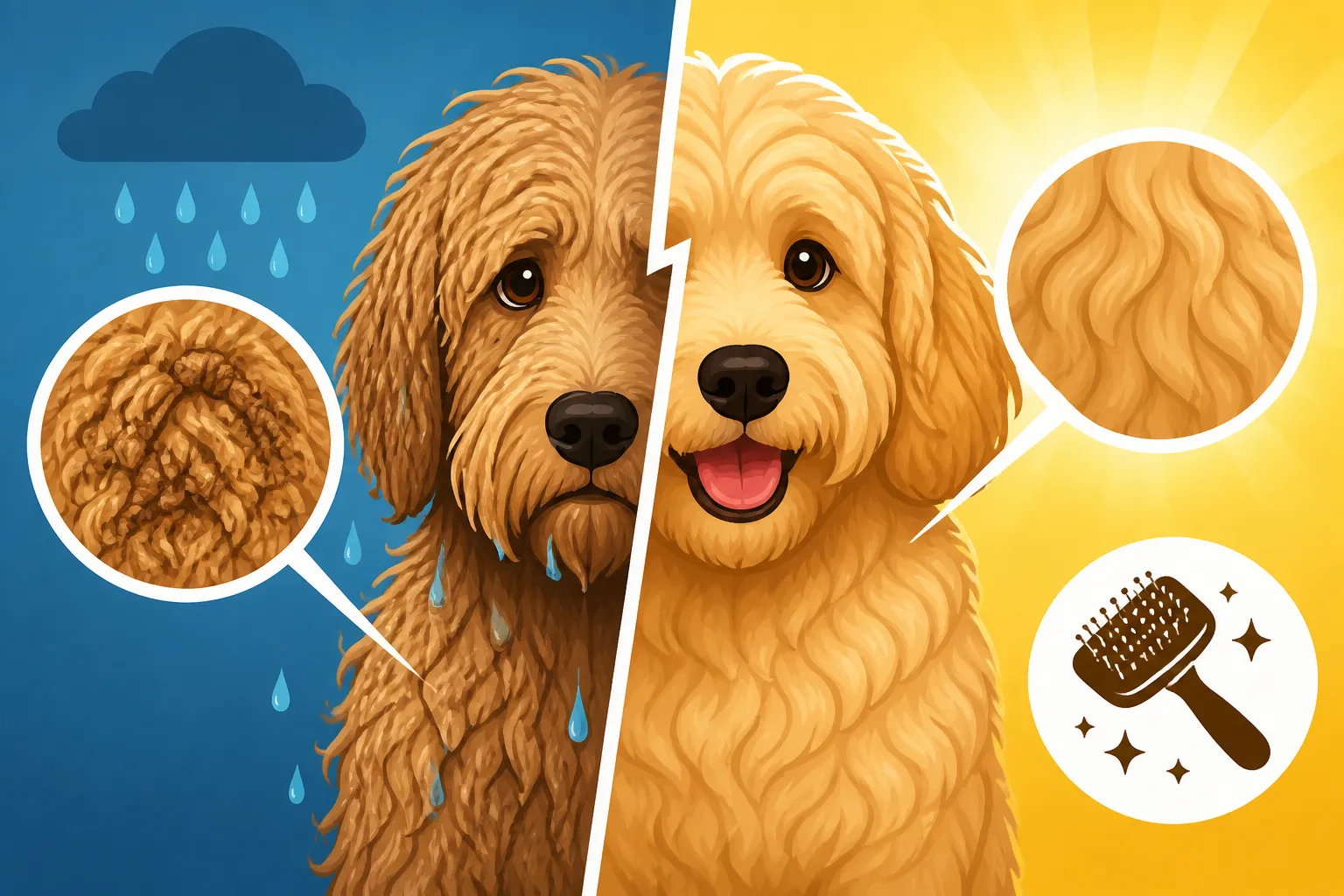
Why a Damp Goldendoodle Coat Mats Faster
It’s a scenario Goldendoodle owners know all too well: your furry friend just had a wonderful romp outside, maybe got a little damp from a misty morning walk or a quick splash, and suddenly, you notice tiny tangles starting to form. Or perhaps it’s after a bath, and despite your best efforts, you're finding snarls and knots appearing seemingly out of nowhere. The truth is, a damp Goldendoodle coat is an absolute magnet for mats, and understanding why is your first step to preventing this common frustration.
Understanding Your Goldendoodle's Unique Coat & Matting Vulnerabilities
Goldendoodles are cherished for their soft, often curly or wavy coats, a beautiful blend inherited from their Golden Retriever and Poodle parents. But this gorgeous coat, which can range from straight to tightly curled, is also the primary reason they are so prone to matting, especially when moisture enters the picture. It’s a delicate balance, and getting it wrong can lead to serious discomfort for your dog and a hefty grooming bill for you.
The Blended Coat: Poodle Curl Meets Golden Retriever Flow
Think about the distinct qualities of a Golden Retriever’s coat: it’s typically a double coat, with a softer, denser undercoat beneath longer, water-repellent guard hairs. Then consider the Poodle: a single layer of dense, curly hair that grows continuously. When you mix these two, as with a Goldendoodle, you get a beautiful, often low-shedding, but highly complex coat. You might have an F1 Goldendoodle with a wavy, shaggy coat, or an F1b with a tighter, Poodle-like curl. The "furnishings" gene gives them their characteristic beard and eyebrows, adding more texture and length to areas around the face. All these variations share one critical characteristic: their texture and density make them perfect for tangles, and water only amplifies this. The Three Goldendoodle Coat Types and How to Tell Them can really help you identify what you're working with.
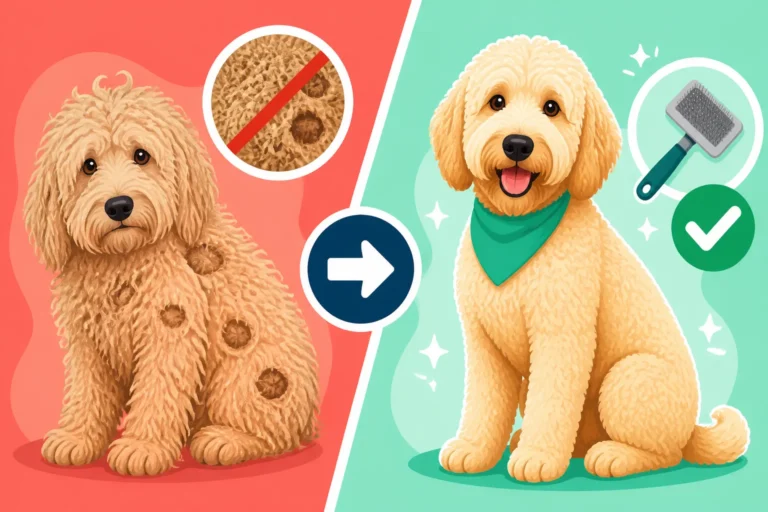
This isn't just about aesthetics; it's about the very structure of the hair shafts themselves. Each strand, whether wavy or curly, has natural bends and hooks that are just waiting to catch onto another strand. In a dry coat, a diligent brushing routine can often prevent these from forming into serious mats. But introduce water, and those individual strands, already prone to entangling, become even more intertwined as they swell and then contract during drying. It's like trying to untangle wet yarn versus dry yarn – the wet kind clings to itself with tenacious determination.
How Moisture Penetrates and Affects Hair Structure
When your Goldendoodle gets wet, whether from a bath, a puddle, or even just high humidity, water doesn't just sit on the surface of their coat. It penetrates deeply into each individual hair shaft, causing it to swell. Imagine tiny sponges absorbing water – that's what's happening at a microscopic level with your dog's hair. This swelling isn't a problem in itself, but it significantly alters the hair's surface and flexibility.
As the hair absorbs water, its outer cuticle, which is made of tiny overlapping scales, lifts slightly. This creates more friction between individual strands, making them much more likely to snag and cling to each other. When these swollen, friction-prone strands are then left to dry naturally, especially if compressed or moved around, they become locked together in increasingly tight bundles. This process is far more efficient at creating mats than dry friction alone. It's a fundamental physical change that makes your Goldendoodle's damp coat a ticking time bomb for tangles, often turning what seems like minor dampness into a full-blown matting emergency if not addressed swiftly and correctly.
The Science of Accelerated Matting When Wet
It might seem counterintuitive that water, which we often associate with cleaning and detangling our own hair, can be the enemy of a Goldendoodle's coat. But the unique structure of their fur, combined with the physics of water and drying, creates a perfect storm for mat formation. This isn't just about a few stray knots; it's about a fundamental change in how the hair behaves.
Increased Friction: When Wet Strands Cling
When your Goldendoodle’s coat gets wet, a fascinating physical change occurs that dramatically increases its matting potential: increased friction. Unlike human hair, which often becomes slippery and easier to detangle when wet and conditioned, a Goldendoodle's dense, often curly or wavy coat becomes stickier. Each hair shaft, as discussed, absorbs water and slightly opens its cuticle. This roughened surface, instead of sliding past adjacent hairs, now has more points of contact, more microscopic "hooks" that grab onto each other.
Think of it like trying to slide two pieces of velvet past each other when they're slightly damp versus perfectly dry. The damp velvet will resist, clinging and catching, while the dry velvet glides. The same principle applies here. When thousands upon thousands of these now-rougher, swollen hair strands are pressed together or moved, they lock into place with astonishing efficiency. This increased friction is the primary culprit in turning a beautifully damp Goldendoodle into a matted mess in what feels like mere minutes. It’s why you might find mats after even a quick dip in the lake or a humid day.
The Drying Process: A Recipe for Tangles
The drying process is where the true disaster often unfolds. As water evaporates from the hair shafts, they shrink back to their original size. However, if those swollen, friction-prone strands have already tangled together, this shrinking action acts like a cinch, tightening the knots into dense, unforgiving mats. Imagine a wet sponge: as it dries, it becomes firm and rigid. Now apply that to tangled hair. The water effectively "glues" the hairs together temporarily, and as it dries, that "glue" solidifies.
If a Goldendoodle's coat is left to air dry, or is not dried thoroughly and systematically, the conditions are ripe for matting. Gravity, movement, and the natural clumping of wet hair all conspire to create knots that become impossible to brush out once fully dry. This is especially true if the dog is allowed to roll around, rub on furniture, or even just shake after being wet. The forces at play during drying pull the loose hairs tighter and tighter, literally setting the mats in place. This makes Drying a Goldendoodle Coat Properly one of the most critical steps in grooming.
Compression & Movement: Aggravating Damp Mats
Beyond the basic physics of wet hair, compression and movement are huge accelerators for mat formation in a damp Goldendoodle coat. Think about your dog lying down in their bed or crate while still damp. The pressure from their body against the bedding, or even against the floor, compresses the wet hair in those areas – typically the armpits, behind the ears, on the belly, and where their legs meet their body. These are often the first places you find mats. The Spots Where a Goldendoodle Mats First are usually areas of high friction and compression.
Similarly, every shake, every roll, every rub against a couch leg, or even just walking around, creates friction and tangling in a damp coat. The individual wet hairs, eager to cling to each other, are kneaded and pressed into tighter and tighter clumps. It's like trying to felt wool – you need moisture, friction, and pressure. Your Goldendoodle's everyday movements, when damp, are essentially an unwitting felting process. This is why a simple wet walk can lead to significant matting if the coat isn't immediately and thoroughly dried upon returning home. It’s a vicious cycle where dampness, combined with normal canine activity, quickly turns a manageable coat into a matted nightmare.
Common Damp Scenarios That Catch Owners Off Guard
It's easy to imagine a Goldendoodle getting soaked playing in a lake, but often, the most insidious matting comes from less obvious sources of dampness that owners might not even register as a threat. These seemingly innocuous damp situations can lead to extensive matting because they often go unaddressed, allowing the coat to dry haphazardly and solidify tangles.
The After-Bath Rush: Insufficient Drying at Home
This is perhaps the most common scenario for dampness-induced matting. You've given your Goldendoodle a good bath, maybe used a lovely Shampoo That Suits a Goldendoodle Coat and a rich Conditioner and Why a Goldendoodle Needs It, and you feel good about getting them clean. But then, you towel them off, and perhaps let them air dry the rest of the way, or use a regular human hairdryer on a low setting for a few minutes. This is where many Goldendoodle owners inadvertently create mats.
A regular towel can only remove so much surface water, and a human hairdryer often isn't powerful enough to penetrate the dense Goldendoodle coat down to the skin. The outer layer might feel dry, but deep inside, especially around the ears, armpits, and groin, the fur remains damp. As your dog moves around, shakes, and settles, those inner, still-damp layers begin to knot. By the time the coat is fully air-dried hours later, these damp-formed tangles have set into tight mats that are incredibly difficult, if not impossible, to brush out without causing pain or damage. This is a primary reason why Why a Goldendoodle Mats in a Week Without Brushing is so important; the damp post-bath coat is like a turbo-charger for matting.
Rainy Day Adventures and Puddle Play
Another major culprit is the seemingly innocent rainy walk or enthusiastic puddle-jumping session. A light drizzle might not soak your Goldendoodle to the bone, but it can make their topcoat sufficiently damp to initiate the matting process. The water settles on the fur, especially on longer furnishings and wavy areas, and as your dog walks, shakes, and brushes against wet bushes, friction and compression begin their work.
When you come back inside, you might towel them off quickly, thinking it’s enough. But just like after a bath, the partial dampness, especially if left to air dry, is an open invitation for mats to form. Even if the Goldendoodle only gets wet from the knees down, the hair on their legs and belly can quickly mat up if not thoroughly dried and brushed out. Imagine all the loose hair that sheds and gets caught in the coat. When that hair gets wet, it’s going to cling and bind with the live hair, forming mats. This is particularly true during The Goldendoodle Coat Change at Eight to Twelve Months, when the puppy coat is shedding out and the adult coat is growing in, making the coat even more prone to tangles when damp.
High Humidity, Swimming, and Unforeseen Wetness
Beyond direct water exposure, environmental factors like high humidity can also play a role. In very humid climates, your Goldendoodle's coat may never fully feel "dry" in the crisp sense, leading to a constant state of mild dampness that fosters continuous mat development. This slow, steady exposure to moisture provides ample opportunity for tangles to tighten over time, often surprising owners with seemingly spontaneous matting.
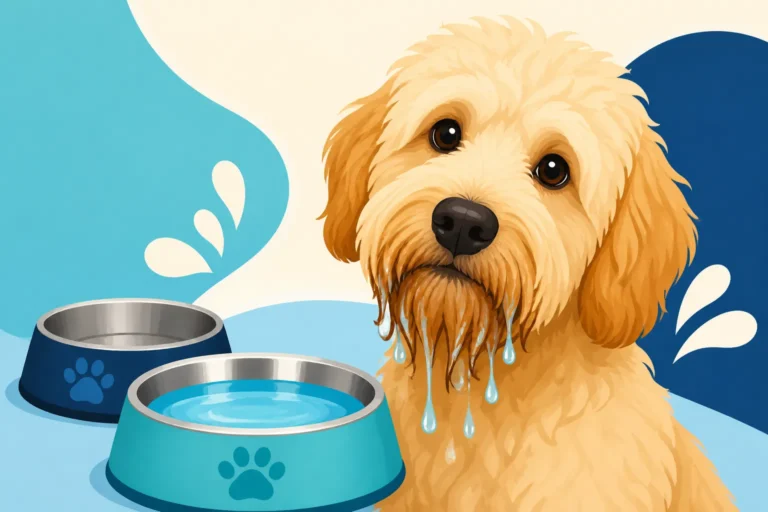
And of course, there's swimming. While many Goldendoodles absolutely adore a good swim, plunging them into water and then allowing them to air dry is a guaranteed recipe for significant matting. Every strand of hair becomes saturated, and the sheer volume of water means a prolonged and aggressive drying routine is essential. Even something as simple as your dog drinking water and getting their beard wet repeatedly can lead to matting around their muzzle and chest if not regularly cleaned and dried. These are all common, but often underestimated, ways dampness can wreak havoc on your Goldendoodle's beautiful coat, proving that Why Goldendoodle Matting Is Almost Always Preventable often comes down to vigilant drying.
Your Proactive Strategy for a Mat-Free, Damp Goldendoodle
Preventing dampness-induced mats requires a proactive and consistent approach. It’s not enough to simply brush a matted dog; the real victory lies in stopping the mats before they ever have a chance to take hold. This involves a combination of the right tools, proper techniques, and unwavering dedication.
The Non-Negotiable Art of Thorough Drying
This is the absolute cornerstone of preventing damp mats. If your Goldendoodle gets wet for any reason—a bath, rain, swimming, or even just high humidity—they must be dried thoroughly and completely, down to the skin. Towel drying is a good first step to remove excess water, but it's rarely sufficient on its own. The real game-changer is a high-velocity pet dryer, also known as a force dryer. These powerful dryers blow air with incredible force, pushing water out of the coat rather than just drying it with heat.
Using a force dryer like those you might find on Amazon or Chewy means you're literally blasting the moisture out of the undercoat, separating the hair strands as they dry. This not only speeds up the process but also prevents those clingy, friction-prone hairs from setting into mats. Always ensure your dog is accustomed to the dryer noise and sensation; start slow, use treats, and make it a positive experience. After force drying, you can finish with a regular hairdryer on a cool or low heat setting while brushing with a slicker brush and metal comb to ensure every last bit of dampness is gone and the coat is smooth and flowing. This commitment to proper drying is the single most important habit you can cultivate to combat matting.
Grooming Tools and Techniques for Damp Coats
Beyond the force dryer, having the right grooming tools is crucial for tackling a damp Goldendoodle coat. A good quality slicker brush and a sturdy metal comb are non-negotiable. After towel drying, and ideally during the force drying process, you should be line brushing your Goldendoodle. Line Brushing a Goldendoodle Down to the Skin is a technique where you systematically brush small sections of the coat, starting from the skin and working your way out, ensuring no tangles are missed. This is particularly important when the coat is damp, as it helps separate individual strands and prevent them from clumping as they dry.
| Drying Method | Pros | Cons | Best Use |
|---|---|---|---|
| Towel Drying | Quick, easy, no equipment needed | Inadequate for dense coats, pushes hair, causes mats | Initial removal of excess water before proper drying |
| Human Hairdryer | Accessible, provides some heat | Insufficient force, can overheat skin, inefficient | Finishing touches after force drying (low/cool heat only), light dampness |
| High-Velocity Pet Dryer | Powerful, penetrates dense coats, prevents mats | Noisy, requires desensitization, upfront cost | Essential for full drying after baths/swimming, daily dampness |
| Air Drying | No effort, natural | Highly prone to severe matting in Goldendoodles | Never recommended for Goldendoodles, especially dense/curly coats |
Don't forget specialty products either. Detangler sprays, often available on Amazon or Chewy, can be invaluable. Apply them liberally to damp areas before brushing to help lubricate the hair and make it easier for the brush to glide through. Always brush with the spray, never on dry hair that is already matted, as this can cause breakage and pain. Remember that Brushing a Goldendoodle Often Enough to Stop Matting means a commitment that changes with their coat's state.
Conditioning and Maintenance as Your First Line of Defense
A well-conditioned coat is less prone to matting, even when damp, because the individual hair shafts are smoother and more resilient. Using a good quality leave-in conditioner after every bath, or even a light conditioning spray between baths, can make a significant difference. These products help to seal the hair cuticle, reducing friction and making it harder for hairs to cling and tangle. You can find excellent conditioning products for Goldendoodles on platforms like Chewy or Amazon.
Regular, consistent maintenance is also key. If your Goldendoodle frequently gets damp, whether from daily walks or a humid environment, you need to adjust your grooming frequency. This might mean brushing more often than the standard How Often a Goldendoodle Actually Needs Brushing recommendation, perhaps even a quick brush and blow-dry of trouble spots (like ears and armpits) after every damp excursion. Grooming a Goldendoodle at Home Between Appointments is not just about tidiness; it’s a critical preventative measure. Pay close attention to areas that naturally experience more friction and tend to mat first, such as behind the ears, in the armpits, and around the collar area. By building a routine that prioritizes thorough drying and consistent conditioning, you can keep your Goldendoodle's beautiful coat free from those frustrating, damp-induced mats.
Disclaimer
This article is for general informational purposes only and does not constitute professional advice. Laws, prices and regulations vary by location and change over time. Consult a qualified professional for guidance on your specific situation.