A Goldendoodle That Jumps on Every Guest
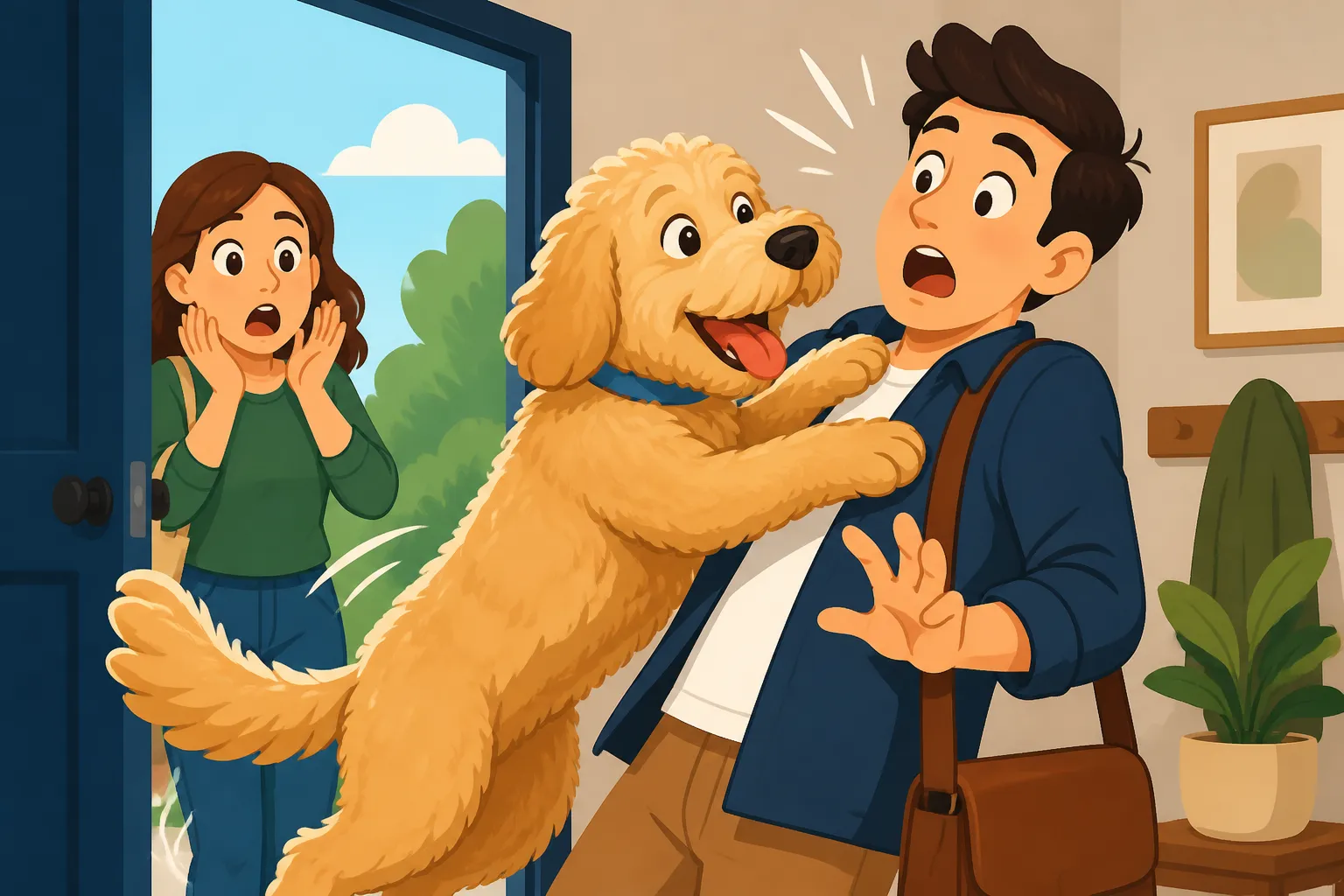
There’s almost nothing more embarrassing or frankly, just plain annoying, than when your otherwise charming Goldendoodle transforms into an overzealous pogo stick every time someone walks through your front door. You love their enthusiasm, of course, but the jumping, the frantic wiggles, the potential for knocking over a child or an elderly relative – it's a huge problem. This guide is here to walk you through understanding why your Goldendoodle greets guests with such unrestrained exuberance and, more importantly, how to teach them to offer a polite, four-paws-on-the-floor welcome instead.
Understanding Why Your Goldendoodle Jumps on Guests
Before we can tackle the behavior itself, it's really helpful to step into your Goldendoodle's paws for a moment and understand why they do what they do. It's rarely out of malice or disrespect. More often than not, it's a combination of their innate traits and, let's be honest, a little bit of accidental human training.
The Goldendoodle's Enthusiastic Greeting Style
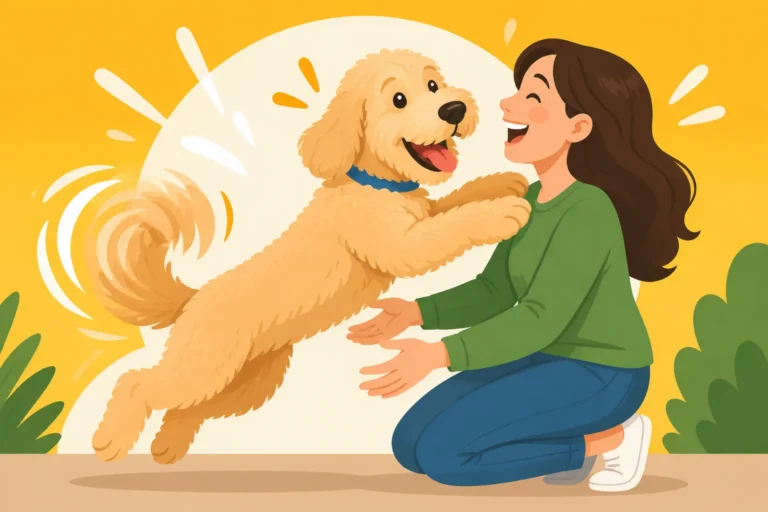
Goldendoodles are truly special dogs, blending the intelligence and social nature of the Poodle with the eager-to-please, outgoing friendliness of the Golden Retriever. This combination often results in a dog that is incredibly excited by new people and new experiences. When a guest arrives, it's like a party in their brain! They want to be close to the new person, to sniff them, to greet them, and to convey just how absolutely thrilled they are that this new, wonderful human has entered their space.
Imagine seeing your best friend after a long time – you might go in for a big hug, right? Your Goldendoodle sees your guests as their new best friends (or potential best friends!) and their version of a big hug is often a full-body jump. They might whine, wiggle their whole rear end, and leap up, trying to get their face closer to yours or the guest's face. It's a very natural canine expression of joy and a desire for connection. They aren't trying to be naughty; they're just expressing their abundant good cheer in a way that, unfortunately for us humans, isn't always appropriate or safe.
Learned Behavior and Reinforcement
Here’s where we, as owners, often inadvertently contribute to the problem. Think about what happens when your Goldendoodle jumps. Do you push them off? Do you say "No!" or "Down!"? Do you make eye contact? Do you even just sigh dramatically? From your Goldendoodle's perspective, any attention, even negative attention, can be seen as a reward. They jumped, and you acknowledged them! Mission accomplished.
If a jumping Goldendoodle consistently gets any form of interaction – a hand to push them down, a vocal command, a look – they quickly learn that jumping is the most effective way to get your attention, and by extension, the attention of your guests. This becomes a deeply ingrained habit, and the more times it’s reinforced, the stronger that behavior becomes. Furthermore, inconsistency from different family members or guests can confuse your Goldendoodle. If Aunt Carol loves the puppy jumps but Uncle Bob always pushes them away, your Goldendoodle doesn’t know what to expect and will likely default to the most attention-grabbing behavior: jumping. They just want to figure out the rules, and if the rules are fuzzy, they’ll keep trying what worked before.
Laying the Foundation: Essential Training for Calm Greetings
Training your Goldendoodle to greet guests calmly isn't about crushing their spirit or making them less friendly; it's about teaching them an alternative, polite way to express their excitement. This takes consistency, patience, and some foundational training.
The "Four Paws on the Floor" Rule
This is the golden rule, no pun intended, for stopping jumping. The idea is simple: your Goldendoodle only gets attention, praise, or a treat when all four of their paws are on the floor. If they jump, all attention immediately stops. This means no eye contact, no pushing, no talking. You turn your back and become a "tree." The moment all four paws return to the floor, even if just for a second, you immediately turn back, offer quiet praise ("Good four paws!"), and a small, high-value treat.
It sounds simple, but it requires incredible discipline from everyone in the household. Practice this first with just family members entering the house. When you walk in, if your Goldendoodle jumps, you step back outside, wait a moment, and re-enter. Repeat until they offer a moment of calm, then reward. Gradually increase the duration of calm before rewarding. For more detailed insights on this core concept, you might find Four Paws on the Floor for a Goldendoodle to be a helpful resource. Remember, consistency is king here. Every time they jump and get attention, you're reinforcing the very behavior you're trying to stop.
Impulse Control Exercises
Jumping is often an impulse control issue. Your Goldendoodle gets so excited that their brain just switches off, and they can't help but leap. Building general impulse control can greatly help with calm greetings. "Sit" and "Stay" are absolutely vital building blocks. Practice these commands frequently throughout the day, in various locations and with increasing distractions.
Another fantastic exercise is "Leave It." This teaches your Goldendoodle to ignore something tempting until you give permission. Start with low-value items and gradually move up to things like a dropped treat or a new toy. Eventually, you can apply this to guests – "Leave It" can mean "ignore the guest for now" until they've settled and you give the "go ahead" signal for a calm greeting. For practical tips on this, explore Goldendoodle Impulse Control With Food on the Floor and Teaching Leave It to a Goldendoodle. These exercises teach your Goldendoodle to pause, think, and make a better choice, even when their excitement is through the roof.
Managing the Environment
While you're working on training, don't be afraid to use management tools to prevent your Goldendoodle from practicing the unwanted behavior. This isn't a substitute for training, but it sets your dog up for success and prevents guests from being overwhelmed.
Consider using:
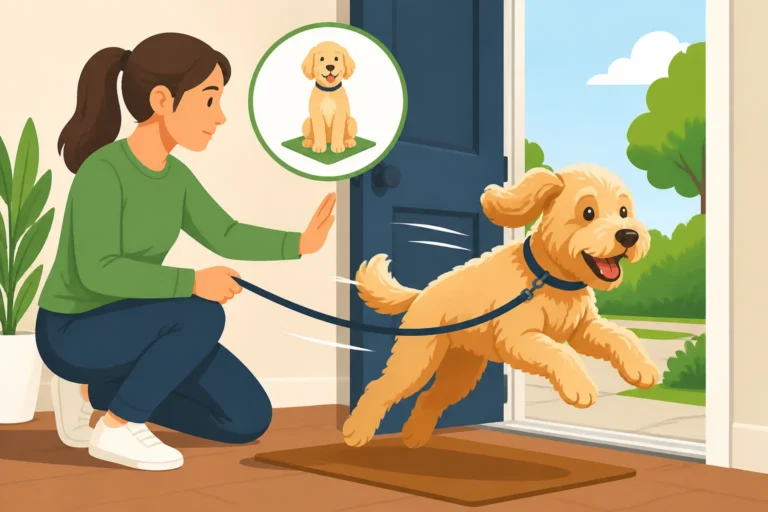
- A leash: When a guest is about to arrive, put your Goldendoodle on a leash and have them sit by your side, or even behind a baby gate. This gives you physical control and allows you to reward them for calm behavior before they even have a chance to jump.
- Baby gates: These are fantastic for creating a barrier between your Goldendoodle and the front door, or between them and arriving guests. They allow your dog to see and hear the guests but prevent direct jumping.
- Crates: If your Goldendoodle is crate-trained, a calm "crate time" before guests arrive can allow them to settle and prevent them from getting over-stimulated. Release them only when they are calm and you can supervise.
Before any guest even knocks, make sure your Goldendoodle has had plenty of physical exercise and a potty break. A tired Goldendoodle is a good Goldendoodle, and they'll be far less likely to be bouncing off the walls when someone arrives. A short, five-minute training session before a guest arrives can also help them focus and be in a "working" mindset.
Step-by-Step Guide to Introducing Guests Calmly
Once your Goldendoodle has a good grasp of the "four paws on the floor" rule and some basic impulse control, you can start practicing with actual guests. This is where the rubber meets the road!
Preparing Your Goldendoodle Before Guests Arrive
About 20-30 minutes before your guests are due, make sure your Goldendoodle gets some good exercise. A brisk walk, a spirited game of fetch, or some vigorous playtime in the yard can help burn off that initial burst of energy. Next, take them out for a quick potty break. Then, bring them inside and engage in a short, positive training session – maybe 5-10 minutes of "sit," "stay," and "down" commands, rewarding heavily for good behavior. This helps get their brain engaged and puts them in a responsive mood.
Finally, consider putting them in their "place" or "mat" if they are trained to settle there. This gives them a designated spot away from the door, where they can observe the arrival without being in the thick of the action. You can learn more about this valuable technique in Goldendoodle Place Training on a Bed or Mat. Have a handful of high-value treats ready (small pieces of cooked chicken, cheese, or their favorite soft treats work well). These will be your secret weapon for rewarding calm behavior.
The Controlled Entry: Setting Up for Success
This is the critical moment. When the doorbell rings or you hear a knock, if your Goldendoodle is in their crate or on their mat, keep them there. If they're loose, put them on a leash immediately. Ask your guests, before they even step inside, to completely ignore your Goldendoodle. No eye contact, no talking, no petting, no acknowledging the dog's existence. This removes the immediate reinforcement for jumping.
Open the door just enough for your guests to step in. Keep your Goldendoodle on the leash, maintaining a slight distance. The moment your Goldendoodle starts to get excited and before they jump, quietly ask for a "sit" or "four paws." The instant they comply, even for a second, quietly say "Yes!" and give them a high-value treat. Repeat this as your guests come in and take off their coats. If your Goldendoodle does jump, turn your back, walk a few steps away, and wait for all four paws to be on the floor again before you re-engage with praise and treat. Remember, the goal is to reward the absence of jumping.
Gradual Interaction and Reinforcement
Once your Goldendoodle has settled and is offering a consistent "four paws on the floor" greeting (sitting or standing calmly), it's time for some controlled interaction. Give your guest a few of your high-value treats and instruct them on how to interact. Tell them to only offer a treat or pet your Goldendoodle when the dog is calm and has all four paws on the floor. If the dog gets excited and starts to jump again, the guest should immediately stop petting, stand up, and look away, becoming a "tree."
Start with very short periods of interaction, maybe 10-15 seconds, then ask your Goldendoodle to "sit" or "down" and reward them for holding that position. This teaches them that calm behavior leads to good things (treats, pets, attention), while jumping makes the good things disappear. Over several visits, you can gradually increase the duration of interaction, always ensuring the focus remains on rewarding calm, polite behavior. If you notice things getting too chaotic, simply redirect your Goldendoodle back to their mat or crate for a short "reset" and try again after a few minutes of calm.
| Behavior Observed | Action to Take (Owner) | Action to Take (Guest) | Goldendoodle Learning |
|---|---|---|---|
| Jumps on arrival | Turn back, ignore | Ignore dog, no eye contact | Jumping = No attention |
| Four paws on floor (briefly) | "Yes!", treat, praise quietly | Stay neutral | Calm = Attention, reward |
| Sustains calm position | "Good!", treat, soft praise | Can offer treat/pet gently | Calm = Sustained positive interaction |
| Becomes over-excited/jumps during interaction | Stop all interaction, turn away | Stop all interaction, turn away | Over-excitement stops rewards |
Sustaining Calm Greetings for the Long Term
Teaching your Goldendoodle not to jump isn't a one-and-done kind of deal. It's an ongoing process that requires consistent effort and reinforcement from everyone they meet.
Consistency is Key for Every Guest
This is arguably the most challenging part, especially if you have a bustling household or a wide circle of friends and family. Every single person who enters your home needs to be on board with your training protocol. One person who allows (or even encourages!) jumping can set your progress back significantly. Explain the "four paws on the floor" rule to everyone who visits. Give them a few treats and clear instructions on how to reward calm behavior and how to disengage if jumping occurs.
This means being prepared to advocate for your dog's training. It might feel awkward initially to tell Aunt Carol not to pet your dog when he jumps, but it's crucial for your Goldendoodle's long-term success. The more consistent the message your Goldendoodle receives from everyone, the faster they will learn that calm greetings are the only way to get what they want. Remember, every "guest" includes the mail carrier, the delivery driver, and even casual acquaintances. If it's a person, they need to follow the rules!
Continuing Training and Socialization
Don't just practice calm greetings when guests are actually coming over. Incorporate "mock" greetings into your daily routine. Have family members leave and re-enter, practicing the controlled entry and rewarding for calm. This keeps the skills sharp and reinforces the desired behavior. Think of it like regular homework for your dog. Goldendoodle Training Sessions and How Long to Run Them offers insights into how to make these sessions effective and engaging without overdoing it.
Furthermore, continued socialization in a variety of environments will help your Goldendoodle learn to manage their excitement in different contexts. While the goal is not to have them jump on strangers at the park, teaching them to calmly observe people and other dogs from a distance, rewarding appropriate behavior, builds their overall self-control. For Goldendoodles, sometimes their friendliness can become overwhelming, and learning self-regulation is key. Goldendoodle Socialization Beyond Hyper-Friendliness delves deeper into this topic. If you find yourself struggling, or if your Goldendoodle's jumping is particularly persistent or accompanied by other challenging behaviors, don't hesitate to seek guidance from a certified professional dog trainer. Resources like the online BAXTER & Bella program or local trainers (you can search for "dog trainers near me" on platforms like Amazon for related books or training aids) can provide personalized strategies and support. Finding a Trainer Who Works With Goldendoodles can help you choose the right professional. With consistent effort and a clear plan, your Goldendoodle can indeed learn to be a polite, four-paws-on-the-floor greeter, making visits a joy for everyone.
Disclaimer
This article is for general informational purposes only and does not constitute professional advice. Laws, prices and regulations vary by location and change over time. Consult a qualified professional for guidance on your specific situation.