Calling a Goldendoodle Off a Dog It Wants to Greet
It’s a scenario almost every Goldendoodle parent knows all too well: you’re on a peaceful walk, enjoying the fresh air, when suddenly, your sweet, fluffy companion spots another dog across the street. In an instant, the calm walk dissolves into a frantic lunge, a torrent of barks, and a mighty pull that nearly yanks your arm out of its socket. The sheer embarrassment and physical strain can make you dread every encounter. This comprehensive guide is here to help you understand why your Goldendoodle acts this way and, more importantly, how to teach them to politely disengage and focus on you, making walks enjoyable again.
Understanding Your Goldendoodle's Drive to Greet
Goldendoodles are bundles of joy, but their enthusiasm can sometimes be… overwhelming, especially when another dog appears on the horizon. This isn’t a sign of naughtiness; it’s deeply rooted in their genetics and personality. Understanding these underlying drives is the first step to managing them effectively.
The Golden Retriever's Friendly Instincts
The Golden Retriever half of your Goldendoodle brings a strong lineage of friendliness, eagerness to please, and a desire for social interaction. Goldens were originally bred as gun dogs, primarily to retrieve fowl, and part of their charm is their soft mouth and biddable nature. They’re inherently optimistic, often assuming every person and dog they meet is a potential friend just waiting for an introduction.
When your Goldendoodle sees another dog, their Golden Retriever instincts kick in with full force. They don't just want to greet; they feel an almost irresistible pull to make contact, to play, to be part of the action. They aren't thinking about leash manners or your comfort; they're simply responding to that powerful genetic predisposition to be gregarious. While this makes them wonderful family pets, it also means you're working against a strong, natural drive when you try to call them off. Their desire to "retrieve" that interaction is incredibly powerful. The Retriever Biddability Inside a Goldendoodle is often a double-edged sword when it comes to managing greetings.
The Poodle's High Energy and Alertness
Then we have the Poodle side, which contributes its own unique set of traits to this greeting dynamic. Poodles are incredibly intelligent, athletic, and often quite observant of their environment. They have a keen awareness of their surroundings and can spot another dog long before you do. This alertness, combined with their high energy levels, can amplify the Golden Retriever's social drive.
Imagine a highly intelligent, energetic dog that notices everything and has a strong desire for interaction. That’s your Goldendoodle! The Poodle's energy isn't just physical; it's mental, too. They process information quickly, and once they've fixated on another dog, their focus can be intense. This intelligence means they can learn to disengage, but it also means they learn patterns quickly – including the pattern that if they pull hard enough, they often get to say hello. This combination of Poodle brain and Retriever heart creates a dog that can be incredibly enthusiastic, to say the least, when another canine friend enters their field of vision. Learning What a Goldendoodle Inherits From the Poodle Brain can help you tailor your training.
The "Goldendoodle Greeting" Problem
So, what does this combination look like in action? It's the classic "Goldendoodle Greeting": your dog is walking calmly, then BAM! They see a dog, their body tenses, ears perk, and before you can even react, they've launched themselves forward, pulling with all their might. This can manifest as barking, whining, jumping, or even a frantic, high-pitched vocalization that sounds like they're saying, "LET ME GO! I NEED TO SAY HI!"
Often, this behavior is misinterpreted by passersby as aggression, which can be mortifying for you. However, most of the time, it's pure over-excitement and a lack of impulse control. Your Goldendoodle isn't trying to be mean; they just lack the coping skills to process their excitement calmly. They haven't learned that there are other ways to acknowledge another dog besides a full-throttle charge. The physical challenge of holding back a strong, enthusiastic Goldendoodle can be exhausting, and it inevitably strains your relationship with your dog on walks, turning what should be a pleasant bonding experience into a source of constant tension.
Building the Foundation: Reliable Recall and Disengagement
Before you can reliably call your Goldendoodle off a dog they desperately want to greet, you need a solid foundation of basic obedience and attention. This isn't just about saying "no"; it's about teaching them what to do instead.
Starting with a Strong "Come" Command (Recall)
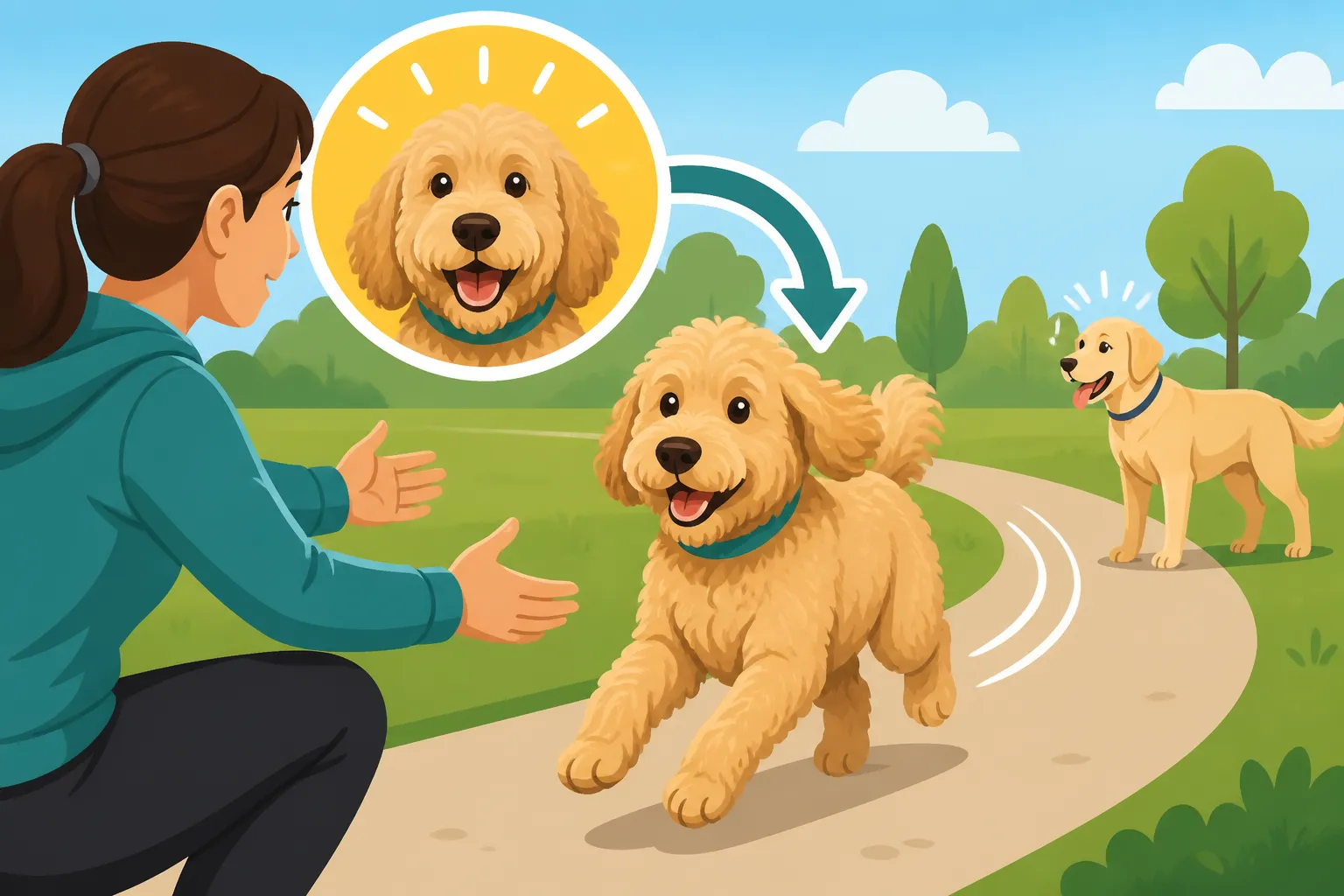
A rock-solid recall is the single most important command for any dog owner, but it's especially crucial for a Goldendoodle with a high drive to greet. Your "come" command needs to be more exciting and rewarding than anything else in the environment, including another dog. Start teaching "come" in a quiet, distraction-free environment, like your living room or backyard.
Use an enthusiastic tone and high-value treats (think tiny pieces of cooked chicken, cheese, or hot dogs – something truly special). When your Goldendoodle comes to you, make a huge fuss! Praise them like they've just won Best in Show, and shower them with those amazing treats. Practice this many, many times a day, making it a fun game. Gradually introduce minor distractions, always ensuring success by keeping them far away at first. The goal is to build a positive association: "When Mom/Dad calls, amazing things happen!" A strong Goldendoodle Recall and the Retriever Half leverages their natural biddability.
Teaching "Look at Me" and Eye Contact
Before you can ask your Goldendoodle to disengage from another dog, you need a way to reliably get their attention back on you. This is where "look at me" or "watch me" comes in. This command teaches your dog to make eye contact with you on cue, which is incredibly powerful for breaking their focus on distractions.
To teach "look at me," hold a high-value treat near your eye. The moment your Goldendoodle glances at your face, even for a split second, say "yes!" or click a clicker, and give them the treat. Repeat this many times. Once they consistently look at your face, start adding the verbal cue, "Look at me!" Practice in various locations, gradually increasing distractions. The ability to make eye contact on cue is a game-changer when you're out and about and need to quickly redirect their attention from an approaching dog.
The "Leave It" and "Watch Me" Combo
"Leave it" is not just for dropped food; it's a versatile command that tells your dog to ignore anything you want them to, including other dogs. Combine this with "watch me" for maximum effect. Start teaching "leave it" in a very controlled way. Place a low-value treat on the floor and cover it with your hand. When your Goldendoodle tries to get it, say "leave it." The moment they stop trying and look at you, mark the behavior ("yes!") and reward them with a different, higher-value treat from your other hand.
Once they understand to disengage from the covered treat, move to an uncovered treat on the floor, saying "leave it" before they can grab it. Reward for looking away from the treat. Gradually increase the difficulty: a treat on your shoe, then a moving toy, and eventually, other dogs at a distance. The combination is powerful: "Leave it!" (ignore the dog) then "Watch me!" (focus on me for a reward). This builds strong Goldendoodle Impulse Control Exercises which are essential for calm greetings.
Practical Strategies for Managing Dog-to-Dog Greetings
With a solid foundation in place, you can now start implementing practical strategies to manage those frantic greetings when you're out on walks. It's all about being proactive, setting your dog up for success, and gradually changing their emotional response.
Proactive Management on Walks
The key to managing over-excited greetings is to intervene before your Goldendoodle reaches their "over-threshold" point – that moment where they can no longer control themselves. This means being vigilant and proactive. Scan your surroundings constantly for other dogs. If you see one approaching, don't wait for your Goldendoodle to notice it and start reacting.
As soon as you spot another dog, immediately start asking for "look at me" or "heel," and reward heavily for any attention you get. If the approaching dog is too close or your Goldendoodle is already starting to fixate, create distance. Change your direction, cross the street, or duck behind a car or a bush to create a visual barrier. The goal is to avoid allowing your Goldendoodle to practice the lunging behavior. Every time they successfully lunge and pull, that behavior is reinforced. Your mantra should be: prevent the practice of unwanted behavior. Practicing Long Line Practice With a Goldendoodle in a secure area can help you refine their recall and focus amidst distractions before taking it to busy streets.
Controlled Greetings, Not All Greetings
One common misconception is that all dogs need to greet every other dog. This isn't true, and for Goldendoodles who get over-excited, it can actually make the problem worse. Instead, aim for controlled greetings, and only when appropriate. Not every dog is friendly, and not every dog wants to be greeted.
When you do allow a greeting, ensure it's on a loose leash and both dogs are calm. Ask the other owner if their dog is friendly, and if yours is calm enough to approach. Keep greetings short – just a few seconds of sniffing – and then call your Goldendoodle away with a "let's go!" cue and a high-value treat. Reward them for moving on calmly. Avoid nose-to-nose greetings on leash, as this can be confrontational for some dogs. Instead, allow them to sniff each other's rear ends, which is a more polite canine introduction. Remember, Goldendoodle Play Style With Other Dogs is often bouncy and enthusiastic, so brief, calm greetings are usually best on leash.
Desensitization and Counter-Conditioning
This is the long-term strategy for changing your Goldendoodle's emotional response to other dogs. Instead of seeing another dog and feeling an explosion of frantic energy, you want them to see another dog and associate it with something positive from you. This involves working below their threshold.
Here’s how it works: Find a distance where your Goldendoodle notices another dog but doesn't react (no pulling, no barking, just a glance). The moment they see the other dog, immediately say "yes!" and give them a super high-value treat. The other dog appears = treat. The other dog disappears = no treat. You are essentially saying, "That dog predicts good things from me." Slowly, over many, many sessions, you can gradually decrease the distance. If your Goldendoodle starts to react, you've moved too close, too fast. Increase the distance again. This method, rooted in Positive Reinforcement and Why It Suits a Goldendoodle, systematically reshapes their perception of other dogs from an irresistible urge to an opportunity for a reward from you.
Tools and Training Aids to Support Your Efforts
Effective training is often supported by the right tools and resources. While no gadget is a substitute for consistent training, some can certainly make the process easier and safer for both you and your Goldendoodle.
Harnesses and Leashes for Control, Not Correction
When dealing with a strong Goldendoodle who loves to pull, the right equipment can make a world of difference. A front-clip harness is often a fantastic choice. Unlike back-clip harnesses that can encourage pulling by allowing your dog to lean into it, a front-clip harness attaches the leash to a ring on your dog's chest. When your Goldendoodle pulls, it gently redirects their momentum to the side, turning them back towards you, making it much harder for them to lunge forward with full force.
Avoid retractable leashes, as they teach your dog that pulling extends the leash, giving them inconsistent feedback and making it harder to maintain control. A standard 6-foot leash gives you enough slack for sniffing but keeps your dog close when needed. For practicing recall in safe, open areas, a long line (15-30 feet) can be invaluable, allowing your Goldendoodle to experience more freedom while still being under your control. Check out options for Harnesses That Suit a Goldendoodle Coat to find one that's comfortable and effective without causing matting. Many reliable harnesses can be found on Amazon.
High-Value Rewards are Key
I cannot stress this enough: your rewards must be high-value to compete with the excitement of another dog. Dry kibble, or even standard training treats, often won't cut it when your Goldendoodle is fixated on a potential new friend. Think irresistible, smelly, delicious treats: tiny pieces of cooked chicken, cheese, hot dogs, or liverwurst.
These aren't everyday treats; they are your "jackpot" rewards reserved specifically for those challenging moments when you need to capture their attention. Use them generously and enthusiastically when your Goldendoodle chooses to disengage from another dog or looks to you instead. The more rewarding you make focusing on you, the more likely they are to choose you over the distraction. Remember to keep treat size small to avoid overfeeding!
Professional Help When You Need It
Sometimes, despite your best efforts, you might find yourself struggling. Perhaps your Goldendoodle's reactions are getting worse, or you're just not seeing progress. This is absolutely nothing to be ashamed of; sometimes, an outside perspective and expert guidance are exactly what you need. Don't hesitate to seek out a certified professional dog trainer or a veterinary behaviorist.
A good trainer can observe your Goldendoodle's specific reactions, help you identify triggers, and provide tailored exercises and strategies. They can teach you techniques for precise timing, effective leash handling, and how to read your dog's body language better. If anxiety or fear are underlying the reactivity, a veterinary behaviorist can offer medical interventions alongside behavior modification plans. Finding a reputable expert, perhaps through a recommendation from your vet or local dog community, can be a game-changer. For comprehensive online resources, programs like BAXTER & Bella offer structured curricula that can guide you through these training challenges, often including live support. Don't underestimate the value of professional insight when you're tackling something as ingrained as leash reactivity. If you're looking for guidance, searching for Finding a Trainer for a Goldendoodle can be a great first step.
Here’s a quick overview of Goldendoodle greeting behaviors and how to approach them:
| Goldendoodle Greeting Behavior | Common Underlying Cause | Management Strategy |
|---|---|---|
| Lunging & Pulling | Over-excitement, lack of impulse | Proactive management, front-clip harness, "look at me" |
| Barking & Whining | Frustration, desire for attention | "Leave it," counter-conditioning, create distance |
| Ignoring Owner | Distraction, low reward value | High-value treats, consistent recall, "watch me" |
| Unsolicited Greetings | Social drive, lack of controlled | Controlled, brief greetings, changing direction |
Ultimately, teaching your Goldendoodle to calmly walk past other dogs is a journey that requires patience, consistency, and a deep understanding of their unique blend of Golden Retriever enthusiasm and Poodle intelligence. By building a strong foundation of attention and recall, and implementing proactive management and counter-conditioning, you can transform stressful walks into enjoyable outings for both you and your beloved companion.
Disclaimer
This article is for general informational purposes only and does not constitute professional advice. Laws, prices and regulations vary by location and change over time. Consult a qualified professional for guidance on your specific situation.