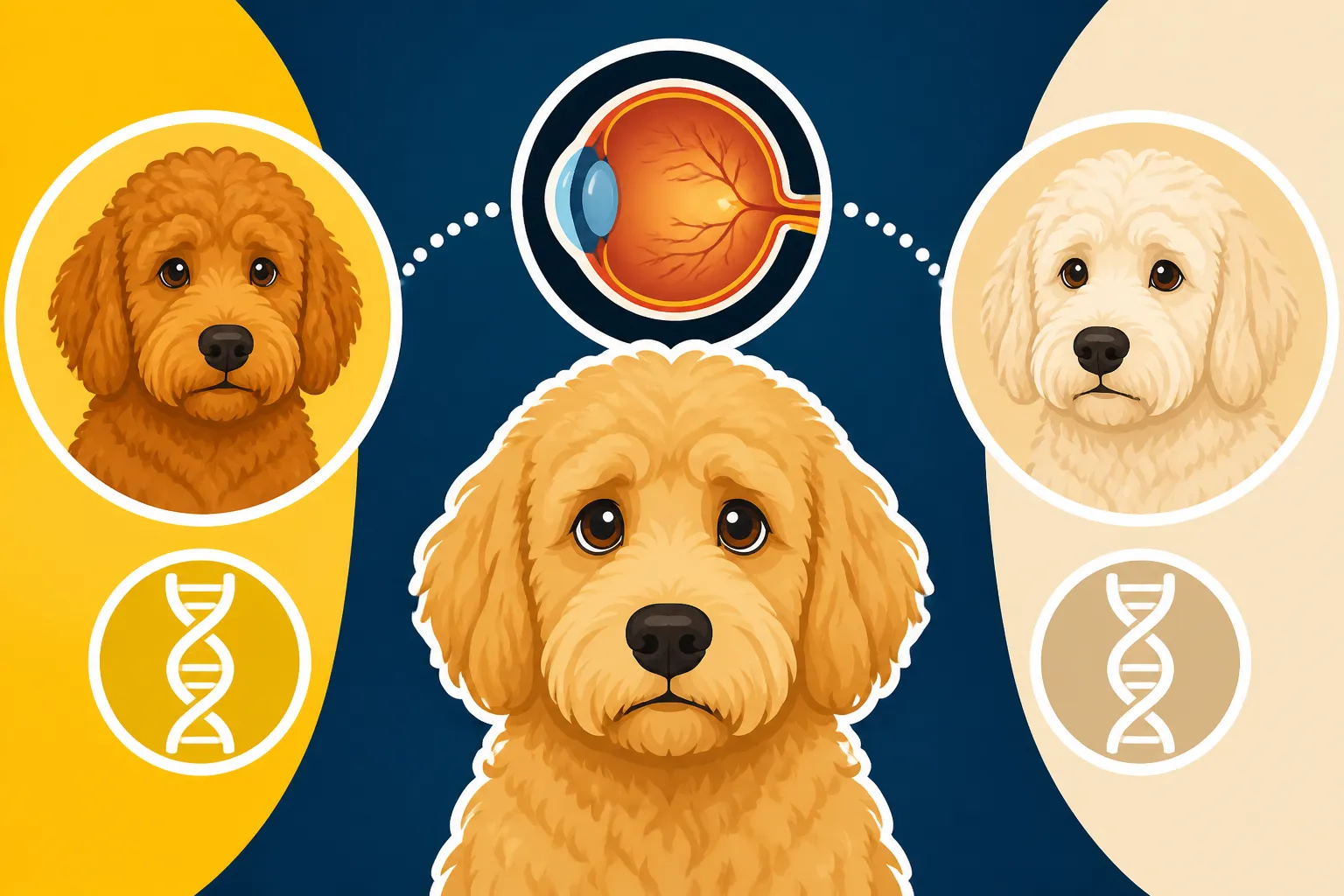
Progressive Retinal Atrophy Carried by Both Goldendoodle Lines
When you bring a Goldendoodle into your home, you're welcoming a bundle of joy, energy, and undeniable charm. But like all breeds, Goldendoodles can inherit certain health challenges, and one of the most heartbreaking is Progressive Retinal Atrophy, or PRA. The thought of your beloved companion slowly losing their sight can be incredibly daunting and confusing, especially when you’re trying to understand how a crossbreed could inherit such a specific genetic condition. This comprehensive guide is here to demystify PRA, explain how it affects Goldendoodles from both their Golden Retriever and Poodle lineage, and equip you with the knowledge to recognize, manage, and ideally, prevent this condition.
Understanding Progressive Retinal Atrophy in Goldendoodles
Progressive Retinal Atrophy (PRA) isn't a single disease but rather a blanket term for a group of inherited degenerative diseases that affect the retina, the light-sensitive tissue at the back of the eye. For Goldendoodle owners, grappling with the idea that their dog’s vision might slowly fade can be incredibly distressing. It’s a condition that often develops stealthily, making early detection a true challenge for even the most vigilant pet parents.
What PRA Is and How It Affects Vision
At its core, PRA involves the gradual deterioration of the photoreceptor cells in the retina—specifically the rods and cones. Rods are responsible for vision in dim light and detecting movement, while cones handle bright light vision and color perception. Most forms of PRA begin with the degeneration of the rods, which is why the first noticeable symptom in many dogs is a struggle with night vision. Imagine trying to navigate your own home in the dark, constantly bumping into familiar objects. That’s often what your Goldendoodle might experience.
As the disease progresses, the cone cells also begin to degenerate, eventually leading to complete blindness, even in daylight. This process is irreversible and there is currently no cure. The progression rate can vary, but for many Goldendoodles, it means a slow but certain journey towards blindness, leaving owners to wonder what they could have done differently or how to best support their pet through such a profound change.
The Different Types of PRA Affecting Goldendoodles
Because Goldendoodles are a cross between Golden Retrievers and Poodles, they are susceptible to the forms of PRA found in both parent breeds. This means breeders and owners need to be aware of multiple genetic mutations, not just one. The most common form of PRA affecting Poodles and, consequently, many Goldendoodles, is Progressive Rod-Cone Degeneration (PRCD-PRA). This type is an autosomal recessive inherited disorder, meaning a dog must inherit two copies of the defective gene (one from each parent) to be affected.
Golden Retrievers are also known to carry specific forms of PRA, including GR-PRA1 and GR-PRA2. Like PRCD-PRA, these are also autosomal recessive conditions. GR-PRA1 tends to have a later onset, often appearing around 6-8 years of age, while GR-PRA2 can manifest earlier. The complexity of the Goldendoodle’s genetic makeup means they could inherit any of these, or even combinations, depending on their parentage. This multi-layered risk is precisely why relying on a single "doodle test" isn't enough, and why understanding the nuances is so critical.
The Genetic Link: How PRA Comes from Both Parent Breeds
Understanding the genetic blueprint of PRA in Goldendoodles is crucial for anyone considering adding one to their family, or for current owners trying to make sense of a diagnosis. It’s not just about one parent; it’s about the intricate dance of genes inherited from both sides of their lineage. This genetic heritage means that even if a Goldendoodle shows fantastic hybrid vigor in other areas, specific genetic diseases like PRA can still be passed down.
PRA in Golden Retrievers
Golden Retrievers are generally wonderful dogs, known for their friendly demeanor and intelligence. However, they are predisposed to certain types of PRA, notably GR-PRA1 and GR-PRA2. These specific forms are well-documented within the Golden Retriever breed and are inherited in an autosomal recessive manner.
For GR-PRA1, affected dogs typically start showing signs of night blindness between 6 and 8 years of age, gradually progressing to full blindness. GR-PRA2 can also manifest in a similar timeframe, though sometimes earlier. A Golden Retriever parent, even if perfectly healthy and seeing well, can be a "carrier" of these genes. This means they possess one copy of the defective gene but do not show symptoms themselves. If this carrier Golden Retriever is bred with another carrier (or an affected dog, though responsible breeders would avoid this), there's a risk of producing affected puppies. This highlights the vital importance of DNA testing even for apparently healthy Golden Retriever parents used in Goldendoodle breeding programs.
PRA in Poodles
Poodles, whether Standard, Miniature, or Toy, contribute significantly to the Goldendoodle's intelligence, coat type, and often, their lanky grace. Unfortunately, Poodles are also known carriers of PRCD-PRA, or Progressive Rod-Cone Degeneration. This is a widely recognized and well-studied form of PRA that can lead to blindness in affected dogs.
Poodle lines have been impacted by PRCD-PRA for decades, with the onset of night blindness typically occurring between 3 and 6 years of age, followed by complete blindness. Similar to the Golden Retriever forms, PRCD-PRA is an autosomal recessive condition. A Poodle parent, whether a Standard Poodle or a smaller variety, can also be a carrier, silently passing on the gene. If this Poodle carrier is bred with a Golden Retriever who is a carrier of its own type of PRA (or even a Goldendoodle carrier), the potential for an affected Goldendoodle puppy increases dramatically. The complexity arises because the Poodle might be clear for GR-PRA1/2 but a carrier for PRCD-PRA, while the Golden Retriever might be the reverse.
What Happens When Both Goldendoodle Parents Carry the Same Gene
This is where the genetics become particularly critical for Goldendoodles. Since both parent breeds, Golden Retrievers and Poodles, can carry different types of PRA (and sometimes even the same type, like PRCD in some Golden lines), the possibility of producing an affected Goldendoodle puppy increases if breeders aren't diligent with DNA testing. The Goldendoodle inherits half its genes from the Golden Retriever and half from the Poodle.
For an autosomal recessive disease like PRA, here's how it breaks down:
- Clear Dog: Has two normal genes (NN). Cannot get the disease and cannot pass it on.
- Carrier Dog: Has one normal gene and one defective gene (Nn). Does not show symptoms of the disease but can pass the defective gene to offspring.
- Affected Dog: Has two defective genes (nn). Will develop the disease and will pass one defective gene to all offspring.
If you breed two dogs who are both carriers (Nn x Nn), the outcome for their puppies is statistically:
- 25% chance of being affected (nn)
- 50% chance of being a carrier (Nn)
- 25% chance of being clear (NN)
This means that even if both parent dogs appear perfectly healthy, if they are both carriers for the same specific PRA mutation, a quarter of their litter could be born genetically destined to go blind. This is a critical point that When Both Goldendoodle Parents Carry the Same Gene explores in depth. Responsible breeders will use DNA testing to ensure they never breed two carriers for the same disease together, thereby eliminating the risk of producing affected puppies.
Here's a simplified table demonstrating the inheritance patterns:
| Parent 1 (DNA Status) | Parent 2 (DNA Status) | Puppy Outcomes (Approximate) | Risk of Affected Puppy |
|---|---|---|---|
| Clear (NN) | Clear (NN) | 100% Clear | 0% |
| Clear (NN) | Carrier (Nn) | 50% Clear, 50% Carrier | 0% |
| Clear (NN) | Affected (nn) | 100% Carrier | 0% |
| Carrier (Nn) | Carrier (Nn) | 25% Clear, 50% Carrier, 25% Affected | 25% |
| Carrier (Nn) | Affected (nn) | 50% Carrier, 50% Affected | 50% |
| Affected (nn) | Affected (nn) | 100% Affected | 100% |
This table makes it starkly clear why testing both parents is non-negotiable for breeders.
Recognizing the Signs of PRA in Your Goldendoodle
One of the most frustrating aspects of Progressive Retinal Atrophy for Goldendoodle owners is that its onset can be incredibly subtle. Our dogs are masters of adaptation, and they often compensate for gradual vision loss so well that owners don't notice until the disease is quite advanced. However, knowing what to look for can make a significant difference in getting an early diagnosis and adjusting your home environment to support your dog.
Early Symptoms: Night Blindness and Behavioral Changes
The rod cells, which are crucial for low-light vision, are usually the first to degenerate in most forms of PRA. This means that night blindness is typically the earliest detectable symptom. You might start noticing your Goldendoodle exhibiting unusual behaviors when it gets dark, or in dimly lit rooms. Perhaps they hesitate to go outside for their last potty break when it's dark, or they become more hesitant on stairs at dusk.
Other early signs can include:
- Bumping into furniture or objects in familiar environments, but only when the lighting is poor.
- Increased apprehension or clumsiness in unfamiliar, dimly lit places.
- Dilated pupils: Their pupils might appear larger than usual, especially in normal or dim light, as their eyes try to gather more light to compensate for the failing photoreceptors. This can make their eyes look "shiny" or "reflective" in photographs due to tapetal reflection.
- Reluctance to retrieve toys in low light conditions, even if they usually have a strong retriever drive.
- Changes in interaction: A dog struggling with vision might be more easily startled or less keen on playing in certain situations.
It’s easy to dismiss these subtle changes as just a bit of clumsiness or a dog getting older, especially if the dog is still young but past its boisterous puppy phase. But for Goldendoodles, these early indicators could be the first whispers of PRA. Paying close attention to your dog's habits and environment, especially as light changes, is key. As explored in Night Blindness as a Goldendoodle's First PRA Sign, these early signs are critical for timely intervention.
Advanced Stages: Daytime Vision Loss and Adaptation
As PRA progresses, the cone cells also begin to deteriorate, leading to a loss of vision even in bright light. This is when the vision impairment becomes more pronounced and harder to miss, though your Goldendoodle will likely have developed remarkable coping mechanisms by this stage.
In advanced stages, you might observe:
- Difficulty navigating in well-lit, but unfamiliar, environments.
- Hesitation when jumping off furniture or moving through doorways.
- More frequent bumping into objects regardless of lighting.
- Lack of direct eye contact or difficulty tracking moving objects.
- Eyes appearing cloudy or having a blueish haze, although this is often due to cataracts, which can sometimes develop secondary to PRA or alongside it in older dogs. It's important to remember that PRA itself doesn't cause cloudiness, but the pupil dilation is usually prominent.
- Increased reliance on other senses: Your dog will start using their nose and ears more prominently to navigate, locate toys, and recognize people. They might sniff the air more, or react more strongly to sounds.
It's truly amazing how adaptable dogs are. They often memorize their environment, using scent trails, textures on the floor, and even air currents to get around. This incredible resilience can sometimes mask the true extent of their vision loss, making it appear as though they still have some sight even when they are completely blind.
When to Seek Veterinary Attention
If you suspect any changes in your Goldendoodle's vision, or if you notice any of the behavioral changes mentioned above, it is imperative to seek veterinary attention promptly. While PRA is not curable, an early diagnosis can help you understand the prognosis, make necessary adjustments to your home, and prepare for your dog’s future.
Your regular veterinarian can perform an initial eye exam, but for a definitive diagnosis of PRA, a referral to a veterinary ophthalmologist is typically recommended. These specialists have advanced equipment and expertise to thoroughly examine the retina and other eye structures. Early detection doesn't prevent the progression, but it empowers you as an owner to provide the best possible quality of life for your Goldendoodle as their vision changes.
Diagnosing PRA: Tests and What They Tell You
Getting a definitive diagnosis of Progressive Retinal Atrophy in your Goldendoodle involves a combination of specialized eye examinations and, most importantly, genetic testing. This isn't just about confirming vision loss; it's about understanding the specific genetic mutation at play, which is vital for both managing the affected dog and making informed breeding decisions.
DNA Testing for Parent Dogs and Puppies
The most powerful tool in the fight against inherited diseases like PRA is DNA testing. This isn't something done after a dog goes blind; it should ideally be performed on potential parent dogs before they are bred. Several commercial laboratories offer comprehensive DNA panels that screen for known PRA mutations in Poodles (e.g., PRCD-PRA) and Golden Retrievers (e.g., GR-PRA1, GR-PRA2).
When a Goldendoodle breeder runs a DNA panel, they receive results indicating whether a dog is:
- Clear: The dog does not carry the gene mutation and cannot pass it on.
- Carrier: The dog carries one copy of the gene mutation. It will not develop the disease but can pass the mutation to its offspring.
- Affected: The dog carries two copies of the gene mutation. It will develop the disease and will pass one copy of the mutation to all of its offspring.
For responsible breeding, knowing these statuses is paramount. A "clear" dog can be bred with a "carrier" without producing affected puppies, though some of the offspring will be carriers. However, a responsible breeder will never breed two carriers together for the same specific PRA mutation, as this risks producing affected puppies. This pre-emptive testing is part of The DNA Panel a Goldendoodle Breeder Should Run and helps ensure puppies are born free from this devastating condition. It also informs owners about the genetic health of their prospective puppy’s lineage, offering peace of mind or, at least, preparedness. A deeper dive into What a Carrier PRA Result Means for a Goldendoodle can help new owners understand these results.
Ophthalmic Examinations and ERG Testing
While DNA testing tells you a dog's genetic predisposition, an ophthalmic examination by a board-certified veterinary ophthalmologist is crucial for diagnosing PRA in a living dog, especially if symptoms are present. These specialists can:
- Perform a thorough eye exam: This includes examining the external structures of the eye, the cornea, lens, and anterior chamber, but most importantly, the retina at the back of the eye (fundic examination). In early PRA, changes in the retina might be subtle, but an expert can detect them.
- Evaluate pupillary light reflexes: Although not definitive, abnormal pupil dilation can be an indicator.
- Electroretinography (ERG): This is the definitive diagnostic test for PRA. The ERG measures the electrical responses of the retina's photoreceptor cells to light. In dogs with PRA, the ERG will show a significantly reduced or absent retinal response, confirming the diagnosis. This test requires sedation and specialized equipment, which is why it's typically performed by an ophthalmologist.
Regular eye examinations, even before symptoms appear, can be a part of comprehensive health monitoring, especially for dogs from lines known to carry PRA. This is often part of The Annual Eye Exam a Goldendoodle Breeder Should Have, ensuring the breeding stock maintains optimal eye health. While ERG confirms an affected dog, DNA testing is what truly prevents the disease from being passed on to future generations.
Living with a Goldendoodle Diagnosed with PRA
Receiving a diagnosis of Progressive Retinal Atrophy for your Goldendoodle can be devastating. It’s natural to feel a mix of sadness, anxiety, and perhaps even guilt. However, it's vital to remember that a blind dog can still lead a full, happy, and incredibly rich life. Their other senses are incredibly acute, and with a few adjustments and a lot of love, your Goldendoodle will continue to thrive.
Managing Daily Life with a Blind or Visually Impaired Dog
The key to supporting a Goldendoodle with PRA is to create a stable, predictable, and safe environment. Their ability to adapt is astounding, and they will quickly learn to navigate their world without sight, especially if you help them.
Here are some practical tips:
- Maintain Consistency: Avoid moving furniture, food bowls, or beds around. Dogs rely heavily on spatial memory once they lose their sight. If you must rearrange, do it slowly and guide your dog frequently until they've re-mapped the new layout.
- Create Safe Zones: Block off dangerous areas like stairs (especially for smaller Goldendoodles where a fall could be serious), swimming pools, or areas with sharp objects until you can supervise. Baby gates are your friends!
- Use Scent Markers: You can use distinct scents (like vanilla extract, essential oils, or even specific air fresheners) on doorways, steps, or furniture corners to give your dog additional cues about their location.
- Verbal Cues are Essential: Start using clear verbal cues for everything: "step up," "step down," "wait," "danger," "find your bed," or "cookie." This helps them anticipate and understand their environment.
- Keep a Routine: Predictable feeding, potty, and playtime schedules provide comfort and confidence.
- Safety Outside: Always keep your blind Goldendoodle on a leash when outdoors, unless in a securely fenced and familiar area. Be aware of new obstacles on walks and verbally guide them. Consider a harness that says "Blind Dog" to alert others.
- Interactive Toys: Provide toys that make noise, have interesting textures, or dispense treats to engage their other senses.
- Touch and Voice First: Always announce your presence with your voice before touching your Goldendoodle to avoid startling them. Approach them from the front whenever possible.
- Rugs and Runners: Use rugs to delineate pathways, especially on slippery hard floors, providing tactile cues and better traction.
It takes patience and observation, but your Goldendoodle will amaze you with their ability to adjust. Many resources exist for owners of blind dogs, offering ingenious solutions for common challenges.
Supportive Care and Maintaining Quality of Life
While there is no cure for PRA, and no supplement or diet can reverse the damage, supportive care focuses on maintaining your Goldendoodle’s overall health and happiness.
- Nutrition: Ensure your Goldendoodle receives a balanced, high-quality diet. While specific supplements won't cure PRA, some veterinarians suggest antioxidants (like Vitamin E, C, lutein, zeaxanthin) and Omega-3 fatty acids might support general eye health, though their direct impact on PRA progression is unproven. Always consult your vet before adding supplements.
- Mental and Physical Stimulation: Just because they can't see doesn't mean they can't play! Scent games, puzzle toys, and familiar walks are still important. Vision Loss in an Old Goldendoodle emphasizes how important continued enrichment is. Physical activity, appropriate for their age and other health conditions, is still vital for their well-being.
- Regular Vet Check-ups: Continue routine veterinary visits to monitor their overall health and address any other potential issues. Secondary conditions, though rare, can sometimes arise, or other age-related changes, like Goldendoodle Cataracts and Vision Loss, might occur.
- Emotional Support: Your Goldendoodle will pick up on your emotions. Stay calm, confident, and reassuring. They rely on you for guidance and security.
Many owners find pet insurance, such as plans from Healthy Paws, can help manage the ongoing costs of veterinary visits and supportive care, especially if other health issues arise alongside PRA. While policies typically don't cover pre-existing conditions, if PRA is diagnosed after enrollment, it can help with subsequent related vet bills.
The Emotional Toll on Owners
It's absolutely okay to grieve the loss of your Goldendoodle's sight. This is a profound change for both you and your dog. You might feel overwhelmed, sad, or frustrated during the adjustment period. Give yourself grace and time to process these emotions. Connecting with online forums or local groups for owners of blind dogs can provide invaluable support, tips, and a sense of community. Remember, your Goldendoodle still knows your love, your touch, and your voice, and that bond is unbreakable.
Responsible Breeding Practices to Reduce PRA Risk
Preventing Progressive Retinal Atrophy in future generations of Goldendoodles hinges entirely on responsible and ethical breeding practices. It's not enough to simply say a dog is a "Goldendoodle" or to rely on claims of "hybrid vigor" – for specific genetic diseases like PRA, diligent health screening is the only way to minimize risk.
The Importance of Health Testing Both Parent Breeds
This cannot be stressed enough: both the Golden Retriever parent and the Poodle parent must undergo comprehensive health testing before any breeding takes place. This includes DNA testing for specific forms of PRA. A breeder claiming their Goldendoodles are "healthier" simply because they are a crossbreed is misunderstanding the fundamentals of genetic inheritance. The Goldendoodle Hybrid Vigor Claim and Where It Breaks explains that while hybrid vigor can offer some benefits, it doesn't magically negate the risk of specific inherited diseases if the parent stock carries those genes.
For Goldendoodles, this means testing both parents for:
- PRCD-PRA: Essential for all Poodle lines, and sometimes relevant for Golden Retriever lines too.
- GR-PRA1 and GR-PRA2: Essential for all Golden Retriever lines.
A reputable breeder will not only test for these conditions but will be completely transparent with the results. They should be able to provide clear documentation from reputable genetic testing laboratories for both the sire (father) and the dam (mother). Health Testing Both Goldendoodle Parents Should Have details a full range of necessary tests beyond just PRA, emphasizing a holistic approach to genetic health.
Understanding "Clear," "Carrier," and "Affected" Results
As discussed earlier, DNA test results will categorize a dog as "Clear," "Carrier," or "Affected" for specific genetic conditions. A responsible Goldendoodle breeder will understand what these terms mean for their breeding program:
- Clear parents: Breeding two clear dogs together for a specific PRA mutation guarantees all puppies will also be clear for that mutation. This is the ideal scenario.
- Clear x Carrier parents: Breeding a clear dog with a carrier dog for the same PRA mutation will result in a litter where approximately 50% are clear and 50% are carriers. Critically, no puppies will be affected by that specific PRA mutation. This is an acceptable breeding practice as it allows for widening the gene pool, but future puppy owners should be informed their puppy could be a carrier, and should test if they ever plan to breed.
- Carrier x Carrier parents: Breeding two carriers for the same PRA mutation is considered irresponsible practice. As we saw, this carries a 25% risk of producing affected puppies, who will eventually go blind. Responsible breeders simply will not do this.
- Affected parent: An affected dog should never be used for breeding, as it will pass at least one copy of the defective gene to all offspring.
By carefully selecting breeding pairs based on these DNA test results, ethical breeders can systematically reduce the incidence of PRA in Goldendoodle puppies. They also often perform additional clearances, such as OFA Clearances on a Goldendoodle Sire and Dam, which include eye evaluations by veterinary ophthalmologists.
What to Ask a Goldendoodle Breeder
When you're looking for a Goldendoodle puppy, arm yourself with questions to ensure you're choosing a responsible breeder committed to the health of their dogs. Don't be shy; a good breeder will welcome your questions and be eager to share their health protocols.
Here’s a checklist of specific questions regarding PRA:
- "Can I see the full DNA health panel results for both the sire and the dam? Specifically, I'm interested in the results for PRCD-PRA, GR-PRA1, and GR-PRA2."
- "Are both parents 'clear' for all forms of PRA tested, or if one is a carrier, can you show me documentation that the other parent is 'clear' for that specific mutation?"
- "Do the parent dogs receive annual eye examinations by a board-certified veterinary ophthalmologist? Can I see their most recent OFA Eye Certification Registry (CAER) results?"
- "What is your policy regarding puppies identified as carriers? Do you disclose this to prospective owners?"
- "What is the typical age of onset for PRA in the lines you breed, if any cases have occurred in prior generations?"
A reputable breeder will have these documents readily available and be happy to explain them. They understand that What Health Papers a Goldendoodle Breeder Should Show is essential for building trust and ensuring you take home a healthy puppy. If a breeder is evasive, claims testing isn't necessary for Goldendoodles, or only offers vague assurances, consider it a significant red flag. Investing in a Goldendoodle means investing in its lifelong health, and starting with a responsible breeder is the best possible foundation. Many reputable breeders will explicitly mention that The PRA DNA Test Both Goldendoodle Parents Need has been completed.
Disclaimer
The information provided in this article is for general informational purposes only and does not constitute veterinary advice. Always consult with a qualified veterinarian or veterinary ophthalmologist for any health concerns or before making any decisions about your Goldendoodle's health care. Individual results may vary, and medical conditions should always be diagnosed and treated by a professional.