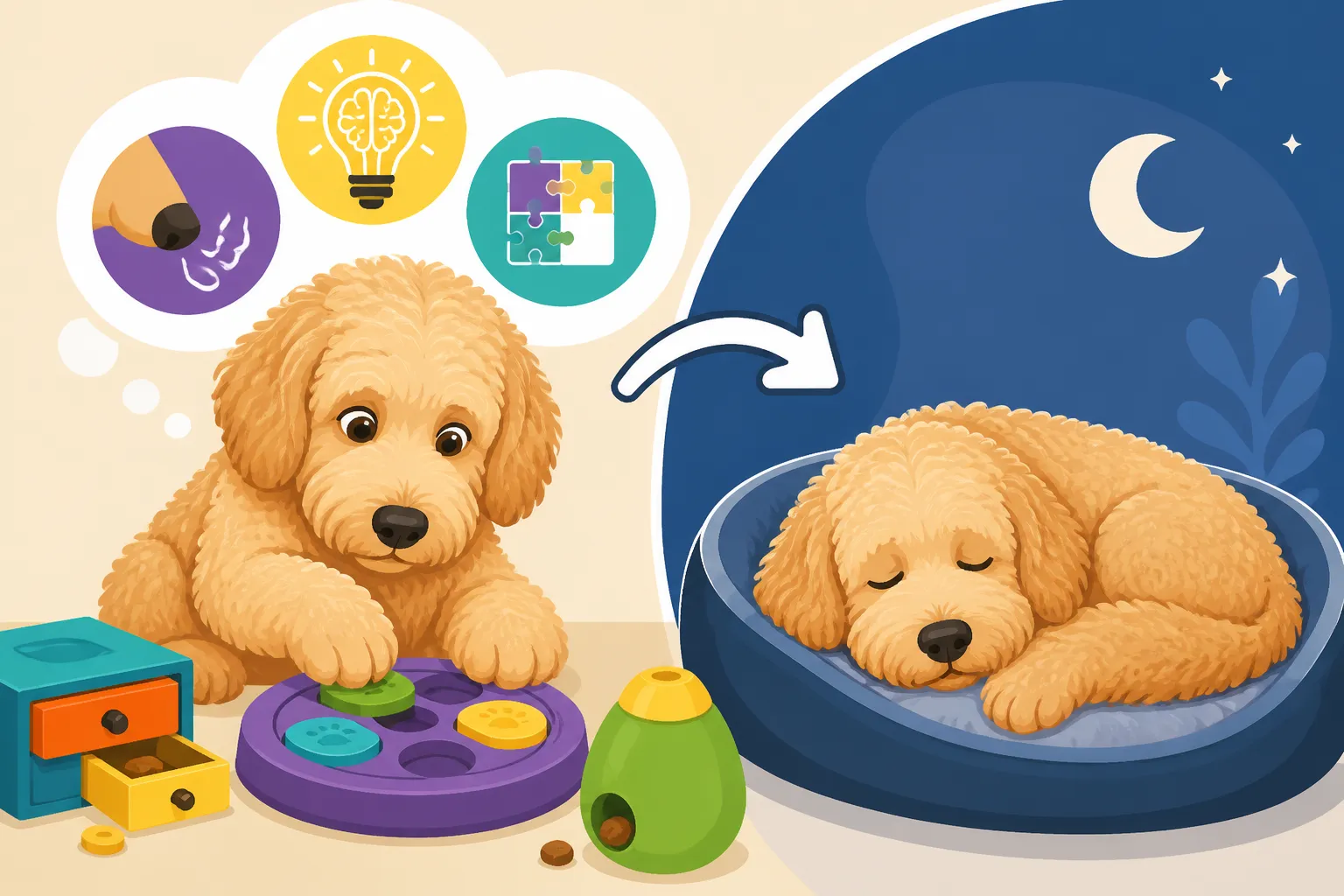
The Thinking Work That Actually Tires a Goldendoodle
One of the biggest eye-openers for new Goldendoodle owners is realizing that an hour at the dog park, while great for physical energy, often leaves their furry friend still bouncing off the walls. You might feel like you're doing everything right, burning off all that excess enthusiasm, only to be met with a mischievous glint in their eyes and a fresh mission to "redecorate" your sofa cushions. The truth is, Goldendoodles don't just need physical exercise; they crave mental work that truly taps into their intelligent Poodle and biddable Golden Retriever heritage. This guide is all about exploring those often-overlooked avenues of mental stimulation that will leave your Goldendoodle not just tired, but genuinely content and settled.
Why Just Running Around Isn't Enough for a Goldendoodle
It's a common misconception that a tired dog is purely a physically exhausted dog. While Goldendoodles absolutely need their daily romps and opportunities to stretch their legs, their intelligent minds are often left underutilized if physical exercise is the only outlet. Think about it: if you spent all day running, but never had to think, learn, or solve a problem, you'd likely still feel restless and unfulfilled, wouldn't you? Your Goldendoodle is much the same.
The Poodle Brain's Need to Work
Let's not forget that a significant part of your Goldendoodle's genetic makeup comes from the Poodle, a breed historically known for its keen intelligence and trainability. Poodles weren't just fancy show dogs; they were originally bred as water retrievers, requiring problem-solving skills, memory, and focus to perform their duties. That sharp intellect didn't magically disappear when the Golden Retriever genes entered the mix. It's still there, waiting to be challenged. If that Poodle brain isn't given constructive problems to solve, it will often invent its own, which can manifest as behaviors we label as "naughty" or "stubborn." They need to use their smarts, to figure things out, and to feel engaged in a task that requires more than just chasing a ball.
Imagine a highly intelligent person stuck in a job that only requires them to physically move boxes. They might be physically tired at the end of the day, but mentally, they're probably bored and looking for something more. This is exactly how your Goldendoodle can feel if all they get is physical exercise. Their minds are wired for complexity, for learning, and for engagement, and ignoring that aspect can lead to a host of behavioral frustrations for both of you.
The Retriever Drive for Purpose
Then there's the Golden Retriever side, known for its eagerness to please and strong retrieve drive. Goldens thrive on having a "job" – whether it's retrieving game, carrying a basket, or simply bringing you your slippers. This inherent desire to work with their human companions means they often find immense satisfaction in tasks that involve cooperation and problem-solving. When a Goldendoodle combines this retriever drive with the Poodle's intelligence, you have a dog that truly flourishes when given a purpose. Poodle Brains and Retriever Eagerness in One Goldendoodle touches on this powerful combination.
Leaving this drive unaddressed can lead to a Goldendoodle who constantly seeks attention, brings you every toy in the house without an apparent goal, or becomes overly mouthy in an attempt to engage you. They're not being disobedient; they're trying to fulfill that intrinsic need for a job, for interaction, and for being a productive member of their "pack." Providing mental work taps into this deeply ingrained desire, giving them a constructive outlet for their energy and fostering a stronger bond with you.
Engaging Your Goldendoodle's Mind with Daily Challenges
The good news is that providing mental stimulation doesn't have to be complicated or require specialized equipment. Many effective strategies can be woven into your daily routine, transforming mundane moments into enriching learning experiences for your Goldendoodle. The key is variety and consistency, making mental work as much a part of their day as physical exercise.
Puzzle Feeders and Snuffle Mats
One of the easiest and most impactful ways to introduce mental work is by making mealtime a challenge instead of just a quick gulp from a bowl. Puzzle feeders require your Goldendoodle to manipulate objects, push levers, or slide panels to get their kibble. This slows down their eating, prevents bloat (especially in larger Goldendoodles), and, most importantly, makes them think. You can find a wide variety of these on platforms like Amazon, from beginner-friendly designs to more complex ones that will genuinely make your dog work for their dinner.
Snuffle mats are another fantastic option. These fabric mats have numerous fleece strips sewn into them, creating hiding spots where you can sprinkle kibble or treats. Your Goldendoodle has to use their nose and paws to "snuffle" through the fabric and find the food. It's incredibly satisfying for them and a wonderful way to engage their natural foraging instincts. Both puzzle feeders and snuffle mats turn what could be a 30-second meal into a 10-15 minute mental workout, leaving them much more satisfied and tired afterward. Goldendoodle Puzzle Feeders and Scent Games delves deeper into these specific tools.
Scent Work and Nose Games
Did you know your Goldendoodle's nose is one of their most powerful tools? Goldendoodles inherit an incredible sense of smell from both parent breeds, especially the Golden Retriever. Scent work, or nose games, taps into this natural ability and is incredibly tiring for dogs because it requires immense concentration. You can start with simple hide-and-seek games. Hide a high-value treat in an obvious spot and encourage your dog to "find it." As they get better, gradually increase the difficulty by hiding treats in different rooms, under blankets, or inside boxes.
Another fun game is "shell game" where you hide a treat under one of three cups and shuffle them around, letting your Goldendoodle tap the correct cup with their nose or paw. You can also teach them to find specific toys by name or even play "find the human" with family members hiding. These activities not only provide mental stimulation but also build confidence and reinforce their natural problem-solving skills. The beauty of scent work is that it can be done indoors, regardless of weather, making it a perfect rainy-day activity.
Trick Training and New Commands
Teaching your Goldendoodle new tricks and commands isn't just for showing off; it's a fantastic form of mental exercise. Every new command requires focus, memory, and the ability to link a verbal cue to a physical action. Start with simple tricks like "shake a paw," "roll over," or "bow." Once they master those, move on to more complex sequences or practical skills like "go to your bed" and stay, or "put your toys away." Trick Training as Goldendoodle Mental Work offers even more ideas on this front.
The process of learning itself is highly engaging. Goldendoodles, with their eager-to-please nature, often thrive on this collaborative learning. The mental effort involved in figuring out what you want, combined with the satisfaction of earning a reward, is profoundly tiring in a good way. Keep training sessions short, positive, and fun to maintain their enthusiasm. Even five-minute bursts of trick training throughout the day can add up to significant mental enrichment. Five Minute Goldendoodle Training Sessions emphasizes how effective short, focused sessions can be.
Weaving Mental Work into Everyday Goldendoodle Life
Making mental stimulation a regular part of your Goldendoodle's day doesn't mean you need to dedicate large blocks of time to elaborate games. Instead, think about how you can integrate these brain-boosting activities into moments you're already sharing, turning ordinary interactions into extraordinary learning opportunities.
Mealtime as a Training Opportunity
We touched on puzzle feeders, but even without a fancy gadget, mealtime can be a mental exercise. Instead of just putting their bowl down, ask your Goldendoodle to perform a series of commands before they get to eat. "Sit," "stay," "down," "wait"—these are all small mental challenges that require focus and impulse control. You can even hand-feed portions of their meal, using each piece of kibble as a reward for a different behavior or command.
Consider turning mealtime into a scavenger hunt. Hide small portions of their food around the house (in safe, accessible spots, of course!) and let them sniff it out. This engages their powerful sense of smell and makes eating a much more active and thought-provoking experience. The more they have to think and search, the more truly satisfied they will be when they finally get to eat.
Walks as Mental Exploration
A walk doesn't just have to be about covering distance. For a Goldendoodle, it can be a rich tapestry of scents, sounds, and novel experiences. Instead of rushing through your route, allow your Goldendoodle time to sniff. Seriously, let them sniff! Sniffing is an incredibly enriching and calming activity for dogs. It engages their primary sense, helps them process information about their environment, and is surprisingly tiring. Imagine reading a whole newspaper with your nose – that's how much work sniffing is for them.
Vary your walking routes to introduce new smells and sights. Let them explore different textures under their paws, like grass, pavement, and dirt. Practice short bursts of training during your walk, like "sit" at every curb, "heel" for a few paces, or "leave it" when encountering interesting (but inappropriate) items on the ground. These little moments of focus amidst the outdoor stimulation add up to a much more mentally fatiguing and satisfying walk. Goldendoodle Leash Manners by Size can provide more guidance on making walks productive.
Short, Frequent Sessions
The key to successful mental enrichment is often not about marathon sessions, but rather short, frequent bursts of activity. Goldendoodles, especially when young, can have shorter attention spans, so 5-10 minute training or game sessions multiple times a day are often more effective than one long, drawn-out session. These mini-sessions keep their minds engaged without causing frustration or burnout.
Think about how you can integrate these small moments: a quick trick training session while your coffee brews, a nose game before you leave for work, a puzzle toy while you're making dinner, or a few impulse control exercises during commercial breaks. These seemingly small efforts accumulate to provide a consistent level of mental stimulation throughout the day, preventing boredom from setting in and reducing the likelihood of your Goldendoodle inventing their own (potentially destructive) entertainment.
Essential Tools and Resources for Mental Engagement
While many mental enrichment activities can be done with household items, there are some fantastic tools and resources available that can make your life easier and keep your Goldendoodle engaged. These items are designed specifically to challenge their minds and provide long-lasting entertainment.
Interactive Toys and Dispensers
The market is flooded with interactive dog toys, and for good reason! These toys are built to hold treats or kibble and require your dog to figure out how to release the food. Brands like KONG, West Paw, and Nina Ottosson offer a range of products, from simple stuffable rubber toys to multi-step puzzles. You can often find a great selection of these on Amazon, with options for every skill level and chewing style. A classic KONG, for instance, can be stuffed with peanut butter, yogurt, or wet dog food and then frozen, providing a long-lasting challenge that keeps your Goldendoodle occupied and mentally focused for a significant period.
Beyond treat-dispensing, some interactive toys feature buttons, lights, or even recorded messages that engage your dog in different ways. Choose toys appropriate for your Goldendoodle's size and chewing strength. The goal is to provide a challenge, not something they'll destroy in two minutes or get bored with instantly.
Online Training Programs and Courses
Sometimes, you need a little structured guidance to maximize your Goldendoodle's potential. Online training programs can be an incredible resource for learning new tricks, addressing specific behaviors, and continuously challenging your dog's intellect. Companies like BAXTER & Bella offer comprehensive online puppy and dog training programs that cover everything from basic obedience to advanced skills and problem-solving. These courses often provide step-by-step instructions, video demonstrations, and even personalized support, allowing you to work at your own pace from the comfort of your home.
These programs are excellent for keeping your Goldendoodle's brain active and for helping you learn how to better communicate with and motivate your intelligent companion. They can introduce you to new games, strategies, and ways of thinking about mental enrichment that you might not discover on your own. Investing in such a resource can provide a lifetime of learning opportunities for both you and your Goldendoodle.
DIY Brain Games
You don't always need to buy new things to keep your Goldendoodle's brain busy. Many effective mental games can be created with items you already have around the house. The "muffin tin game" is a prime example: place treats in some of the muffin tin holes and then cover each hole with a tennis ball. Your Goldendoodle has to figure out how to remove the balls to get to the treats.
Another simple DIY idea is the "towel roll-up." Lay a towel flat, sprinkle treats along one edge, and then roll or fold it up tightly. Your Goldendoodle will have to unroll it to get their reward. You can also use cardboard boxes, crinkled paper, and even old blankets to create layered sniffing puzzles. The beauty of DIY games is that they cost next to nothing, are easy to set up, and can be customized endlessly to keep things fresh and engaging for your clever Goldendoodle. Nose Games to Play With a Goldendoodle Indoors has some great concepts for these types of activities.
Here's a quick comparison of popular mental enrichment options:
| Activity Type | Setup Difficulty | Engagement Level | Cost | Primary Skill Engaged | Benefits |
|---|---|---|---|---|---|
| Puzzle Feeder | Easy | Medium to High | Low to Medium | Problem-solving | Slows eating, mental fatigue, independent play |
| Snuffle Mat | Easy | High | Low to Medium | Scent work | Calming, natural foraging, independent play |
| Scent Hide-and-Seek | Medium | High | Very Low (treats) | Scent work, memory | Builds confidence, works entire body, very tiring |
| Trick Training | Medium | High | Very Low (treats) | Learning, focus | Builds bond, improves obedience, boosts confidence |
| Interactive Toys | Easy | Medium | Medium | Problem-solving | Independent play, distraction, varied challenges |
| DIY Games (e.g., Muffin Tin) | Easy | Medium | Very Low (recycled) | Problem-solving, dexterity | Adaptable, cheap, creative |
Avoiding Overstimulation and Burnout
While mental stimulation is crucial, it's possible to have too much of a good thing. Just like humans, dogs can get overwhelmed or stressed if constantly bombarded with challenges without adequate downtime. A Goldendoodle needs a balance of physical exercise, mental work, and quiet rest to truly thrive. Recognizing the signs of overstimulation and ensuring proper recovery is just as important as providing the activities themselves.
Recognizing Signs of Fatigue
A mentally tired Goldendoodle will often appear settled, sleepy, and content. They might nap soundly, lie quietly at your feet, or simply be less inclined to seek constant attention or engage in mischievous behaviors. On the flip side, an overstimulated Goldendoodle might actually seem more hyperactive, prone to excessive barking, nipping, or an inability to settle. This isn't because they need more activity, but because their brains are on overdrive and they're struggling to decompress.
Other signs of overstimulation can include increased panting (without physical exertion), excessive yawning, lip licking, or repeatedly shaking off as if wet. They might also become less responsive to commands or seem more easily frustrated by challenges that were previously manageable. Learning to read these subtle cues from your Goldendoodle is vital to ensuring a healthy balance.
Balancing Mental and Physical Rest
After an intense puzzle session or a challenging training class, your Goldendoodle needs time to "process" and relax. Think of it like a child after a busy day at school – they might be tired, but they also need quiet time to unwind before bed. Provide a comfortable, quiet space where your Goldendoodle can retreat without interruption. This might be their crate, a cozy dog bed in a low-traffic area, or a designated "place" mat.
Ensure they're getting enough quality sleep, especially puppies and adolescent Goldendoodles who are still developing. Just like humans, sleep is essential for memory consolidation and general well-being. A routine that includes structured mental work followed by enforced quiet time can be incredibly beneficial for teaching your Goldendoodle how to switch off and relax. Goldendoodle Exercise for Body and Mind also covers this balance effectively.
The Importance of Down Time
"Down time" isn't just about sleeping; it's about learning to do nothing. For many Goldendoodles, especially those with high energy levels, learning to simply exist calmly in the house without constant engagement can be a huge challenge. This is where "place" training or "mat settle" can be invaluable. Teach your Goldendoodle to go to a designated spot (like a bed or mat) and stay there calmly, even when there's activity around them. Start with short durations and gradually increase the time.
This skill is not only practical (e.g., when guests arrive, or you're trying to eat dinner), but it also teaches them self-control and allows their brains to rest actively. Providing appropriate chew toys or long-lasting chews during this down time can also help them relax and self-soothe. By building in intentional periods of calm, you're helping your Goldendoodle develop crucial coping mechanisms for a busy world, ensuring they are truly well-adjusted and not just constantly seeking the next thrill.
Identifying When Your Goldendoodle Needs More Brain Games
Sometimes, it's not obvious that your Goldendoodle is bored. You might attribute certain behaviors to "being a puppy" or "just being a Goldendoodle." However, many common behavioral issues stem directly from a lack of adequate mental stimulation. Learning to recognize these indicators can help you intervene with appropriate activities before problems escalate.
Destructive Chewing and Nipping
If your Goldendoodle is constantly chewing on furniture, shoes, or anything they can get their paws on, beyond normal puppy teething, it could be a sign of boredom and under-stimulation. Chewing is a natural canine behavior, but destructive chewing often indicates an unmet need for mental engagement or a healthy outlet for energy. They're trying to entertain themselves, and your favorite armchair might be the most exciting thing in the room. Goldendoodle Puppy Chewing Through Furniture addresses this common issue.
Similarly, excessive nipping or mouthing that goes beyond playful puppy nips can also be a cry for more mental work. A bored Goldendoodle might try to initiate play by nipping at your hands or clothes, seeking interaction in the most direct way they know how. Providing appropriate chew toys, puzzle toys, and redirecting their attention to mentally stimulating games can significantly reduce these unwanted behaviors.
Excessive Barking or Whining
A Goldendoodle that barks incessantly at every sound, whines for attention, or paces restlessly might be telling you, in their own way, that they're bored and understimulated. Barking can be a self-rewarding behavior; it gets a reaction (even if it's negative), and that's often enough for a bored dog. Whining is a clear bid for your attention, signaling that they're not content with their current state. Goldendoodle Barking and What Sets It Off provides deeper insights into barking triggers.
When a Goldendoodle isn't given enough productive outlets for their energy, their minds can become overactive, leading to anxiety and vocalizations. Introducing more nose games, structured training, and interactive toys can help redirect this excess mental energy into more positive channels, leading to a calmer and quieter household.
Hyperactivity Indoors
Perhaps one of the most frustrating signs for owners is a Goldendoodle that simply cannot settle indoors. They might race through the house, jump on furniture, or constantly pester you for play, even after a long walk. This "zoomies" behavior or general restlessness, especially when it's inappropriate for the setting, is a strong indicator that their brain hasn't been adequately challenged. Physical exercise alone might energize their body without tiring their mind, leaving them with pent-up mental energy.
By integrating more thinking work, you're not just burning physical calories; you're taxing their brain, which leads to a more profound sense of fatigue and satisfaction. A mentally tired Goldendoodle is much more likely to settle down and relax indoors, transforming from a whirling dervish into a calm, contented companion. Consistent application of Goldendoodle Impulse Control Exercises can also help manage this hyperactivity and teach them how to regulate their excitement.
Ultimately, understanding that your Goldendoodle is a creature of immense intelligence and an innate desire for purpose is key. By consciously providing engaging mental activities, you're not just solving behavioral problems; you're nurturing a happier, healthier, and more well-adjusted dog who thrives on learning and collaboration.
Disclaimer
This article is for general informational purposes only and does not constitute professional advice. Laws, prices and regulations vary by location and change over time. Consult a qualified professional for guidance on your specific situation.