Why F2 Goldendoodle Litters Vary So Much
If you've ever gazed at a litter of F2 Goldendoodle puppies, you might have been struck by how incredibly different they look, even from the same parents. One puppy might be a fluffy, curly-haired dream, another a sleek, wavy wonder, and a third a surprisingly flat-coated little sprite. This isn't just charming diversity; it's a peek into the genetic lottery that is the F2 Goldendoodle generation, where predictability takes a backseat to the fascinating dance of dominant and recessive genes. This guide will dive deep into why these litters vary so much, helping you understand the genetic mechanisms at play and what to expect if you're considering bringing an F2 Goldendoodle into your life.
Understanding Goldendoodle Generations: A Quick Refresher
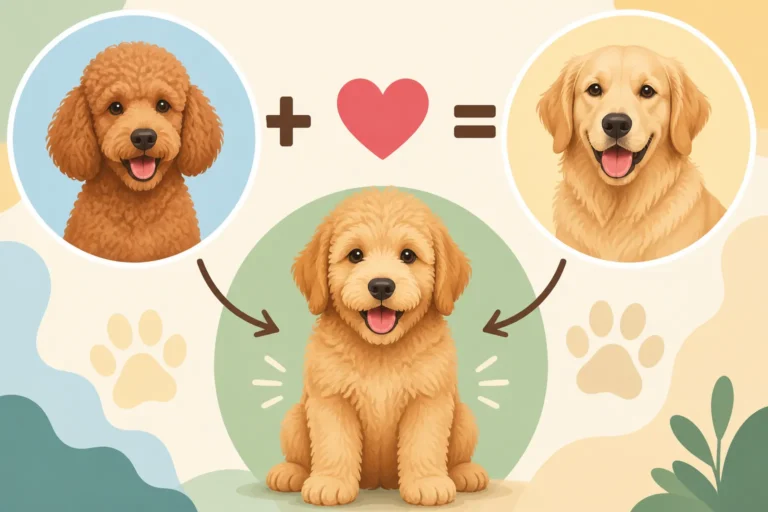
Before we jump into the wild world of F2 Goldendoodles, it helps to understand where they come from. The Goldendoodle lineage is all about crossing two incredible breeds, the Golden Retriever and the Poodle, to combine their best qualities. But it's not always a straightforward 50/50 blend, and each generation brings its own level of genetic shuffling.
What is an F1 Goldendoodle?
The F1 Goldendoodle is the original hybrid, the first generation cross between a purebred Golden Retriever and a purebred Poodle. Think of it as the perfect genetic blend, at least on paper, because each parent contributes exactly 50% of its genetic material. This means an F1 Goldendoodle puppy gets half its genes from one breed and half from the other. This initial cross often results in what breeders refer to as "hybrid vigor," a general robustness and genetic diversity that can sometimes lead to healthier offspring than either purebred parent. While F1s are often more consistent in terms of desired traits like the wavy coat and lower shedding, they can still vary. You can learn more about this initial cross in How an F1 Goldendoodle Is Bred.
The Jump to F2: Two F1 Parents
Now, an F2 Goldendoodle is born when two F1 Goldendoodles are bred together. This is where things get really interesting, and frankly, a bit unpredictable. Instead of receiving a predictable 50/50 split directly from purebred parents, each F1 parent is already a mixed bag of Golden Retriever and Poodle genes. When these two F1 individuals mate, their offspring (the F2 litter) receive a random assortment of those mixed genes. It's like shuffling two decks of cards, each already a mix of two suits, and then dealing out new hands. You might get a lot of one suit, a lot of the other, or an even mix, but it's hard to predict exactly what combination any single card (or gene) will appear in. This genetic recombination is the primary reason why F2 litters display such a wide spectrum of traits, from coat type and shedding levels to size and even aspects of temperament.
The Genetics Behind the Goldendoodle Lottery
The variability in F2 Goldendoodle litters isn't magic; it's pure genetics in action. It all comes down to how genes are passed from parents to offspring, especially when those parents are themselves first-generation hybrids. Understanding a few basic genetic principles can help clarify why this generation is such a delightful surprise package.
Punnett Squares and Trait Inheritance
Remember those Punnett squares from high school biology? While we don't need to draw them out, the concept is crucial here. Each parent carries two copies of most genes, passing one copy to each offspring. In an F1 Goldendoodle, for many traits, one gene copy came from the Golden Retriever and one from the Poodle. When two F1 Goldendoodles breed, those gene pairs can combine in several ways.
Let's take coat type as a prime example. The Poodle typically carries genes for a very curly, low-shedding coat, along with "furnishings" (the genes for facial hair, like eyebrows and a beard). Golden Retrievers have a flat, shedding coat and lack furnishings. An F1 Goldendoodle usually inherits one copy of each, resulting in a wavy, somewhat low-shedding coat with furnishings. But when two F1s breed, their puppies can inherit:
- Two copies of the Golden Retriever coat genes (leading to a flat, shedding coat)
- Two copies of the Poodle coat genes (leading to a very curly, low-shedding coat)
- One copy of each (leading to another wavy, low-shedding coat, similar to an F1)
This simple recombination means that within a single F2 litter, you can see all three possibilities. It's truly a genetic roll of the dice for each individual puppy. This also helps explain Why F2 Goldendoodle Litters Vary So Much.
The Role of the "Furnishings" Gene
The "furnishings" gene (often denoted as F/f) is perhaps the most significant factor in the appearance of a Goldendoodle. This is the gene responsible for the longer hair on the muzzle and eyebrows, which gives the Goldendoodle its characteristic "doodle" look and contributes significantly to its low-shedding qualities. A dog without furnishings will have a smooth face, much like a Golden Retriever.
Most F1 Goldendoodles carry one copy of the furnishings gene (F) and one copy of the non-furnishings gene (f). They express the furnishings because the gene is dominant. However, when two F1 Goldendoodles (Ff x Ff) are bred, their puppies have a 25% chance of inheriting two copies of the non-furnishings gene (ff), meaning they will have a smooth, shedding face and coat, much closer to a Golden Retriever. There's a 50% chance they'll be Ff (furnished, wavy/curly) and a 25% chance they'll be FF (furnished, typically curlier). This explains why some F2 puppies can look dramatically different, even appearing like purebred Golden Retrievers, without the signature doodle beard. It's a key part of understanding What Furnishings Give a Goldendoodle Its Beard and why not every Goldendoodle will have that look.
Size and Temperament Surprises
While coat variations are visually striking, genetic recombination also impacts size and temperament. Both Golden Retrievers and Poodles come in a range of sizes, and while breeders often try to match parent sizes, the genes for size are still shuffled in F1s. An F2 litter can throw puppies that are larger or smaller than both F1 parents, depending on which size-influencing genes they inherit. A standard Goldendoodle, for instance, could have parents that lean towards the smaller end of the standard range, yet still produce a puppy that grows up to be a very large dog, or vice versa.
Similarly, temperament traits, which are complex and influenced by many genes, are also mixed. While Goldendoodles are generally known for their friendly, intelligent nature—a wonderful blend of the Golden Retriever's biddability and the Poodle's smarts—an F2 puppy might lean more heavily towards one parent breed's personality traits than the other. One puppy might be a focused, eager-to-please retriever, while another might be a more sensitive, independent poodle type. You can learn more about this in Goldendoodle Temperament From Two Parent Breeds. Environmental factors and socialization play a huge role too, but the underlying genetic blueprint from those F1 parents is definitely being tossed in the air for an F2 litter.
What to Expect (and Not Expect) from an F2 Goldendoodle Litter
Given the genetic complexities, approaching an F2 Goldendoodle litter requires a certain openness and appreciation for individuality. You're less likely to find perfect uniformity, but what you lose in predictability, you gain in the unique character of each puppy.
Coat Types: A Spectrum of Possibilities
As discussed, F2 litters are a showcase of all possible Goldendoodle coat types. You might find:
- Flat Coats: These puppies will have a coat similar to a Golden Retriever. They will shed, sometimes quite a bit, and will likely not be suitable for allergy sufferers. They won't have the characteristic "furnishings" on their face.
- Wavy Coats: Often resembling the F1 parents, these coats are a mix of curly and straight hair. They tend to shed minimally to moderately and generally have furnishings. This is often the most desired coat type for a Goldendoodle.
- Curly Coats: These coats are dense and tightly curled, much like a Poodle's. They are typically very low-shedding and will have strong furnishings. While great for allergies, these coats require the most intensive grooming to prevent matting.
It's common for breeders to DNA test their F1 parents for the furnishings gene (and other coat traits) to give potential buyers a better idea of what to expect, but even then, it's a probability, not a guarantee for each puppy. The Three Goldendoodle Coat Types and How to Tell Them article goes into more detail about these variations. Remember, a puppy's coat can also change significantly during The Goldendoodle Coat Change at Eight to Twelve Months, so what you see at eight weeks might not be what you get at one year.
Predicting Adult Size and Weight
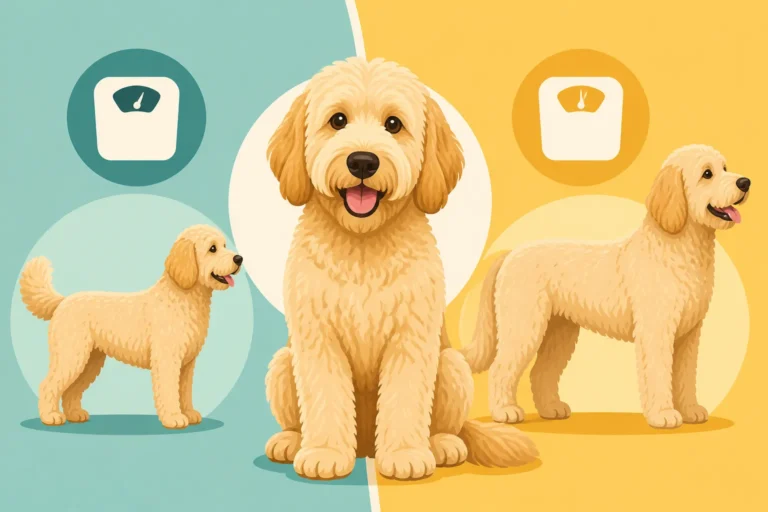
Predicting the adult size of an F2 Goldendoodle can be more challenging than with other generations. Even if both F1 parents are roughly the same size, their underlying genetic makeup is a blend of different-sized purebred Poodles and Golden Retrievers. This means the puppies can inherit a wider range of growth genes. You might have parents that are both 50 pounds, but one puppy in the litter could end up being 40 pounds, while another could hit 65 pounds.
Breeders will usually provide a general size estimate based on the parents, but it’s vital to understand that it’s less precise with F2s. For a standard Goldendoodle, this variation can be quite significant, impacting everything from how much space they need to how much food you'll buy from places like Chewy. If you have a strong preference for a specific size, an F2 might not be the most predictable choice.
Temperament and Drive: A Mixed Bag
While most Goldendoodles are celebrated for their outgoing, friendly, and intelligent dispositions, the F2 generation can display a broader spectrum of behavioral traits. You might encounter puppies that are:
- More Retriever-like: Very eager to please, high retrieving drive, generally laid-back indoors but ready for adventure outside.
- More Poodle-like: Highly intelligent, sometimes a bit more sensitive, excellent problem solvers, and potentially more reserved with strangers until they warm up.
- A True Blend: Exhibiting a harmonious mix of both, which is often the Goldendoodle ideal.
It’s less about one being "better" than the other and more about understanding the potential for different expressions of these traits. This is why thorough socialization from a young age is paramount for any Goldendoodle puppy, but especially important for an F2, to help them develop into well-adjusted adults regardless of their inherited leanings.
Here's a quick comparison of Goldendoodle generations regarding predictability:
| Goldendoodle Generation | Parentage | Coat Predictability | Shedding Predictability | Size Predictability | Temperament Predictability |
|---|---|---|---|---|---|
| F1 | Purebred Golden x Purebred Poodle | Mostly wavy | Low to moderate | Moderate | Good |
| F1b | F1 Goldendoodle x Purebred Poodle | Mostly curly | Very low | Good | Good |
| F2 | F1 Goldendoodle x F1 Goldendoodle | Highly varied | Highly varied | Varied | Varied |
| Multigen | F1b/F2/Multigen x F1b/F2/Multigen | Good (with testing) | Good (with testing) | Good | Good |
Note: "Good" predictability means a higher likelihood of desired Goldendoodle traits, but not a guarantee.
Navigating the F2 Goldendoodle Purchase
If you're still drawn to the charm and individuality of an F2 Goldendoodle, that's fantastic! Many wonderful dogs come from this generation. However, because of the inherent variability, there are extra steps you'll want to take to ensure you find a puppy that's a good fit for your family.
Breeder Transparency and Health Testing
This is non-negotiable for any Goldendoodle, but perhaps even more critical for F2s. A responsible breeder should be completely transparent about the parent dogs, their health testing results, and what they know about the genetic makeup of the litter. Ask to see the health clearances for both F1 parents, including OFA or PennHIP certifications for hips and elbows, eye clearances from a veterinary ophthalmologist, and DNA tests for common genetic conditions in both Golden Retrievers and Poodles, such as Progressive Retinal Atrophy (PRA) or Von Willebrand Disease. You'll want to investigate Health Testing Both Goldendoodle Parents Should Have.
A good breeder will also be honest about the coat potential of the F2 litter. They should be able to tell you if they've DNA tested the F1 parents for the furnishings gene, which gives you a clearer picture of the likelihood of flat-coated puppies. If a breeder guarantees a non-shedding, curly coat from an F2 litter without showing you genetic testing results for the parents, that's a red flag. Be wary of anyone who makes guarantees that genetics simply can't back up.
Spending Time with the Puppies and Parents
Since F2 litters are so varied, spending time with the puppies and observing their individual personalities is incredibly important. While it's true that puppy personalities can change, observing their interactions, play styles, and how they respond to you can offer valuable clues. Are you looking for a more laid-back companion or a high-energy adventure buddy? Watch how the different puppies behave.
It’s also crucial to meet the F1 parents, if possible. Not only does this allow you to see their health and temperament first-hand, but it also helps you gauge the general demeanor and physical characteristics that might be passed on. While it won't guarantee an F2 puppy will be an exact replica of either F1 parent, it gives you a better sense of the genetic pool. If you can't meet the parents in person, ask for videos and detailed descriptions of their personalities and energy levels.
Preparing for a Range of Outcomes
Bringing an F2 Goldendoodle into your home means embracing a bit of a wonderful unknown. You might end up with a dog that has a Poodle's tight curls and intelligence, a Golden Retriever's soft, shedding coat and endless enthusiasm, or anything in between. The key is to be prepared for the range of possibilities, particularly concerning grooming needs. If your F2 puppy inherits a curlier, low-shedding coat, you'll be dedicating significant time and resources to regular grooming appointments or learning to groom at home. You can find many grooming essentials, from specialized brushes to shampoos, on platforms like Chewy. If your puppy has a flatter, more shedding coat, your grooming needs will be different but still present, mostly focused on managing shedding.
The cost of a Goldendoodle puppy, regardless of generation, can be substantial, and F2 puppies are no exception. You can often find F2 Goldendoodle puppies among Goldendoodle Puppy Prices From $2,000 to $5,000, depending on the breeder and region. This is why managing your expectations and preparing for varying grooming and exercise needs based on the individual dog is so important. Embrace the uniqueness of your F2 Goldendoodle, provide consistent training and socialization, and you'll undoubtedly have a loving, albeit wonderfully unpredictable, companion.
Disclaimer
This article is for general informational purposes only and does not constitute professional advice. Laws, prices and regulations vary by location and change over time. Consult a qualified professional for guidance on your specific situation.