Five Minute Goldendoodle Training Sessions
One of the biggest frustrations Goldendoodle owners face is feeling like they never have enough time to dedicate to training. Life gets busy, and those ambitious hour-long sessions you planned often fall by the wayside, leaving you with an adorable, but perhaps slightly unruly, furry friend. But what if I told you that some of the most effective training you can do with your Goldendoodle only takes five minutes? This guide is all about embracing the power of short, consistent bursts of training to build a well-behaved, happy Goldendoodle without the daily overwhelm.
Why Short, Sweet, and Frequent Sessions Work Wonders for Your Goldendoodle
Let's be real, our Goldendoodles are smart cookies, but they're not always known for their marathon attention spans. Trying to force a long training session when their brain has already moved on to chasing squirrels or begging for belly rubs is a recipe for frustration for both of you. This is where the magic of five-minute sessions comes in.
Tapping Into the Goldendoodle's Eagerness and Attention Span
Goldendoodles inherit a wonderful blend of intelligence and eagerness from their parent breeds. The Poodle side brings a keen mind and a desire to learn, while the Golden Retriever side offers that incredible biddability and desire to please. This combination means they want to work with you, but that doesn't mean they want to do it for an hour straight. Especially as puppies or during their sometimes-challenging adolescent phase, their focus can flicker faster than a candle in a breeze.
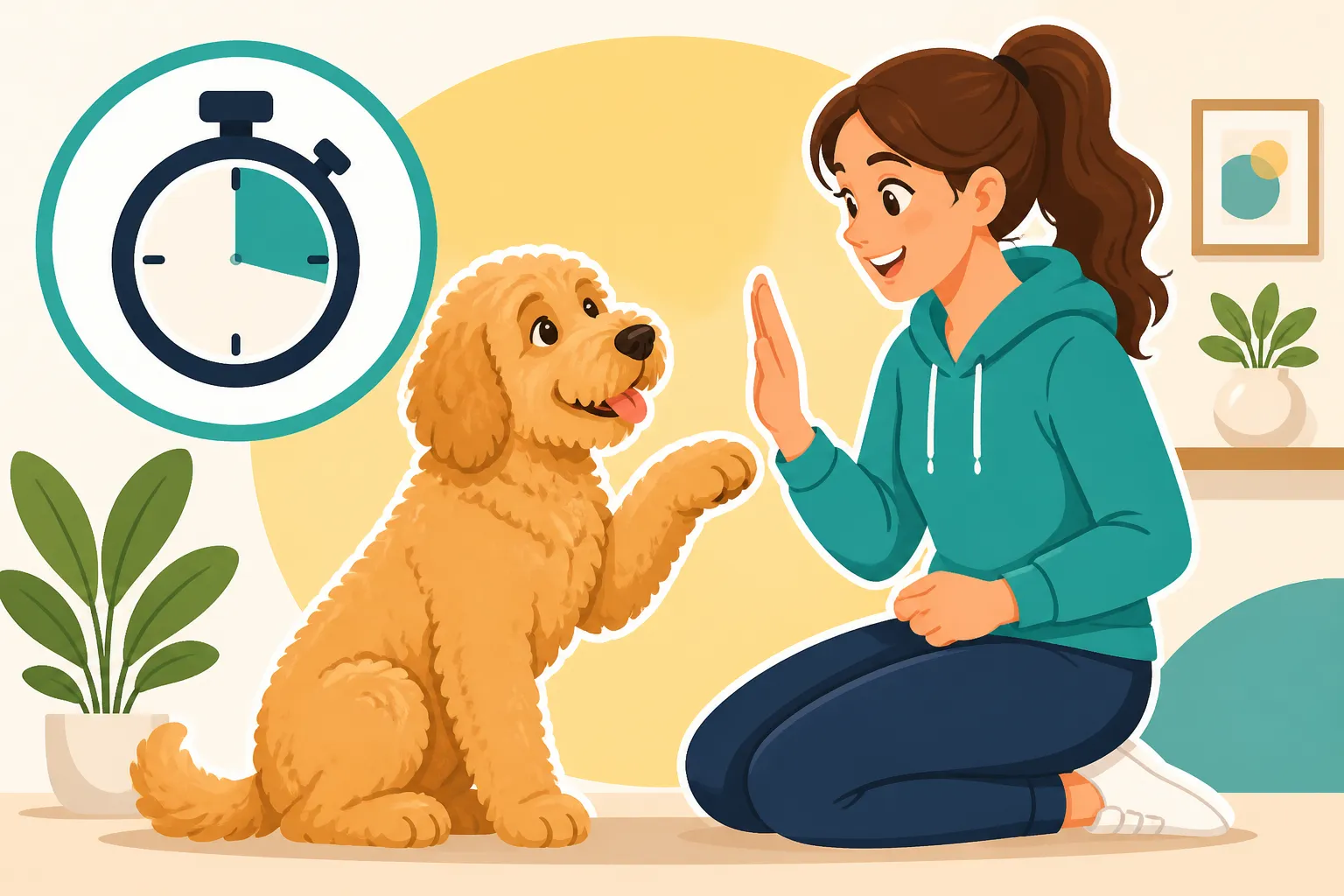
Think about it from your Goldendoodle's perspective. A five-minute session feels like a fun game, a quick interaction that always ends on a positive note. It keeps them engaged and eager for the next session, rather than dreading a long, drawn-out ordeal. When you keep sessions short, you're constantly working within their peak attention window, maximizing the learning potential. This method also aligns beautifully with Why a Goldendoodle Learns Faster Than Most Crosses, playing directly into their natural abilities.
Building Consistency Without Overwhelm for Owners
The biggest benefit for you is how manageable these short sessions are. We all have busy lives, packed with work, family, and endless errands. Finding an hour every day to dedicate to dog training can feel like an impossible task, leading to guilt and inconsistency. But five minutes? Most of us can find five minutes, even on the busiest of days.
Imagine fitting in a quick session before breakfast, another during a TV commercial break, and one more before bed. These small, consistent efforts compound over time, building a strong foundation of good habits. It's far better to do five minutes of focused training every single day than to attempt an hour once a week. This consistent exposure reinforces behaviors, makes them stick, and prevents your Goldendoodle from "forgetting" what you've taught them between sessions. This approach is key to harnessing Positive Reinforcement and Why It Suits a Goldendoodle, creating a positive feedback loop that strengthens your bond.
Structuring Your Five-Minute Goldendoodle Training Session for Success
So, how do you make the most of those precious five minutes? It's not just about haphazardly asking for a "sit" and moving on. A little structure goes a long way in ensuring each mini-session is effective and enjoyable for your Goldendoodle.
The Anatomy of a Perfect Mini-Session
A successful five-minute session follows a simple yet powerful structure:
- Warm-up (30 seconds – 1 minute): Start with something easy your Goldendoodle already knows and loves. A quick "sit" or "down" followed by immediate praise and a high-value treat gets their brain engaged and reminds them that training is fun and rewarding. This sets a positive tone right from the start.
- New Concept or Reinforcement (3-4 minutes): This is the core of your session. You can either introduce one new, simple concept or work on reinforcing 1-2 existing commands that need a little polish. For example, if you're working on "stay," practice it for short durations, gradually increasing the time or distance. If you're introducing "shake a paw," break it down into tiny, achievable steps. Remember to use high-value treats that your Goldendoodle absolutely adores – think small pieces of cooked chicken, cheese, or specialized training treats you can easily buy on Amazon.
- End on a High Note (30 seconds): Always, always end the session with a command your Goldendoodle nails and lavish praise. This leaves them feeling successful and happy, eager for the next training opportunity. Don't push it until they're frustrated or distracted. Stop while they're still keen. This positive association ensures they view training as a fun interaction with you, not a chore.
| Session Focus | Sample 5-Minute Activities | Goals Achieved |
|---|---|---|
| Basic Manners | 1 min: Sit, Down, Treat. 3 min: Practice "Stay" (short duration/distance). 1 min: Quick "Paw," high praise. | Reinforces known commands, builds patience, introduces body awareness. |
| Recall Practice | 1 min: Easy "Come" in quiet room. 3 min: Play "Hide & Seek" (call from nearby room). 1 min: Big praise, toy reward. | Strengthens "Come," makes it fun, builds reliability. |
| Impulse Control | 1 min: Quick "Leave It" with toy on floor. 3 min: "Wait" for food bowl, then release. 1 min: "Sit," then release to chew toy. | Builds patience, self-control, prepares for real-world distractions. |
| Grooming Prep | 1 min: Gentle ear rub, treat. 3 min: Pick up paw, touch nail clippers, treat. 1 min: Brush a small area, praise. | Desensitizes to handling, builds positive associations with grooming tools. |
| Leash Manners | 1 min: Loose leash walking in living room. 3 min: Practice "Heel" for 5-10 steps, reward. 1 min: "Sit" at door, then open for short walk. | Encourages calm walking, reduces pulling, practices door manners. |
Choosing the Right Environment and Avoiding Distractions
Where you train matters, especially when you're working with short attention spans.
- Start Simple: Begin your five-minute sessions in a quiet, low-distraction environment. Your living room, kitchen, or a calm corner of the yard are perfect. The goal is to set your Goldendoodle up for success, minimizing anything that might pull their focus away from you.
- Gradual Progression: As your Goldendoodle becomes more proficient and their focus improves, you can gradually introduce mild distractions. Try moving to a different room, then outside in the backyard, and eventually to a park during off-peak hours. Always remember to make the environment slightly harder, not overwhelmingly so. If they struggle, go back to an easier environment. This step-by-step increase in challenge is crucial for building reliable behavior in any situation.
- Consistency is Key (Initially): While varying environments is good for generalization, maintaining some consistency in your initial training spots can help your Goldendoodle understand that "this is training time." Over time, they'll learn to focus on you no matter where you are. This structured approach is often highlighted in comprehensive training programs, such as those offered by BAXTER & Bella, which guide you through progressive steps from home to more distracting environments.
Practical Exercises for Your Goldendoodle's Five-Minute Training
Now that you know why and how to run these short sessions, let's dive into some specific exercises perfect for a five-minute burst. The beauty is you can mix and match these, focusing on one or two per session.
Core Commands to Master in Short Bursts
These foundational commands are essential for any well-behaved Goldendoodle and can be easily practiced in five-minute increments.
- Sit: A classic for a reason. Ask for a "sit," mark the behavior with a verbal cue like "yes!" or a clicker, and reward immediately. Practice this several times. Then, try asking for a "sit" as you open the fridge, before putting their food bowl down, or before attaching the leash. This helps them understand that "sit" is a versatile, polite behavior.
- Stay: Once your Goldendoodle knows "sit," you can start adding a "stay." Ask for a "sit," say "stay," take one step back, then immediately step forward, reward, and release with a joyful "free!" Slowly increase the distance and duration, but remember, for a five-minute session, just a few seconds of stay is a huge win. The key is to build success, not push them to failure.
- Come: This is arguably the most important command for safety. Start in a quiet area. Say "come" excitedly, crouch down, and when they approach, reward lavishly with treats and praise. Run away from them a few steps to encourage pursuit, then call them again. Make "come" the best game ever. Goldendoodle Recall in an Open Field takes consistent practice, starting small.
- Down: Often harder than "sit" for many dogs, "down" requires more commitment. Lure your Goldendoodle into a down position with a treat, moving it from their nose to the floor and slightly back. Mark and reward. Practice this from a "sit" and eventually from a standing position.
- Leave It: This impulse control command is invaluable. Place a low-value treat on the floor, cover it with your hand, say "leave it." When your Goldendoodle looks at you (even for a split second), mark and reward with a different, higher-value treat. Gradually uncover the treat on the floor as they learn. This is a fantastic exercise for developing Goldendoodle Impulse Control Exercises.
For all these, consider using a marker word or clicker training, as discussed in Marker Training a Goldendoodle From Week One. It makes your communication incredibly clear for your dog. And don't forget appropriate Training Treats Sized for a Mini Goldendoodle or whatever size your Goldendoodle happens to be.
Incorporating Fun and Mental Stimulation
Training isn't just about commands; it's also about engaging your Goldendoodle's intelligent mind and strong drive to interact. These activities fit perfectly into a five-minute slot and are often deeply enriching.
- Puzzle Feeders and Scent Games: Instead of a regular food bowl, use a puzzle feeder for one of their meals. This turns mealtime into a mental workout. You can find a wide variety of these on Amazon. Or, play a simple "find it" game: hide a few treats around a small room and encourage your Goldendoodle to use their nose to sniff them out. This engages their natural Golden Retriever scenting abilities and provides wonderful mental enrichment. Puzzle Toys That Occupy a Goldendoodle for an Hour can be adapted for shorter bursts of activity.
- Short Fetch or Tug Sessions: Goldendoodles, with their retriever heritage, often adore fetch. A quick five-minute session of tossing a soft toy in the house or yard can burn off some energy and reinforce a "drop it" command. Tug is also a great interactive game, but ensure you teach them to release the toy on command. These games satisfy their innate desire to retrieve and play.
- Trick Training: Teaching fun tricks like "shake a paw," "spin," or "bow" is a fantastic way to bond with your Goldendoodle and provide mental stimulation. Goldendoodles love showing off! Break down a trick into tiny steps (e.g., for "spin," lure them with a treat to turn in a circle). Reward each small movement in the right direction. This builds confidence and makes training feel like play. You can get more ideas from Trick Training as Goldendoodle Mental Work.
Common Pitfalls and How to Keep Your Goldendoodle Engaged
Even with short sessions, there are moments where things might not go according to plan. Learning to recognize these cues and adapt is crucial for sustained success.
Recognizing When to End a Session (or Take a Break)
The golden rule of five-minute sessions is to always end on a success. This means you need to pay close attention to your Goldendoodle's body language.
- Signs of Disengagement: Is your Goldendoodle sniffing the floor more than looking at you? Are they wandering away, yawning, or suddenly more interested in a speck of dust than your delicious treat? These are clear signals that their focus is waning, and it's time to wrap it up. Pushing past this point will only lead to frustration for both of you and create negative associations with training.
- The "One-More-Rep" Trap: It's tempting to think, "Oh, just one more successful 'sit'!" But if you notice their focus slipping, resist the urge. Better to end slightly early, leaving them wanting more, than to push them to a point where they fail or get bored. This keeps the enthusiasm high for the next session.
- When You Need a Break: Let's not forget about you! If you're feeling stressed, rushed, or impatient, your Goldendoodle will pick up on that energy. If you're not in the right headspace, it's okay to skip a session or reschedule it for a calmer moment. Training should be a positive experience for both of you.
Troubleshooting Lack of Motivation and Distraction
Sometimes, even with the best intentions, your Goldendoodle might seem less than thrilled to train. Don't worry, this is normal, and there are ways to re-ignite that spark.
- Vary Your Rewards: Are you always using the same dry kibble as a reward? Goldendoodles can get bored! Mix it up. Use different kinds of high-value treats (small bits of cheese, boiled chicken, hot dogs), different toys, or even just extra enthusiastic praise and a quick game of tug. The value of the reward needs to outweigh the distraction.
- Increase Treat Value for Harder Tasks: If you're working on something particularly challenging, or in a slightly more distracting environment, upgrade your treats significantly. If your Goldendoodle isn't paying attention in the backyard, those bits of dry kibble probably aren't going to cut it. Bring out the really good stuff!
- Go Back to Basics: If your Goldendoodle is struggling with a new concept or is easily distracted, simply go back to a command they know perfectly in a super easy environment. Rebuild their confidence and enthusiasm with easy successes, then slowly reintroduce the challenge. Remember, progress isn't always linear.
- Consider a Structured Program: If you're finding it difficult to maintain consistency or know what to teach next, an online training program like BAXTER & Bella can provide a fantastic framework. They often break down training into manageable steps, offering clear guidance and support that can help keep both you and your Goldendoodle motivated and on track. Sometimes having that external structure makes all the difference. Finding a Trainer Who Works With Goldendoodles is also an excellent option if you need personalized, hands-on help to troubleshoot specific behavioral challenges or motivation issues.
The reality is that goldendoodles thrive on interaction and learning. By committing to just a few five-minute training sessions throughout your day, you’ll not only teach them important life skills but also strengthen the incredible bond you share. It's about working smarter, not harder, and truly enjoying the journey with your furry best friend.
Disclaimer
This article is for general informational purposes only and does not constitute professional advice. Laws, prices and regulations vary by location and change over time. Consult a qualified professional for guidance on your specific situation.