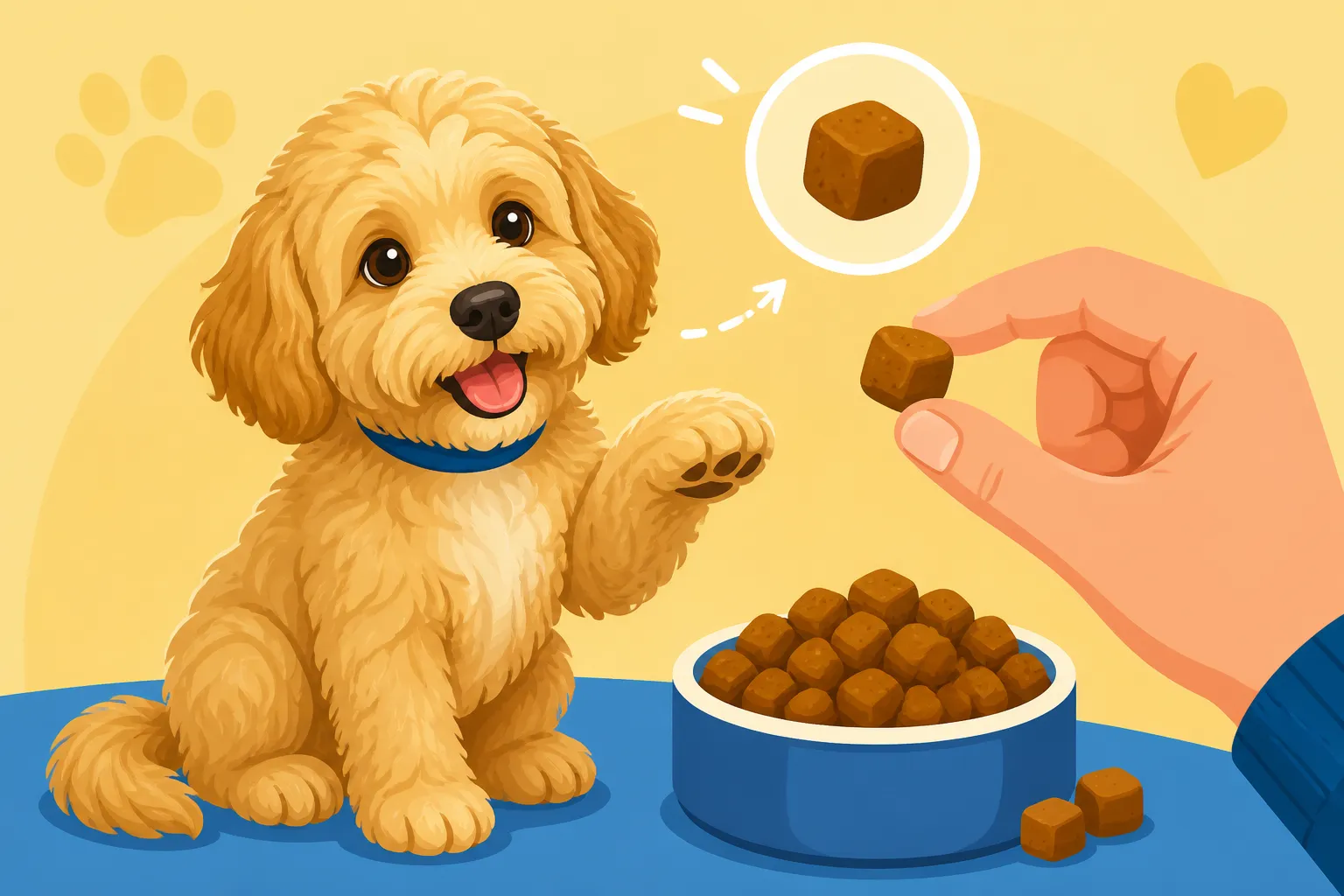
Training Treats Sized for a Mini Goldendoodle
One of the most common frustrations new mini Goldendoodle owners face in their excitement to train is realizing that not all treats are created equal – especially when you're working with a smaller mouth and a dog that needs frequent, high-value rewards without overfeeding. It's easy to grab any bag off the shelf, but then you're left with treats that are too big, too crumbly, or just not motivating enough, leaving both you and your adorable mini Goldendoodle feeling a bit deflated. This comprehensive guide will walk you through everything you need to know about selecting and using training treats perfectly sized and suited for your mini Goldendoodle, ensuring your training sessions are effective, fun, and healthy.
The Unique Challenges of Training a Mini Goldendoodle with Treats
Training a mini Goldendoodle, while often a joy due to their intelligence and eagerness, comes with its own set of considerations, especially when it comes to positive reinforcement with food. Their smaller stature means that treat size, calorie count, and even the texture become paramount in a way they might not for their larger Goldendoodle cousins. If you're not careful, those tiny treats can quickly add up, or conversely, a treat that's too large can slow down your training flow or become a choking hazard.
Why Size Matters: The Mini Mouth and Fast-Paced Training
Imagine trying to reward your mini Goldendoodle multiple times in a minute for holding a "stay" or nailing a quick "sit" with a treat chunk meant for a standard-sized dog. It just doesn't work. A large treat forces your mini Goldendoodle to stop, chew, swallow, and often lick their chops, breaking their focus and slowing down the rhythm of your training session. This interruption can derail the connection between the desired behavior and the reward, making the learning process less efficient. For rapid-fire training, where you might be marking and rewarding every few seconds, you need treats that are tiny, instantly consumable, and don't require much chewing.
Furthermore, a treat that's too big might even be perceived as a whole meal by your smaller companion, reducing their motivation to work for the next reward. We want them always thinking, "What can I do to earn that again?" rather than feeling full. This is especially critical when you're working on basic obedience or proofing behaviors in distracting environments. The goal is to make the reward a quick, satisfying burst, not a prolonged chewing event.
Calorie Count: Preventing Unwanted Weight Gain
One of the biggest pitfalls when using treats, especially with mini Goldendoodles, is inadvertently overfeeding. Their smaller bodies mean they require fewer daily calories than their larger relatives. A handful of standard-sized training treats can quickly equate to a significant portion of their daily caloric intake without you even realizing it. This isn't just about fitting into their cute sweaters; it's about their long-term health. Goldendoodle Weight Gain and the Strain on Joints is a serious concern, especially as they age. Excess weight puts undue stress on their joints, contributes to heart issues, and can even shorten their lifespan.
It's a constant balancing act: you need treats that are high-value enough to motivate them, but low-calorie enough that you can use them frequently during training without risking their waistline. This is why understanding the caloric density of your chosen treats is just as important as their size and palatability. You might find yourself doing mental math or looking up nutritional information more often than you'd expect, but it's a critical step in responsible treat usage. Remember, every treat counts towards their Daily Calories for a Mini Goldendoodle.
The Role of Texture and Palatability
Beyond size and calories, the texture and palatability of a treat are hugely important, particularly for a mini Goldendoodle. Some dogs can be a bit finicky, while others have very specific preferences that can impact their training motivation. A treat that crumbles easily might make a mess, but more importantly, it might not deliver that satisfying immediate reward if bits are falling everywhere. Harder treats require more chewing, bringing us back to the issue of slowing down training.
Think about what truly excites your mini Goldendoodle. Is it something soft and chewy that mimics a bit of meat? Or do they prefer a slightly crunchy texture? The goal is to find treats that they absolutely adore, making them willing to perform almost anything for a taste. For high-distraction environments, you might even need "jackpot" treats – something extra special and super high-value to break through the noise. The right texture also means it's easy for you to break into even smaller pieces if needed, without leaving a powdery mess in your training pouch.
What Makes an Ideal Training Treat for Your Pint-Sized Pal?
Choosing the perfect training treat isn't just about what your dog likes; it's about what works best for efficient, effective training sessions while keeping your mini Goldendoodle healthy. There are several key characteristics to look for that will make your life easier and your dog's learning faster.
Small Size and Easy to Break
This is arguably the most crucial factor for a mini Goldendoodle. We're talking pea-sized or even smaller. The ideal training treat should be something your dog can gobble up in a fraction of a second, without needing to stop and chew excessively. This allows for rapid-fire rewarding, which is essential for Five Minute Goldendoodle Training Sessions and capturing fleeting moments of good behavior. If a treat is too large, it not only slows down the process but also adds unnecessary calories.
Many commercial treats designed for training are already pre-cut into small pieces. However, even these can sometimes be too big for a tiny mouth or too calorically dense for frequent use. Don't be afraid to take out a pair of kitchen shears or break them into even smaller morsels before your session. The goal is a quick "pop" of reward that keeps your Goldendoodle focused on you and eager for the next opportunity to earn another. You want them to be able to take the treat and immediately look back at you for the next cue.
Low Calorie and Healthy Ingredients
As we touched on earlier, calorie control is non-negotiable. Even small treats can contribute significantly to a mini Goldendoodle's daily intake. Look for treats that are specifically marketed as low-calorie or where a small portion provides a satisfying reward without much energy. Often, single-ingredient treats or those with simple, natural ingredients are best. Ingredients like lean cooked chicken, turkey, or even certain vegetables can be excellent, low-calorie options.
Beyond calories, consider the overall health of the ingredients. Just like us, dogs benefit from whole, recognizable foods. Avoid treats with artificial colors, flavors, or excessive fillers that offer little nutritional value. If your mini Goldendoodle has Goldendoodle Food Allergies Showing on the Skin or a sensitive stomach, opting for limited-ingredient treats or specific protein sources (like salmon or duck) can be a game-changer. Reading labels and understanding what's actually in the treat is crucial for their well-being.
High Value and Highly Motivating
This might seem obvious, but it's worth emphasizing: a training treat must be something your mini Goldendoodle loves. If your dog isn't excited by the treat, it loses its power as a motivator. What one dog considers "high-value," another might turn their nose up at. For some, a crunchy biscuit is fine. For others, particularly when you're working on challenging behaviors or in distracting environments, you'll need something truly irresistible, like small bits of cheese, cooked meat, or a special soft chew.
The level of value can be situational, too. For basic commands in a quiet living room, a moderately valued treat might suffice. But for working on Goldendoodle Recall in an Open Field or helping them settle during a vet visit, you'll want to pull out the "big guns" – treats so good they can't possibly ignore them. Experiment with different types and textures to discover your mini Goldendoodle's absolute favorites. The more enthusiastic they are about the treat, the more enthusiastic they'll be about training.
Non-Messy and Easy to Handle
Nobody wants greasy fingers or a pocket full of crumbs after a training session. Ideal training treats should be relatively dry, non-crumbly, and easy to handle. This means they can be stored in a training pouch without making a mess, retrieved quickly, and won't leave a sticky residue on your hands or your dog's beard. Moist, soft treats are often perfect for this, as they tend to be less crumbly than hard biscuits.
When you're out and about, especially during walks or in puppy class, ease of handling becomes even more important. You need to be able to access the treat quickly and cleanly, without fumbling. This minimizes interruptions and keeps the training flow smooth. Consider treats that come in a convenient size for your pouch or that you can easily pinch between your fingers without them disintegrating.
Here's a quick reference table for ideal training treat characteristics:
| Characteristic | Why it's Important for Mini Goldendoodles | Examples of Good Choices |
|---|---|---|
| Small Size | Quick consumption, maintains focus, prevents overfeeding. | Pea-sized or smaller, easily broken soft chews. |
| Low Calorie | Prevents weight gain with frequent use. | Lean cooked chicken/turkey, small veggie bits. |
| High Value | Strong motivator for learning, especially in distractions. | Cheese, hot dogs, freeze-dried meat, favored soft chews. |
| Non-Messy | Easy to handle, keeps hands/pouch clean, no lingering smell. | Drier soft chews, kibble, certain baked treats. |
| Digestible | Avoids stomach upset, especially with frequent use. | Simple ingredients, novel proteins for sensitive dogs. |
Commercial vs. Homemade: Finding the Perfect Treats for Your Mini Goldendoodle
The world of dog treats is vast, and deciding whether to buy commercial options or whip up your own can feel overwhelming. Both have their merits, and often, a combination of the two works best for a well-rounded training regimen.
Commercial Training Treats: Convenience and Variety
Commercial training treats offer unparalleled convenience. They're pre-made, often perfectly sized, and come in a dazzling array of flavors and textures. Brands like Zuke's Mini Naturals, Wellness Soft Puppy Bites, or many of the small, soft jerky-style treats available on platforms like Amazon are specifically designed with training in mind. They are typically lower in calories per treat and formulated to be highly palatable.
When choosing commercial treats, it's worth doing a little research into the brand's reputation and ingredient sourcing. Look for transparent labeling, minimal artificial additives, and clearly stated calorie counts. Many companies now offer treats tailored for sensitive stomachs or specific dietary needs, which is a blessing if your mini Goldendoodle has Goldendoodle Allergies and Itchy Skin. Keep a variety on hand; some days, your dog might respond better to one type over another, or you might need a higher-value option for a more challenging training scenario. For instance, BAXTER & Bella, known for their comprehensive online puppy training programs, often recommends using high-value, small commercial treats as part of their positive reinforcement methods, encouraging owners to experiment to find what truly motivates their individual puppy. Their approach emphasizes consistent, rewarding training, where the right treat makes all the difference.
Homemade Treats: Control and Customization
Making your own treats gives you ultimate control over ingredients, size, and nutritional content. This is a fantastic option if your mini Goldendoodle has allergies, dietary restrictions, or if you simply prefer to feed whole, unprocessed foods. Think about cooking up a batch of plain, boiled chicken breast or lean ground turkey, dicing it into tiny, pea-sized pieces. These are often extremely high-value for dogs and naturally low in calories. Other simple options include steamed carrots, green beans, or even small pieces of apple (without seeds).
You can also get creative with recipes using dog-safe ingredients like pumpkin puree, peanut butter (xylitol-free!), whole wheat flour, and eggs. Baking them into thin sheets and then cutting them into small squares or using tiny cookie cutters allows you to control the size perfectly. Just be mindful of shelf life, as homemade treats often lack preservatives and will spoil faster than commercial ones. Storing them in the refrigerator or freezer in small batches can help extend their freshness. The beauty of homemade is that you know exactly what your Goldendoodle is consuming, which can provide peace of mind and help manage specific health needs.
Smart Treat Management for a Healthy, Motivated Mini Goldendoodle
Using treats effectively in training goes beyond just picking the right ones; it involves thoughtful management to ensure your mini Goldendoodle remains healthy and engaged. It's a balance between motivation and moderation.
Incorporating Treats into Daily Calorie Intake
It's easy to forget that treats are food, and all food contributes to your dog's overall calorie intake. For a mini Goldendoodle, whose daily calorie needs are smaller, this is particularly important. A good rule of thumb is that treats should make up no more than 10% of their daily diet. To truly manage this, you'll need to know roughly how many calories are in your chosen treats and then reduce their regular meal portions accordingly on heavy training days. If you're doing intense training sessions, especially with a puppy, you might even consider using some of their regular kibble as training rewards. Feeding a Twenty-Five Pound Goldendoodle for a Month is a budget line item, but it's also a calorie budget for their health.
This method can be incredibly effective, particularly if your Goldendoodle finds their kibble motivating. It ensures they're still getting all the balanced nutrition from their primary food source while keeping their overall calorie intake in check. If you're unsure about your mini Goldendoodle's exact caloric needs, a quick chat with your veterinarian can provide personalized guidance, taking into account their age, activity level, and current weight.
Timing and Delivery: Maximizing Impact
The effectiveness of a treat isn't just about its deliciousness; it's also about when and how you deliver it. The treat needs to be given immediately after the desired behavior – within 1-3 seconds. This creates a clear association for your dog, helping them understand what they did to earn the reward. This immediate delivery is fundamental to Marker Training a Goldendoodle From Week One. A verbal marker ("Yes!") or a clicker used simultaneously with the treat can further sharpen this connection.
Consider how you deliver the treat too. Sometimes, a quick toss can be fun, but often, delivering it directly to their mouth helps maintain focus. Use a training pouch or a treat bag that allows for easy and quick access. Fumbling for treats can break the moment and dilute the impact of the reward. For behaviors like Goldendoodle Impulse Control With Food on the Floor, you might start with holding the treat, then placing it, gradually increasing the challenge. The goal is smooth, efficient delivery that reinforces the behavior without distraction.
The Power of Variety and "Jackpot" Rewards
Even the most loved treat can lose some of its appeal if it's the only treat your dog ever gets. Introducing variety keeps things interesting and can prevent your mini Goldendoodle from becoming complacent. Rotate between different types of commercial treats, homemade options, and even small bits of their favorite fruits or vegetables. This keeps them guessing and excited about what the next reward might be.
For especially challenging behaviors, or when your Goldendoodle achieves a breakthrough in a difficult environment, consider using a "jackpot" reward. This isn't just one treat, but several high-value treats given in quick succession, or an extra special, larger portion of their absolute favorite. It's like saying, "Wow, you totally nailed that!" and it supercharges their motivation for future training. This approach is particularly effective for reinforcing crucial behaviors like a reliable recall or handling a novel, potentially scary situation calmly. Training a Goldendoodle That Wants to Please You is often about tapping into that enthusiasm with the right kind of reward.
By thoughtfully selecting, preparing, and managing your training treats, you're setting your mini Goldendoodle up for success in their training journey. It's a small detail that makes a huge difference in their learning, motivation, and overall health.
Disclaimer
This article is for general informational purposes only and does not constitute professional advice. Laws, prices and regulations vary by location and change over time. Consult a qualified professional for guidance on your specific situation.