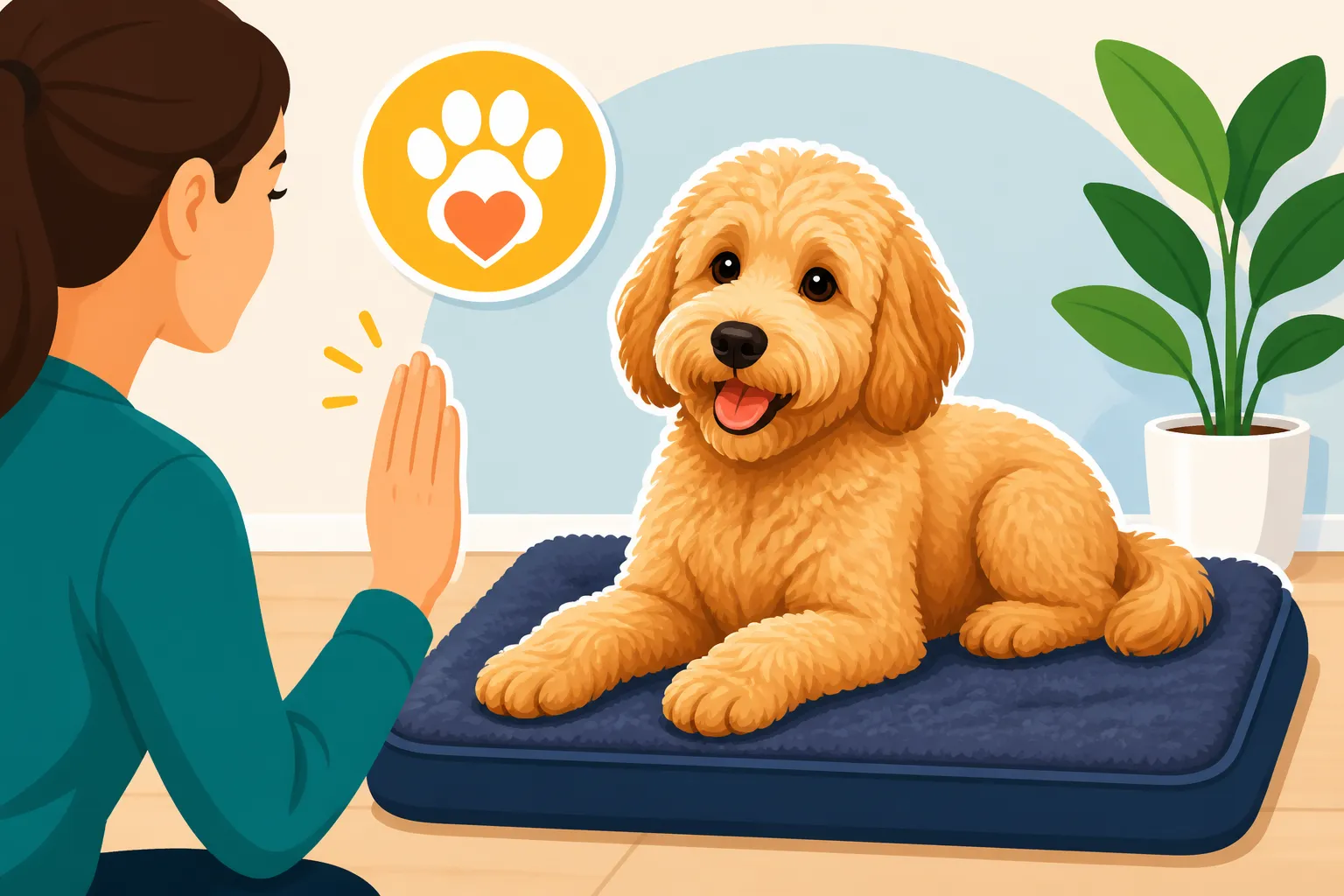
Goldendoodle Place Training on a Bed or Mat
Does your Goldendoodle shadow your every move, making it hard to walk across the kitchen without tripping over a furry friend, or perhaps jumping up on every guest who walks through the door? This constant "velcro dog" tendency, while endearing, can sometimes mean your Goldendoodle struggles to settle independently or manage their excitement. This comprehensive guide is designed to help you teach your Goldendoodle the invaluable skill of "place" training, giving them a designated spot where they can relax calmly, offering both of you much-needed personal space and peace of mind.
Why Place Training is Essential for Your Goldendoodle
Goldendoodles are often celebrated for their friendly, outgoing, and people-oriented personalities. They love to be involved, to be near their families, and to know what's going on. While this makes them wonderful companions, it can also manifest as over-excitement, constant seeking of attention, or an inability to simply be without being right at your side. Place training isn't about punishment or confinement; it's about teaching a dog to enjoy a specific, calming space, building their confidence, and fostering a crucial "off switch."
Managing Hyper-Friendliness and Jumping
One of the most common complaints Goldendoodle owners have, especially during puppyhood and adolescence, is their dog's boundless enthusiasm for greetings. That joyous leap onto visitors, the insistent pawing for attention, or the continuous circling underfoot during meal prep can be overwhelming. Place training provides an immediate, polite alternative. Instead of wrestling your excited Goldendoodle, you can direct them to their "place" before guests arrive or when you start cooking. It gives them a job to do and teaches them that calm behavior in their spot earns rewards, rather than demanding attention with less desirable actions. This helps immensely with Goldendoodle Jumping and the Impulse Control Problem.
Imagine a scenario: the doorbell rings, and your Goldendoodle, usually a whirlwind of tail wags and jumps, immediately turns to look at you. You calmly point to their mat, say "Place!", and they trot over, lie down, and wait for your cue. This isn't just about managing a single moment; it's about fundamentally shifting how your dog perceives excited situations and giving them a constructive way to channel that energy.
Creating a Calm "Off Switch"
Goldendoodles are intelligent and active, inheriting both the Poodle's sharp mind and the Golden Retriever's enthusiasm. This combination often results in a dog that thrives on engagement and can find it genuinely hard to settle down. You might notice your Goldendoodle constantly pacing, nudging for interaction, or bringing toys over even when you're clearly busy. They might struggle to relax in the evenings, leading to A Goldendoodle That Cannot Settle in the Evening.
"Place" becomes their personal relaxation station, a cue that means "it's time to chill out here." By consistently rewarding them for settling on their mat, you're actively reinforcing calm behavior. Over time, they learn that this spot is where they can truly unwind, without needing to constantly be on guard for the next exciting event. It’s an invaluable tool for building an internal "off switch" that benefits both dog and owner. Think of it as teaching your Goldendoodle mindful relaxation, a skill many human adults even struggle with!
Building Independence for Separation Anxiety
The "velcro" nature of Goldendoodles can sometimes tip into separation anxiety if not managed proactively. If your Goldendoodle constantly follows you from room to room, struggles when you leave for even short periods, or exhibits destructive behavior when left alone, place training can be a small but significant step in building their independence. It teaches them that being separate from you, even just a few feet away, is safe and rewarding.
By asking your Goldendoodle to go to their place while you move about the house – doing laundry, cooking, or even just going to the bathroom – you're gradually increasing their comfort with being physically apart from you. This can be particularly helpful if you have A Goldendoodle That Follows You Room to Room. It helps them understand that your presence isn't always required for them to feel secure, fostering a sense of self-reliance that can eventually translate to greater comfort when you leave the house. This is a subtle but important aspect of addressing potential Goldendoodle Separation Anxiety From Both Parent Lines.
Getting Started: The Right Gear and First Steps for Place Training
Before you dive into the nitty-gritty of training, setting yourself and your Goldendoodle up for success with the right tools and mindset is crucial. Remember, consistency and positive reinforcement are your best friends here.
Choosing the Perfect Place Mat or Bed
The "place" itself needs to be clearly defined and comfortable. This isn't just any spot on the floor; it needs to be their spot.
- Dedicated Item: A specific mat, dog bed, or even a raised cot works best. The key is that it's easily distinguishable from the rest of the floor and is portable enough that you can move it to different rooms if needed. Avoid using a blanket that blends into your rug or a spot that they naturally nap in already; the goal is to create a new, intentional space. You can find excellent, durable mats and beds on Amazon, often in sizes perfect for any Goldendoodle.
- Comfort is Key: Your Goldendoodle should want to be on their place. Ensure it's comfortable, especially for longer stays. A plush dog bed, a cooling mat in summer, or even a sturdy, elevated cot can work well, depending on your dog's preferences and size. For a standard Goldendoodle, make sure it's large enough for them to stretch out fully.
- Location, Location, Location: Start with the mat in a low-traffic area where your Goldendoodle can see you but won't be constantly interrupted. As they get better, you can move it closer to the action (e.g., in the living room while you watch TV, or near the kitchen while you cook), increasing the challenge and proofing their skills.
Introducing the "Place" Concept Positively
From day one, the "place" must be associated with good things. This means high-value treats and praise, and absolutely no negative associations.
- High-Value Rewards: Goldendoodles are highly motivated by food and praise. Use treats your dog loves – small, soft, and easy to chew. For a mini Goldendoodle, Training Treats Sized for a Mini Goldendoodle will work perfectly. Think tiny pieces of cooked chicken, cheese, or specialized training treats. The higher the value, the faster they'll learn and the more enthusiastic they'll be.
- Short, Sweet Sessions: Keep early training sessions brief, typically 5-minute bursts a few times a day. This ensures your Goldendoodle stays engaged and doesn't get bored or frustrated. Five Minute Goldendoodle Training Sessions are much more effective than one long, drawn-out one.
- No Force: Never push or drag your Goldendoodle onto their mat. The goal is for them to choose to go there and to associate it with positive experiences. If they're resistant, take a step back and make the rewards even more enticing.
Timing and Treats: Setting Up for Success
Success in place training hinges on precise timing and knowing how to use your treats effectively.
- Mark and Reward: When your Goldendoodle performs the desired action (all four paws on the mat, lying down), you need to mark that behavior immediately. A verbal marker like "Yes!" or a clicker followed by a treat works wonders. This instantaneous feedback tells your dog exactly what they did right.
- Lure, Don't Push: Initially, you'll use a treat to lure your Goldendoodle onto the mat. Hold a treat near their nose and guide them onto the mat. As soon as all four paws are on, mark and reward. This sets the foundation without any verbal cues yet.
- Fade the Lure: Once they understand the concept of getting on the mat, start making your lure motion smaller and less obvious. Eventually, you want them to go to their place simply from your verbal cue and hand signal.
Step-by-Step Guide to Goldendoodle Place Training
Now that you have your gear and understand the basics, let's get into the actionable steps to teach your Goldendoodle to love their place. Remember, patience is key, and every Goldendoodle learns at their own pace. Consistency is far more important than speed.
Luring to the Mat and Reinforcing the Position
This is the very first step, focusing purely on getting your Goldendoodle to physically get onto their designated spot and lie down.
- Introduce the Mat: Place the mat on the floor. With your Goldendoodle nearby, simply toss a high-value treat onto the mat. As they step onto the mat to eat the treat, say "Yes!" (or click) and toss another treat. Repeat this several times. The goal here is just to create a positive association with stepping onto the mat.
- Lure Onto the Mat: Hold a treat at your Goldendoodle's nose and slowly move your hand in an arc that guides them onto the mat. As soon as all four paws are on the mat, mark and reward with the treat in your hand. Praise them enthusiastically.
- Lure into a Down: Once they are consistently stepping onto the mat, use the treat to lure them into a down position while they are on the mat. Hold the treat at their nose, move it down to their chest, then slowly back between their paws. As their elbows touch the mat, mark and reward. This combines two actions: on the mat and down.
- Practice Repetitions: Repeat steps 2 and 3 several times in a session. Don't worry about duration yet; focus on getting them to go to the mat and lie down quickly and happily. Keep it fun! Remember, Positive Reinforcement and Why It Suits a Goldendoodle is the most effective approach.
Adding the "Place" Cue and Short Duration
Once your Goldendoodle understands the physical action, it's time to add the verbal command and start building up how long they stay.
- Introduce the Verbal Cue: As you begin to lure your Goldendoodle onto the mat, say "Place!" (or "Mat!" or "Bed!"). Say the cue as they are moving toward the mat, not before, initially. Once they are on the mat and in a down, mark and reward.
- Fade the Lure: Gradually reduce the size and prominence of your hand lure. First, make it smaller, then just a finger movement, then just a pointer to the mat. Eventually, you want your Goldendoodle to go to their place just with the verbal cue. If they don't respond, go back to using a more obvious lure.
- Introduce Short Stays: Once your Goldendoodle reliably goes to their place and lies down on cue, start adding a tiny bit of duration. Ask them to "Place," and when they lie down, mark and reward. Then, before they get up, say "Yes!" and give another treat. Then release them with a clear verbal cue like "Okay!" or "Free!" and let them off the mat.
- Gradually Increase Time: Start with holding the stay for literally 1-2 seconds, then 3 seconds, then 5. Build up slowly. If your Goldendoodle breaks the stay, don't scold them. Simply calmly lead them back to their mat, give the "Place!" cue again, and restart from a shorter duration. Reward frequently while they are still on the mat for staying.
Extending Duration and Distance
This is where the real challenge and benefit come in – teaching your Goldendoodle to stay on their mat for longer periods and even when you move away.
- Increase Duration: Continue to gradually increase the time your Goldendoodle stays on the mat. Aim for 10 seconds, then 15, 30, and eventually a minute or more. Remember to reward multiple times during a longer stay. Every 15-20 seconds, walk over and drop a treat on the mat, praise them quietly, and return to your spot. This reinforces that staying is continuously rewarding.
- Increase Distance: Once your Goldendoodle can stay for a short period while you stand still, start taking a step away from the mat. Say "Place!", reward when they lie down, then take one step back. If they stay, step back, mark, reward, and then release. Slowly increase the number of steps you take.
- Move Around the Room: As they master single steps, try walking in a small circle around the mat, or going to the kitchen counter and back. The key is to make it progressive. If they break the stay, calmly lead them back to the mat and shorten the distance or duration for the next attempt.
- Incorporate Distractions: Once your Goldendoodle is solid in a quiet room, start adding minor distractions. Have someone else walk by, drop a spoon, or have a quiet conversation. Gradually increase the level of distraction, always setting your Goldendoodle up for success by starting easy. If you're utilizing an online program like BAXTER & Bella, you'll find plenty of examples and video demonstrations for this proofing stage.
Proofing in Different Environments and Real-Life Scenarios
The true test of "place" training is how well your Goldendoodle performs in various real-world situations, not just your quiet living room.
- Different Rooms: Practice "place" in every room of your house: the kitchen, the bedroom, the dining room. Each new environment is a new challenge.
- New Locations: If you visit a friend's house or a dog-friendly cafe, bring their mat! Start with very short, easy sessions in the new environment. This generalizes the skill.
- High-Traffic Times: Use "place" during dinner prep, when children are playing, or when guests arrive. This is where the training truly pays off. For example, when the delivery driver comes, tell your Goldendoodle "Place!" and have them hold it until the door is closed and the excitement has passed. This helps curb that frantic greeting behavior.
- Duration with Distractions: Combine duration, distance, and distractions. Can your Goldendoodle hold a "place" for five minutes while a family member walks through the room? What about ten minutes while you're talking on the phone? Keep pushing the boundaries slowly but surely.
- Build It Into Your Routine: Make "place" training a part of your daily life. Before you eat dinner, ask your Goldendoodle to go to their place. Before you leave the house, ask them to go to their place for a brief moment. This consistency reinforces the behavior.
| Training Stage | Goal | Key Actions | Common Challenges |
|---|---|---|---|
| Stage 1: Introduction | Positive association with the mat | Toss treats on mat, lure onto mat, lure into down. | Dog avoids mat, not interested in treats. |
| Stage 2: Cue & Duration | Understands "Place" cue, holds short stay | Add verbal "Place" cue, fade lure, reward for 1-5 second stays. | Breaks stay immediately, doesn't link cue to action. |
| Stage 3: Distance | Stays when you move away | Take 1-3 steps back, then more; circle mat, leave room briefly. | Breaks stay when you move, whines. |
| Stage 4: Distraction | Stays with minor disruptions | Practice with family walking by, door opening, quiet conversation. | Easily distracted, gets up to investigate. |
| Stage 5: Generalization | Performs in various environments | Practice in different rooms, new locations, during high-activity times. | Regresses in new places, needs reminders. |
Troubleshooting Common Goldendoodle Place Training Challenges
Even with the best intentions and methods, you're bound to hit a few bumps in the road. Goldendoodles, for all their intelligence, can be stubborn, easily distracted, or just have an off day. Here are some common issues and how to tackle them.
When Your Goldendoodle Won't Stay
This is probably the most frequent frustration for owners. You give the "Place!" cue, they go, they lie down, and then pop – they're up again a second later.
- Go Back to Basics: If your Goldendoodle isn't staying, you've likely progressed too quickly. Go back to the previous step where they were consistently successful. For instance, if they can't stay for 10 seconds, go back to 5 seconds.
- Increase Reinforcement Rate: Are you rewarding enough? For new behaviors or when increasing duration/distraction, you should be rewarding very frequently. Every few seconds initially, dropping treats on the mat while they are still in position.
- Higher Value Treats: Sometimes, the treats aren't motivating enough. Experiment with different types of high-value rewards. Cooked chicken, tiny pieces of hot dog, or specialty soft treats can make a huge difference.
- Manage the Environment: Reduce distractions. If you're trying to practice "place" in a busy kitchen with kids and other pets, it's too much too soon. Start in a quiet room, then slowly reintroduce elements.
- Don't Nag or Punish: If they break the stay, simply say "Ah-ah" or "Nope," lead them calmly back to the mat (no force!), give the "Place!" cue again, and immediately reward the correct position. Never punish them for making a mistake; it will only create a negative association with the mat. Why Harsh Corrections Backfire on a Goldendoodle is an important concept here.
Dealing with Mat Chewing or Refusal
Sometimes, your Goldendoodle might decide the mat is a chew toy, or they simply refuse to go to it.
- Mat Chewing: If your Goldendoodle is chewing the mat, it could be a sign of boredom, anxiety, or simply not understanding the purpose of the mat.
- Redirection: As soon as you see them mouth the mat, redirect them to an appropriate chew toy. Reward them heavily for chewing the toy.
- Mental Stimulation: Ensure your Goldendoodle is getting enough mental exercise. Goldendoodle Exercise and Mental Work Every Day is crucial. A tired Goldendoodle is a good Goldendoodle. Puzzle toys, training sessions, and scent games can help.
- Supervise Heavily: Don't leave your Goldendoodle unsupervised with the mat until they consistently understand its purpose.
- Refusal to Go to Place: If your Goldendoodle actively avoids the mat or resists going to it:
- Re-evaluate Rewards: Are your treats truly high-value? Sometimes a Goldendoodle can be picky.
- Is the Mat Comfortable? Maybe the texture or material isn't appealing to them. Try a different type of mat or bed.
- Negative Association? Have you inadvertently created a negative association with the mat? Perhaps they were sent there when they were in trouble, or left there too long. Reset by only making it a place of positive reinforcement.
- Check for Pain: In rare cases, refusal to lie down might indicate discomfort or pain. If this is a sudden change, a vet check might be warranted to rule out underlying issues.
Integrating Place into Daily Life
The ultimate goal is for "place" to be a natural part of your Goldendoodle's routine, not just a trick they do on command.
- Regular Practice: Don't just practice when you need them on their place. Incorporate short, fun "place" sessions throughout the day, even when there are no distractions.
- Fade the Treats: Once your Goldendoodle is reliably performing "place" for longer durations and in various environments, you can start to gradually reduce the frequency of treats. Still reward, but intersperse treats with enthusiastic verbal praise and gentle pets. You never want to stop rewarding entirely, but the frequency can decrease as the behavior becomes established.
- Use it Proactively: Don't wait until your Goldendoodle is already jumping on guests to send them to their place. Proactively ask them to go to their place before the doorbell rings or before you start cooking dinner.
- Give Them a Purpose: "Place" can be more than just sitting still. It can be where they chew a special bone, or where they wait patiently while you prepare their meal. This gives the mat an additional positive association and makes it a rewarding spot to be.
"Place" training takes time and dedication, but the payoff is immense. You'll gain a calmer, more independent Goldendoodle, and a much more peaceful household. It’s an investment in your Goldendoodle's manners and your shared quality of life.
Disclaimer
This article is for general informational purposes only and does not constitute professional advice. Laws, prices and regulations vary by location and change over time. Consult a qualified professional for guidance on your specific situation.