Patellar Luxation in a Mini Goldendoodle
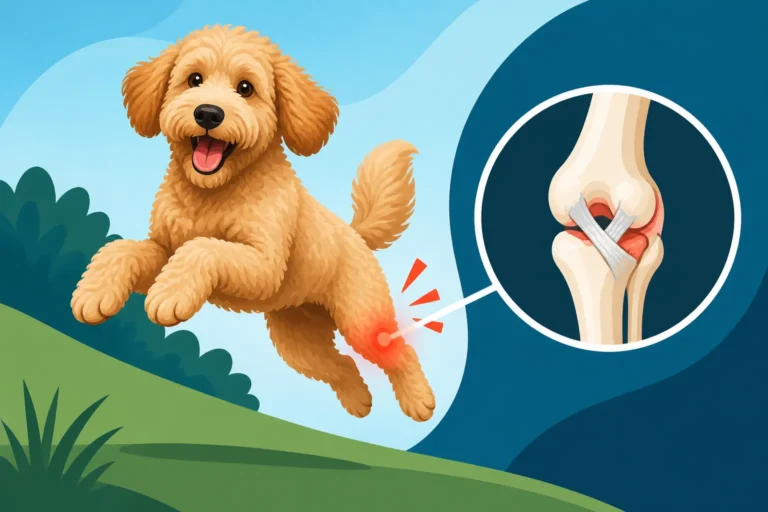
Your Mini Goldendoodle is trotting across the park when suddenly one back leg flicks up, they hop three or four steps on three legs, and then carry on as if nothing happened. If you have seen that skip, you have probably already searched “kneecap” at midnight. This guide explains patellar luxation in Mini Goldendoodles, how vets grade it, what treatment costs and how to protect those knees for life.
What Patellar Luxation Actually Is
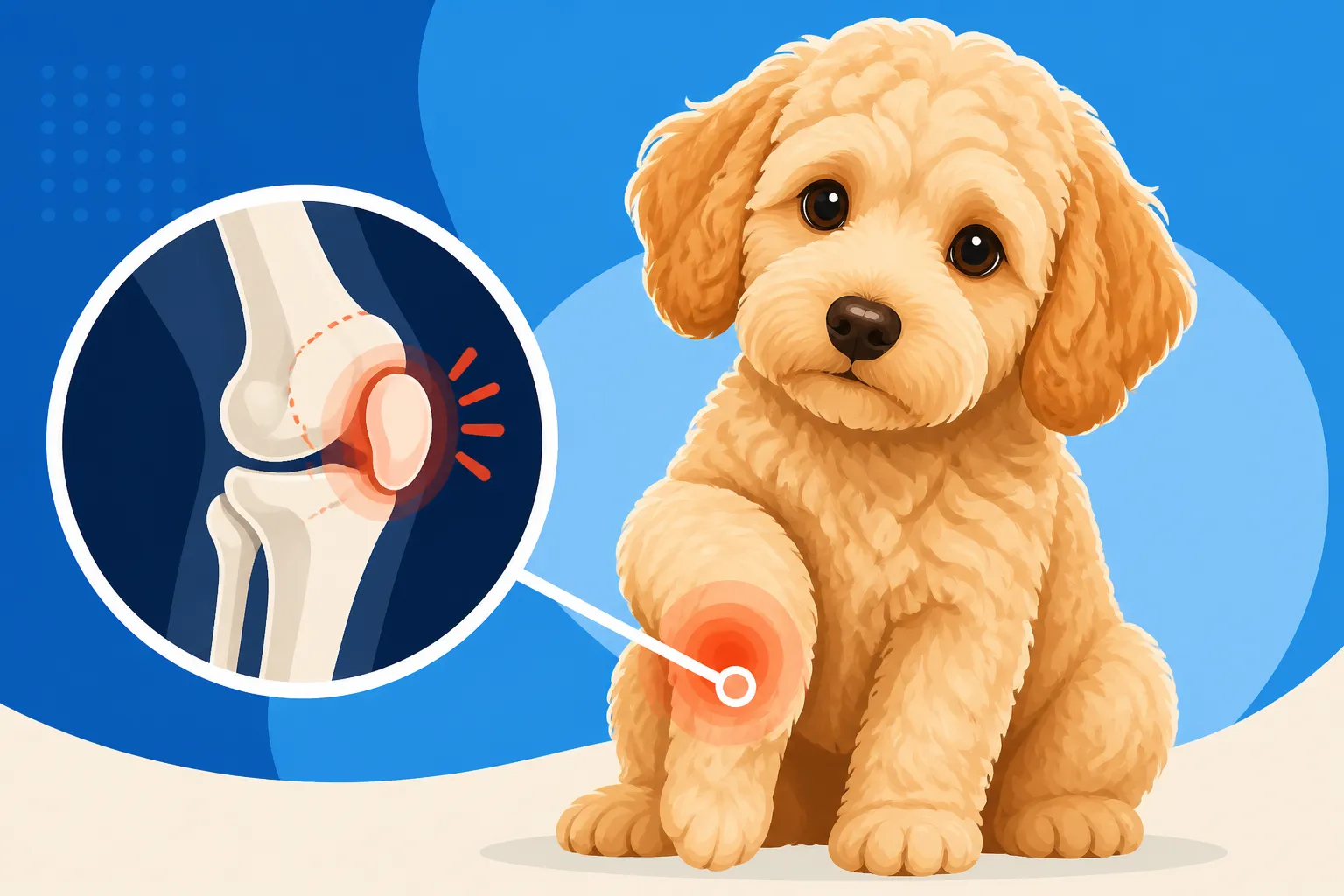
Patellar luxation simply means the kneecap slips out of its normal position. In a healthy knee, the patella sits in a groove at the lower end of the thigh bone, called the trochlear groove, and glides up and down as the leg bends and straightens. It is held in place by the shape of that groove, the alignment of the bones and the pull of the quadriceps muscles and their tendon.
When something in that system is off, the kneecap can slide out of the groove, usually toward the inside of the leg. Sometimes it pops back in by itself within a few steps. Sometimes it stays out until someone or something pushes it back. In the most severe cases, it lives permanently outside the groove.
Because the joint surfaces are designed to meet in one particular way, a kneecap that keeps riding over the edge of its groove slowly wears down the cartilage on both the kneecap and the ridge of the groove. That wear is painless at first but eventually leads to inflammation and arthritis, which is why vets care about luxation even in dogs who seem perfectly happy.
Why the Kneecap Slips
In most small dogs, patellar luxation is developmental rather than caused by an injury. A shallow trochlear groove, a slightly twisted shin bone or a tibial crest that sits off-centre means the quadriceps pull the kneecap at an angle instead of straight up and down. Over time, the kneecap rides up and over the edge of the groove.
Trauma can cause luxation too, for example a hard fall off a sofa or a collision during rough play. But when a young Mini Goldendoodle has a slipping kneecap without any obvious accident, the cause is almost always built into the way the leg developed.
Medial and Lateral Luxation
Vets describe luxation by direction. Medial luxation means the kneecap slips toward the inside of the leg, and it accounts for the large majority of cases in small and medium dogs. Lateral luxation means it slips toward the outside and is more often seen in larger breeds.
Both knees are frequently affected, even if only one causes visible symptoms. When your vet examines one leg, expect them to check the other carefully too. Many owners are surprised to learn their dog has a mild luxation on the “good” side.
The direction matters for surgery planning more than for day-to-day life. A medial luxation usually goes hand in hand with a slightly bowed hind leg and toes that point inward, while a lateral luxation tends to give a knock-kneed look. If you stand behind your dog while they are standing square, you can sometimes see these differences yourself, although only a hands-on exam confirms what is going on inside the joint.
Why Mini Goldendoodles Are Prone to It
Mini Goldendoodles usually come from a Golden Retriever or a standard-sized Goldendoodle crossed with a Miniature Poodle, or from multi-generation crosses. Miniature and Toy Poodles are among the breeds most often affected by medial patellar luxation. When you scale a dog down, the bones of the hind leg and the groove for the kneecap scale down too, and small-breed anatomy carries a higher risk of shallow grooves and misalignment.
That does not mean every Mini will have trouble. But it does mean you should take knee health seriously from puppyhood. For a deeper look at why size matters, see Why Small Goldendoodles Slip Kneecaps.
There is also the matter of unpredictable genetics. A Mini Goldendoodle is a crossbreed, and puppies in the same litter can inherit very different leg shapes. One puppy may take after the sturdier Golden Retriever side, while a littermate inherits the finer bones of the Miniature Poodle. That is why two siblings raised in the same house on the same food can end up with completely different knees, and why a clean bill of health in one puppy tells you little about the rest of the litter.
Recognising the Signs in Your Mini Goldendoodle
Patellar luxation can be surprisingly easy to miss in the early stages. Dogs adapt quickly, and many owners write off the occasional skip as quirky behaviour.
The Classic Skip
The most recognisable sign is the intermittent skip I described at the start. Your dog is walking or trotting normally, then suddenly holds one hind leg up for a few strides before putting it down again. Some dogs kick the leg backward or stretch it out to help the kneecap pop back into place. To the owner, it can look almost like a little dance step.
This skip happens because the kneecap has slipped out of the groove and the leg cannot extend properly until it slides back. It is usually not painful in the early stages, which is why the dog carries on happily afterward.
A helpful habit is to film it. The skip often happens at home or on walks but never in the consulting room, where nervous dogs tend to walk stiffly or not at all. A short phone video of your dog trotting toward and away from you, with the skip caught on camera, gives your vet far more to work with than a verbal description. Note the date, which leg it was and roughly how often it happens in a typical week.
Other Signs to Watch For
As luxation progresses, signs can include:
- Skipping more often, or holding the leg up for longer.
- A bow-legged stance in the back legs or toes pointing inward.
- Stiffness after rest, especially in the morning.
- Reluctance to jump onto furniture or into the car.
- Sitting with one back leg stuck out to the side.
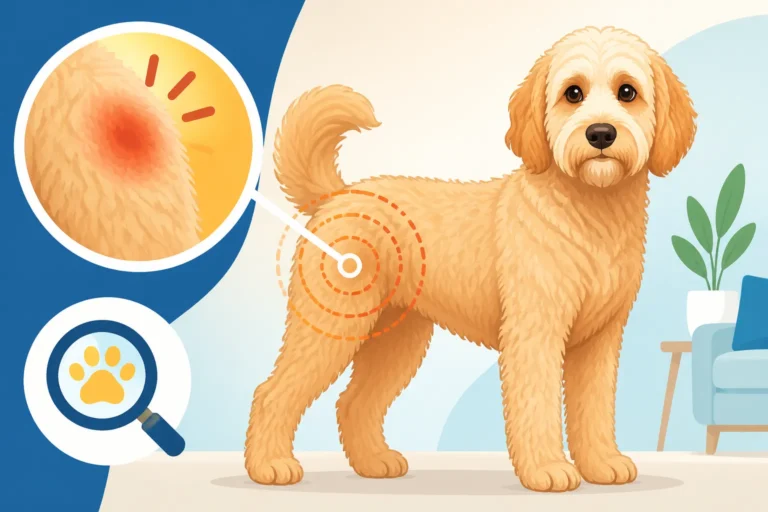
- Muscle loss in the thigh of the affected leg.
- Persistent lameness, especially if the knee becomes arthritic.
Sudden severe lameness in a dog with known luxation can also mean something else has happened, such as a cranial cruciate ligament tear. Dogs with luxating kneecaps are at higher risk of cruciate injuries because the knee is already unstable. If your dog suddenly will not put weight on a leg, see a vet promptly.
When the Limp Is Something Else
Not every hind leg limp is a kneecap problem. Puppies can strain soft tissue, step on something sharp or develop growing pains. Older dogs can develop arthritis or hip problems. A front leg limp has a different list of causes altogether, covered in A Goldendoodle Limping on One Front Leg.
If the limp lasts more than a day or two, keeps coming back or is associated with pain, crying or swelling, book a vet visit. A quick hands-on exam can usually tell whether the kneecap is involved.
What to Do When You First Notice a Skip
- Stay calm and watch whether your dog puts the leg back down normally within a few strides.
- Check the paw and toes for thorns, cuts or a torn nail, which can mimic a skip.
- Record a short video the next time it happens, from behind and from the side.
- Keep a simple diary of how often it happens and what your dog was doing at the time.
- Cut out jumping off furniture and frantic ball games until your vet has examined the knee.
- Book a routine appointment if the skip is occasional, or an urgent one if your dog will not bear weight, cries out or the knee looks swollen.
This sequence keeps you from panicking over a single odd step while making sure a genuine problem is not left to get worse. Most owners I know who caught luxation early did so because they noticed a pattern rather than one dramatic event.
How Vets Diagnose and Grade Patellar Luxation
Diagnosis is mostly done by feel. Your vet will manipulate the knee, flex and extend the leg, and try to push the kneecap in and out of the groove.
The Four Grades
Vets use a four-grade system to describe how severe the luxation is.
| Grade | What the vet finds | Typical signs at home | Usual approach |
|---|---|---|---|
| Grade 1 | Kneecap can be pushed out by hand but returns immediately when released | Often none, or very occasional skip | Monitor, weight control, muscle building |
| Grade 2 | Kneecap slips out on its own when the leg bends and stays out until the leg is extended or it is pushed back | Intermittent skipping, sometimes several times a day | Conservative care or surgery depending on frequency and comfort |
| Grade 3 | Kneecap sits out of the groove most of the time but can be pushed back in by hand | Frequent lameness, abnormal gait, bow-legged stance | Surgery usually recommended |
| Grade 4 | Kneecap is permanently out and cannot be pushed back | Persistent lameness, crouched gait, difficulty extending the leg | Surgery strongly recommended, often more complex |
A dog’s grade can change over time. A Grade 2 at one year can progress to Grade 3 by three or four years old, especially if the dog is overweight or very active without good muscle support. For more detail on each stage, read Kneecap Grades One Through Four in a Goldendoodle.
Imaging and Further Tests
X-rays are often taken to look at the shape and alignment of the bones, check for arthritis and plan surgery if it is needed. Your vet may also take X-rays of the hips, since hip problems can coexist with kneecap problems and change the treatment plan.
In some cases, especially before surgery, a specialist will take CT scans or detailed measurements to plan bone corrections. This is more common in severe or complicated cases.
Expect your vet to ask about your dog’s age, weight history, exercise habits and any previous injuries. They may also watch your dog walk and trot on a lead, sometimes outside in the car park, to see how the leg moves under real conditions. If both knees are affected, they will grade each one separately, so it is common to hear something like “Grade 2 on the left and Grade 1 on the right.” Ask for the grades in writing for your records and for any insurance claim.
Testing Breeding Dogs
The Orthopedic Foundation for Animals offers a patellar evaluation for dogs at least 12 months old, giving a clearance for breeders to show. Responsible Mini Goldendoodle breeders should have both parents examined for patellar luxation, along with hips, elbows and eyes. If a breeder cannot show these results, that is a serious warning sign. Health Testing Both Goldendoodle Parents Should Have explains what to ask for.
Treatment Options and What They Involve
Treatment depends on the grade, how often the kneecap slips, your dog’s age and whether there is pain or arthritis.
Conservative Management
Many Grade 1 and some Grade 2 cases can be managed without surgery. The foundations are keeping your dog lean, building strong thigh muscles and avoiding activities that put sudden twisting forces on the knee.
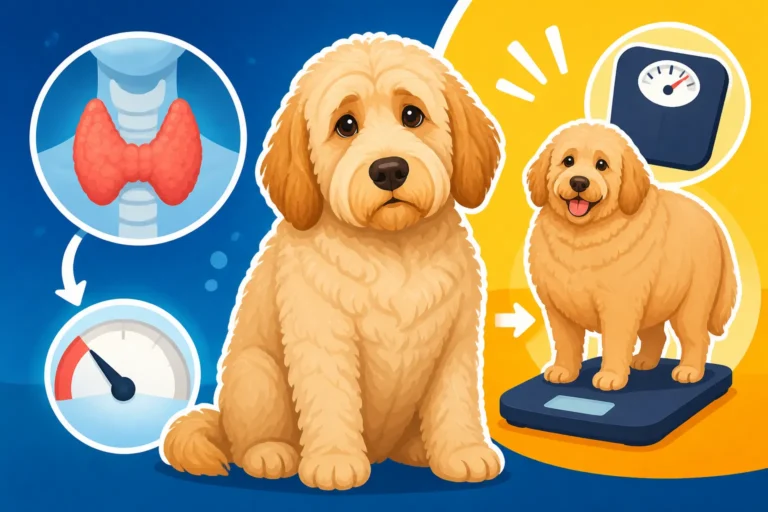
Weight is the single most important factor you control. Every extra pound adds strain to the knees, and for a 25-pound dog, even two pounds of extra weight is a big proportional increase. Goldendoodle Weight and the Load on Its Joints explains how to assess body condition.
Muscle building means controlled exercise: leash walks on varied terrain, gentle uphill walking, sit-to-stand exercises and, if available, swimming or an underwater treadmill. Avoid repetitive jumping, sharp turns at speed and slippery floors. Joint supplements such as omega-3 fatty acids may help support the joint, though they do not fix the anatomy. Joint Support Dosed to Goldendoodle Size Category covers sensible dosing.
A simple home strengthening routine, done most days, might look like this:
- Five minutes of slow leash walking to warm up.
- Five to ten sit-to-stand repetitions on a non-slip surface, rewarding each stand.
- A few minutes of walking up a gentle slope or over low obstacles such as broom handles laid on the ground.
- Short sessions of standing with the front paws raised on a low step, which shifts weight onto the hind legs.
- A cool-down walk and a calm chew to finish.
Ask your vet or a rehabilitation therapist to check your dog’s form before you start, because doing these exercises badly can strain the knee rather than strengthen it. Progress slowly, and stop if your dog skips more often or seems sore the next day.
Surgical Options
When luxation is frequent, painful or progressive, surgery is usually the best long-term solution. Surgeons typically combine several techniques to address the specific problem in each knee:
- Deepening the trochlear groove so the kneecap sits more securely, often with a wedge or block recession technique.
- Moving the bony attachment of the patellar tendon on the shin, called tibial tuberosity transposition, so the quadriceps pull in a straight line.
- Tightening the joint capsule on the side away from the luxation and releasing tight tissue on the other side.
- In severe cases with bone deformity, correcting the angle of the thigh bone with a more complex procedure.
The goal is to rebuild a straight, stable track for the kneecap. Most dogs with Grade 2 or 3 luxation do very well after surgery, and many return to normal or near-normal activity.
Surgery Costs and Recovery
Costs vary widely by region, the complexity of the knee and whether a general practice vet or a board-certified surgeon performs the operation. For a Mini Goldendoodle, the table below shows typical ranges.
| Item | Typical range per knee | Notes |
|---|---|---|
| Initial exam and X-rays | $200 to $600 | Sedation for X-rays adds cost |
| Surgery at a general practice | $1,500 to $3,000 | Suitable for straightforward Grade 2 or 3 cases |
| Surgery with a specialist surgeon | $3,000 to $6,000 | Recommended for Grade 4 or complex cases |
| Post-operative rechecks and X-rays | $200 to $500 | Usually at two and eight weeks |
| Physical therapy sessions | $50 to $150 per session | Several sessions over the recovery period |
Both knees are often operated on separately, a few months apart, which doubles the bill. A worked price example for a dog this size is in Kneecap Surgery Priced for a Twenty Pound Goldendoodle.
Recovery usually takes eight to twelve weeks. Expect strict rest for the first few weeks, short leash walks only, no stairs or jumping, and a cone to protect the incision. Physical therapy, either at home or with a rehabilitation vet, speeds recovery and rebuilds muscle. Physical Therapy After Goldendoodle Knee Surgery walks through a typical recovery plan.
A Typical Recovery Timeline
| Period after surgery | What usually happens | What you can do |
|---|---|---|
| Weeks 1 to 2 | Incision healing, stitches or staples removed, strict crate or pen rest | Short toilet trips on lead, cone on, pain relief as prescribed |
| Weeks 3 to 6 | Gradually more weight on the leg, early muscle work | Slow lead walks increasing by a few minutes each week, gentle exercises |
| Weeks 7 to 8 | Recheck X-rays to confirm bone healing | Continue walks, begin controlled hill work if approved |
| Weeks 9 to 12 | Return toward normal activity | Reintroduce off-lead time gradually, avoid rough play until cleared |
Every dog heals at its own pace, and your surgeon’s instructions always take priority over a general timeline. The most common setback I hear about is a dog who feels so good at week four that they leap off the sofa when the owner looks away, so keep the restrictions in place even when your dog insists they are fine.
Two Real-World Scenarios
Sometimes it helps to see how all of this plays out for real families. These two scenarios are composites of situations I have heard about from fellow owners.
Biscuit: A Grade 2 Managed Without Surgery
Biscuit is a 24-pound Mini Goldendoodle whose family noticed an occasional skip on the left hind leg at around ten months. Their vet diagnosed Grade 2 luxation on the left and Grade 1 on the right. Biscuit was carrying about two extra pounds, so the first step was a gradual diet, measuring food by weight instead of by scoop.
The family added rugs to their wooden hallway, bought a ramp for the sofa, swapped fetch for sniffing walks and did sit-to-stand exercises after breakfast. Within a few months the skip became much less frequent. Biscuit still has the occasional hop, but rechecks show no progression, and the family knows that if the skip becomes more frequent or painful, surgery is the next step.
Maple: A Grade 3 That Needed Surgery
Maple, a 19-pound Mini, had a bow-legged stance from puppyhood and was skipping several times on every walk by her first birthday. Her vet found a Grade 3 luxation on the right and a Grade 2 on the left and referred her to a surgeon. Maple had the right knee repaired first, with groove deepening and a tibial tuberosity transposition.
Recovery was hard work for the family, with weeks of lead walks and crate rest, but by three months Maple was trotting normally. The left knee was operated on later that year. Because the family had insured Maple as a young puppy before any skip was recorded, their policy covered a large part of both surgeries after deductibles. Their advice to other owners is to insure early and keep every vet note.
Living With a Mini Goldendoodle Who Has Luxating Kneecaps
Whether your dog has surgery or not, small changes at home and in daily routines make a real difference to knee health.
Home Adjustments
Slippery floors are the enemy of a dog with unstable knees. Add rugs or runners on hard floors, especially in hallways and around the food bowl. Use ramps or pet steps for sofas and beds instead of letting your dog jump. Many owners also add a ramp for getting into the car.
Trim the fur between the paw pads regularly. Mini Goldendoodles grow thick hair there, and it acts like socks on a wooden floor. Keeping it short improves grip noticeably.
Exercise That Helps Instead of Hurts
Exercise should build muscle without hammering the joints. Steady walks, sniffing games, gentle hill work and swimming are all excellent. Avoid repeated ball throwing with sudden stops and turns, frisbee jumping and rough play with much larger dogs.
Puppies need extra care because their growth plates are still developing. Short, varied activity is better than long runs. Growth Plates and Goldendoodle Puppy Exercise has guidance on safe puppy exercise.
Managing Arthritis Later in Life
Even after successful surgery, knees with a history of luxation are prone to arthritis. Watch for stiffness after rest, slower walks and reluctance to jump as your dog ages. Your vet may recommend anti-inflammatory medication, omega-3 supplements, joint diets or newer arthritis injections as needed.
Senior check-ups are a good time to reassess the knees and adjust exercise. Keeping your dog lean remains just as important in old age as in youth.
Questions Worth Asking Your Vet
- Which grade is each knee, and has either changed since the last exam?
- Is there any sign of arthritis or cruciate ligament strain on X-ray?
- What body weight should my dog aim for, and how quickly should they lose it?
- Which exercises are safe right now, and which should we avoid?
- At what point would you recommend surgery, and would you refer us to a specialist?
- Are there pain or arthritis signs I should watch for between visits?
Writing the answers down after each appointment builds a clear history. That history is valuable if you change vets, consult a surgeon or need to support an insurance claim, and it helps you notice gradual changes that are easy to miss when you see your dog every day.
Insurance, Breeding Choices and Long-Term Planning
The financial and practical side of patellar luxation catches many owners off guard. Planning ahead makes a big difference.
Pet Insurance and Pre-Existing Conditions
Pet insurance can cover patellar luxation surgery, but only if the condition was not diagnosed or showing symptoms before the policy started or before any waiting period ended. This is why many owners insure young puppies before any vet records mention a skip.
Healthy Paws is one of the insurers many Goldendoodle owners consider, and like other providers it excludes pre-existing conditions. Policies differ in how they treat conditions that affect both knees: some insurers treat a luxation in one knee as a pre-existing condition for the other knee too. Read the policy wording carefully, and check Healthy Paws’ own pages and those of any other insurer you compare for current terms, waiting periods and age limits. The Goldendoodle Conditions Insurers Exclude explains common exclusions.
When comparing quotes, ask each insurer specifically how they handle orthopedic conditions, whether there are separate waiting periods for knees, and how bilateral conditions are handled. A provider like Healthy Paws will list its rules in the policy documents, and it is worth reading them before you buy rather than after a diagnosis. Goldendoodle Insurance Premiums by Size gives a sense of how premiums change by dog size.
Choosing a Puppy With Lower Risk
If you are still choosing a puppy, ask breeders about patellar luxation in both parents and grandparents. Ask to see OFA patella results, not just a verbal assurance. Watch the parents move if you can. A breeder who refuses health testing or dismisses knee problems as “normal for small dogs” is not someone to buy from.
Be cautious about very small Minis and Toys bred for size alone. The smaller the dog, the higher the risk tends to be. Ask the breeder how they estimate adult size and what the parents weigh.
Budgeting for the Future
Even with insurance, you may pay deductibles, co-payments and costs not covered. Setting aside a small monthly amount in a pet savings account helps. If surgery comes up unexpectedly, many vets offer payment plans, and third-party financing exists for veterinary bills. Financing a Goldendoodle Surgery covers these options.
If you already have insurance through Healthy Paws or another provider, keep all vet records organised and submit claims promptly. Good records make claims smoother and help if you ever need to dispute a decision.
Living Well With a Knee Diagnosis
A patellar luxation diagnosis is not the end of an active life. Many Mini Goldendoodles with Grade 1 or 2 knees live entirely normal lives with sensible weight control and exercise. Those who need surgery usually recover well and go on to enjoy walks, hikes and play for years.
The most important things you can do are to keep your dog lean, build strong muscles, make your home knee-friendly and get any new or worsening limp checked promptly. With that approach, those little skips do not have to define your dog’s life.
Disclaimer
This article is for general informational purposes only and does not constitute professional advice. Laws, prices and regulations vary by location and change over time. Consult a qualified professional for guidance on your specific situation.