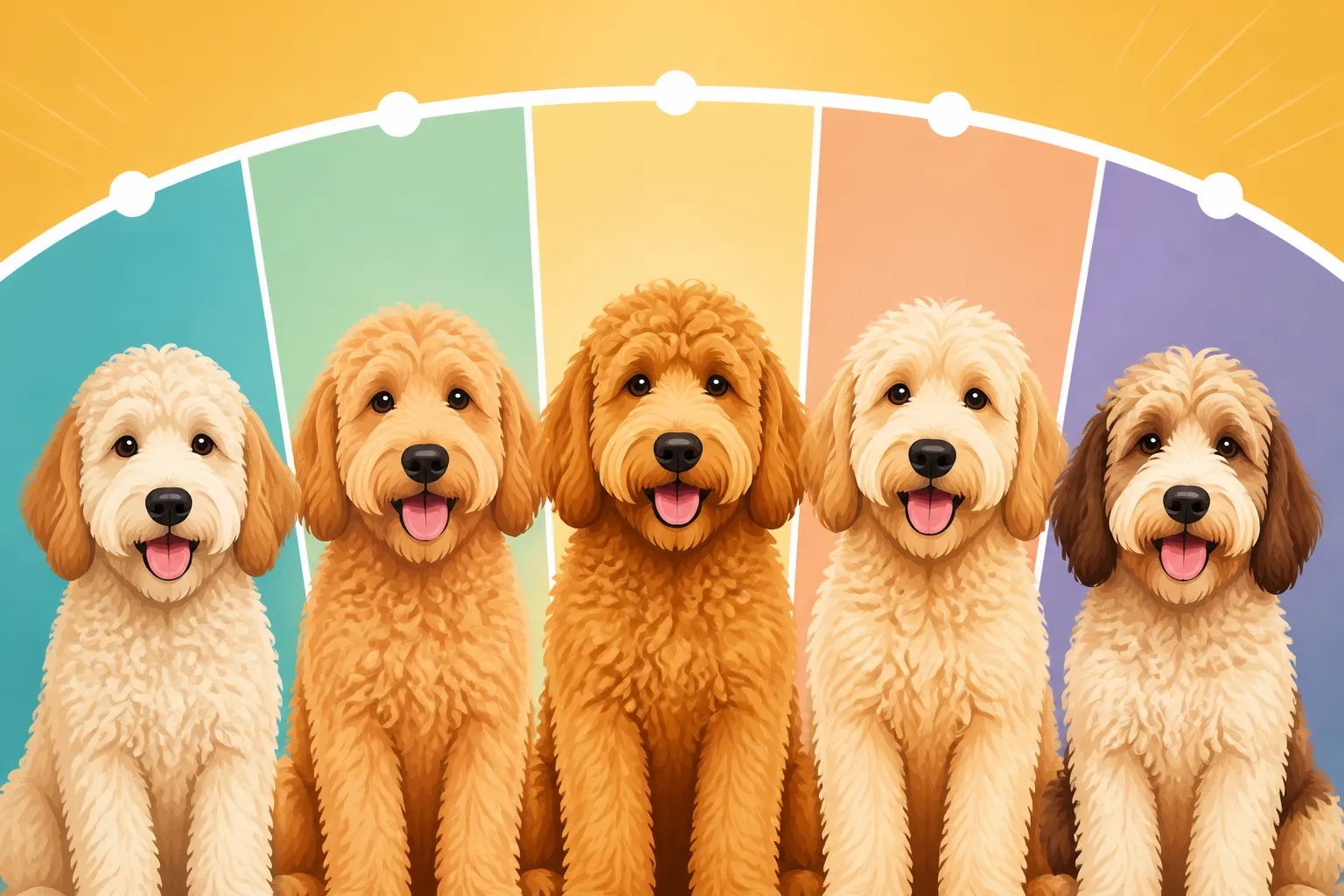
Goldendoodle Generations From F1 to Multigen
If you've ever found yourself scrolling through endless Goldendoodle listings, completely stumped by terms like "F1," "F1b," and "Multigen," you are definitely not alone. It feels like deciphering a secret code, doesn't it? You're just trying to figure out what kind of fuzzy companion will best fit your family, only to be met with an alphabet soup of generations that leaves you more confused than when you started. This comprehensive guide is here to untangle all that jargon, explaining exactly what each Goldendoodle generation means for you, your family, and your future furry friend. We'll dive deep into what to expect from each type, helping you make an informed decision without feeling like you need a genetics degree.
Understanding Goldendoodle Generations: More Than Just Letters and Numbers
When you first start looking into Goldendoodles, the "generation" terms can feel overwhelming, almost as if breeders are speaking a different language. It’s natural to feel a bit lost in the sea of F1, F1b, F2, and multigen labels. But these aren't just arbitrary classifications; they're actually a shorthand for understanding the genetic makeup of a Goldendoodle and, more importantly, what that might mean for traits like coat type, shedding, and even temperament. Unlike purebred dogs, which have universally recognized pedigrees and breed standards, Goldendoodles are a crossbreed, and their generations are a way for breeders and buyers to track the lineage and predict characteristics. Think of it as a roadmap for understanding the blend of Golden Retriever and Poodle that makes up your potential pup.
The "F" Factor: What the Numbers and Letters Actually Mean
The "F" in Goldendoodle generation terms stands for "Filial Hybrid," which essentially means "first-generation hybrid" when you start with F1. It’s a genetic term that refers to the offspring of distinct parental types. The number following the "F" indicates which generation the dog is. So, F1 is the first generation, F2 is the second, and so on. The addition of a "b" or even a "bb" simply means "backcross," indicating that the dog has been bred back to one of its parent breeds—typically the Poodle, to enhance certain traits like a curlier, lower-shedding coat.
For example, an F1 Goldendoodle is a direct cross between a purebred Golden Retriever and a purebred Poodle. There’s a 50/50 split in their genetic contribution. When you move to an F1b, that "b" signals a backcross. This means an F1 Goldendoodle has been bred back to a purebred Poodle, resulting in a dog that is roughly 75% Poodle and 25% Golden Retriever. This intentional breeding choice aims to amplify specific traits from the Poodle side. Understanding this fundamental notation is the first step in demystifying the whole process, helping you see that these aren't just random labels but a structured way to describe a Goldendoodle's genetic heritage.
Why Generation Matters to Future Owners
For a prospective Goldendoodle owner, understanding these generations is incredibly important, primarily because it offers a glimpse into what you can expect in terms of your dog's physical characteristics and, to some extent, its potential temperament. Let's be honest, many people seek out Goldendoodles because of their reputation for being low-shedding and intelligent. The generation of a Goldendoodle is often the strongest indicator of how likely these traits are to manifest.
If you have family members with allergies, for instance, an F1 Goldendoodle might still produce enough dander or shed enough hair to trigger a reaction, whereas an F1b or a multigen specifically bred for low-shedding might be a better fit. Similarly, if you're picturing a specific curly or wavy coat, knowing the generation helps you gauge the likelihood of achieving that look. It’s not a guarantee, because genetics are always a roll of the dice to some extent, but it's the best predictive tool we have. Without this knowledge, you might end up with a dog whose traits don't align with your expectations, leading to frustration for both you and your new companion. It's about setting realistic expectations and choosing a dog that truly fits your lifestyle and needs. For more on what these crosses actually mean, check out What a Goldendoodle Actually Is and Is Not.
The Unregistered Nature of Goldendoodle Generations
One crucial thing to understand about Goldendoodle generations is that, because they are a crossbreed, these designations aren't officially recognized by major kennel clubs like the American Kennel Club (AKC). Unlike purebred Golden Retrievers or Poodles, which have strict breed standards and detailed registration processes, Goldendoodles don't have a universal, overarching breed club that dictates these generational standards. This means that while the "F1," "F1b," and "Multigen" terms are widely used and understood within the Goldendoodle breeding community, they aren't codified or regulated in the same way.
What this translates to for you as a buyer is a need for extra vigilance. Since there isn't an official body overseeing these generations, breeders largely self-report the lineage. This makes it absolutely essential to choose a reputable breeder who is transparent about their breeding practices, shows you the parentage, and provides detailed health clearances. Without official registration, you're relying heavily on the breeder's honesty and integrity. It's why doing your homework and asking many questions about the parents and their health testing is far more important than just seeing an F-number on a website. You can learn more about why these dogs aren't recognized by traditional kennel clubs in Why No Kennel Club Recognizes the Goldendoodle.
The F1 Goldendoodle: The Original 50/50 Cross
Ah, the F1 Goldendoodle! This is where it all began, the original blend that first captured the hearts of so many dog lovers. If you're picturing the classic Goldendoodle look—that shaggy, often wavy coat and a perpetually happy demeanor—you're likely imagining an F1. These dogs represent the most straightforward genetic mix, a true 50/50 split of their Golden Retriever and Poodle heritage. They often embody the best of both worlds, combining the Golden's friendly, eager-to-please nature with the Poodle's intelligence and lower-shedding coat qualities.
How the F1 Generation is Bred
An F1 Goldendoodle is created by breeding a purebred Golden Retriever with a purebred Poodle. It's that simple. There are no other Goldendoodles in the immediate parentage. The Golden Retriever can be either the sire or the dam, and the Poodle can be any of its recognized sizes (Standard, Miniature, or Toy), which then dictates the projected size of the Goldendoodle offspring. For example, a Standard Poodle bred with a Golden Retriever will produce a Standard F1 Goldendoodle.
This direct cross is often touted for "hybrid vigor," a phenomenon where the first-generation offspring of two distinct purebred lines tend to be healthier and more robust than either parent breed. This is because the genetic diversity reduces the likelihood of inheriting two copies of a detrimental recessive gene from a single breed line. While the concept of What Hybrid Vigor Means for a Goldendoodle is appealing, it's not a magic bullet, and proper health testing of both parent breeds is still paramount to ensure the healthiest possible puppies. Breeders who focus on F1 often highlight this initial genetic diversity as a key benefit, promising a well-rounded and generally healthy dog.
What to Expect from an F1 Coat and Shedding
The coat of an F1 Goldendoodle is perhaps the most variable and, for many, the most unpredictable aspect of this generation. Because they get exactly half their genetics from each parent, you can see a wide spectrum of coat types even within a single litter. Some F1s might lean more towards the Golden Retriever side with a straighter, wavier coat that sheds moderately, similar to a Golden. Others might inherit more of the Poodle's curl and have a wavier or even lightly curly coat, which tends to shed less. You’ll often hear descriptions like "wavy fleece" or "shaggy" for F1 coats.
It's crucial to understand that while many F1 Goldendoodles do shed less than a purebred Golden Retriever, they are generally not completely non-shedding. If you or a family member has severe allergies, an F1 might still be problematic. This is a common misconception, leading many new owners to be surprised by the amount of hair they find. Their coats also require consistent grooming to prevent matting, even if they aren't heavily shedding, as their longer, softer hair can easily tangle. Remember, Why Goldendoodle Puppy Coat Predicts Nothing is especially true for F1s, as their adult coat can be quite different from their puppy fluff.
Temperament and Hybrid Vigor in F1 Goldendoodles
In terms of temperament, F1 Goldendoodles often hit a sweet spot, combining the best behavioral traits of both parent breeds. They tend to inherit the Golden Retriever's famous friendliness, eagerness to please, and gentle nature, making them wonderful family dogs. They are typically very social, good with children and other pets, and thrive on being part of family activities. From the Poodle side, they often gain a keen intelligence, a desire to learn, and a playful mischievousness. This combination usually results in a dog that is highly trainable, adaptable, and a joy to live with.
The "hybrid vigor" mentioned earlier isn't just about physical health; it can also manifest in a robust and balanced temperament. F1s often exhibit fewer of the extreme personality traits sometimes seen in very specialized purebred lines. However, individual personalities will always vary, and early socialization and consistent training are just as vital for an F1 Goldendoodle as they are for any other dog. They are often described as intelligent and enthusiastic learners, which is a fantastic foundation for training. For a deeper dive into their genetic makeup, explore What a Goldendoodle Inherits From Each Parent Breed. You'll find these pups usually make very enthusiastic students, ready to soak up whatever you teach them, whether it's tricks or basic manners from a reputable dog training program like those you might find on Chewy.
The F1b Goldendoodle: The Backcross for Allergy Sufferers
If you've heard whispers about Goldendoodles being "hypoallergenic," the F1b generation is likely what people are referring to. This generation represents a deliberate effort by breeders to create a dog that retains the lovable Goldendoodle personality but with a significantly reduced shedding potential, making them a more suitable option for individuals with mild to moderate allergies. The "b" for backcross is key here, signifying a move towards a higher percentage of the Poodle's genetic contribution.
How the F1b Generation is Bred
An F1b Goldendoodle is produced by taking an F1 Goldendoodle (the 50/50 Golden/Poodle mix) and breeding it back to a purebred Poodle. This means the resulting F1b puppy will be approximately 75% Poodle and 25% Golden Retriever. This intentional "backcrossing" to the Poodle is done specifically to increase the likelihood of inheriting the Poodle's low-shedding and curly coat genes. It's a calculated move to push the genetic pendulum further away from the shedding tendencies of the Golden Retriever.
It's important to note that while usually bred back to a Poodle, in rare instances, a Goldendoodle can be backcrossed to a Golden Retriever. However, this is far less common as it would increase shedding, which usually goes against the primary goal of Goldendoodle breeding. The 75/25 genetic split is what makes the F1b generation stand out for its potential to be more allergy-friendly. For a comprehensive look at this specific cross, check out The F1b Goldendoodle at Three Quarters Poodle.
The F1b Coat and Reduced Shedding Potential
The most defining characteristic of the F1b Goldendoodle is its coat, which is typically curlier and has a much lower shedding rate than an F1. You'll often find F1b Goldendoodles with wavy to very curly coats, often described as "fleece" or "wool" textures. These coats are much more likely to be considered "allergy-friendly" because the tight curls tend to trap any shed hair and dander, preventing it from dispersing into the environment.
While no dog is truly 100% hypoallergenic—because allergies are triggered by dander and saliva proteins, not just hair—the F1b Goldendoodle comes closest among the earlier generations to fitting that description for many allergy sufferers. However, it's still not a guarantee, and individuals with severe allergies should always spend time with an F1b Goldendoodle before committing. Even with reduced shedding, these coats require diligent grooming. That dense, curly fur is a magnet for mats, and without regular brushing (often daily) and professional grooming every 6-8 weeks, it can become tangled and uncomfortable for the dog. Regular grooming supplies, like those available on Chewy, are an absolute must for this coat type. You might want to consider Whether a Goldendoodle Is Really Hypoallergenic for more details on this topic.
Temperament and Health Considerations in F1b Goldendoodles
In terms of temperament, F1b Goldendoodles generally maintain the desirable traits of the F1 generation, but with a slight leaning towards the Poodle's characteristics due to their higher Poodle percentage. This means they are often incredibly intelligent, highly trainable, and eager to please. They typically retain the Golden Retriever's affectionate and friendly disposition, making them still excellent family companions. However, some F1b Goldendoodles might exhibit a bit more of the Poodle's sensitive nature or their characteristic energy, requiring consistent mental and physical stimulation to prevent boredom.
From a health perspective, F1b Goldendoodles can still inherit health conditions from both parent breeds, despite the higher Poodle percentage. The advantage of the backcross is that it dilutes the genetic contribution of the Golden Retriever, potentially reducing the incidence of some Golden-specific issues like certain cancers. However, they are still susceptible to Poodle-related health concerns, such as Addison's Disease or Progressive Retinal Atrophy Carried by Both Goldendoodle Lines. A responsible breeder will conduct comprehensive health testing on both the F1 Goldendoodle parent and the purebred Poodle parent to mitigate these risks. As always, thorough health clearances are non-negotiable, regardless of generation.
The F2 Goldendoodle: The Often Misunderstood Second Generation
The F2 Goldendoodle is a generation that sometimes causes confusion and, frankly, can be quite a gamble in terms of predictable traits. While F1 and F1b generations have a relatively straightforward genetic makeup that allows for some educated guesses about their appearance and shedding, the F2 throws a wrench into that predictability. This is why you often hear conflicting information or warnings about the F2 generation, particularly concerning coat types. It's not inherently "bad," but it's certainly less consistent.
How the F2 Generation Comes About
An F2 Goldendoodle is the result of breeding two F1 Goldendoodles together. This means both parents are 50% Golden Retriever and 50% Poodle. On the surface, you might think this would produce offspring that are also 50/50, but genetics are rarely that neat and tidy. When you breed two hybrid dogs, their offspring receive a mix of genes from both sides of their F1 parents' ancestry, rather than a fresh, even split from purebreds.
Imagine each F1 parent as a shuffled deck of cards, half Golden and half Poodle. When these two decks are combined, the resulting F2 puppies can inherit a much wider, and less predictable, array of genes. Some might get a heavier dose of Golden Retriever genes, others more Poodle genes, and some a true mix. This genetic lottery is precisely what makes the F2 generation so variable. Unlike the clear ratios of F1 or F1b, the F2 is a mosaic of possibilities, which can be exciting for some but a significant concern for those seeking specific traits.
The Highly Unpredictable F2 Coat
This is where the F2 generation really earns its reputation for being unpredictable. Because of the way genes recombine when two F1 Goldendoodles are bred, you can find F2 puppies in a single litter that exhibit all three main coat types: straight, wavy, and curly. You might have one puppy with a flat, Golden-like coat that sheds considerably, another with the desired wavy fleece coat, and yet another with a tight, Poodle-like wool coat that barely sheds.
For those looking for a specific low-shedding, allergy-friendly Goldendoodle, the F2 generation carries a higher risk of disappointment. A family expecting a wavy, low-shedding dog could easily end up with a straighter-coated, moderate-shedding dog, which could be a significant issue if allergies are a concern. This unpredictability means that even responsible F2 breeders can't guarantee a specific coat type, even if both F1 parents have desirable coats. It's a genetic roll of the dice, and it's why many breeders who prioritize consistency in coat (especially for allergy sufferers) tend to move towards F1b or multigen lines rather than F2. This variability is explored further in Why F2 Goldendoodle Litters Vary So Much.
Why F2 Goldendoodle Litters Vary So Much
The extreme variability within F2 litters stems directly from Mendelian genetics and the principle of independent assortment. Each F1 parent carries two copies of genes for certain traits – one from their Golden parent and one from their Poodle parent. When two F1s breed, these genes are shuffled and passed on in countless combinations to the F2 puppies. It's not a simple averaging out of traits.
Consider coat traits like shedding and curl. An F1 Goldendoodle might have a wavy coat and shed moderately because it inherited one shedding gene from the Golden and one non-shedding gene from the Poodle. When two such F1s breed, their F2 offspring could inherit two shedding genes (resulting in a heavy-shedding, straight coat), one shedding and one non-shedding gene (resulting in a wavy, lower-shedding coat), or two non-shedding genes (resulting in a curly, very low-shedding coat). All these possibilities can exist within the same litter. This also applies to other physical traits and even predispositions to certain behaviors, making F2s a fascinating but challenging generation to predict. This is why it's especially important for F2 breeders to perform The DNA Panel a Goldendoodle Breeder Should Run to give buyers a clearer picture of potential coat types, even if it's still not 100% guaranteed.
Multigen Goldendoodles: The Quest for Consistency
After navigating the unpredictable waters of the F2 generation, breeders often turn their attention to Multigen Goldendoodles. This generation represents a concerted effort to move beyond the genetic lottery of earlier crosses and establish greater predictability in traits like coat type, shedding, and even temperament. For many families seeking a specific Goldendoodle look or aiming for a truly allergy-friendly companion, Multigens are often presented as the ideal choice.
What Defines a Multigen Goldendoodle
A Goldendoodle is generally considered "Multigen" (or Multi-generational) when both of its parents are already Goldendoodles from F1b or later generations. This means you're breeding Goldendoodle to Goldendoodle, and importantly, these parent Goldendoodles have themselves been carefully selected for specific, desirable traits. For example, breeding two F1b Goldendoodles together would produce an F2b litter, which could also be considered Multigen. More commonly, it involves breeding F1b or F2b Goldendoodles to other F1b or F2b Goldendoodles, or even further generations, over several breeding cycles.
The key distinction is that with Multigens, breeders are no longer using purebred Golden Retrievers or Poodles in the immediate parentage. Instead, they are working within the Goldendoodle gene pool itself, selecting parents that consistently exhibit the desired qualities—such as a specific coat texture, a low-shedding characteristic, or a particular temperament. This continuous selection over multiple generations is what aims to increase the consistency and predictability that earlier generations often lack.
The Goal of Multigen Breeding for Coat and Temperament
The primary goal of Multigen breeding is to achieve greater consistency and predictability in desired Goldendoodle traits, especially regarding coat type and shedding. By selectively breeding Goldendoodles with proven low-shedding, allergy-friendly coats (typically wool or fleece textures), breeders aim to produce litters where all puppies are likely to inherit these characteristics. This is a significant improvement over the F1 or F2 generations, where coat types can vary wildly within a single litter.
Beyond coat, Multigen breeding also focuses on solidifying temperament. Breeders strive to select parent dogs that exhibit the best of the Goldendoodle personality: intelligent, friendly, adaptable, and eager to please. Over multiple generations, this selective pressure helps to reduce the likelihood of inheriting less desirable traits and enhances the traits that make Goldendoodles such beloved family pets. It's an ongoing process of refinement, moving closer to a standardized "Goldendoodle type," even though they are still a crossbreed. The idea is to consistently produce the ideal Goldendoodle Temperament From Two Parent Breeds combined into one dog.
The Debate Around "True" Multigens and Designer Dog Claims
While Multigen Goldendoodles offer the promise of greater consistency, there's an ongoing debate within the wider dog breeding community, and even among Goldendoodle enthusiasts, about what truly constitutes a "Multigen" and the implications of this type of breeding. Some purists argue that without official breed standards or registry recognition, "Multigen" is a somewhat arbitrary term, and the idea of "designer dogs" itself is problematic. They point out that a true breed takes many generations and careful, documented lineage to establish consistent traits, far beyond what currently exists for Goldendoodles.
However, advocates for Multigen breeding argue that it's a necessary step to meet the demand for predictable, allergy-friendly companions, and that responsible breeders are indeed working to improve and standardize the Goldendoodle over time. They emphasize the health testing and careful selection involved in their programs. For a buyer, this means it's still absolutely vital to look for transparency and integrity in a Multigen breeder. Don't just take the "Multigen" label at face value; inquire about the specific generations of the parent dogs, their health clearances, and the breeder's long-term goals. While Multigen aims for consistency, the quality of breeding practices behind the label is what truly matters. For more information on why specific generations have more consistent coats, see Multigen Goldendoodles and Coat Consistency.
Beyond the Basics: Other Goldendoodle Generation Notations
Just when you thought you had a handle on F1, F1b, and Multigen, you might encounter even more letters and numbers thrown into the mix! Breeders, in their quest for specific coat types or other desired traits, sometimes perform further backcrosses or breed specific generational combinations. These additional notations can look even more like a scientific formula, but they follow the same logic as the core generations. It's all about precisely documenting the lineage and the ratio of Golden Retriever to Poodle genes.
F1bb and F2b: Even More Backcrosses
Let's break down some of these more complex notations:
-
F1bb Goldendoodle: This means an F1b Goldendoodle is bred back to a purebred Poodle. So, you're essentially taking a dog that's already 75% Poodle and breeding it again with a 100% Poodle. The resulting F1bb puppy would be approximately 87.5% Poodle and 12.5% Golden Retriever. The "bb" signifies a double backcross. This generation is bred for maximum Poodle traits, aiming for the curliest, most non-shedding coat possible, making it potentially the most allergy-friendly Goldendoodle.
-
F2b Goldendoodle: An F2b Goldendoodle results from breeding an F2 Goldendoodle (which is an F1 x F1 cross) back to a purebred Poodle. This means you have an F2 (which is already quite varied in its genetic makeup) now being influenced heavily by the Poodle's genes. The resulting F2b would typically be around 62.5% Poodle and 37.5% Golden Retriever, or sometimes even closer to 75% Poodle, depending on the genetic leanings of the F2 parent. The goal here is similar to the F1b: to enhance the low-shedding Poodle characteristics while still retaining some of the Golden Retriever's desirable traits. However, because one parent is an F2, there can still be a bit more variability in the F2b coat than in an F1b, though generally less than a pure F2.
These additional backcrosses demonstrate breeders' commitment to refining the Goldendoodle to meet specific demands, especially those related to allergies.
Goldendoodle DNA Testing: Understanding Coat Genetics
Given the complexity and variability of Goldendoodle coats, especially in the F2 and F2b generations, many responsible breeders now utilize DNA testing to understand the genetic makeup of their breeding dogs. These tests can identify specific genes related to coat type, shedding, and furnishings (the genes that give Goldendoodles their characteristic facial hair, beard, and eyebrows).
For example, a DNA test can tell a breeder if a dog carries genes for a flat coat (which sheds more) or a curly/wavy coat (which sheds less), and whether it has two copies of the "furnishings" gene, which is crucial for the classic Goldendoodle look. This information allows breeders to make more informed decisions about pairings, increasing the likelihood of producing puppies with the desired coat traits. If you're concerned about allergies, asking a breeder about the DNA test results for the parent dogs, particularly regarding the furnishing and curl genes, can provide a much more reliable indicator of a puppy's adult coat than simply relying on its generation number alone. It adds a layer of scientific predictability to the breeding process that was once purely observational. Services like Embark (a brand available at Chewy's online store) provide these detailed genetic reports.
Why Generation is Only One Piece of the Puzzle
While understanding Goldendoodle generations is incredibly helpful, it's vital to remember that it's only one piece of the much larger puzzle when choosing a puppy. Focusing solely on the generation number can lead you to overlook other equally, if not more, important factors. A generation label provides a general guideline, but it's never a guarantee.
For example, an F1b Goldendoodle might technically be more likely to be low-shedding, but if the individual parent dogs weren't health tested, or if they have poor temperaments, you could still end up with a dog that has significant health issues or behavioral challenges. Conversely, a well-bred F1 Goldendoodle from thoroughly health-tested parents with excellent temperaments could be a far better fit for many families, even if it sheds a bit more. The generation explains the genetic mix, but it doesn't tell you about the quality of the breeding stock, the care given to the puppies, or the individual puppy's personality. Always consider the whole picture: health clearances, breeder reputation, early socialization, and the individual puppy's temperament, in addition to its generational label. Why Testing Beats the Word Hybrid on a Goldendoodle is an excellent resource for this.
Choosing the Right Goldendoodle Generation for Your Home
Making the decision about which Goldendoodle generation is right for your home can feel like a monumental task. There are so many factors to consider, from allergies and shedding to how much time you have for grooming and what kind of personality you're hoping for. It’s not just about picking the "best" generation, because "best" is entirely subjective and depends on your unique circumstances. Instead, it's about finding the right fit for your family, your lifestyle, and your expectations.
Considering Allergies and Shedding Preferences
For many prospective Goldendoodle owners, the primary driver behind choosing a specific generation is the hope of a low-shedding, allergy-friendly dog. Here’s a general guideline, keeping in mind that individual dogs can always be an exception:
- F1 Goldendoodle: Generally, the most variable in terms of shedding. Some will shed moderately (like a Golden), others less. If allergies are present, even mild ones, an F1 might not be the safest bet. Their coats are often wavy or shaggy.
- F1b Goldendoodle: This is often the go-to choice for families seeking reduced shedding and a more allergy-friendly dog. With 75% Poodle genetics, they are much more likely to have a curly or wavy-fleece coat that sheds very little. They are a strong option for those with mild to moderate allergies.
- F1bb / F2b / Multigen Goldendoodles: These generations are bred for maximum consistency in low-shedding, curly coats, pushing the Poodle genetics even higher. They are generally considered the most allergy-friendly options, but again, no dog is 100% hypoallergenic.
If allergies are a serious concern, spending time with adult Goldendoodles of the generation you're considering (and ideally from the same breeder's lines) is highly recommended. Pay close attention to how your allergies react. For an in-depth look, consider Which Goldendoodle Generation Sheds Least.
Temperament Expectations Across Generations
While coat type is often the most discussed aspect of Goldendoodle generations, temperament is equally important. The good news is that Goldendoodles, across all generations, generally inherit wonderful personality traits from both the Golden Retriever and the Poodle. They are known for being intelligent, friendly, eager to please, and highly adaptable.
- F1 Goldendoodles: Tend to have a very balanced blend of both parent breeds. They often display the Golden's outgoing friendliness and the Poodle's intelligence, creating a well-rounded and affectionate companion.
- F1b, F1bb, F2b, and Multigen Goldendoodles: As the Poodle percentage increases, you might notice a slight shift towards more Poodle-like traits. This can mean even higher intelligence, sometimes a bit more "sass" or sensitivity, and often a higher energy level that requires more mental and physical stimulation. They typically retain the Golden's desire to please, making them still highly trainable.
Regardless of generation, consistent training, early socialization, and plenty of positive reinforcement are crucial for nurturing a well-adjusted Goldendoodle. Their inherent desire to please means they typically respond very well to training, making them a joy to work with. Remember, individual personality will always trump genetic percentages to some degree.
The Importance of a Reputable Breeder Over Generation Labels
This cannot be stressed enough: the quality and ethics of the breeder you choose are far more important than any generational label. A poorly bred F1b Goldendoodle from a backyard breeder who skips health testing and doesn't socialize their puppies can be a much bigger liability than a well-bred F1 Goldendoodle from a responsible, ethical breeder.
A reputable breeder will:
- Conduct all recommended health clearances for both parent dogs (Hips, Elbows, Eyes, Heart, and genetic tests for common issues in Golden Retrievers and Poodles). You can find more about this in Health Testing Both Goldendoodle Parents Should Have.
- Be transparent about the parentage, health history, and temperament of their breeding dogs.
- Welcome questions and be eager to educate you on their breeding practices.
- Prioritize the health and temperament of their dogs over specific coat colors or arbitrary generational numbers.
- Provide a health guarantee and support you throughout your dog's life.
- Socialize their puppies from birth, ensuring they have a good foundation for life in a family home.
- Never pressure you into a sale or allow you to pick a puppy before 8 weeks of age.
Don't let the allure of a "hypoallergenic" F1b or Multigen overshadow the absolute necessity of finding a breeder who prioritizes the well-being of their dogs. Research, ask tough questions, and trust your gut. A good breeder is your best resource, no matter the generation.
Disclaimer
This article is for general informational purposes only and does not constitute professional advice. Laws, prices and regulations vary by location and change over time. Consult a qualified professional for guidance on your specific situation.