Identifying a Curly Wool Goldendoodle Coat
One of the most common points of confusion and even frustration for new Goldendoodle owners is understanding their dog's coat, especially when terms like "curly wool" are thrown around. You might have been promised a low-shedding marvel, only to find yourself battling mats and wondering if your pup's fur is normal. This guide will help you definitively identify if your Goldendoodle has that distinctive curly wool coat and what that truly means for you both.
Decoding the Goldendoodle Coat Types
Before we dive into the specific characteristics of the curly wool coat, it's crucial to understand that Goldendoodles, being a crossbreed, don't have a single, predictable coat type. Unlike purebreds with breed standards, Goldendoodles can inherit a wide range of hair textures and patterns from their Golden Retriever and Poodle parents. This is where a lot of the initial surprise, and sometimes disappointment, for new owners comes from. It’s a bit like a genetic lottery, and sometimes you get a bit of everything!
The Three Primary Goldendoodle Coat Types
Generally speaking, Goldendoodles typically display three main coat types, though there can be variations and blends within these categories. Understanding these helps set the stage for identifying the curly wool variety.
- Straight/Flat Coat: This coat tends to be more like a Golden Retriever's fur – straight, sometimes a bit coarse, and usually sheds a fair amount. Owners often hope to avoid this type if they're looking for a low-shedding dog, but it's a perfectly normal variation.
- Wavy/Fleece Coat: This is perhaps the most common and often desired Goldendoodle coat. It's soft, usually forms loose waves, and can range from slightly wavy to quite curly. It has a beautiful, flowing texture that many people associate with the "classic" Goldendoodle look. This coat is generally moderate in shedding, but still requires consistent grooming.
- Curly/Wool Coat: This is the coat we're focusing on. It's dense, tightly curled, and has a distinct texture often likened to a Poodle's coat or even lamb's wool. It's typically the least shedding of the three, which is why many breeders aim for it, especially for allergy sufferers.
Each of these coats comes with its own set of grooming challenges and joys. If you want to learn more about the broader spectrum, take a look at The Three Goldendoodle Coat Types and How to Tell Them.
What Defines a Curly Wool Goldendoodle Coat?
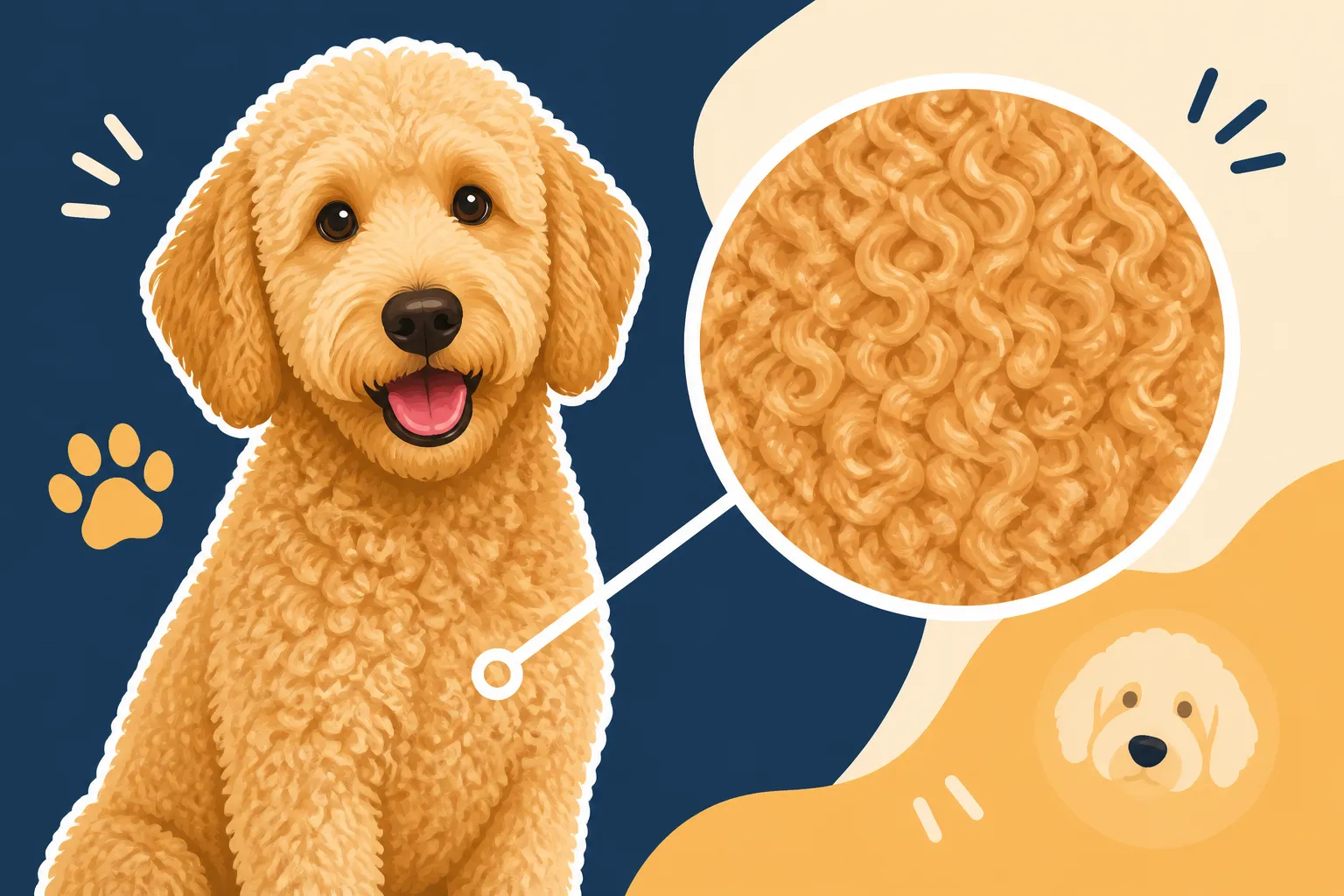
When you hear "curly wool," visualize a dense, springy, and often thick coat that is unmistakably curled. It's not just a little wave; it's a full-on curl, sometimes forming tight ringlets or even cords if left untended. This coat type is highly desirable for many due to its low-shedding properties, but it's also a serious commitment in terms of grooming.
Visual and Tactile Characteristics
To truly identify a curly wool coat, you need to use both your eyes and your hands.
- Appearance: From a distance, a curly wool Goldendoodle often looks like a fluffy cloud or a meticulously groomed Poodle. The curls are evident, not just subtle waves. They'll hug the body more tightly than a fleece coat and typically don't have the flowing appearance of a wavy coat. If you look closely, especially when the dog is wet, you'll see the individual curls spring up. The hair itself can be quite fine but dense, giving it a soft, yet resilient feel. You might notice that the hair stands out from the body somewhat due to the density and springiness of the curls.
- Texture: This is where the "wool" part of the name comes in. When you run your hand through it, a curly wool coat feels distinctly different from a Golden Retriever's silky fur or even a wavy Goldendoodle's soft fleece. It's often described as feeling like soft lamb's wool, dense and springy. It doesn't feel coarse, but rather has a resilient bounce to it. If you try to pull it straight, it will spring back into its curl. This density and texture are what make it so effective at trapping loose hair, leading to its low-shedding reputation.
- Density: The curly wool coat is incredibly dense. Part the hair anywhere on your Goldendoodle's body, and you'll often find it hard to see the skin without really pushing the hair aside. This density contributes to its warmth and protection but also its propensity for matting if not properly cared for. The amount of hair packed into a small area is surprising.
The Role of the Poodle Parent
It's no secret that the Poodle parent is the primary influencer when it comes to the curly wool coat. Poodles are known for their signature non-shedding, curly hair, and when a Goldendoodle inherits more of those Poodle genes, the curly wool coat is the likely result. This is often seen in F1b Goldendoodles (where an F1 Goldendoodle is bred back to a Poodle) or in multigen Goldendoodles where Poodle genetics have been selectively emphasized over generations. This explains What a Goldendoodle Inherits From Each Parent Breed in terms of coat.
Distinguishing Curly Wool from Other Coats
It can be tricky to differentiate coat types, especially when a puppy is young, as their coats often change significantly as they mature. However, there are key distinctions that will become clearer as your Goldendoodle grows.
Curly Wool vs. Wavy Fleece
This is the most common point of confusion. Many people think their wavy Goldendoodle has a curly coat, but there's a definite difference.
| Feature | Curly Wool Coat | Wavy Fleece Coat |
|---|---|---|
| Appearance | Tight, distinct curls, often forming ringlets. Denser, stands away from body. | Loose, flowing waves. Can be slightly curly but not tight. Softer, drapes more. |
| Texture | Dense, springy, feels like lamb's wool. Resilient. | Soft, silky, flowing. Less spring-back. |
| Shedding | Very low shedding, hair trapped in curls. | Moderate shedding, can still leave hair around. |
| Matting Risk | High, due to density and tight curls. | Moderate to high, depending on wave tightness. |
| Grooming Needs | Daily brushing, professional grooms every 4-6 weeks. | Regular brushing (3-4 times/week), grooms every 6-8 weeks. |
If your Goldendoodle's hair doesn't easily straighten out and instead springs back into tight curls, you likely have a curly wool coat. A wavy fleece coat, while lovely, will have more of a gentle undulation rather than a true curl.
Curly Wool vs. Flat Coat
This comparison is usually much easier, as the flat coat is quite distinct.
- Curly Wool: As described, dense, tightly curled, low-shedding.
- Flat Coat: Straight, typically coarser, lays flat against the body, and sheds much more like a Golden Retriever. You won't find any significant curl here. If you're wondering Why a Fluffy Goldendoodle Puppy May Shed as an Adult, it's often due to these underlying genetic traits manifesting as they mature past their puppy fluff.
Sometimes, a Goldendoodle puppy will have what looks like a fluffy, slightly wavy coat that later "blooms" into a dense curly wool coat during the infamous coat change between 8-12 months. This is a common phenomenon where the puppy fluff gives way to the adult coat, often increasing in curl and density. Don't be surprised if your seemingly wavy pup suddenly becomes a curly sheepdog!
Caring for the Curly Wool Goldendoodle Coat
Identifying that you have a curly wool Goldendoodle is just the first step; the next is understanding the significant grooming commitment required. While these coats are fantastic for minimizing shedding in your home, they are also notorious for matting.
The Matting Monster
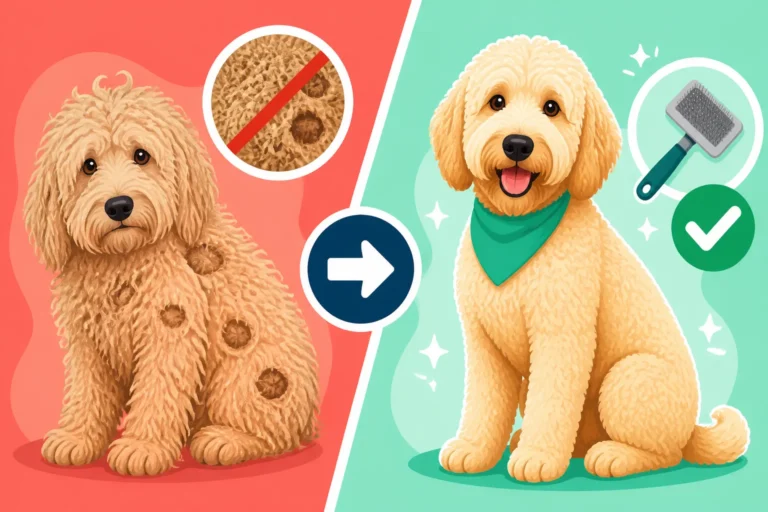
The dense, tightly curled nature of a wool coat means that shed hair gets trapped within the existing curls instead of falling out. If this trapped hair isn't regularly brushed out, it quickly forms tangles, which then compact into mats. Mats can range from small, hidden knots behind the ears or under the armpits to large, painful sheets of felted fur that pull on your dog's skin. These aren't just cosmetic issues; severe matting can restrict movement, cause skin infections, hide parasites, and be incredibly uncomfortable for your Goldendoodle. This is precisely why Why Goldendoodle Matting Is Almost Always Preventable is a topic we emphasize so much.
Essential Grooming Regimen
Caring for a curly wool Goldendoodle coat demands diligence. Here’s what you absolutely need to do:
- Daily Brushing: This isn't optional; it's mandatory. You need a good quality slicker brush and a metal comb. The key is to "line brush" down to the skin, section by section, ensuring you're removing all trapped hair. Don't just skim the top of the coat! Pay special attention to high-friction areas like behind the ears, armpits, groin, and under the collar or harness, as these are The Spots Where a Goldendoodle Mats First. Many owners find useful grooming tools on sites like Amazon or Chewy.
- Professional Grooming: Your curly wool Goldendoodle will need professional grooming every 4-6 weeks, without fail. Skipping appointments, even by a week or two, can lead to matting that requires extensive (and costly) dematting, or even a full shave-down. Be honest with your groomer about how often you brush at home; they can tell! If you’re not consistent with home brushing, you’ll definitely face Dematting Surcharges on a Goldendoodle.
- Bathing: Bathe your Goldendoodle as needed, using a good quality dog shampoo and conditioner. Never let a curly wool coat air dry without thorough brushing and blow-drying, as damp curls will tighten and mat instantly. Blow-dry the coat completely, brushing as you go, to prevent matting.
- Ear Care: Those furnished ears are adorable but can harbor moisture and lead to infections. Regularly check and clean your Goldendoodle’s ears, and discuss ear hair plucking with your vet or groomer. Learn more in Goldendoodle Ear Care Under All That Hair.
Tools of the Trade
Having the right tools makes all the difference in managing a curly wool coat.
- Slicker Brush: Invest in a sturdy, large slicker brush with pins that are not too sharp.
- Metal Comb: A good quality, stainless steel comb with both wide and fine teeth is indispensable for checking for mats after brushing. It will find what the slicker brush missed.
- Detangling Spray: Keep a good detangling spray on hand for those tricky spots. Brands available through retailers like Chewy or Amazon often carry effective options.
- High-Velocity Dryer: If you plan to bathe your Goldendoodle at home, a high-velocity force dryer will be your best friend. It dramatically speeds up drying time and helps straighten the hair for easier brushing, preventing those instant post-bath mats.
Caring for a curly wool coat is a labor of love, but with consistent effort, you can keep your Goldendoodle comfortable, healthy, and looking fabulous.
Genetics and Future Coat Predictions
Understanding the genetics behind your Goldendoodle's coat can help you anticipate how much curl and density it might develop, especially if you're looking at a puppy. While a DNA test can give you definitive answers, observing the parents and understanding generations can also offer clues.
The Furnishings and Curl Genes
Two main genes dictate the Goldendoodle coat type:
- Furnishings (F/f): This gene is responsible for the longer hair on the face (beard, mustache, eyebrows) that gives Goldendoodles their distinctive "doodle" look. Without furnishings, a Goldendoodle will have a smooth face more like a Golden Retriever, even if the body has a curly coat. This is discussed further in The Furnishings Gene and the Goldendoodle Beard. A Goldendoodle with a curly wool coat will almost certainly have inherited furnishings.
- Curl (C/c): This gene directly influences the amount of curl in the coat. A Goldendoodle needs at least one copy of the curl gene (C) to have any curl, and two copies (CC) will typically result in a very curly, woolly coat.
Breeders aiming for low-shedding, curly coats will often select parent dogs that are known to carry the curl gene (often determined by DNA testing). This is why F1b (first-generation backcross, typically F1 Goldendoodle x Poodle) and Multigen Goldendoodles are more likely to have curly wool coats, as they have a higher percentage of Poodle genetics.
Predicting a Puppy's Adult Coat
Predicting an adult coat from a tiny Goldendoodle puppy can be notoriously difficult. They all start with soft, fluffy "puppy coats" that bear little resemblance to their mature fur. However, there are a few indicators:
- Curl at the Tips: Look at the tips of the hair, especially on the ears or tail. If you see even a slight curl or wave there, it's a good sign that more curl will develop.
- Texture: Even as a puppy, a wool coat might feel denser and springier than a puppy destined for a wavy or straight coat.
- Parent Coats: Observing the coats of both parent dogs, if possible, is one of the best predictors. If one parent is a Poodle and the other an F1 Goldendoodle with a wavy fleece coat, the F1b puppies have a higher probability of inheriting that curly wool.
The Goldendoodle coat change, usually happening between 8 and 12 months of age, is a critical period. This is when the soft puppy fur is replaced by the adult coat, and the true texture and curl will emerge. Be prepared for intensified matting during this time, and double down on your brushing efforts. As they transition, you'll really start to see the mature curly wool coat take its definitive shape.
Disclaimer
This article is for general informational purposes only and does not constitute professional advice. Laws, prices and regulations vary by location and change over time. Consult a qualified professional for guidance on your specific situation.