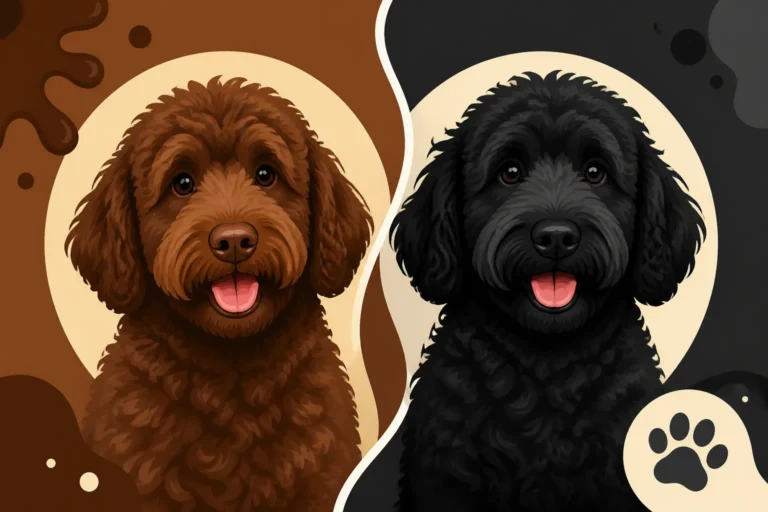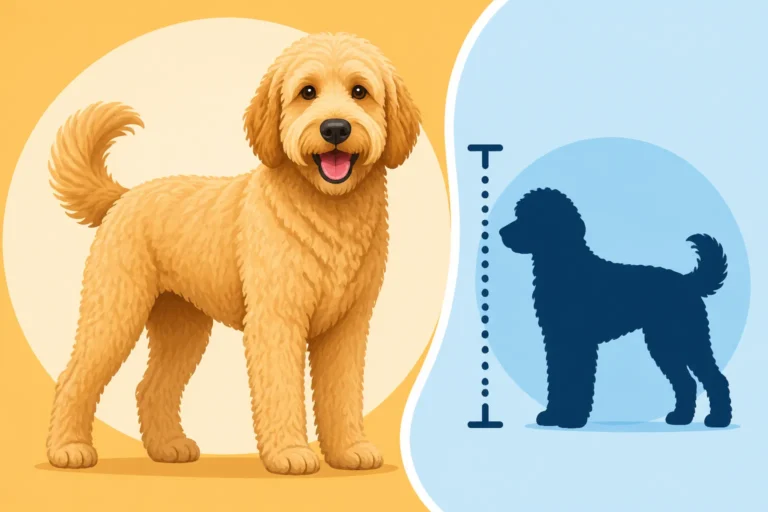
The F2 Goldendoodle and Its Unpredictable Coat
Bringing home a Goldendoodle puppy, many families dream of that iconic fluffy, low-shedding coat, especially if allergies are a concern. But if you're looking at an F2 Goldendoodle, the truth is, the coat genetics can be a real roll of the dice, leading to unexpected shedding, varying textures, and often, more grooming surprises than you might anticipate. This comprehensive guide will peel back the layers of F2 Goldendoodle genetics, helping you understand why their coats are so famously unpredictable and how to prepare for whatever adorable fluffball comes home with you.
What Exactly is an F2 Goldendoodle?
Before we dive into the fascinating, sometimes frustrating, world of F2 Goldendoodle coats, it's essential to grasp what an F2 generation actually represents in the grand scheme of Doodle breeding. Many people hear "Goldendoodle" and imagine one specific look or coat type, but the reality is far more diverse, especially when you move beyond the initial cross.
The Breeding Behind an F2 Generation
An F2 Goldendoodle is created by breeding two F1 Goldendoodles together. To break that down further, an F1 Goldendoodle is a first-generation cross between a purebred Golden Retriever and a purebred Poodle. So, when two F1 Goldendoodles—each with a 50/50 genetic mix of Golden Retriever and Poodle—are bred, their offspring are F2s. This seems straightforward enough, right? You might assume that breeding two F1s would simply reproduce that consistent 50/50 genetic blend, but that's where the magic, and the mystery, of genetics comes into play. It's not like mixing two buckets of paint and getting the same shade every time; it's more like drawing cards from two shuffled decks. You can read more about the different generations in Goldendoodle Generations From F1 to Multigen.
Think of it this way: each F1 parent carries a complex tapestry of genes from both their Golden Retriever and Poodle ancestors. When they reproduce, these genes are shuffled and combined in unique ways for each puppy in the litter. While both F1 parents have a 50/50 split on average, the specific genes each puppy inherits from that F1 parent can vary wildly. Some F2 puppies might lean more heavily into their Golden Retriever ancestry, while others might take after the Poodle side more strongly, even within the same litter. This genetic variability is precisely why predicting an F2's traits, especially their coat, becomes so much harder.
Why F2 Goldendoodles Are Less Predictable
The primary reason for the unpredictability of F2 Goldendoodle coats, and indeed many of their other traits, boils down to the concept of genetic segregation. In an F1 Goldendoodle, you have one set of genes from the Golden Retriever and one set from the Poodle. These genes are largely heterozygous, meaning they have different versions (alleles) for many traits. When two F1s breed, these different alleles have a 25% chance of combining in various ways, allowing for traits that might have been "hidden" in the F1 parents to express themselves.
For example, both Golden Retrievers and Poodles carry genes for shedding and coat texture. The F1 cross often results in a generally wavy coat with reduced shedding because the Poodle's non-shedding gene is dominant. However, when two F1s breed, the recessive shedding genes from both sides can combine in an F2 puppy, resulting in a coat that sheds much more like a Golden Retriever. This is a common point of frustration for families who specifically chose a Goldendoodle for its low-shedding reputation. This genetic "re-shuffling" means you can see a much wider spectrum of appearances and characteristics in an F2 litter compared to the more uniform F1 generation. It's fascinating from a biological standpoint, but certainly challenging for prospective owners trying to pick a puppy based on future coat traits.
The Genetic Lottery of the F2 Coat
The unpredictable nature of the F2 Goldendoodle's coat isn't just a matter of "will it shed or won't it?" It's a complex interplay of several specific genes that dictate everything from texture to the presence of facial hair. Understanding these key genetic players can help decode some of the mystery, even if it doesn't guarantee a specific outcome for any individual F2 pup.
The Furnishings Gene: Beards and Eyebrows
One of the most defining characteristics of a Goldendoodle's appearance is its "furnishings." These are the longer hair on the face, specifically the beard, mustache, and eyebrows, that give Doodles their distinctive shaggy, teddy bear look. These furnishings are governed by a specific gene, often referred to as the "F" (for furnishings) locus. Poodles carry two copies of the furnishing gene (F/F), while Golden Retrievers carry two copies of the non-furnishing gene (f/f).
An F1 Goldendoodle, inheriting one furnishing gene from the Poodle and one non-furnishing gene from the Golden Retriever, will typically be heterozygous (F/f) and express furnishings. This is why most F1 Goldendoodles have that characteristic bearded look. However, when two F1 Goldendoodles (both F/f) are bred to create an F2 litter, the puppies have a 25% chance of inheriting two non-furnishing genes (f/f). These puppies are known as "unfurnished" or "flat-coated" Doodles. They will have a smooth face, much more like a Golden Retriever, lacking the beard and shaggy eyebrows. This can be a significant surprise for owners expecting the classic Doodle look. It's not just about aesthetics; furnishings are also linked to the low-shedding quality of a Doodle, making this gene particularly important. You can delve deeper into this specific trait in What Furnishings Give a Goldendoodle Its Beard.
The Curl Gene: From Straight to Wool
Another major player in the F2 coat lottery is the curl gene. Poodles are known for their tightly curled, non-shedding coats, while Golden Retrievers have straight or slightly wavy coats. There are different alleles for curl, but for simplicity, think of a "curl" gene (Cu) and a "straight" gene (cu). Poodles typically carry two curl genes (Cu/Cu), and Golden Retrievers carry two straight genes (cu/cu).
An F1 Goldendoodle typically inherits one curl gene from the Poodle and one straight gene from the Golden Retriever (Cu/cu). This often results in the popular wavy coat that many Goldendoodle owners adore. But again, when two F1 Goldendoodles (both Cu/cu) are bred, the F2 puppies can inherit a variety of combinations:
- Cu/Cu (25% chance): These puppies will have a very curly, Poodle-like coat, often referred to as a "wool" coat.
- Cu/cu (50% chance): These puppies will have the desired wavy coat, similar to their F1 parents.
- cu/cu (25% chance): These puppies will inherit two straight genes, resulting in a straight coat, very much like a Golden Retriever.
The implication here isn't just visual. Tightly curled coats require a different grooming regimen than wavy or straight coats, and a straight coat can also shed more. It's a spectrum, and within an F2 litter, you can genuinely see all three The Three Goldendoodle Coat Types and How to Tell Them side-by-side.
The Shedding Gene: Less Hair or More Hair
Perhaps the most crucial, and often misunderstood, aspect of the Goldendoodle coat is its shedding potential. The main reason many people seek out a Goldendoodle is the promise of a low-shedding, potentially hypoallergenic dog. This trait is strongly linked to the Poodle's non-shedding gene, which is often dominant. However, the shedding gene is also influenced by the furnishings gene, as dogs without furnishings tend to shed more, regardless of curl.
In F1 Goldendoodles, the combination of genes usually results in reduced shedding. But in F2 litters, with all the genetic reshuffling, it's entirely possible for puppies to inherit combinations that lead to higher shedding. If an F2 puppy inherits two copies of the non-furnishing gene (f/f) and two copies of the straight coat gene (cu/cu), it's very likely to shed significantly, possibly as much as a Golden Retriever. Even F2s with furnishings can shed if they inherit specific combinations of other shedding-related genes. This is a common heartbreak for families who chose an F2 hoping for a truly low-shedding companion. It's vital to remember that Why a Goldendoodle Curl Gene Is Not a Shedding Gene – curl doesn't automatically mean no shed, especially in F2s. The shedding outcome in F2s is truly a genetic lottery, and breeders often use DNA testing to try and predict these outcomes, but even then, nature finds a way to surprise.
Visualizing F2 Coat Variations
Because of the genetic complexities we've just discussed, the visual outcome of an F2 Goldendoodle's coat can be astonishingly diverse. If you've ever seen an F2 litter, you might think the puppies have different parents, simply because their coats can look so distinct. This variation is both a wonder of genetics and a challenge for prospective owners.
The "Golden Retriever" Look in an F2
It’s not uncommon to find F2 Goldendoodle puppies that look remarkably like purebred Golden Retrievers. These are typically the puppies who have inherited two copies of the non-furnishing gene (f/f) and often two copies of the straight coat gene (cu/cu). They will have a smooth face without the characteristic beard and eyebrows, and their body coat will be straight, flat, and often quite feathery, just like a Golden.
For families drawn to the Goldendoodle for its low-shedding qualities, encountering an F2 pup with this appearance can be disappointing. These "unfurnished" F2s will shed more significantly, often as much as a Golden Retriever. Their grooming needs will also differ; while they won't mat in the same way a curly Doodle might, they will still benefit from regular brushing to manage shedding and prevent tangles in their longer feathering. If you're considering an F2 and see a puppy with a smooth face, be prepared for a coat that behaves more like a Golden Retriever's, shedding and all.
The "Poodle" Look in an F2
On the opposite end of the spectrum, some F2 Goldendoodle puppies can inherit a strong dominance of Poodle genes, resulting in a coat that looks very much like a purebred Poodle's. These puppies usually have two copies of the furnishing gene (F/F) and two copies of the curl gene (Cu/Cu). Their coats will be tightly curled, dense, and often have that "wool-like" texture.
While these coats are generally very low-shedding, they come with a significant grooming commitment. Poodle-like coats are highly prone to matting if not brushed thoroughly and regularly, down to the skin. They will require professional grooming every 6-8 weeks to stay healthy and mat-free. This can be a surprise for owners who expected the more manageable wavy coat. On the upside, these F2s are typically the best choice for severe allergy sufferers, as their tight curls tend to trap any loose hair and dander. However, always remember that Why No Goldendoodle Is Truly Hypoallergenic, as allergies are triggered by dander and saliva, not just hair.
The Classic "Wavy" Doodle Coat
And then, of course, there are the F2 Goldendoodles who hit the genetic sweet spot, inheriting the blend of genes that results in the classic wavy, shaggy, low-shedding coat that most people associate with the Goldendoodle. These puppies will have furnishings (F/f or F/F) and a combination of curl genes (Cu/cu) that produces a relaxed wave rather than tight curls or a straight coat.
These coats are often considered the "ideal" Goldendoodle coat type, offering a good balance of low shedding and that beloved soft, wavy texture. However, even these coats require diligent grooming. Wavy coats are still prone to matting, especially behind the ears, in the armpits, and under harnesses. Regular line brushing is crucial to prevent discomfort and costly dematting fees at the groomer. So, even if you get the coveted wavy coat, don't let its beauty fool you into thinking it's low maintenance. Every Goldendoodle coat, especially those with furnishings, needs dedicated care.
Here’s a simplified table to help visualize the coat characteristics across different Goldendoodle generations:
| Generation | Parentage | Coat Predictability | Common Coat Type | Shedding Level | Grooming Needs |
|---|---|---|---|---|---|
| F1 | Golden x Poodle | High | Wavy, Furnished | Low | Moderate-High |
| F1b | F1 GD x Poodle | Very High | Curly, Furnished | Very Low | High |
| F2 | F1 GD x F1 GD | Low | Highly Variable | Low-High | Variable |
| Multigen | F? GD x F? GD | Moderate-High* | Wavy/Curly, Furnished | Low | Moderate-High |
- *Multigen predictability depends on the breeder's selective breeding for consistent traits.
Managing and Grooming an Unpredictable F2 Coat
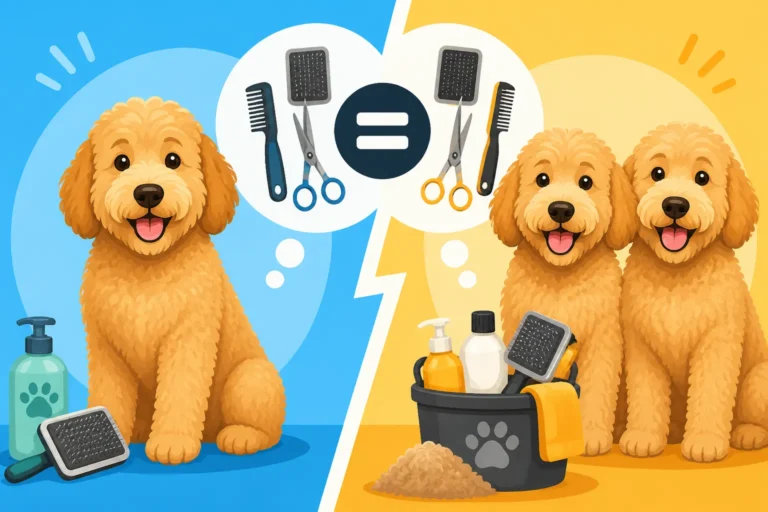
No matter what kind of coat your F2 Goldendoodle ends up with, one thing is certain: you'll need to commit to a consistent grooming routine. The unpredictability of the F2 coat means you might need to adapt your grooming tools and techniques more than you would with a more uniform F1 or F1b. It's all part of the Goldendoodle adventure!
Essential Grooming Tools for F2 Coats
Having the right tools on hand is half the battle when it comes to managing any Goldendoodle coat, but especially an F2's potentially varied texture. You might start with certain tools, only to find as their adult coat comes in that you need to adjust.
- Slicker Brush: This is your primary weapon against mats. Look for one with fine, bent wire bristles. You'll use it to line brush your Goldendoodle down to the skin, ensuring you get all the loose hair and prevent mats from forming at the base of the coat. For areas prone to matting, like behind the ears or in the armpits, a good quality slicker brush is indispensable.
- Metal Comb: A sturdy metal comb with both wide and fine teeth is crucial for checking your work after brushing. If the comb can't easily glide through the coat down to the skin, you've missed a mat. It’s also excellent for detangling smaller knots and for working on the facial hair.
- Detangling Spray: These sprays can be a lifesaver for working out tangles or small mats without causing discomfort to your dog. A good quality detangling spray can make the brushing process much smoother and more pleasant for both of you. Many pet supply stores, like Chewy, offer a wide selection of brushes, combs, and detangling sprays specifically designed for long-haired or curly breeds.
- Nail Clippers or Grinder: Don't forget nail care! Keeping your Goldendoodle's nails trimmed is vital for their comfort and joint health. If you're nervous about clipping, a grinder can be a gentler alternative.
- Ear Cleaner: Goldendoodles, especially those with Poodle heritage, can be prone to ear infections due to their floppy, furnished ears. Regular cleaning with a vet-approved solution is a must. Goldendoodle Ear Care Under All That Hair is a good resource to learn more.
Remember, even if your F2 ends up with a flatter, more Golden-like coat, these tools will still be useful for managing shedding and preventing tangles in the longer feathering. The key is consistency, starting from puppyhood.
Adapting Your Grooming Routine to the Coat Type
The type of coat your F2 Goldendoodle develops will dictate the specifics of your grooming routine. What works for a woolly coat won't be sufficient for a straight coat, and vice versa.
- Curly/Wool Coats: If your F2 takes after the Poodle side with a dense, curly coat, daily brushing is almost non-negotiable. These coats mat quickly and severely. You'll need to dedicate at least 15-30 minutes each day to line brushing, working in small sections down to the skin. Professional grooming every 4-6 weeks will also be essential to keep the coat trimmed to a manageable length and prevent painful matting. This will likely be your biggest expense and time commitment.
- Wavy Coats: The classic Goldendoodle wavy coat still requires significant attention, typically brushing 3-4 times a week. Focus on areas prone to matting, such as the armpits, behind the ears, and around the collar or harness. Professional grooming every 6-8 weeks is usually sufficient for these coats to maintain a healthy length and shape.
- Straight/Flat Coats: If your F2 has a straighter, more Golden Retriever-like coat, you might not be battling mats as much, but you will be dealing with shedding. Regular brushing 2-3 times a week will help remove loose hair and minimize shedding around your home. A de-shedding tool might be useful for these coats. Professional grooming can still be beneficial for tidying up feathering and maintaining overall coat health.
No matter the coat type, it’s crucial to start grooming training early. Get your Goldendoodle puppy accustomed to being handled, brushed, and having their paws and ears touched. This will make future grooming sessions, whether at home or with a professional, much less stressful for everyone. You can find excellent shampoos and conditioners for different coat types on Chewy, which can also help keep the coat healthy and manageable.
The Dreaded "Coat Change"
One of the biggest surprises for many Goldendoodle owners, especially with F2s, is the "coat change" that typically occurs between 8 to 12 months of age. During this period, your puppy's soft, easy-to-manage puppy coat starts to shed out, making way for the denser, adult coat. This transition is a matting nightmare if not managed properly.
The puppy coat literally "weaves" into the incoming adult coat, creating dense mats that can be incredibly painful if left untended. For an F2 Goldendoodle, where the adult coat type itself can be a surprise, this period requires even more vigilance. Daily, thorough line brushing is absolutely critical during these months, regardless of what you think their adult coat will be like. Many Goldendoodles end up needing to be shaved down during their coat change because their owners weren't prepared for the intensity of matting. Be prepared to step up your grooming game significantly during this stage, and consider booking an earlier professional groom to help navigate this tricky time. Find out more in The Goldendoodle Coat Change at Eight to Twelve Months.
Setting Expectations for an F2 Goldendoodle
Bringing any dog into your home requires setting realistic expectations, but with an F2 Goldendoodle, this is even more paramount, particularly concerning their physical traits and care needs. The promise of the perfect, non-shedding, fluffy companion can sometimes overshadow the genetic realities.
Embracing the Variety
The most important thing to remember about an F2 Goldendoodle is that you are truly getting a unique individual. While breeders can make educated guesses based on parent DNA testing, there are no guarantees, especially with F2s. You might get the classic wavy, furnished coat, a tightly curled Poodle-like coat, or a flatter, more Golden Retriever-like coat. You might also find variations in temperament and even size within the same litter, as the genetic lottery applies to more than just coats.
Embracing this variety means being prepared for any of the potential coat outcomes. If a low-shedding coat is your absolute top priority due to severe allergies, an F2 might not be the safest bet, as there's a 25% chance of an unfurnished, shedding coat. In such cases, an F1b Goldendoodle (F1 Goldendoodle bred back to a Poodle) offers much higher predictability for low shedding. However, if you are open to different coat types and are simply looking for a wonderful, intelligent companion, an F2 can be a fantastic choice. The beauty of the F2 generation is truly in its diversity.
The Importance of Health Testing and Breeder Transparency
Regardless of generation, always prioritize a breeder who is transparent about their dogs' health testing. With the unpredictability of the F2 generation, understanding the health history of both F1 parents is even more crucial. A responsible breeder will conduct comprehensive health screenings on their breeding dogs for conditions common to both Golden Retrievers and Poodles, such as hip and elbow dysplasia, eye conditions like Progressive Retinal Atrophy, and heart issues.
They should also be able to explain the genetic makeup of their F1 parents, including DNA coat testing results, which can help them predict the probability of certain coat types in the F2 litter. Ask to see the results of these tests, not just hear about them. A breeder who avoids sharing this information or downplays the genetic variability of F2 coats is a red flag. Ethical breeders prioritize health and temperament first and foremost, and will be upfront about the potential variations in their F2 litters. Resources like The DNA Panel a Goldendoodle Breeder Should Run can help you understand what tests to ask for.
Long-Term Commitment to Grooming
Finally, a major expectation to set is the lifelong commitment to grooming. Even the straightest F2 coat will require regular brushing, and a curly or wavy F2 coat demands significant time and financial investment. It's not a "wash and wear" kind of dog, especially with that adult coat coming in.
Think about the time commitment: daily or several times a week for brushing, plus professional grooms every 4-8 weeks. And the financial commitment: professional grooming can be a significant recurring expense over the lifetime of your dog. If you're considering grooming at home to save costs, you'll need to invest in quality tools and learn proper techniques. Many owners underestimate this aspect, which unfortunately can lead to neglected coats, painful matting, and even dogs being surrendered to rescue organizations because their owners couldn't keep up. Chewy offers a subscription service for grooming supplies, which can help ensure you never run out of the essentials. Be honest with yourself about whether you have the time and budget for consistent, thorough grooming, because your Goldendoodle's comfort and health depend on it.
Disclaimer
This article is for general informational purposes only and does not constitute professional advice. Laws, prices and regulations vary by location and change over time. Consult a qualified professional for guidance on your specific situation.