Guessing a Goldendoodle Adult Coat at Eight Weeks
Bringing home a Goldendoodle puppy is an incredibly exciting time, filled with dreams of fluffy snuggles and playful antics. But for many prospective owners, especially those with allergy concerns, there’s one big question that looms: what will this adorable eight-week-old fluffball’s adult coat actually look like? The honest truth is, guessing a Goldendoodle's adult coat at eight weeks is notoriously difficult, often leading to surprises down the road. This guide will walk you through why early predictions are so tricky, what signs to look for, and how to set realistic expectations for your puppy's evolving coat.
The Allure and the Reality of Goldendoodle Coats at Eight Weeks
You’ve fallen in love with a tiny Goldendoodle puppy, maybe a little apricot bundle or a creamy white fluff. They’re soft, cuddly, and just perfect. But that innocent puppy fluff is a master of disguise, rarely hinting at the mature coat that will emerge. Owners often feel a sense of both hope and anxiety, wondering if their low-shedding dream will turn into a shedding reality, or if that perfectly wavy puppy fur will become a dense, curly challenge.
Why the Puppy Coat is So Misleading
It’s easy to get swept up in the cuteness of an eight-week-old Goldendoodle. Their coats are almost uniformly soft, fine, and relatively easy to manage. They don't shed much at this stage because their hair follicles are still developing, and they haven't yet gone through the hormonal changes that trigger the "blowing" of the puppy coat. This initial lack of shedding can give families false hope, especially if they're looking for a genuinely "hypoallergenic" dog.
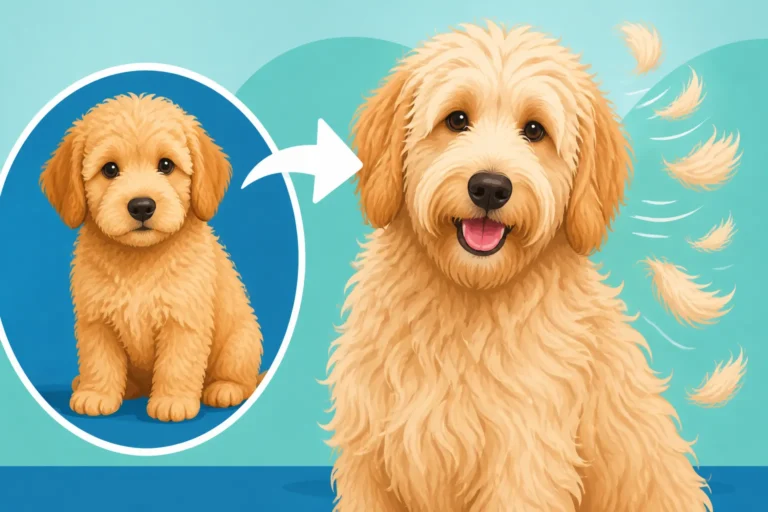
Imagine bringing home a sweet, soft puppy, believing their easy-care coat will last forever. Then, around eight to twelve months, a dramatic transformation begins. The fine puppy hair starts to shed out, making way for the coarser, denser, and often much curlier adult coat. This period, affectionately (or sometimes exasperatedly) known as the "coat change," can be a shock for unsuspecting owners. That gentle fluff transforms into a coat that might be prone to matting or have a different texture entirely. This is precisely why relying on the eight-week-old appearance can be a huge misstep. As we discuss in Why a Goldendoodle Puppy Coat Predicts Nothing, the early days are simply not a crystal ball.
The Furnishings Gene and Early Clues
While the overall texture and curl of an adult Goldendoodle coat are hard to predict early on, there’s one critical indicator that you can often spot at eight weeks: the presence of "furnishings." Furnishings refer to the longer hair on the face, specifically the beard, mustache, and eyebrows. This trait comes from the Poodle side of the family and is what gives a Goldendoodle its characteristic "doodle" look. Without furnishings, a Goldendoodle will have a smoother face, much more akin to a Golden Retriever, and will almost certainly shed.
At eight weeks, you might need to look closely, but if a puppy has furnishings, you'll usually see slightly longer hair around the muzzle and over the eyes that stands out from the shorter coat on the rest of the head. It might not be a full beard yet, but it will be noticeable. Puppies without this gene (often called "unfurnished" or "flat-faced") will have a sleek, Golden Retriever-like face right from the start. This is one of the most reliable visual clues for determining potential shedding characteristics, as furnished dogs are typically lower shedding. For more detail, check out What Furnishings Give a Goldendoodle Its Beard.
Deciphering Coat Types and Their Development
One of the biggest mysteries for new Goldendoodle owners is what kind of coat their puppy will ultimately develop. The term "Goldendoodle coat" isn't a single entity; it encompasses a spectrum from flat to very curly, each with its own grooming demands and shedding potential.
Understanding the Three Main Goldendoodle Coat Types
Goldendoodles generally fall into three broad coat categories as adults, though there's a lot of variation within each:
- Straight/Flat Coat: This coat type often looks very similar to a Golden Retriever's coat – long, flowing, and relatively straight. Dogs with this coat type are usually unfurnished (no beard) and will shed, often moderately. An eight-week-old puppy with a flat coat might simply look like a Golden Retriever puppy, with smooth, soft fur.
- Wavy/Fleece Coat: This is the most common and often desired Goldendoodle coat. It’s soft, flowing, and has noticeable waves or loose curls. Dogs with this coat type usually have furnishings and are typically low-shedding. An eight-week-old puppy destined for a wavy coat might show subtle waves behind the ears or on the back, but much of the body might still look quite fluffy and straight. This type of coat requires regular brushing to prevent matting, as it can be deceivingly dense.
- Curly/Wool Coat: This coat strongly resembles a Poodle's coat, with tight, dense curls. It's the least likely to shed and is often considered the most "hypoallergenic" option. Furnishings are always present with a curly coat. At eight weeks, a puppy with a wool coat might already have very tight curls, or their puppy coat might just feel very dense and springy, rather than fine and soft. This coat type requires the most intensive grooming to prevent severe matting.
It's crucial to remember that a fluffy, straight-looking puppy at eight weeks can easily mature into a dog with a wavy or even curly fleece coat. The puppy coat simply isn't a reliable indicator of the adult texture. Why a Fluffy Goldendoodle Puppy May Shed as an Adult delves into this unpredictability.
The Role of DNA Testing in Coat Prediction
Given the uncertainties of visual prediction, many breeders and prospective owners turn to DNA testing. Genetic tests can identify the genes responsible for furnishings (F/f), curl (Cu/cu), and shedding (SD locus). This provides a much more accurate picture of a puppy’s potential adult coat than simply looking at them at eight weeks old.
For example, a breeder can test the parent dogs to understand what coat traits their offspring are likely to inherit. If both parents carry genes for furnishings, the puppies are very likely to be furnished. Similarly, if a puppy inherits two copies of the curl gene, it's highly probable it will have a curly coat. While breeders typically test parents, sometimes individual puppies are tested, giving you a clear answer on what genetic blueprint they carry for their coat. This information can be invaluable for allergy sufferers or those with specific grooming preferences. However, it's worth noting that while genetics tell us what genes are present, the expression of those genes can still lead to slight variations in texture or density. You can learn more about this in DNA Coat Testing on a Goldendoodle. While a DNA test can be a powerful tool, it's not always available for every puppy, especially from less scrupulous breeders.
The Great Goldendoodle Coat Change (and What it Means for an 8-Week Puppy)
If there's one phase every Goldendoodle owner must prepare for, it's the notorious "coat change." This transition period can profoundly impact grooming routines and often surprises those who thought their fluffy puppy coat would last forever.
What to Expect During the "Ugly Bettys" Phase
Around eight to twelve months of age, Goldendoodles undergo a significant transformation where their soft, fine puppy coat begins to shed out, making way for the denser, often coarser adult coat. This period is affectionately known by some as the "ugly bettys" phase, not because the puppy looks ugly, but because their coat becomes incredibly prone to matting. The shedding puppy hair gets tangled with the emerging adult hair, creating a perfect storm for knots and mats to form deep within the coat, right down to the skin.
During this time, daily brushing is not just recommended, it's essential. Without diligent line brushing, the mats can become so severe that they pull at the skin, causing discomfort and potentially skin infections. Many Goldendoodles end up needing to be shaved down completely during this period because their coats become too matted to brush out. This can be heartbreaking for owners who envisioned a long, flowing coat. It’s a direct consequence of the genetic blend and the density that comes with it. Knowing this from the start helps you appreciate that the easy-care fluff of an eight-week-old puppy is fleeting. For a deeper dive into this challenging period, check out When a Goldendoodle Starts Blowing Its Puppy Coat and Why a Goldendoodle Suddenly Mats at Nine Months. Preparing for this phase, even when your pup is just eight weeks old, is key to preventing future grooming woes.
Managing Expectations for Shedding and Allergies
One of the primary reasons people choose a Goldendoodle is the hope of a low-shedding, "hypoallergenic" dog. While many Goldendoodles do shed less than a purebred Golden Retriever, it’s critical to manage expectations right from the start. An eight-week-old puppy's minimal shedding offers no guarantee for their adult coat. Even a dog with a beautifully curly, furnished coat can shed some, and no dog is truly 100% hypoallergenic. Allergies are caused by dander (dead skin cells) and saliva proteins, not just hair itself. Even if a Goldendoodle sheds minimally, they still produce dander and saliva.
It's also important to understand that the curl of the coat isn't directly correlated with shedding as many assume. Why a Goldendoodle Curl Gene Is Not a Shedding Gene explains this in more detail. The genetics for curl and shedding are separate. A wavy or curly coat can trap loose hair, making it appear that the dog sheds less, but the hair is still being released from the follicles. For families with severe allergies, simply observing an eight-week-old puppy's coat is insufficient. If possible, spend time with the puppy's parents or an older Goldendoodle from the same lines. See how you react. Even then, be prepared for a degree of individual variation. Whether a Low-Shedding Goldendoodle Helps Allergies offers more insight into this complex topic. Responsible breeders will be transparent about the coat types and potential for shedding in their lines.
Practical Tips for Goldendoodle Puppy Buyers
Choosing a Goldendoodle puppy involves more than just falling for the cutest face. If coat type is important to you – whether for allergy reasons or grooming preferences – there are specific steps you can take, even when evaluating an eight-week-old puppy.
What to Ask Your Breeder About Coats
A reputable Goldendoodle breeder will be a wealth of information about their puppies' potential adult coats. Don't be shy about asking direct questions. Here’s what you should inquire about:
- Parent Coat Types and DNA Testing: Ask to see the sire and dam (the puppy's parents). What are their coat types? Are they straight, wavy, or curly? More importantly, ask if they've had DNA testing for coat traits like furnishings, curl, and shedding. A breeder who has this information can give you a much more educated guess about your puppy's future coat. For example, if both parents are furnished (F/F), then all puppies will also be furnished. If one parent is F/f and the other is F/f, there's a chance for unfurnished puppies in the litter.
- Previous Litters: If the breeder has had previous litters from the same parent pair, ask to see photos of those grown-up puppies. This is often the best real-world indicator of what to expect. Seeing how previous puppies developed can offer tangible proof of the breeder's predictions.
- Breeder's Predictions: While they can't be 100% accurate, an experienced breeder can often give you their best guess based on lineage and their understanding of Goldendoodle genetics. They might even be able to point out subtle signs they look for at eight weeks.
- Grooming Requirements: Ask about the typical grooming needs for their dogs. High-quality breeders understand the significant commitment involved in Goldendoodle grooming and can advise you on what to expect for different coat types. This insight is invaluable. This information is key when Choosing a Goldendoodle Breeder Worth Buying From. Also, understanding Goldendoodle Generations From F1 to Multigen can give you an idea of coat predictability, as some generations are more consistent than others.
Observing the 8-Week Puppy with a Critical Eye
While we’ve stressed that an eight-week-old puppy coat is misleading, there are still a few things you can look for, alongside the breeder's information, to help you form your best guess.
- Feel the Texture: Gently run your hand through the puppy's coat. Is it very fine and silky, or does it already have a slightly thicker, springier feel? Puppies with a silkier coat might lean towards wavy or straighter, while a springier feel could suggest more curl.
- Look for Waves/Curles: Check behind the ears, on the back, and around the tail. Does the hair show any natural bend or wave, even a subtle one? Sometimes, a very faint wave can be a precursor to a curlier adult coat.
- Inspect the Furnishings: As mentioned, look for the beard, mustache, and eyebrows. Even if they are just subtle tufts of longer hair around the muzzle and eyes, their presence is a strong indicator of a furnished, typically lower-shedding adult coat.
- Consider the Parents' Coats: If you can see both parents, take note of their coats. Are they very curly, wavy, or straight? This gives you the genetic baseline for what your puppy could inherit. Remember, an eight-week-old puppy might look nothing like its curly Poodle parent, but those genes are still there, waiting to express themselves.
And remember, even with all these observations, it's still largely an educated guess. The Goldendoodle coat change is real, and it will happen! Being prepared means having the right tools on hand, like a slicker brush and a good steel comb, perhaps found on sites like Amazon or Chewy. Regular brushing, which we cover in Daily Brushing Through a Goldendoodle Coat Change and Line Brushing a Goldendoodle Section by Section, will become your best friend.
To give you a slightly better visual reference, here's a simple table summarizing what you might observe:
| 8-Week Puppy Observation | Potential Adult Coat Tendency (Still a Guess!) | Grooming Implications | Shedding Likelihood |
|---|---|---|---|
| No visible furnishings (smooth face, short muzzle hair) | Likely Straight/Flat Coat | Moderate brushing needed; more shedding | High |
| Subtle furnishings (slight longer muzzle/brow hair) | Likely Wavy/Fleece Coat | Regular brushing (2-3x/week); low shedding | Low |
| Clear furnishings (noticeable beard/brows) | Likely Curly/Wool or very Wavy Fleece Coat | Daily brushing & professional grooming; very low shedding | Very Low |
| Very soft, silky coat | More likely to be Wavy or Straight | Varies by final texture | Varies |
| Slightly coarse, springy coat | More likely to be Curly | Varies by final texture | Varies |
| Visible waves/curls (especially behind ears) | Stronger indicator of Wavy or Curly Coat | More demanding grooming | Low |
When it comes to nutrition, a healthy coat also benefits from a good diet. Brands like Ollie or high-quality kibbles available on Chewy can provide the omega fatty acids and other nutrients essential for skin and coat health, which will be important once that adult coat starts to come in. Don't forget the right tools either; a quality slicker brush and metal comb from Amazon are indispensable for managing any Goldendoodle coat, as highlighted in The Slicker Brush and Comb a Goldendoodle Needs.
Ultimately, embracing the journey of your Goldendoodle's coat development is part of the fun of owning this wonderful crossbreed. While the eight-week puppy coat is adorable, the true beauty and character of their adult coat will unfold over time, offering a unique reflection of their Poodle and Golden Retriever heritage.
Disclaimer
This article is for general informational purposes only and does not constitute professional advice. Laws, prices and regulations vary by location and change over time. Consult a qualified professional for guidance on your specific situation.