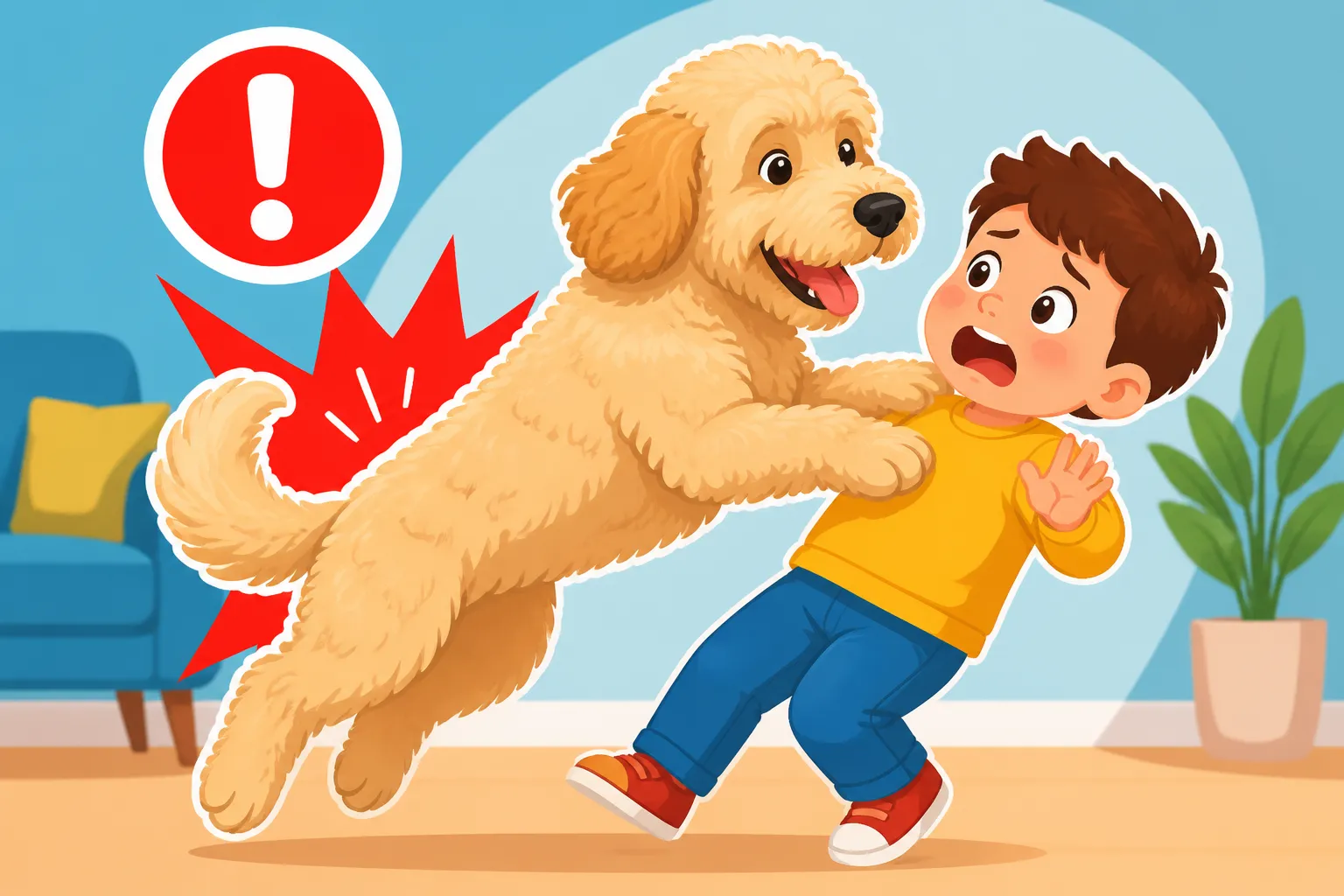
A Goldendoodle That Jumps on Small Children
Oh, that Goldendoodle enthusiasm! It's one of their most endearing traits, isn't it? They just love people, and often, that love comes exploding out in a joyous, bouncy greeting. But when that boundless energy is directed at small children, what starts as charming puppy play can quickly become overwhelming, intimidating, or even dangerous. You're not alone in facing this — many Goldendoodle parents grapple with how to manage a dog that simply cannot contain its excitement around the littlest members of the family or neighborhood. This guide is here to walk you through understanding why your beloved Goldendoodle launches itself at kids and, more importantly, how to teach them a calmer, safer way to say hello.
Understanding Why Your Goldendoodle Jumps on Kids
It's easy to feel frustrated, or even a little guilty, when your Goldendoodle is knocking over a toddler with an overzealous greeting. But understanding the root cause of this behavior is the first step toward changing it. It's rarely malicious; more often, it's a cocktail of natural instincts, lack of self-control, and sometimes, unintentional human reinforcement.
The Enthusiastic Retriever Instinct
Think about what Goldendoodles are made of: Golden Retrievers and Poodles. The Golden Retriever side is famously known for its biddability, its love of people, and its strong desire to "retrieve." This isn't just about fetching a ball; it's about engaging with and bringing things to you, including themselves, often with great vigor. When a Goldendoodle sees a small child, especially one who is giggling, running, or making high-pitched sounds, it can trigger an intense urge to engage. Children, with their unpredictable movements and enthusiastic squeals, often act like giant, exciting toys to a dog wired for interaction. The dog isn't trying to harm the child; it's simply trying to participate in the perceived fun, or get closer to what it finds so interesting. This strong drive to be part of the action, coupled with an inability to control their physical impulses, makes jumping a default greeting behavior. For more on their inherited traits, consider What a Goldendoodle Inherits From Each Parent Breed.
Lack of Impulse Control and Over-Arousal
Goldendoodles, particularly in their puppy and adolescent phases, can struggle significantly with impulse control. They are intelligent and eager, but that often means they get very excited, very quickly. This state of intense excitement is what we call "over-arousal." When a Goldendoodle is over-aroused, their ability to think clearly and respond to cues goes right out the window. Imagine a child on a sugar rush – they're not intentionally misbehaving, but their body is just buzzing with energy they can't quite manage. Similarly, a Goldendoodle seeing a child might instantly go from calm to 100 mph, leading to frantic jumping, nipping, or "zoomies." The presence of small children, who themselves are often high-energy and less predictable than adults, can easily push a Goldendoodle into this over-aroused state. They might start panting heavily, their eyes might dilate, and they just can't seem to settle their bodies. This isn't aggression; it's simply a lack of the internal brakes needed to manage their big feelings in a polite way. Understanding Frantic Greeting Behavior in a Goldendoodle can shed more light on this.
Unintentional Reinforcement from Humans
Here's a tough pill to swallow: sometimes, we inadvertently teach our Goldendoodle that jumping is an effective way to get attention. Think about it. When your dog jumps on a child, what's the immediate reaction? Often, it's a flurry of activity: someone might yell "no!" or "down!", push the dog away, or quickly pick up the child. While these reactions are completely understandable, from your Goldendoodle's perspective, they just got a whole lot of attention – even if it was negative attention. To a dog that craves interaction, any attention can be a reward. If jumping consistently leads to people talking to them, touching them (even pushing), or looking at them, the dog learns, "Aha! Jumping works!" It's a common mistake, and it highlights why consistency in our own reactions is so crucial. We need to teach them that the only way to get the attention they desire is to keep all four paws on the floor. This applies to jumping on adults too, as you can read about in A Goldendoodle That Jumps on Every Guest.
Immediate Strategies to Prevent Jumping Incidents
When you have a Goldendoodle that jumps and children in the picture, safety is paramount. These immediate strategies focus on management and teaching alternatives to keep everyone safe while you work on long-term training.
Managing the Environment for Safety
Before you can even begin to train, you need to manage your Goldendoodle's environment to prevent jumping from happening in the first place. This is your first line of defense, especially when children are present. Think of it as putting up guard rails before teaching someone to drive. Use baby gates to create physical barriers between your Goldendoodle and children. If a child is visiting, keep your dog on a leash, even indoors, so you have immediate control. A simple house line (a lightweight leash that drags on the floor) can be incredibly useful for gently guiding your dog away from unwanted behaviors without harsh corrections.
Consider using a crate or a designated "place" mat, like a dog bed, where your Goldendoodle can settle calmly away from the action. Teach them that this is their safe, quiet zone. When children are around, you might put your Goldendoodle in their crate with a chew toy, or tether them to a piece of furniture (under supervision, of course) a safe distance from the children. The goal is to set up situations where jumping cannot occur, or where you can easily intervene before it becomes an issue. This reduces the opportunities for your dog to practice the unwanted behavior and for anyone to get hurt. Many great gates and tethers can be found on Amazon, making it easy to create these safe zones.
Teaching a "Four Paws on the Floor" Alternative
Instead of just telling your Goldendoodle what not to do, you need to teach them what to do instead. The most effective alternative to jumping is having "four paws on the floor." This means that whenever your Goldendoodle wants to greet someone or seek attention, all four of their feet must remain on the ground.
Here's how to teach it:
- Practice in Calm Settings: Start with just yourself, in a quiet environment without children.
- Ignore the Jump: When your Goldendoodle tries to jump, immediately turn your back, cross your arms, and completely ignore them. No eye contact, no talking, no pushing. Become a "boring tree."
- Reward the Calm: The instant your Goldendoodle's four paws hit the floor, turn back around, praise them calmly ("Yes! Good four paws!"), and give them a small, high-value treat.
- Consistency is Key: Every single time. Every family member. Every guest. If they jump, attention (and treats) vanish. If they keep four paws on the floor, they get everything they want.
- Add a Cue: Once your Goldendoodle reliably offers "four paws on the floor," you can add a verbal cue like "off" or "four on the floor" right before they settle, then reward.
This method teaches your Goldendoodle that calm behavior earns rewards, while jumping makes the desired interaction disappear. For more detailed steps, check out Four Paws on the Floor for a Goldendoodle.
Desensitizing to Children's Energy
The bustling, unpredictable energy of children can be a lot for a Goldendoodle. Desensitization is about gradually exposing your dog to children in a controlled, positive way, helping them learn to remain calm.
- Start from a Distance: If you know children will be present, ensure your Goldendoodle is on a leash, perhaps even behind a gate or across the room. Reward them heavily with treats for simply looking at the children without reacting, or for lying down calmly. The goal is for them to associate children's presence with good things (treats), not with the need to jump.
- Teach "Be a Tree": This is a critical lesson for children. Teach them that if a dog is too excited or jumpy, they should stand still like a tree, cross their arms, and look at the sky. This makes them less interesting to the dog and removes the "reward" of movement or engagement. Only when the dog calms down should the child (under adult supervision) gently offer a treat at nose level.
- Controlled Greetings: If your Goldendoodle can maintain "four paws on the floor" with adults, try short, supervised greetings with calm, dog-savvy children. Keep your dog on a leash. Have the child stand still and offer a treat low to the ground. If the dog jumps, the child immediately "becomes a tree" and the interaction ends. The key is short, positive interactions where the dog succeeds.
Long-Term Training to Build Calmness and Control
Immediate management is crucial, but for lasting change, you need to invest in long-term training that builds your Goldendoodle's overall impulse control and ability to be calm in exciting situations.
Building Foundational Impulse Control
Jumping on children is often a symptom of broader impulse control issues. By working on general impulse control, you're teaching your Goldendoodle to think before acting, which will benefit them in all areas of life, including greetings.
- "Sit for Everything" Protocol: This means your Goldendoodle learns to sit and wait patiently for anything they want: their food bowl, a toy, going outside, getting a pat. Make them earn everything with a calm sit. This reinforces the idea that polite, calm behavior gets them what they desire.
- "Place" Training: Teach your Goldendoodle to go to a designated "place" (a mat, bed, or crate) and stay there until released. This is an invaluable tool when you have visitors, especially children, allowing your dog to relax in their own space without being over-stimulated. Reward them heavily for staying on their place, gradually increasing the duration and distractions.
- "Leave It": This cue is incredibly important for safety and self-control. Teach your Goldendoodle to ignore tempting items on the ground or even hands reaching out to them if you haven't given the "okay" for interaction. Practice with low-value items first, then gradually increase the distraction. Mastery of "leave it" gives you a powerful tool to redirect your Goldendoodle's attention away from a child if they are getting too excited. You can find excellent resources for this kind of training, sometimes in the form of online courses like those offered by BAXTER & Bella, which provide step-by-step guidance. For more ideas, explore Goldendoodle Impulse Control Exercises and Teaching Leave It to a Goldendoodle.
Providing Appropriate Mental and Physical Exercise
A tired Goldendoodle is often a well-behaved Goldendoodle. These dogs are intelligent and athletic, and if their needs aren't met, that pent-up energy can manifest as undesirable behaviors, including jumping.
- Physical Exercise: Ensure your Goldendoodle gets enough physical activity for their size and age. This might mean long walks, games of fetch, or trips to a secure dog park (if they are well-socialized). A standard Goldendoodle might need significantly more exercise than a mini Goldendoodle. Remember, a quick potty break isn't exercise!
- Mental Enrichment: Don't underestimate the power of mental exercise. Goldendoodles thrive on having their brains challenged. Incorporate puzzle feeders, scent work (hiding treats for them to find), or trick training into their daily routine. Ten minutes of focused mental work can often be as tiring as a 30-minute walk. Using a snuffle mat or a KONG filled with frozen peanut butter can keep them engaged and calm when children are present. You can find many interactive toys and puzzle feeders on Amazon that can help with this. Getting their brains engaged can truly make a difference, as highlighted in The Thinking Work That Actually Tires a Goldendoodle.
Involving Children Safely in Training
Once your Goldendoodle has made progress with impulse control and "four paws on the floor," you can start to involve older, dog-savvy children in the training process, always with close adult supervision. This helps build a positive association between the dog and the child, making the child part of the solution rather than just a trigger for jumping.
- Supervised Treat Delivery: Teach children how to calmly and safely offer treats to the Goldendoodle when the dog is exhibiting desired behavior (e.g., sitting or lying down with four paws on the floor). They should extend their hand flat, palm up, with the treat, rather than reaching over the dog's head.
- Gentle Play: Guide children in appropriate ways to play with your Goldendoodle, such as rolling a ball rather than roughhousing, which can escalate excitement. Teach them to avoid teasing or sudden, loud movements.
- Respecting Boundaries: Crucially, teach children to respect the dog's space, especially when the dog is on its "place" or resting. This mutual respect builds trust and reduces the likelihood of the dog feeling overwhelmed or resorting to undesirable behaviors. The goal is for children to become positive figures in the Goldendoodle's world, associated with calm interactions and rewards. For safety, it’s always wise to remember that Goldendoodle Puppy Biting and Mouthing can happen if boundaries aren't clear, even playfully.
When to Seek Professional Help and Considerations
Sometimes, despite your best efforts, the jumping behavior persists, or you might feel overwhelmed and unsure how to proceed. This is a perfectly normal and common experience, and it's a sign that professional guidance can make a world of difference.
Recognizing When You Need a Trainer
It can be difficult to admit that you need help, but recognizing the signs is crucial for both your Goldendoodle's well-being and the safety of children. Here are some indicators that it might be time to call in a professional:
- Persistent Jumping: If your Goldendoodle continues to jump on children despite consistent application of the strategies above.
- Escalation of Behavior: If the jumping is accompanied by other concerning behaviors, such as nipping, excessive mouthing, or growling (even if playful), especially if directed at children.
- Fear or Anxiety in Children: If children are becoming genuinely fearful or avoiding your Goldendoodle because of the jumping.
- Feeling Overwhelmed: If you simply feel out of your depth, frustrated, or like you're not making progress. A good trainer can provide tailored strategies and hands-on support.
- History of Trauma: If your Goldendoodle has a rescue history or any known past trauma, a professional can help you navigate potentially complex behavioral issues.
Don't wait for an incident to happen. Proactive intervention is always better. For specific advice on choosing a specialist, consider Finding a Trainer Who Works With Goldendoodles.
Choosing the Right Professional
Selecting the right dog trainer is paramount, especially when children's safety is a concern. Not all trainers use the same methods, and it's essential to find someone who aligns with humane, effective practices.
- Positive Reinforcement Focus: Always look for a trainer who uses positive reinforcement methods. These trainers reward desired behaviors (like four paws on the floor) rather than punishing unwanted ones. Punitive methods, like alpha rolling, leash jerks, or shock collars, can damage your relationship with your Goldendoodle, suppress behavior without addressing the underlying cause, and potentially escalate fear or aggression. Positive Reinforcement and Why It Suits a Goldendoodle explains why this approach is best for your Goldendoodle's intelligent and sensitive nature.
- Certifications and Experience: Look for trainers with reputable certifications (e.g., CPDT-KA, KPA-CT) and specific experience working with Goldendoodles or large, excitable breeds, especially around children.
- Observation, Not Just Advice: A good trainer will observe your Goldendoodle in their home environment (or a similar setting) to assess the behavior firsthand. They won't just offer generic advice.
- Family Inclusion: They should be willing to work with your entire family, including older children, to ensure consistency in training methods.
- Interview Process: Don't hesitate to interview potential trainers. Ask about their methods, their philosophy, and how they would approach your specific situation. A professional will be happy to discuss these things with you.
Consistency Across All Family Members
This cannot be stressed enough: consistency is the cornerstone of successful behavior modification. Your Goldendoodle needs to understand that the rules are the same, no matter who they are interacting with. If one family member allows jumping, even occasionally, it completely undermines the training efforts of everyone else.
- Unified Front: All adults and older children in the household must agree on the training plan and implement it consistently. This means everyone turns away when the dog jumps, and everyone rewards calm, four-paws-on-the-floor greetings.
- Educate Guests: Inform frequent visitors, especially those with children, about your Goldendoodle's training plan. Ask them to follow the "four paws on the floor" rule and to practice "being a tree" if your dog gets over-excited.
- Regular Practice: Training isn't a one-and-done event. It requires regular, short practice sessions throughout the day and consistent reinforcement during real-life interactions. The more your Goldendoodle practices staying calm around children, the more it will become their default behavior. It takes time and patience, but the reward of a well-mannered, safe Goldendoodle around children is absolutely worth the effort.
| Behavior | Do | Don't |
|---|---|---|
| Jumping | Turn your back, cross arms, ignore immediately. | Yell, push the dog, make eye contact, or give any attention. |
| Calm Greetings | Praise softly, offer a treat low to the ground. | Allow jumping, even if it's "just this once." |
| Child Interaction | Supervise closely, teach children to "be a tree." | Leave dog and small children unsupervised. |
| Training | Use positive reinforcement, reward desired behaviors. | Use punishment, harsh corrections, or physical intimidation. |
| Energy Management | Provide adequate physical and mental exercise. | Assume a quick potty break is enough to burn off energy. |
| Consistency | Ensure all family members and regular guests follow the rules. | Send mixed signals or allow exceptions to the training plan. |
Disclaimer
This article is for general informational purposes only and does not constitute professional advice. Laws, prices and regulations vary by location and change over time. Consult a qualified professional for guidance on your specific situation.