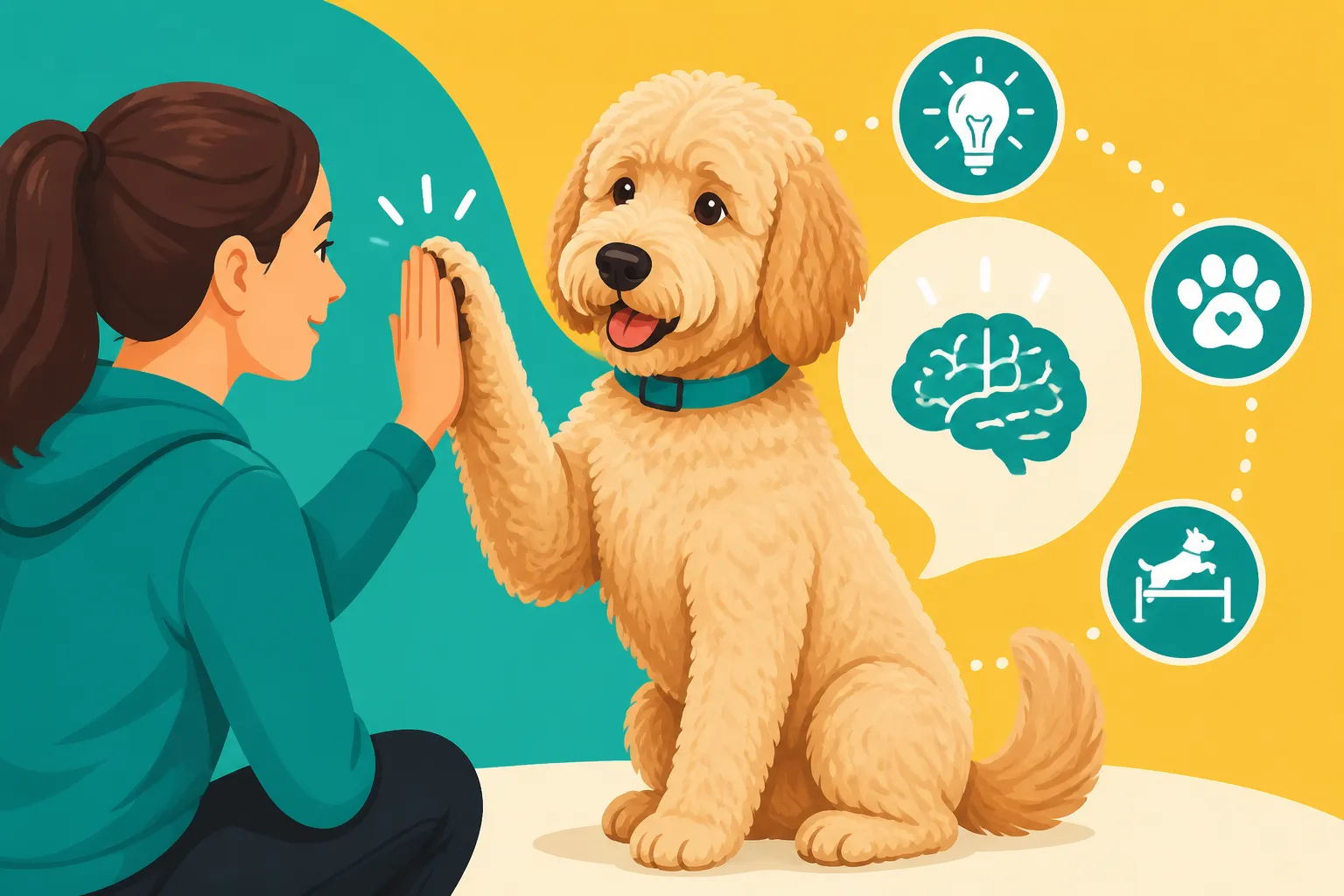
Trick Training as Goldendoodle Mental Work
Many Goldendoodle owners find themselves with a dog that is endlessly energetic, but not just physically. You might be hitting the park twice a day, going for long walks, and still find your beloved Dood pacing, sighing, or worse, getting into mischief. It's frustrating when you feel like you're doing everything right, but your Goldendoodle still seems bored. The truth is, these smart, eager-to-please dogs need more than just physical exertion; they need to use their brains. This guide is all about harnessing that incredible Goldendoodle intelligence through trick training, turning that boundless energy into focused, enriching mental work that truly tires them out and builds a stronger bond between you.
Why Mental Work is Crucial for Goldendoodles
It's a common misconception that a tired dog is always a good dog, meaning a physically tired dog. While Goldendoodles certainly need their zoomies and long walks, we often overlook the vast intelligence bubbling beneath that adorable, fluffy exterior. These aren't just pretty faces; they're thinkers, problem-solvers, and companions who thrive on engagement beyond just chasing a ball.
The Goldendoodle Brain: A Demand for Engagement
Goldendoodles inherit their intelligence from both sides of their family tree. From the Standard Poodle, they get a reputation for being exceptionally smart, often ranking among the most intelligent dog breeds. Poodles are known for their problem-solving abilities, quick learning, and capacity for complex training. Then, from the Golden Retriever, they inherit a strong desire to please, coupled with excellent memory and a drive to work alongside their human companions. This combination creates a Goldendoodle brain that isn't just capable; it's hungry for mental stimulation.
Ignoring this mental need is akin to giving a highly intelligent child endless playground time but no books, puzzles, or creative outlets. They might get physically tired, but their minds will still be buzzing, potentially leading to boredom-driven behaviors like excessive barking, destructive chewing, or even an inability to settle down. You might notice your Goldendoodle staring intently at you, bringing you toys repeatedly, or becoming a bit mischievous if their brain isn't sufficiently engaged. They're trying to tell you, in their own way, "I'm bored! Give me a job!"
Providing opportunities for your Goldendoodle to think, learn, and problem-solve is just as vital as their daily physical exercise. Trick training offers a structured, positive, and incredibly fun way to fulfill this innate need, providing an enriching activity that benefits both of you. It taps into their natural inclination to learn and interact, transforming that boundless energy into focused mental effort. You'll be amazed at how quickly they pick up new concepts when their intelligent minds are genuinely put to work. You can explore more about their innate abilities in Why a Goldendoodle Picks Up Cues So Quickly and What a Goldendoodle Inherits From the Poodle Brain.
When Physical Exercise Isn't Enough
While Goldendoodles absolutely need regular physical exercise—and often a lot of it, especially in their younger years—it's rarely the only solution for a well-behaved and content dog. A Goldendoodle who runs five miles a day might still be a menace indoors if their mind isn't challenged. They might be physically exhausted but still mentally alert and looking for something to do. This is particularly true for breeds with a strong working heritage, like the Golden Retriever and Poodle, where their ancestors were bred to think and solve problems, whether retrieving game or performing in circuses. This intrinsic drive means they need The Thinking Work That Actually Tires a Goldendoodle.
Imagine a rainy day, a snowstorm, or when you're recovering from an injury, and those long walks or trips to the dog park just aren't possible. This is when the lack of mental exercise really hits home. A bored Goldendoodle confined indoors can quickly become destructive, tearing up cushions, chewing on furniture, or incessantly nudging you for attention. These aren't signs of a "bad" dog; they're often cries for engagement. Trick training provides an excellent indoor alternative, allowing you to burn off mental energy even when physical activity is limited. A 15-minute trick training session can be as tiring, if not more so, than a 30-minute walk around the block, because it forces their brain to work hard.
Moreover, relying solely on physical exercise can sometimes exacerbate certain issues, especially if your Goldendoodle is prone to overstimulation. Continuously pushing for more and more physical activity without balance can lead to an over-aroused dog that struggles to settle down, even after intense play. Mental work, like trick training, helps teach focus and Goldendoodle Impulse Control Exercises, channeling that energy into something productive. It's about quality over quantity; providing meaningful mental engagement allows your Goldendoodle to feel fulfilled and content, which is a much healthier state than simply being physically exhausted. It's about finding that perfect balance between physical exertion and cognitive challenges, leading to a truly balanced and happy dog.
Getting Started with Trick Training: The Basics
Embarking on the trick training journey with your Goldendoodle is a rewarding experience, but like any new endeavor, it helps to start with a solid foundation. You don't need to be a professional trainer, just a patient and enthusiastic owner ready to have some fun with your furry friend.
Setting Up for Success: Tools and Environment
Starting your trick training journey doesn't require a lot of fancy equipment, which is great news for your budget! The most important tools are high-value treats and a clicker, if you choose to use one. High-value treats are those irresistible snacks your Goldendoodle absolutely adores – small, soft, smelly, and easily swallowed, so they don't take forever to chew. Think tiny pieces of cooked chicken, cheese, or specialized training treats. You can find excellent options on Amazon or at your local pet store, specifically looking for Training Treats Sized for a Mini Goldendoodle if you have a smaller Dood. Keep training sessions short and sweet, usually 5-10 minutes, especially when you're first starting out, to keep your dog engaged and prevent them from getting overwhelmed or bored. Remember, consistency over duration is key.
The environment you choose for training can make a huge difference in your Goldendoodle's ability to focus. Begin in a quiet, distraction-free space, like your living room or kitchen, away from other pets, people, or tempting toys. As your Goldendoodle gets better at a trick, you can gradually introduce more distractions, but starting simple sets them up for success. Make sure you're in a good mood and ready to be patient and positive. Dogs pick up on our emotions, and a frustrated owner can quickly lead to a frustrated dog. Remember that these sessions are meant to be fun for both of you, strengthening your bond rather than creating stress.
Having a clear plan for what you want to teach will also help. Don't try to teach five tricks in one session. Pick one new trick, or one that your dog is still mastering, and focus on that. Break down complex tricks into tiny, achievable steps. For example, teaching "play dead" might involve first teaching "down," then "roll over," then adding the cue for "play dead" when they're in the right position. Celebrating every small success with enthusiastic praise and treats is crucial for keeping your Goldendoodle motivated. They really do want to please you, and positive feedback reinforces that desire.
Positive Reinforcement: The Goldendoodle Way
Goldendoodles absolutely thrive on positive reinforcement. They are incredibly biddable dogs, inheriting that eagerness to please from their Golden Retriever side, and the intelligent responsiveness from their Poodle side. This means that harsh corrections or negative training methods are not only unnecessary but can actually be detrimental to their confidence and your relationship. Instead, focus on rewarding the behaviors you want to see. When your Goldendoodle offers the desired action, immediately mark it with a verbal "Yes!" or a clicker, followed by a treat and praise. This clear communication tells them exactly what they did right, making them more likely to repeat it. You can learn more about this approach in Positive Reinforcement and Why It Suits a Goldendoodle.
The beauty of positive reinforcement is that it makes training a joyful experience for your Goldendoodle. They associate learning with good things – tasty treats, your happy voice, and satisfying your desire to interact. This builds immense trust and strengthens the bond between you. You'll see their eyes light up, their tail wagging, and an almost palpable excitement when you pull out the training treats, because they know a fun brain game is about to begin. This intrinsic motivation is far more powerful and sustainable than any fear of punishment.
Consistency in your positive reinforcement is key. Everyone in the household should use the same cues and reward system. If one person allows your Goldendoodle to jump on them during greetings while another tries to prevent it, your dog will become confused. Make sure your rewards are varied to keep things interesting. Sometimes it's a treat, sometimes it's a quick game of tug, or a favorite toy. The goal is to make learning the most rewarding activity they can do. Online resources, like those offered by BAXTER & Bella, often emphasize these positive, family-friendly training methods, providing structured programs that work wonderfully with a Goldendoodle's temperament. Remember that short, frequent Goldendoodle Training Sessions and How Long to Run Them are much more effective than long, drawn-out ones.
Popular Goldendoodle Tricks and How to Teach Them
Once you've got the basics of positive reinforcement and setting up for success down, you're ready to dive into the fun world of tricks! Goldendoodles, with their intelligent and eager-to-please nature, are fantastic candidates for learning a wide variety of tricks.
Foundation Tricks: Sit, Stay, Down with a Twist
Before diving into flashier tricks, ensure your Goldendoodle has a solid grasp of basic obedience commands like "sit," "stay," and "down." These aren't just polite manners; they're the building blocks for almost every other trick you'll teach. For instance, a reliable "down" is essential for "play dead" or "roll over." You can even start adding simple twists to these basics. Instead of just "sit," teach a "duration sit" where they hold the position for longer periods, or a "distance sit" where they sit even if you're a few feet away. This takes foundational commands and elevates them into mental challenges, boosting their focus and impulse control.
When teaching these, lure your Goldendoodle into the position with a treat. For "sit," hold a treat above their head and move it slowly backward; their nose will follow, and their rear end will naturally drop. As soon as their rear hits the floor, mark and reward. For "down," lure their nose from a sit position straight down to the floor, then out between their paws. The instant they lie down, mark and reward. Repeat these many times in short sessions. Once they consistently perform the action, add the verbal cue (e.g., "sit") just as they're moving into position. Gradually fade the lure, replacing it with just your hand signal, then eventually just the verbal cue.
Many Goldendoodle owners underestimate the mental exertion involved in these "simple" commands, especially when practiced with increasing difficulty. Holding a "stay" for an extended period while you walk away, or performing a "down" amidst distractions, requires significant mental focus and self-control. These aren't just physical acts; they are exercises in mental discipline that truly tire a Goldendoodle's brain. For dogs that are naturally prone to exuberance, like many Goldendoodles, mastering impulse control through these foundational tricks can be incredibly beneficial for overall behavior.
Advanced Fun: Fetching Specific Items or Weaving
Once your Goldendoodle has the basics down, the world of advanced tricks opens up! Many Goldendoodles absolutely adore fetching, thanks to their Golden Retriever heritage, which gives them The Retriever Biddability Inside a Goldendoodle. You can take this to the next level by teaching them to fetch specific items by name. Start with two distinct toys. Name one, toss it, and reward them for retrieving it. Then, introduce the second. Over time, they'll learn to differentiate. This taps into their natural retrieving instincts but adds a significant cognitive challenge. Imagine the fun of telling your Goldendoodle, "Go get your leash!" or "Bring me your squeaky pig!" This kind of trick requires not just memory but object recognition and problem-solving, providing excellent mental work.
Another popular advanced trick that looks impressive and requires excellent body awareness is weaving through your legs. Begin by luring them with a treat to go around one leg, then the other, stepping forward with the appropriate leg as they pass through. Mark and reward each successful weave. Initially, you might hold a treat in your hand and guide them, but eventually, you'll want to fade the lure to just your body movement and a verbal cue like "weave." This trick is fantastic for building coordination and communication between you and your Goldendoodle. Just remember that it takes patience and many repetitions, broken down into small, digestible steps, especially when they are still developing their full coordination as Goldendoodle Growth Plates by Size Category are closing.
For Goldendoodles with a strong Poodle influence, tricks that involve balance or intricate paw movements, like "spin" or "bow," can be particularly engaging. "Spin" is taught by luring them in a circle with a treat held to their nose, marking and rewarding as they complete the rotation. "Bow" involves luring their front paws to the ground while keeping their rear end up. These tricks not only provide mental stimulation but also help improve their physical dexterity and body awareness. Consistency, clear cues, and enthusiastic rewards are the ingredients for success, turning these fun challenges into powerful brain workouts.
Incorporating Brands: Tools for Trick Training
In today's connected world, there are so many fantastic resources available to help you on your trick training journey. For instance, online platforms like BAXTER & Bella offer comprehensive puppy and dog training programs that include trick training modules. Their step-by-step guides, video tutorials, and live Q&A sessions can be incredibly helpful for Goldendoodle owners looking for structured learning, especially if you're new to dog training or want to expand your repertoire beyond basic commands. These kinds of structured programs can take the guesswork out of trick training, providing a clear path to success from the comfort of your own home.
When it comes to physical tools, Amazon is an excellent place to find everything you need. You can easily pick up a good quality clicker if you decide to use marker training, which is highly effective for precise communication during trick teaching. There are also a wide variety of treat pouches that attach to your belt, making it easy to have rewards readily available and keep your hands free during training sessions. Don't forget to explore their selection of high-value training treats – having a variety on hand can keep your Goldendoodle extra motivated and engaged.
Beyond specific training tools, you might also find puzzle toys or interactive feeders useful as supplemental mental work. While not strictly trick training, they encourage problem-solving and can keep your Goldendoodle's mind busy when you're not actively training. For example, a treat-dispensing ball or a snuffle mat (often available on Amazon) can provide a fun challenge and satisfy their natural foraging instincts. Remember, the goal is consistent mental engagement, and combining formal trick training with these enrichment activities creates a well-rounded mental workout plan for your intelligent Goldendoodle.
Benefits Beyond Entertainment: How Tricks Enhance Your Goldendoodle's Life
While teaching your Goldendoodle to "play dead" or "fetch a tissue" is certainly entertaining, the true value of trick training extends far beyond mere amusement. These sessions are powerful tools for building a well-adjusted, confident, and deeply connected canine companion.
Building Confidence and Trust
Trick training isn't just about showing off; it's a powerful way to build your Goldendoodle's confidence. Every time they successfully perform a trick and receive praise and a reward, they experience a surge of positive affirmation. This repeated success teaches them that they are capable, that they can understand what you're asking, and that their efforts are valued. For Goldendoodles who might be a little shy or insecure, learning tricks can be particularly transformative, helping them come out of their shell and feel more comfortable interacting with the world. It provides a sense of accomplishment that is vital for their emotional well-being.
Furthermore, engaging in regular, positive training sessions deepens the trust between you and your Goldendoodle. They learn that you are a benevolent leader, someone who guides them, makes them feel good, and provides clear communication. This trust translates into all areas of their life, making them more resilient in new situations and more responsive to your cues even outside of formal training. When your Goldendoodle looks to you for direction and eagerly participates in a training game, it reinforces that profound connection, solidifying their role as a cherished member of your family. This trust is crucial for managing common Goldendoodle behaviors, like the propensity for Goldendoodle Separation Anxiety From Both Parent Lines.
Think about the difference between a dog who is forced to comply and one who wants to participate. Trick training falls firmly into the latter category. It's a cooperative endeavor where both parties are actively engaged and enjoying themselves. This collaborative spirit builds a foundation of mutual respect and understanding. Your Goldendoodle isn't just performing an action; they are learning to think and choose to engage with you, which is a massive confidence booster and trust builder. It helps them feel secure in their relationship with you, knowing that you're a source of positive experiences and clear, kind guidance.
Strengthening the Bond with Your Dog
There's something truly special about the shared experience of learning and achieving something together. Trick training creates unique opportunities for connection that go beyond simple walks or playtime. When you're teaching your Goldendoodle a new trick, you're communicating, observing, and celebrating together. You learn to read their body language more effectively, understanding when they're confused, excited, or about to offer the right behavior. And they, in turn, learn to pay closer attention to your cues, expressions, and tone of voice. This intense, focused interaction is a potent bond-builder.
Those moments of shared joy, when your Goldendoodle finally nails a tricky maneuver and you both light up with excitement, are priceless. These positive experiences accumulate, forging a deep and resilient connection. You become a team, working towards a common goal, and this strengthens your emotional ties. It's not just about the treats; it's about the positive attention, the praise, and the sheer delight of spending meaningful time with their favorite human. The stronger this bond, the more responsive and cooperative your Goldendoodle will be in everyday life, making your shared life much more harmonious. This consistent engagement is just as important as Goldendoodle Exercise and Mental Work Every Day.
For Goldendoodles, who are often described as "velcro dogs" that thrive on human companionship, trick training is a natural fit. It satisfies their need to be close to you and to interact in a meaningful way. It turns routine moments into engaging lessons and builds a common language that enriches your relationship. This kind of consistent, positive interaction can also help prevent or mitigate common behavioral challenges, as a dog that feels deeply connected and understood is less likely to act out from boredom or anxiety. It's a win-win situation, where your Goldendoodle gets valuable mental stimulation and you get an even more devoted, well-behaved companion.
Preventing Boredom Behaviors
A bored Goldendoodle is often a mischievous Goldendoodle. Their intelligence and energy, when left undirected, can quickly lead to undesirable behaviors around the house. This might include excessive chewing on inappropriate items, incessant barking at every perceived noise, digging in the yard, or even developing destructive habits out of sheer frustration. It's not because they're being "bad," but because they're looking for an outlet for their mental energy. Trick training provides a constructive and positive channel for that energy, effectively preventing these boredom-induced problems before they even start.
By regularly engaging their brains with trick training, you're essentially giving your Goldendoodle a "job" to do. This mental exertion helps them feel satisfied and fulfilled, reducing the likelihood that they'll seek out their own, less desirable, forms of entertainment. Instead of gnawing on your coffee table leg, they're focused on learning "shake a paw" or figuring out how to retrieve a specific toy. The mental fatigue from a good training session can be incredibly effective at calming an otherwise restless dog, leading to a more relaxed and content companion. For issues like Goldendoodle Puppy Chewing Through Furniture, targeted mental work can be a game-changer.
Think of trick training as an investment in your Goldendoodle's overall well-being and your household's peace. It's a proactive approach to managing their inherent intelligence and energy, channeling it into productive and enjoyable activities. A Goldendoodle that has regular mental stimulation is generally a happier, calmer, and better-behaved dog. It shifts their focus from potential destructive outlets to positive interaction, making life more harmonious for everyone involved. It's one of the best ways to ensure that their smarts work for you, rather than against you, in the quest for a happy, well-adjusted family pet.
Trick Difficulty and Goldendoodle Engagement
To give you an idea of where to start and how to progress, here's a simple guide to trick difficulty and the mental engagement they provide. Remember, every Goldendoodle learns at their own pace, and the goal is always fun and positive reinforcement!
| Trick Name | Difficulty (1-5) | Requires Prior Skills | Mental Engagement Level | Example of Real-World Use |
|---|---|---|---|---|
| Sit/Down/Stay | 1 | None | Moderate | Impulse control at doors, waiting for meals |
| Touch (targeting) | 1 | None | Moderate | Guiding your dog to specific spots, shutting doors |
| Shake a Paw | 2 | Sit | Moderate | Polite greetings, charming guests |
| Spin/Twist | 2 | Lure following | Moderate | Fun party trick, burning off mild energy |
| High Five | 2 | Sit, Paw lift | Moderate | Enthusiastic greeting |
| Roll Over | 3 | Down | High | Cooperative grooming, veterinary exams |
| Weave Through Legs | 3 | Lure following, Body awareness | High | Fun active game, agility foundation |
| Play Dead | 4 | Down, Roll Over | High | Impress friends, settle during loud noises |
| Fetch Specific Items | 4 | Retrieve, Item recognition | Very High | Helping around the house (e.g., "get my keys") |
| Clean Up Toys | 5 | Fetch by name, Place object in bin | Very High | Encouraging tidiness, practical assistance |
Disclaimer
This article is for general informational purposes only and does not constitute professional advice. Laws, prices and regulations vary by location and change over time. Consult a qualified professional for guidance on your specific situation.