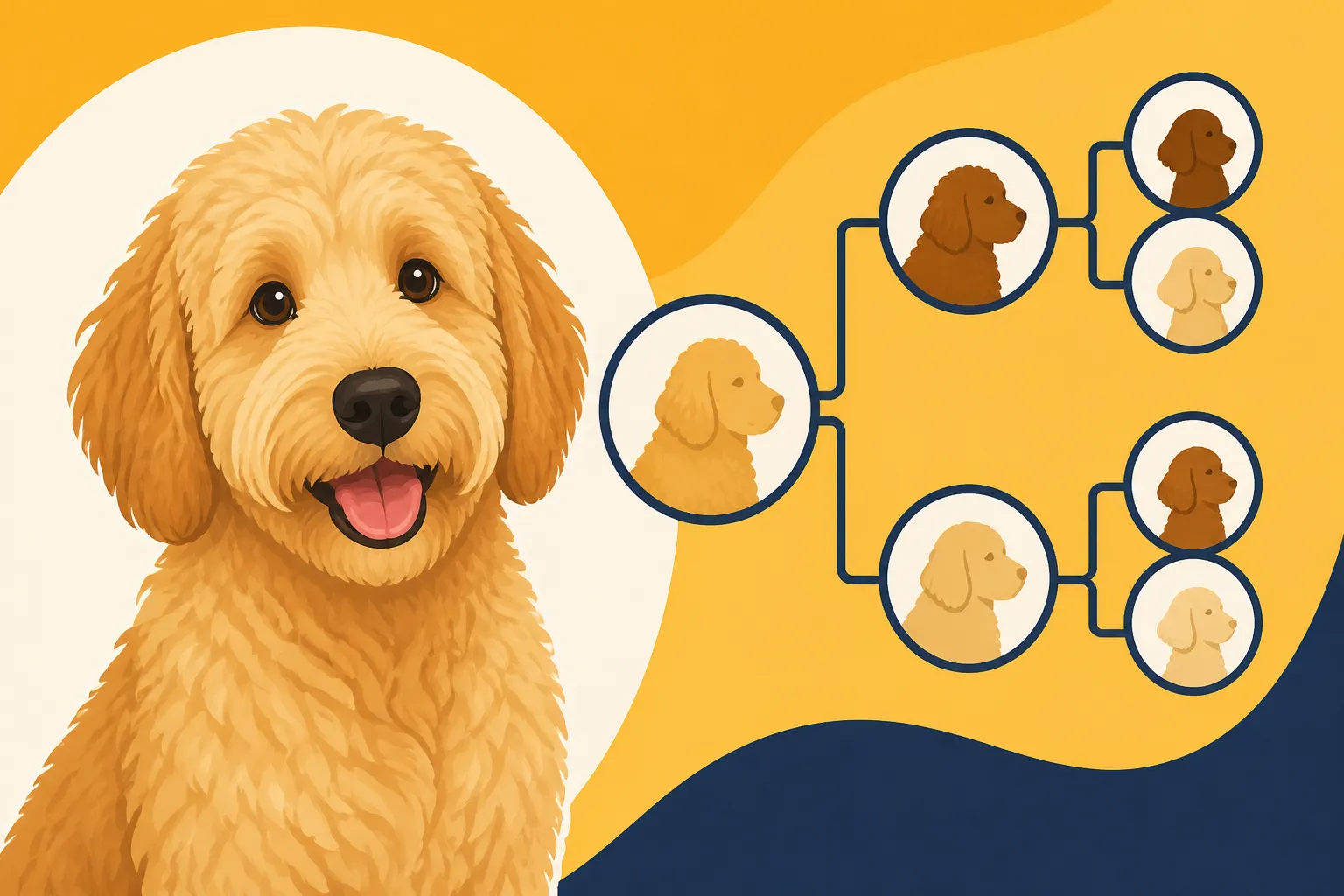
Reading a Goldendoodle Pedigree Back Three Generations
Bringing home a Goldendoodle puppy is incredibly exciting, but as you start looking into their background, you might hit a frustrating roadblock: the traditional "pedigree" you expect for a purebred dog just isn't there in the same way. It's not uncommon to feel a little lost when a breeder talks about F1 or F1b, or when you’re trying to understand your puppy’s lineage without official-looking papers. This guide is here to demystify what a Goldendoodle "pedigree" truly means, how to read back through at least three generations of their family tree, and what critical information you should be looking for to ensure you’re bringing home a healthy, well-bred companion.
The Unique Nature of a Goldendoodle's "Pedigree"
Let's face it, when you hear "pedigree," most of us picture a fancy document from a kennel club, tracing a dog's lineage back for decades with official stamps and champion titles. For a Goldendoodle, that picture just doesn't exist, and it can be a real source of confusion and even anxiety for prospective owners. It's important to understand why this is the case and what kind of information you can expect.
Why Goldendoodles Don't Have Traditional Kennel Club Papers
The fundamental reason Goldendoodles don't come with a traditional pedigree is that they are a crossbreed, not a recognized purebred dog breed. Organizations like the American Kennel Club (AKC) exist to maintain breed standards, register purebred dogs, and track their lineage for generations within that specific breed. Since the Goldendoodle is a deliberate mix of a Golden Retriever and a Poodle, they simply don't fit into these purebred registries. This isn't a reflection of their value or quality as a companion; it's purely a technical distinction based on how official dog registries operate.
Many new Goldendoodle owners feel a pang of disappointment or even suspicion when they learn this. "No papers? Does that mean my puppy isn't legitimate?" This feeling is totally valid because we're conditioned to see "papers" as a mark of quality. However, for a Goldendoodle, the absence of an AKC pedigree doesn't mean your dog is any less of a Goldendoodle, or that their breeding wasn't thoughtful. It just means the official systems aren't set up for them. While Goldendoodles cannot be AKC registered, they can participate in certain AKC events like agility or obedience if they are registered through the AKC Canine Partners program, but that's a different kind of registration entirely. Why the AKC Will Not Register a Goldendoodle dives deeper into this topic.
What You Might Get Instead of a Pedigree
So, if there are no official kennel club pedigrees, what do Goldendoodle breeders provide to show your puppy's lineage? Reputable breeders understand the desire for background information and will usually provide their own form of ancestral record. This often includes:
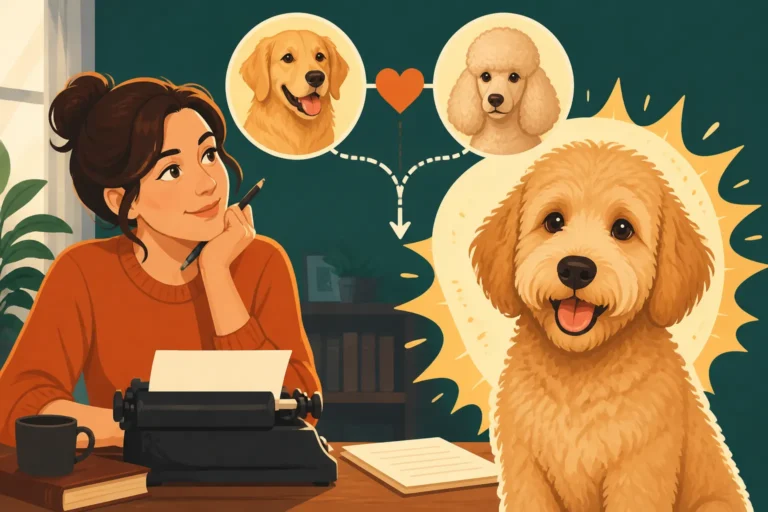
- A Multi-Generational Chart: This is essentially a family tree diagram, sometimes hand-drawn or generated by specialized software, showing the puppy's parents, grandparents, and sometimes great-grandparents. These charts will typically specify the breed of each ancestor (Golden Retriever, Poodle, F1 Goldendoodle, F1b Goldendoodle, etc.).
- Copies of Parent Health Clearances: This is arguably more important than a traditional pedigree for a Goldendoodle. A good breeder will provide documentation of health testing for the parent dogs, such as OFA (Orthopedic Foundation for Animals) certifications for hips, elbows, and patellas, and genetic testing results for conditions common in Golden Retrievers and Poodles, like Progressive Retinal Atrophy (PRA) or Von Willebrand Disease. This is your true insight into the genetic health of your puppy's line.
- Certificates from Hybrid Registries: While not on par with the AKC, organizations like the Goldendoodle Association of North America (GANA) do exist. Some breeders will register their dogs and litters with GANA. These certificates will often show the parents and their registered GANA numbers. While GANA standards do provide some guidelines for breeders, it's not a guarantee of ethical breeding practices, and it's essential to understand that this is a separate entity from traditional purebred registries. What GANA Registration Buys a Goldendoodle Owner offers more details on these specialized registries.
These documents, when provided by a transparent and ethical breeder, constitute the Goldendoodle's "pedigree." They offer insights into the health and genetic background that truly matter for your future companion.
Decoding Goldendoodle Generations: The "F" System
Without a formal pedigree, the Goldendoodle community has developed its own shorthand for describing lineage: the "F" system. Understanding this system is absolutely essential for "reading" a Goldendoodle's family tree back through several generations. It tells you about the percentage of Golden Retriever and Poodle in your dog, which can influence everything from coat type to temperament and even potential health predispositions.
The F System: A Goldendoodle's Real "Pedigree"
The "F" in F1, F1b, F2, etc., stands for "Filial Hybrid." It's a genetic term used to denote generations of a cross between two distinct purebred lines. For Goldendoodles, this system helps breeders and buyers understand how far removed a dog is from its purebred Golden Retriever and Poodle ancestors. It's the most common way to track a Goldendoodle's lineage and is the foundation of any "pedigree" information you'll receive.
Each "F" designation tells a story about the dog's parents and, by extension, its grandparents and great-grandparents. It’s not just a random letter and number; it signifies the genetic recipe. While it won't tell you specific names of ancestors like a traditional pedigree, it gives you a crucial understanding of the composition of your dog's background.
Tracing Back Three Generations: F1, F1b, F2, F2b, and Multigen
Let's break down the most common generations and what they reveal about your Goldendoodle's ancestry, looking back three generations where possible.
F1 Goldendoodle (First Generation)
- Definition: An F1 Goldendoodle is the direct offspring of a purebred Golden Retriever and a purebred Poodle.
- Parentage (1st Generation back): Golden Retriever x Poodle.
- Grandparentage (2nd Generation back): The two purebred parents of the Golden Retriever, and the two purebred parents of the Poodle.
- Great-Grandparentage (3rd Generation back): The four purebred grandparents of the Golden Retriever, and the four purebred grandparents of the Poodle.
- What this tells you: For an F1, looking back three generations means examining the purebred lines of both the Golden Retriever and Poodle parents. This is where you want to see extensive health testing on all eight great-grandparents, four grandparents, and the two parents. An F1 is a 50% Golden Retriever and 50% Poodle mix. They are often touted for "hybrid vigor," though this can be overstated and not always present after the first generation. What Hybrid Vigor Means for a Goldendoodle explains this concept further.
F1b Goldendoodle (First Generation Backcross)
- Definition: An F1b Goldendoodle is the offspring of an F1 Goldendoodle and a purebred Poodle (most common) or, more rarely, an F1 Goldendoodle and a purebred Golden Retriever. The "b" stands for backcross.
- Parentage (1st Generation back): F1 Goldendoodle x Purebred Poodle (or Golden Retriever).
- Grandparentage (2nd Generation back): For the F1 Goldendoodle parent, it's a purebred Golden Retriever and a purebred Poodle. For the purebred parent, it's their two purebred parents.
- Great-Grandparentage (3rd Generation back): The four purebred grandparents of the F1's parents, and the four purebred grandparents of the purebred parent.
- What this tells you: An F1b typically results in a dog that is 75% Poodle and 25% Golden Retriever, or vice-versa. This generation is often bred to increase the chances of a non-shedding, hypoallergenic coat because of the higher Poodle genetics. When looking back three generations, you're tracking the purebred Poodle and Golden Retriever lines that make up the F1 parent, and then the purebred Poodle or Golden Retriever line of the other parent. It's crucial to examine the health testing of all these ancestors. Whether an F1b Goldendoodle Acts More Like a Poodle discusses how the higher Poodle percentage can influence traits.
F2 Goldendoodle (Second Generation)
- Definition: An F2 Goldendoodle is the offspring of two F1 Goldendoodles.
- Parentage (1st Generation back): F1 Goldendoodle x F1 Goldendoodle.
- Grandparentage (2nd Generation back): Each F1 parent has a purebred Golden Retriever and a purebred Poodle parent. So, the F2 puppy has two purebred Golden Retriever grandparents and two purebred Poodle grandparents.
- Great-Grandparentage (3rd Generation back): The four purebred grandparents of each purebred Golden Retriever, and the four purebred grandparents of each purebred Poodle.
- What this tells you: F2 Goldendoodles are also a 50/50 mix, but their genetic expression can be much more unpredictable. Because both parents carry the mixed genetics of the F1, their offspring can inherit a wider range of traits, from very Poodle-like to very Golden-like. When tracing back three generations, you're looking at the purebred Golden and Poodle ancestry that created the F1 parents. Health testing on all these ancestors is paramount due to the potential for recessive genes from both sides to combine. Why F2 Goldendoodle Litters Vary So Much highlights this unpredictability.
F2b and Multigen Goldendoodles (Second Generation Backcross and Multi-Generational)
- Definition: An F2b Goldendoodle is typically the offspring of an F2 Goldendoodle and a purebred Poodle. Multigen Goldendoodles (F3 and beyond) are bred from two Goldendoodles of F2b or higher generations, or sometimes F1b x F1b.
- Parentage (1st Generation back): Varies (e.g., F2 Goldendoodle x Poodle for F2b; F1b x F1b for Multigen).
- Grandparentage (2nd Generation back): Varies greatly depending on the specific "F" numbers of the parents. You might see a mix of F1s, F2s, and purebreds.
- Great-Grandparentage (3rd Generation back): Even more varied, reaching back into the purebred Poodle and Golden Retriever lines through multiple Goldendoodle generations.
- What this tells you: These generations are often bred for greater consistency in coat type (non-shedding) and temperament, by carefully selecting parent dogs. However, the genetic pool can become narrower. Tracing three generations back can be complex, often requiring the breeder to provide a detailed chart. The focus shifts to the consistency of health testing and desired traits across these multiple generations.
Here's a simplified table to help visualize the Goldendoodle generations and their typical genetic makeup:
| Generation | Parentage | Approx. Golden/Poodle % | Typical Coat Predictability | Key Focus for "Pedigree" |
|---|---|---|---|---|
| F1 | Purebred Golden Retriever x Purebred Poodle | 50% Golden / 50% Poodle | Varies (straight, wavy, curly) | Parent purebred health tests |
| F1b | F1 Goldendoodle x Purebred Poodle (or Golden) | 25% Golden / 75% Poodle (or vice versa) | Often curlier, lower shed | Parent & Grandparent health tests |
| F2 | F1 Goldendoodle x F1 Goldendoodle | 50% Golden / 50% Poodle | Most varied & unpredictable | Parent & Grandparent health tests |
| F2b | F2 Goldendoodle x Purebred Poodle (or Golden) | ~12.5% Golden / ~87.5% Poodle (or vice versa) | Often curlier, lower shed | Consistency in breeding line health |
| Multigen | F3+ generations Goldendoodle x Goldendoodle | Varies, breeder's goal | More consistent, lower shed | Consistent health/temperament in line |
What to Look For Beyond the "F" Number
While the "F" system provides a framework, the real substance of a Goldendoodle's lineage lies in the details about their actual ancestors. A number alone tells you very little about the health, temperament, or specific traits of your future puppy. This is where you, as a prospective owner, become an amateur genetic detective!
Parentage Details: The True Value of a Goldendoodle Pedigree
Beyond just knowing "F1" or "F1b," you want to know the specific dogs that make up those generations. A responsible breeder will be happy to share information about the dam (mother) and sire (father) of your puppy, including their full names, photos, and even their temperaments. But don't stop there. For a truly transparent look back three generations, you should be able to learn about the grandparents and even the great-grandparents.
Why does this level of detail matter?
- Health: Knowing the specific dogs allows you to verify their health testing.
- Temperament: You can inquire about the temperaments of the parents and grandparents. Are they known to be gentle? Energetic? Shy? This gives you clues about what your puppy might inherit. Goldendoodle Temperament From Two Parent Breeds goes into more detail on how these traits combine.
- Physical Traits: You can see photos of ancestors to get a better idea of potential adult size, coat type (e.g., straight, wavy, curly), and color. While puppy coats can be misleading, seeing the adult coats of several generations can help predict what your puppy might look like. The Three Goldendoodle Coat Types and How to Tell Them is an excellent resource for understanding these differences.
A breeder who is proud of their lines will have this information readily available and be eager to share it with you, not just tell you an "F" number.
Health Testing and Its Importance in Lineage
This cannot be stressed enough: health testing of the parent dogs, and ideally grandparents, is the most crucial part of any Goldendoodle "pedigree." Because Goldendoodles are a mix of two breeds, they can inherit genetic predispositions from both the Golden Retriever side and the Poodle side.
When you're reading back three generations, you're essentially looking for a pattern of clear health clearances. For each parent, grandparent, and great-grandparent you can identify, you should ideally see evidence of testing for conditions like:
- Hip and Elbow Dysplasia: Both Golden Retrievers and Poodles are prone to these painful joint conditions. Look for OFA (Orthopedic Foundation for Animals) certifications. A good breeder will have clear OFA results (Fair, Good, or Excellent) for hips and normal elbows. Reading an OFA Hip Result on a Goldendoodle Parent explains how to interpret these results.
- Eye Conditions: Progressive Retinal Atrophy (PRA) is a serious genetic eye disease found in both breeds. DNA testing can identify carriers. Regular eye exams by a veterinary ophthalmologist (CERF or OFA Eye certifications) for parents are also important. Progressive Retinal Atrophy and the Goldendoodle Eye Test is a must-read.
- Heart Conditions: Subvalvular Aortic Stenosis (SAS) can affect Golden Retrievers. Poodles can also have certain heart issues. Cardiac clearances by a veterinary cardiologist are important.
- Thyroid Disease: Hypothyroidism is common in both parent breeds. Thyroid panels should be part of the health screening.
- Von Willebrand's Disease (vWD): This is a bleeding disorder that can be carried by Poodles. A DNA test can identify affected, carrier, or clear dogs.
- Addison's Disease: While not a DNA test, breeders should be aware of Addison's in their Poodle lines as it can be inherited. Addison's Disease a Goldendoodle Gets From the Poodle delves into this.
A transparent breeder will not only tell you about these tests but provide physical documentation or direct you to online databases (like OFA's public database) where you can verify the results for yourself. They should be able to show you how their breeding choices aim to minimize the risk of these inherited conditions across at least three generations. This commitment to health testing is a hallmark of an ethical breeder. The DNA Panel a Goldendoodle Breeder Should Run offers a comprehensive look at what tests matter.
Temperament and Physical Traits Through the Generations
The "pedigree" information should also shed light on the physical characteristics and temperaments you can expect. Goldendoodles are renowned for their friendly, outgoing nature, but specific traits can vary.
- Coat Type: By looking at the parent and grandparent generations, you can often get a better idea of your puppy's adult coat. Did the F1 parent have a wavy coat and the Poodle parent a curly one? Then an F1b litter might lean curlier. Breeders might use DNA tests to identify if dogs carry the "furnishings" gene (which gives Goldendoodles their characteristic beard and eyebrows) or the curl gene. This helps predict shedding and grooming needs. The Goldendoodle Coat Change at Eight to Twelve Months is a crucial stage where coat type becomes clearer.
- Size: Knowing the size of the parent Poodle and Golden Retriever, as well as any Goldendoodle parents, helps estimate your puppy's adult size. For example, if both parents are large F1 Goldendoodles, your F2 puppy is likely to be a standard size. If one parent is a Mini Goldendoodle and the other is a small Standard Poodle, your F1b puppy might fall into the medium category.
- Temperament: While environment plays a huge role, genetics contribute to temperament. Ask about the personality of the parents and grandparents. Are they known to be calm and gentle, or more boisterous? Do they have strong retrieve drives? Understanding the general disposition of the ancestral dogs can help you anticipate your puppy's potential personality. The combination of the Poodle's intelligence and the Golden Retriever's biddability is part of what makes Goldendoodles so popular.
Practical Steps for Goldendoodle Buyers
Navigating the world of Goldendoodle lineage can feel like a puzzle, especially when you're looking to confirm information spanning three generations. But with the right approach and clear expectations, you can gather the necessary details to make an informed decision.
Asking the Right Questions to Your Breeder
Transparency is key. A reputable breeder will welcome your questions and be prepared to provide thorough answers. Don't be shy about asking for specific details about your puppy's parents, grandparents, and even great-grandparents. Here are some questions to consider:
- "Can you show me the ancestral chart for this litter, going back at least three generations?"
- "What are the full registered names of the sire and dam (parents), and their parents?"
- "Do you have copies of all health clearances (OFA, DNA, eye exams, heart certifications, etc.) for the parents, and can you tell me about the clearances for the grandparents?"
- "What are the temperaments of the parents like? Are there any known temperament quirks in the lines?"
- "What coat types do the parents and grandparents have? How consistent is the shedding potential across your lines?"
- "Can you provide contact information for your veterinarian who can verify these health records?" (A truly transparent breeder might offer this, though respect their vet's privacy).
Be wary of breeders who are vague, defensive, or only provide an F-number without further detail. The more specific information they offer, the more confidence you can have in their breeding program and the lineage they are presenting.
Documenting Your Goldendoodle's "Pedigree"
Even without official kennel club papers, you can create your own comprehensive "pedigree" for your Goldendoodle. Keep a physical or digital folder with all the documents your breeder provides:
- The Multi-Generational Chart: If your breeder gives you one, keep it safe. If not, you can create your own with the information they provide.
- Copies of all Health Certificates: This is invaluable. These documents are proof of responsible breeding and can be important if your dog ever develops a health issue later in life.
- Photos of Ancestors: Ask for photos of the parents, grandparents, and any great-grandparents you learn about. This helps visualize the lineage.
- Breeder's Contract and Health Guarantee: These documents often outline the breeder's commitment to health and can provide valuable information about the puppy's early care. Goldendoodle Puppies Sold With a Health Guarantee is a good read on this.
This personal record isn't just sentimental; it's a practical tool for understanding your dog's background and communicating with your vet about potential genetic predispositions.
Understanding the Limitations
While it's important to be thorough in researching your Goldendoodle's lineage, it's also crucial to maintain realistic expectations. Even with a well-documented "pedigree" spanning three generations, Goldendoodles are still a hybrid. This means:
- Unpredictability: Especially in earlier generations like F1 or F2, there can still be a wider range of traits, even within the same litter. You might see two siblings from the same F2 litter that look entirely different or have very different personalities. Why Two Goldendoodles From One Litter Differ explains this phenomenon.
- No Universal Standard: Unlike purebreds with centuries of established standards, Goldendoodles don't have a single, unified blueprint. Each breeder has their own goals and lines, making "pedigree" information somewhat specific to that particular breeding program.
- The "Hybrid" Factor: While hybrid vigor can offer some benefits, it doesn't make a Goldendoodle immune to inherited diseases. Thorough health testing of ancestors is the only way to mitigate these risks. Don't let the word "hybrid" be a substitute for due diligence. Whether a Goldendoodle Is Healthier Than a Purebred discusses this in more detail.
Ultimately, reading a Goldendoodle's lineage back three generations is about empowering yourself with knowledge. It’s about looking beyond the cute puppy face and understanding the genetic journey that brought them to you.
Understanding a Goldendoodle's "pedigree" isn't about collecting fancy papers; it's about gaining genuine insight into their genetic background. By focusing on the "F" generation system, diligently reviewing health testing records for at least three generations of ancestors, and engaging in open communication with your breeder, you can create a comprehensive picture of your Goldendoodle's lineage. This thoughtful approach ensures you're bringing home a well-bred, healthy companion, ready to become a beloved member of your family. You can also use online retailers like Chewy to stock up on all the food and supplies your new Goldendoodle will need, freeing you up to focus on understanding their unique heritage.
Disclaimer
This article is for general informational purposes only and does not constitute professional advice. Laws, prices and regulations vary by location and change over time. Consult a qualified professional for guidance on your specific situation.